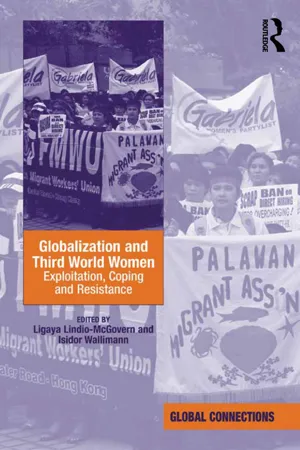
eBook - ePub
Globalization and Third World Women
Exploitation, Coping and Resistance
- 228 pages
- English
- ePUB (mobile friendly)
- Available on iOS & Android
eBook - ePub
Globalization and Third World Women
Exploitation, Coping and Resistance
About this book
Adopting the notion of 'third world' as a political as well as a geographical category, this volume analyzes marginalized women's experiences of globalization. It unravels the intersections of race, culture, ethnicity, nationality and class which have shaped the position of these women in the global political economy, their cultural and their national history. In addition to a thematically structured and highly informative investigation, the authors offer an exploration of the policy implications which are commonly neglected in mainstream literature. The result is a must have volume for sociological academics, social policy experts and professionals working within non-governmental organizations.
Information
Chapter 1
Introduction Neoliberal Globalization and Third World Women: Exploitation, Coping and Resistance
Neoliberal globalization is not a neutral process, it is gendered, and has exacerbated domestic and global social inequalities.1 Thus, a growing resistance against its destructive course and an active search for alternatives is in the making (Smith and Johnston 2002; Brecher, Castello, and Smith 2009; Naples and Desai 2002). Third World women who experience more adversely than First World men and women the negative impact of neoliberal globalization are actively taking part in this growing resistance. The dynamics of power in this dialectics of resistance and change offers insights to better understand neoliberal globalization, rethink the mainstream conceptualization about it, and how we can learn from each other on how to alter its course towards greater global social justice.
We disagree with some who argue that the use of the term “Third World” or “Third World women” is no longer applicable since globalization has increasingly integrated nations of the world. We disagree, first, because such argument tends to imply that neoliberal globalization is a neutral process. It fails to see the hegemonic power (mainly embodied in the G-7) that dominates the formulation of neoliberal policies that advance global capitalism or transnational capital which often, in its constant search for cheap labor and resources, violate the rights of working people and abuse the environment. Second, our use of the term “Third World women” recognizes the uneven impact of neoliberal globalization which has, in many instances, exacerbated gender, race/ethnicity and class inequalities. We use the term “Third World women” as a conceptual category for women marginalized and exploited in the process of neoliberal globalization anywhere, particularly in the non-industrialized world. Their resistance defies the hegemony that neoliberal policies fortify, although the struggle is often difficult and not without problems and risks, especially when the “neoliberal state” (Harvey 2007; Robinson 1996) responds with political and military repression. The concept “Third World women”, therefore, appropriately recognizes the uneven impact of globalization on working people, depending on their and their nations’ position and location in the global political economy. We find “Third World women” in poor and rich countries, in the North and South, in the core and periphery/semi-periphery as neo-liberal globalization continues to structure and re-structure class, race and gender inequalities. It is therefore important that the experience, voice, and politics of Third World women be de-marginalized and included in the mainstream analysis and knowledge construction about neoliberal globalization. This is the thrust of this volume.
We take this thrust, first, because, as David Harvey (2007, 3) argues, “neoliberalism has become hegemonic as a mode of discourse”. Largely dominated by think-tanks and policy-makers in the North (Appadurai 2001), this hegemonic mode of discourse can be problematic as it creates a dominant ideational structure that can serve the very structures of power and ideologies that are to be challenged in the struggle for global social justice. Second, because learning from the experience of Third World women as they respond to the impact of neoliberal globalization can unearth knowledge from below rarely represented in policy-making and mainstream academic circles. This knowledge can be useful both for questioning neoliberal policies, policy transformation, and shaping strategies for change. At this juncture, it is important that we first define neoliberal globalization for clarification as the term globalization has been used and abused with different shades of meaning.
What is Neoliberal Globalization?
Neoliberal globalization designates the transformation of the global political economy based on neoliberalism as a “theory of political economic practices that human well-being can be best advanced” in economic arrangements that promote “private [ownership of the means of production], free markets, and free trade”, whereby the “role of the state is to create and preserve institutional frameworks” and conditions that will facilitate such practices (Harvey 2007, 2). As an economic project, its basic doctrines of deregulation, privatization, economic liberalization, labor flexibilization and diminished state-supported social provisions (Harvey 2007, Lindio-McGovern 2007) are meant to create the appropriate conditions for the preservation and global expansion of capitalism that has maintained a wealthy transnational capitalist interests that in turn plays an active role in maintaining capitalist globalization (Sklair 2001). Deregulation reduces state regulation of the economy or restrictions on the mobility of capital and labor flexibilization to create an abundant supply of cheap, controllable and disposable labor force, and so create appropriate conditions that facilitate global capital expansion. Economic liberalization—that dismantles restrictions on the flow of goods, services, and foreign investment—promotes transnational capital expansion worldwide. Privatization—that puts public productive and service enterprises into the private sector, reducing state-subsidized social services and reducing public sector corporations—further opens up new spheres for transnational capital to control local economies especially of the Third World. The global power of transnational corporations thereby grows (Korten 2001; Lindio-McGovern 2007). The IMF (International Monetary Fund) and the World Bank that impose structural adjustment policies tied to development loans to the Third World and the WTO (World Trade Organization) that regulate trade have become supra-national structures of power that unfetter the reins of neoliberal globalization. They failed to improve the lives of the marginalized sectors of the global economy, and have even exacerbated their poverty and exploitation.
The major themes woven through the works of the contributors in this volume further illuminate an understanding of the gendered process of globalization and its contestations as they examine the experience of Third World women in both North and South, in Asia, Africa, Latin and Central America.
Globalization and Gendered Regional Inequalities
Most discussions on globalization and global inequality have centered on the global North and South disparity. Such discussions while important, blur the inequalities within regions that may also occur as neoliberalism intensifies gender, class and/or racial inequalities. While the uneven impact of neoliberal globalization has maintained a global core and periphery (North and South), it is also creating a regional core/periphery within the South. One conceptual site to examine the gendered nature of this regional inequality is the circulation of cheap and disposable waged reproductive labor necessary for the maintenance of productive labor, which under neoliberal rule, serves capitalism. Who supplies cheap reproductive labor and who is served? Within a region, an urban center develops where women from poorer countries of the region tend to concentrate to work as domestic workers in middle-class homes. Shireen Ally (Chapter 2 in this volume) calls attention to this phenomenon as she observes it in Southern Africa. Poor women seeking support for their families migrate from the poorer regions of Southern Africa—such as Zimbabwe, Basotho, Mozambique—to better-off South Africa providing the reproductive labor demands of mainly white, middle-class homes, concentrating in Johannesburg, South Africa’s urban center. The presence of these women bifurcates the reproductive labor market and wage structure of reproductive labor where the migrant women are placed at the lower end. The post-apartheid South Africa’s implementation of neoliberal policies (Ally in this volume; Benjamin 2007) has not benefitted women (and men) evenly within South Africa and within the region, perpetuating historically rooted raced and classed/ gendered structures. Ally’s observation of regional inequality in Southern Africa corroborates with Lindio-McGovern’s (2004) and Robyn Magalit Rodriguez’s (Chapter 4 in this volume) views on Asia where the rise of the New Industrializing Countries (NICS) has sharpened and given a new face to its regional inequality. Taiwan’s economy, for example, is partly being built on the back of Asian women from poorer countries in the region—such as the Philippines and Indonesia whose economies have been devastated by neoliberal policies—who provide cheap and disposable reproductive labor, alongside its imported low-waged contract male and female productive labor for companies. There are cases when the migrant women’s reproductive labor is extended and blended with productive labor demands of Taiwanese petty capitalists, a way of making productive labor cheaper. Hong Kong—now under Special Administration of mainland China in the post-British colonial rule—has become an urban hub for Filipino and Indonesian reproductive workers pushed out by the economic pressures due to structural adjustment policies imposed on their home countries.
The regional inequality in the South exacerbated under neoliberal globalization is not entirely isolated or delinked from the social construction of inequalities within the richer capitalist countries that comprise the global North. Martha Gimenez’s (Chapter 3 in this volume) notion of the “circulation of labor” as mirroring the intensified inequalities resulting from the “mobility of capital” under capitalist globalization provides an insight into how the presence of migrants from countries in the South partly makes possible the stratification of the labor market within a Northern country, exemplified for instance by the United States.
The mobility of capital under regimes of labor flexibilization has hurt both the working class in the North and South. The de-industrialization, for example, in the U.S. economy has resulted in greater unemployment for men, bringing more women to the workforce but mostly in the lower ranks of the occupational ladder. The expansion of the service sector under global capitalism along with the contraction of manufacturing jobs due to de-industrialization requires as well cheap labor, and women predominating in this sector provide both cheaper and more expendable labor. Migrant labor is used, legal and illegal, to further depress wages. But while the retrenched American workers may have some cushions—such as welfare or unemployment insurance—the men and women in poor countries in the South usually do not have such cushions, and their migration, then, is often part of a survival or coping strategy. Sometimes, their governments (as in the case of Philippines, Indonesia, Mexico) turn to labor export as a response to both unemployment and debt crisis resulting from the structural adjustment policies, thus facilitating their migration into an economic diaspora. With increasing feminization of international migration, this “circulation of capital” also increasingly gets gendered. Thus, as neoliberal policies of labor flexibilization, import liberalization, devaluation of local currency and cuts in state-subsidy in social services continue to destroy Third World economies resulting in increased unemployment and underemployment (Lindio-McGovern 2007), the preconditions for the “circulation of labor” is created in the South. And if we come to think that the neoliberal policies of the IMF, the WTO, and the “transnational practices” of transnational corporations (Sklair 2002) that propel neoliberal globalization are largely controlled by Northern powers, then we see where the neoliberal hegemony is centered. However, although centered in the North, this neoliberal hegemony has developed multiple centers of power, including the shaping of “neoliberal states” (Harvey 2007, Robinson 1996) in the South, creating semi-periphery hegemonies as well.
Another conceptual site to examine the gendered and classed nature of regional inequalities and in the North–South divide under globalization is the flow of sex trafficking in the sexual commodification of women. Bandana Purkayastha and Shweta Majumbar (Chapter 11 in this volume) argue that under globalization sex trafficking of women and girls has increased and Third World women’s vulnerability to it also increased due to their intensified poverty resulting from structural adjustment policies. The flow of sex trafficking is generally from the global south to the industrialized global north, but regional patterns are also discernible as hegemonies there have a hand on its process and organization. Purkayastha’s and Majumbar’s investigation of sex trafficking in South Asia show that India, which is becoming an “economic powerhouse” in the region, has become a major destination of trafficked women and girls from the poorer countries, such as Pakistan, Bangladesh, and Nepal. Purkayatha’s and Majumbar’s observation parallels a pattern in the European region. Women from within Europe whose countries had been more negatively affected by neoliberal and structural adjustment policies resulting in massive job displacement for women—such as Russia and Ukraine (countries in transition from socialist to market economy)—have become vulnerable to sex trafficking to other destination countries within Europe, such as France, Germany, Switzerland, and the Netherlands (Farr 2005).
Neoliberalism in Women in Development Thought/Discourse
In his “Globalization and Development Studies”, Philip McMichael (2005, 111) argues that globalization and development “are two sides of the same coin” and that, as “discursive concepts”, they have an ideological component. Neoliberalism as an economic project—anchored on an ideological base that is essentially within the capitalist mode of thought—seems more attune to the women in development (WID) mainstream perspective. WID became a dominant thought in the early 1970s emanating from Esther Boserup’s seminal work that located Third Women’s socially disadvantaged position from their not being integrated into development (Lindio-McGovern 1997; Chow 2002). Largely rooted in the modernization perspective and from the Western liberal feminist perspective, WID advocated for the integration of Third World women into economic development through institutional reforms, education, technology and income-generating activities. Since WID did not basically question the nature of capitalist development into which women were to be integrated, nor the technocratic, top-down premises of the modernization perspective among the North or Western countries, the neoliberal ideology easily and subtly inserted itself into the women in development (WID) discourse and its practice. This subtle insertion makes it appear that WID is empowering Third World women, and therefore requires a careful analysis of development projects espoused by international development agencies that claim to empower women, while its embedded neoliberal ideology and practice may result in marginalizing many and even maintain or sharpen the class disparity among Third World women. Christobel Asiedu (Chapter 9 in this volume) provides a good example of a careful analysis of the how neoliberal system of thought embedded in a development program can result in an uneven impact of neoliberal globalization on women of different class status, while in subtle ways serve the expansion of transnational capital in the Third World, such as in Africa where she conducted her case study. Hence, just as neoliberal globalization interlocks into pre-existing structures of power and inequalities, it also interlocks itself into frames of thought that serve as basis for development policy and practice. But alternative perspectives or development frameworks emerge as well that may also have implications for change. So, in the latter part of the 1970s as a response to the limitations of WID, women and development perspective (WAD) called attention to how global capital accumulation exploited women even as they were integrated into it (Chow 2002). The emergence of WAD apparently coincided with the growth of export-processing zones that began to emerge in Third World countries where women predominated the labor-intensive transnational corporations’ global assembly lines, such as garment and electronics (Caraway 2007). Integration of women into global capital accumulation did not liberate most Third World women, especially peasant and working class women, from exploitation and poverty after all. Change for liberation of working class women implies transforming capitalist relations of production. Then in the 1980s, the gender and development (GAD) perspective came to prominence, which recognized the presence of patriarchy within class and across class and the oppression of women in both the reproductive and productive spheres. Viewing development as a complex process shaped by political, economic and social forces, it advocated a holistic approach that included all aspects of women’s lives for their empowerment (Chow 2002). It saw Third World women as agents of their own empowerment, not merely beneficiaries of development programs designed from above or by external agencies. DAWN (Development Alternatives with Women for a New Era) came about in 1984 as a response to the marginalization of Third World women’s experience in women in development (WID) thought and practice (Sen and Grown 1987; Moghadan 2005). A Third World women’s initiative, DAWN “affirmed that it is the experiences lived by poor women throughout the Third Word in their struggle to ensure the basic survival of their families and themselves that provide the clearest lens for an understanding of development processes” and advocated “alternative development processes that would give principal emphasis to the basic survival needs of the majority of the world’s people” (Sen and Grown 1987, 10, 9). Asiedu’s (Chapter 9 in this volume) proposal to empower women in sub-Sahara Africa—through the introduction of Information Communication Technologies (without viewing it as panacea) in ways that will be more responsive to the needs of the rural women most neglected in the development process—is a bottom-up approach, and within an integrated development model. It is aimed not only at economic empowerment but also at the social and political empowerment of African women—a development perspective that falls within the GAD and DAWN approaches. Robert Dibie’s (Chapter 10 in this volume) comprehensive proposals for empowering women in Africa fall within the GAD perspective as well, as he pays attention to the African patriarchal culture and how it has shaped the economic, political and social development of Africa that has subordinated African women, and how that subordination is exacerbated under globalization. However, the general current state of women/gender and development discourse is faced with the challenge to evolve new critical analytical frameworks that can best capture the nuanced ways neoliberal ideology and practice re/configure into existing institutions and development programs of both governmental and non-governmental organizations in ways that may subtly preserve capital accumulation on a global scale rather than facilitate its radical transforma...
Table of contents
- Cover Page
- Title Page
- Copyright Page
- Contents
- List of Figure and Tables
- Notes on Contributors
- Acknowledgements
- 1 Introduction Neoliberal Globalization and Third World Women: Exploitation, Coping and Resistance
- 2 Globalization and Regional Inequalities Regional Divisions of Reproductive Labor: Southern African Migrant Domestic Workers in Johannesburg
- 3 Global Capitalism and Women From Feminist Politics to Working Class Women’s Politics
- 4 Migration, Transnational Politics, and the State Challenging the Limits of the Law: Filipina Migrant Workers’ Transnational Struggles in the World for Protection and Social Justice
- 5 Identities, Nation, and Imperialism Confronting Empire in Filipina American Feminist Thought
- 6 The Struggle for Land and Food Sovereignty Feminism in the Mau Mau Resurgence
- 7 Alternative Economies Mexican Women Left Behind: Organizing Solidarity Economy in Response
- 8 Towards a Global Economy of Commoning A “Gift to Humanity”: Third World Women’s Global Action to Keep the Oil in the Ground
- 9 Neo-liberalism in Women in Development Discourse Using ICTs for Gender and Development in Africa: The Case of UNIFEM
- 10 Globalization and Women’s Empowerment in Africa
- 11 Globalization and the Sexual Commodification of Women Sex Trafficking Migration in South Asia
- Index
Trusted by 375,005 students
Access to over 1.5 million titles for a fair monthly price.
Study more efficiently using our study tools.
Frequently asked questions
Yes, you can cancel anytime from the Subscription tab in your account settings on the Perlego website. Your subscription will stay active until the end of your current billing period. Learn how to cancel your subscription
No, books cannot be downloaded as external files, such as PDFs, for use outside of Perlego. However, you can download books within the Perlego app for offline reading on mobile or tablet. Learn how to download books offline
Perlego offers two plans: Essential and Complete
- Essential is ideal for learners and professionals who enjoy exploring a wide range of subjects. Access the Essential Library with 800,000+ trusted titles and best-sellers across business, personal growth, and the humanities. Includes unlimited reading time and Standard Read Aloud voice.
- Complete: Perfect for advanced learners and researchers needing full, unrestricted access. Unlock 1.5M+ books across hundreds of subjects, including academic and specialized titles. The Complete Plan also includes advanced features like Premium Read Aloud and Research Assistant.
We are an online textbook subscription service, where you can get access to an entire online library for less than the price of a single book per month. With over 1.5 million books across 990+ topics, we’ve got you covered! Learn about our mission
Look out for the read-aloud symbol on your next book to see if you can listen to it. The read-aloud tool reads text aloud for you, highlighting the text as it is being read. You can pause it, speed it up and slow it down. Learn more about Read Aloud
Yes! You can use the Perlego app on both iOS and Android devices to read anytime, anywhere — even offline. Perfect for commutes or when you’re on the go.
Please note we cannot support devices running on iOS 13 and Android 7 or earlier. Learn more about using the app
Please note we cannot support devices running on iOS 13 and Android 7 or earlier. Learn more about using the app
Yes, you can access Globalization and Third World Women by Ligaya Lindio-McGovern,Isidor Wallimann in PDF and/or ePUB format, as well as other popular books in Social Sciences & Anthropology. We have over 1.5 million books available in our catalogue for you to explore.