eBook - ePub
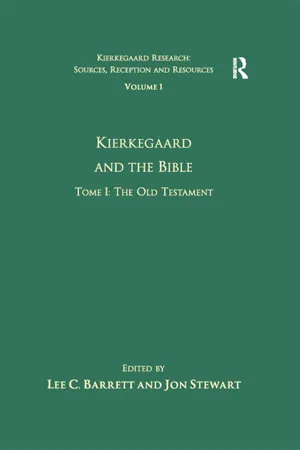
Volume 1, Tome I: Kierkegaard and the Bible - The Old Testament
- 294 pages
- English
- ePUB (mobile friendly)
- Available on iOS & Android
eBook - ePub
Volume 1, Tome I: Kierkegaard and the Bible - The Old Testament
About this book
Exploring Kierkegaard's complex use of the Bible, the essays in this volume use source-critical research and tools ranging from literary criticism to theology and biblical studies, to situate Kierkegaard's appropriation of the biblical material in his cultural and intellectual context. The contributors seek to identify the possible sources that may have influenced Kierkegaard's understanding and employment of Scripture, and to describe the debates about the Bible that may have shaped, perhaps indirectly, his attitudes toward Scripture. They also pay close attention to Kierkegaard's actual hermeneutic practice, analyzing the implicit interpretive moves that he makes as well as his more explicit statements about the significance of various biblical passages. This close reading of Kierkegaard's texts elucidates the unique and sometimes odd features of his frequent appeals to Scripture. This volume in the series devotes one tome to the Old Testament and a second tome to the New Testament. Tome I considers the canonically disputed literature of the Apocrypha. Although Kierkegaard certainly cited the Old Testament much less frequently than he did the New, passages and themes from the Old Testament do occupy a position of startling importance in his writings. Old Testament characters such as Abraham and Job often play crucial and even decisive roles in his texts. Snatches of Old Testament wisdom figure prominently in his edifying literature. The vocabulary and cadences of the Psalms saturate his expression of the range of human passions from joy to despair. The essays in this first tome seek to elucidate the crucial rhetorical uses to which he put key passages from the Old Testament, the sources that influenced him to do this, and his reasons for doing so.
Trusted by 375,005 students
Access to over 1.5 million titles for a fair monthly price.
Study more efficiently using our study tools.
Information
Topic
FilosofiaSubtopic
Storia e teoria della filosofiaPART I
Individual Texts and Figures
Adam and Eve:
Human Being and Nothingness
Although the Bible in Kierkegaard’s Denmark was still the reigning religious authority, the principal collection of stories and teachings that framed human life in a broad vision of meaning and purpose, its explanatory sovereignty had been severely compromised. Other sources of insight in the natural and social sciences had already begun to shine their lights on the human creature. The hermeneutic of suspicion that today so permeates the intellectual culture of the West, which regards ancient texts as the quaint literary vestigia of pre-scientific societies, had begun to press its case, and the vivisection of the Jewish and Christian scriptures into so many straining cords was well underway. Hobbes and Spinoza had long since challenged the Mosaic authorship of the Pentateuch, and groundbreaking works of biblical criticism were published long before Kierkegaard wrote The Concept of Anxiety in 1844.1 Major figures from Hobbes and Hume to Rousseau and Kant had examined human nature in ways not grounded on Genesis. Karl Rosenkranz (1805–79) had generated his Psychologie through conceptual distinctions, not through reflection on the biblical narrative, and Kierkegaard could have done the same.2 In this environment, under these circumstances, the fact that Kierkegaard should root such fundamental convictions in the soil of Eden, that he should write his most psychological work expositing the temptation and Fall of Adam, surely tells us something about Kierkegaard and what he sought to communicate.
Another way to frame the problem is to note that Kierkegaard was a frequent but also a highly selective biblical commentator. Some veins of insight are deeply mined, like the binding of Isaac, the suffering of Job, Paul’s thorn, and Christ’s “abasement,” while the Flood, the Exodus, and the birth narratives are scarcely touched. The lilies and birds are evoked in many works, while eucharistic metaphors of bread, blood and water are not. Kierkegaard commented on those portions of the scriptural heritage that helped him communicate what he considered most important. What, then, of the Eden stories? How did it serve Kierkegaard’s purposes to employ such a fiercely contested text to set forth his view of human beings in relation to God?
This article surveys the history of Kierkegaard’s interpretation of the Adam stories and views that history synoptically to discern patterns within it. In fair warning, it is a lengthy essay, since Adam stands with Abraham and Job as the Old Testament figures Kierkegaard examined most often. Two claims are put forward. First, Kierkegaard’s interpretation of Adam is best understood through three theological principles: creatio ex nihilo, felix culpa, and the “Second Adam” or the new being in Christ. Second, in his reading of the Eden narrative Kierkegaard is concerned not only with the problems of knowledge and human nature, but also with the problem of evil. The Concept of Anxiety is more than theological anthropology. It is also theodicy.
To be precise, it is a distinctly late-modern, psychological version of what Leibniz had called theodicy. Early references will clarify the three theological principles underlying his vision of Adam and of essential human being, yet two works published over the course of six months, an upbuilding discourse on “Every Good Gift” from December 1843 and The Concept of Anxiety from June 1844, advance the argument most strongly. Kierkegaard addresses the nature of spirit and the emergence of sin and suffering through a narrative of fundamental human experience, spanning the interval from the first creation and the first Adam to the second creation and Second Adam. The individual is created from nothing and given freedom, yet confronts in anxiety the nothing of its freedom and posits itself apart from God in sin. In determining itself as a self, the individual strives to be a self apart from God, effecting a “split” between itself and God, and exchanging truth for untruth, freedom for unfreedom, being for nothingness. Yet the self that will be instructed by suffering and anxiety in its nothingness apart from God will learn to rest in God and receive true being and freedom. The solitary spirit flies from nothing to nothingness, and in that nothingness finds its fullest being in the grace of the self-giving God.
I. Adam in the Early Years (1834–41)
Adam is too central a figure in Western philosophical and theological discourse for this article to supply a comprehensive account of the many figures who would have contributed to Kierkegaard’s understanding of him. Some of what Leibniz, Kant, Hegel, and Schelling wrote on Adam will be examined along the way, yet any exhaustive account would begin with the Danes of the Golden Age, from Kierkegaard’s instructors at the university to the ministers of the churches he attended and various other Copenhagen luminaries,3 including Henrik Nicolai Clausen (1793–1877), Jakob Peter Mynster (1775–1854), Johan Ludvig Heiberg (1791–1860) and Hans Lassen Martensen (1808–84),4 and would proceed to German-language philosophers, theologians and biblical critics, many of whom are referenced in Kierkegaard’s early journal and notebook entries on Adam and the Fall: Johann Georg Hamann (1730–88),5 Franz von Baader (1765–1841),6 Friedrich Schleiermacher (1768–1834),7 Anton Günther (1783–1863),8 Johann Eduard Erdmann (1805–92),9 Philipp Marheineke (1780–1846),10 Immanuel Hermann Fichte (1796–1879),11 Julius Müller (1801–78),12 Bruno Bauer (1809–82), and the aforementioned Rosenkranz.13 Yet even this would not be sufficient. The positions of Augustine, Luther, and Meister Eckhart lie in the background, and in The Concept of Anxiety Kierkegaard refers to numerous sources in historical theology from Pelagianism to Aquinas to “federal theology” to the Augsburg Confession.14 Kierkegaard was immaculately educated, and seems to have made a particular effort to familiarize himself with the wealth of available interpretations on sin, predestination, and freedom.
A more focused approach is required. Common though it is to refer to the “story” of Adam and Eve, there are four distinct stories or story threads Kierkegaard employs: the creation of the human ex nihilo and in the divine image; the naming of the animals; the fashioning of Eve; and the temptation and Fall.15 There are also at least four distinct uses to which Kierkegaard puts these threads: the psychological use—a term which referred at the time to something like a phenomenology of the human self in its emergence, development and structure, a self which for Kierkegaard was theologically constructed;16 the epistemological use, concerning the relationship between the knower and the known; the sexual use, concerning the relationship between male and female; and the theodical use, concerning freedom, sin, and suffering.
When these are properly differentiated, patterns emerge. The naming of the animals is primarily employed to image the nature of knowledge or truth prior to the irruption of sin, and the fashioning of Eve of course expounds sexual difference and erotic love.17 More importantly, the first and fourth threads weave together a narrative of universal human experience. Kierkegaard’s distinctive contribution to the interpretation of Adam is in the construction of this narrative—and I will argue the narrative is structured by three theological principles: the creatio ex nihilo (the creation of all things from nothing), felix culpa (the Fall as a “blessed fault,” leading to a greater good), and the Second Adam (a restored humanity in Christ).
Before examining the early references according to these theological principles, the terms themselves must be defined. In telling a narrative structured by these principles, Kierkegaard is drawing on well-established Christian traditions. To begin with the first: the Latin ex nihilo means “out of nothing” and differentiates the Christian creation story from other cosmogonies in which the world is refashioned from preexistent matter or chaos (ex materia) or out of the divine being itself (ex Deo). If God is the absolute free cause of all finite existence, then the finite world is not necessary and eternal but possible and therefore contingent on God’s conservatio, or continuous creative will. Since creatures possess no “aseity,” no independent power of being, they depend upon God for their very being. Although the basic assertion of creatio ex nihilo is arguably implicit in the Hebrew scriptures18 and in the New Testament,19 it is openly declared as early as 2 Maccabees and developed philosophically and theologically in ancient Jewish and Christian apologists. The Shepherd of Hermas in the second century declares that God “created, increased and multiplied that which exists out of that which does not.”20 For Tertullian creatio ex nihilo is sufficient proof of God’s power to resurrect the dead; he advises: “Trust therefore that he has brought forth this everything out of nothing, and you will at once know God by trusting that God has so much power.”21 Augustine presents the doctrine over against Manichaeism, as did the early apologists, in order to defend the unconditioned omnipotence of God and the original goodness of the material world.22 As one of today’s theologians writes, the world “exists as creation, as creatura, as contingent being; its possibility of existence, its particular constitution and its structures are rooted in its permanent ontological dependence on God the Creator. This contingence of the world as creation not only characterizes its being, its ontological status, but also its intelligibility and its created goodness.”23
Felix culpa, or “fortunate fault,” refers to the paradox that Adam’s sin, which exiled humankind from the Garden and cast the creation into pain and strife, also prepared the way for the Incarnation, the demonstration of divine love on the cross, and the redemption of all things. If God is omniscient, it is argued, then presumably God foreknew that Adam would defy him, and yet with this foreknowledge permitted Adam’s freedom; if God is omnibenevolent, then God should not have permitted the Fall, or indeed cre...
Table of contents
- Cover
- Half Title
- Title Page
- Copyright Page
- Table of Contents
- List of Contributors
- Preface
- Acknowledgements
- List of Abbreviations
- PART I INDIVIDUAL TEXTS AND FIGURES
- PART II OVERVIEW ARTICLES
- Index of Persons
- Index of Subjects
Frequently asked questions
Yes, you can cancel anytime from the Subscription tab in your account settings on the Perlego website. Your subscription will stay active until the end of your current billing period. Learn how to cancel your subscription
No, books cannot be downloaded as external files, such as PDFs, for use outside of Perlego. However, you can download books within the Perlego app for offline reading on mobile or tablet. Learn how to download books offline
Perlego offers two plans: Essential and Complete
- Essential is ideal for learners and professionals who enjoy exploring a wide range of subjects. Access the Essential Library with 800,000+ trusted titles and best-sellers across business, personal growth, and the humanities. Includes unlimited reading time and Standard Read Aloud voice.
- Complete: Perfect for advanced learners and researchers needing full, unrestricted access. Unlock 1.5M+ books across hundreds of subjects, including academic and specialized titles. The Complete Plan also includes advanced features like Premium Read Aloud and Research Assistant.
We are an online textbook subscription service, where you can get access to an entire online library for less than the price of a single book per month. With over 1.5 million books across 990+ topics, we’ve got you covered! Learn about our mission
Look out for the read-aloud symbol on your next book to see if you can listen to it. The read-aloud tool reads text aloud for you, highlighting the text as it is being read. You can pause it, speed it up and slow it down. Learn more about Read Aloud
Yes! You can use the Perlego app on both iOS and Android devices to read anytime, anywhere — even offline. Perfect for commutes or when you’re on the go.
Please note we cannot support devices running on iOS 13 and Android 7 or earlier. Learn more about using the app
Please note we cannot support devices running on iOS 13 and Android 7 or earlier. Learn more about using the app
Yes, you can access Volume 1, Tome I: Kierkegaard and the Bible - The Old Testament by Jon Stewart, Lee C. Barrett in PDF and/or ePUB format, as well as other popular books in Filosofia & Storia e teoria della filosofia. We have over 1.5 million books available in our catalogue for you to explore.