"Vivid, fast-paced . . . [An] account of the actions by US Army Rangers on the ground in Afghanistan that best illustrated the commitment in the Ranger creed." —General David Petraeus
On June 28, 2005, a four-man Navy SEAL reconnaissance team under Operation Red Wings was ambushed in northeastern Afghanistan—as depicted in the book and film
Lone Survivor. A quick reaction force was dispatched. Turbine 33, carrying eight Navy SEALs and eight members of the 160th Special Operations Aviation Regiment, was struck by a rocket propelled grenade—careening the dual rotor Chinook toward the rugged peak of Sawtalo Sar.
The result was the single deadliest incident in Special Operations history at the time.
Commanders called on the largest element of US Special Forces, the 75th Ranger Regiment. The rescue mission: Operation Red Wings II.
Author Tony Brooks gives a first-hand account of the daring recovery of Turbine 33 and the subsequent search for the remaining compromised Navy SEAL recon team—one of whom was Marcus Luttrell, the lone survivor.
Tony Brooks lived—and many of his fellow Rangers died—by the axiom, "Leave No Man Behind." He is the first to tell the story other books and films have omitted, one of overcoming overwhelming odds to accomplish a mission: to bring every American soldier home.
"A heart-wrenching story of one of the most important military missions of our generation." —John Spencer, Chair of Urban Warfare Studies at the Modern War Institute, United States Military Academy, author of Connected Brothers"
"In the spirit of Stephen E. Ambrose's
Band of Brothers, Tony Brooks writes with a humble, authentic voice that speaks to all Americans." —Jeffrey Layton, author of
The Vigilant Spy
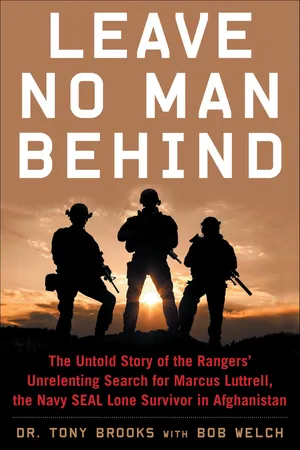
eBook - ePub
Leave No Man Behind
The Untold Story of the Rangers' Unrelenting Search for Marcus Luttrell, the Navy SEAL Lone Survivor in Afghanistan
- English
- ePUB (mobile friendly)
- Available on iOS & Android
eBook - ePub
Leave No Man Behind
The Untold Story of the Rangers' Unrelenting Search for Marcus Luttrell, the Navy SEAL Lone Survivor in Afghanistan
About this book
Trusted by 375,005 students
Access to over 1.5 million titles for a fair monthly price.
Study more efficiently using our study tools.
Information
Topic
HistoriaSubtopic
Historia del siglo XXI1
OUT OF THE WHEELHOUSE
Though I tend to be analytical—that’s a euphemistic term for “nerd”—the moment I decided to join the military came as impulsively as a retaliatory punch. I was eighteen, a freshman at the University of Arizona. At the time, I rarely watched television, but for some reason I had switched on the TV that morning, September 11, 2001. I was stunned by the footage of the first of the two Twin Towers collapsing, but it was an image within that image that gripped me deepest: the tiny speck of a human being plummeting fifty-plus stories to his or her death.
I knew instantly that the crash into the tower had not been an accident, but a “holy-shit” act of terrorism. And I needed to respond. Seeing the first plane ram the building jolted my emotional equilibrium. Watching the smoke roil skyward sickened my stomach. But knowing that this person had either fallen from the building or chosen to jump triggered an anger-fueled call to action on my part.
I would, I decided then and there, enlist in the military. Fight. Tell this enemy, with bullets and bombs instead of words, to never try something like this again. Ever.
After further review, I suppose some analyzing came into play, but it was lightning fast. Instinctual. Personal. You attack us, I’m attacking you. It was as if, in that moment, I decided if that life had been snuffed by some ruthless terrorist, then whatever speck of life I represented was willing to fight so nobody else would have to die such a humiliating, tragic, unnecessary death.
Not that anybody who knew me would have expected such a response from me, myself included. It was nothing short of a sea change in who I was, and who I would become, as a human being. To appreciate how out-of-the-blue the idea of military enlistment was for me, understand that:
- After finishing in the top ten percent of my class at Oakmont High in Roseville, I was studying business at a major university and enjoying the fraternity party scene—in other words, deeply ensconced in a world as far from the military as you could get, a world whose endgame was pleasure and success, not pain and sacrifice;
- my father was president of the family oil company. I had the means to get a good education and make a very good living. As my interest in getting a degree in business waned, I was considering becoming a geologist, or even a doctor;
- though my grandfathers both served in the Korean War, I wasn’t, as they say, from a “military family.” Though the Brookses loved America, we were not an overly flag-waving family;
- at 5'9" tall and 165 lbs., I did not exactly fit the Sergeant Rock stereotype;
- I had no particular interest in, or experience with, weapons.
Hell, I was a golfer; if I was at a range, it wasn’t for target practice but for honing my swing. I’d grown up living the American Dream. In summers, when I was a young teenager, Mom would drop me off at Sierra View Country Club, where our family belonged, and I would play golf all day, stopping only to scarf down burgers, Cokes, and shakes conveniently placed on my father’s tab. People like that don’t take up arms. They take up bocce ball. They slap down credit cards. They order in extravagant pizza. But, no, they don’t enlist in the military.
“Dad,” I said to my father, Steve, in fall 2001, “I’m not sure college is working out so well.”
There was a pause on the other end of the line.
“What’s going on? Is everything okay?”
I sniffled, trying to gather my composure—trying to not mention my sub-2.0 GPA, a freefall caused by too much partying and too little sense of purpose. For the first time in my life, I was failing miserably—and the answer, for once, didn’t seem to be to “work harder.” The answer seemed to be to try something totally different.
“I just don’t like what I am doing here,” I said. “It feels wrong. It feels like I should be doing something else. Something more meaningful.”
I could almost feel the disappointment from my father, but he said nothing.
“I think I want to join the military.”
I could almost hear the gulp on the other end of the call.
“Anthony, finish the year and we can talk about it. You can’t make a decision this important so quickly. This college experience is a moment in time. You have a lot of life to do something more meaningful.”
Even though it wasn’t exactly what I wanted to hear, I knew he was right.
“You’re right. I need to think about this some more.”
My sudden interest in the military was so out of the wheelhouse that when I told my mother, Kathy, about wanting to be a Ranger, she was thinking the US Forest Service. Yogi Bear. Seriously. A park ranger. Checking hiking permits. Telling stories around campfires in the evening. That sort of thing.
Once she understood what I was really talking about, she and my father weren’t opposed to the idea, but neither were they jumping up in mid-air, clicking their heels. They advised me to get more schooling under my belt, code speak, I imagined, for “put the idea on the backburner and you’ll soon forget you even had it on the stove.” Deep down, I wonder if they didn’t figure that the war on terror would be over by the time I was ready to join; surely I would come to my senses and return to college.
I did as they suggested, shifting my major from business to geology in the process, but that didn’t give me any more study traction—or peace of mind—than I had before. I was still lost in some Bermuda Triangle of purposelessness. When Pat Tillman enlisted to become an Army Ranger in May 2002, I only redoubled my commitment to do the same.
As instinctively as seeing that tiny human fall on 9/11 made me want to join the military, hearing about Tillman made me want to follow in his footsteps. True, as an ASU Sun Devil he had attended the rival school of my Arizona Wildcats, but I loved the guy’s guts, grit, and conscience. Here was one of the finest players in the NFL, a guy who’d just been offered $3.6 million over the next three years to play for the Cardinals. And yet he turned his back on such wealth to serve his punched-in-the-gut country.
That was me. I don’t say this with any chest-beating bravado, but despite my life of middle-class privilege, my parents had instilled in me a sense of integrity and conscience. Life was about doing the right thing. And even if none of my other friends had been similarly inspired, this was the right thing to do.
But it was a huge risk, and risk-taking had not been part of my childhood repertoire. Remember, I was an analyzer, not an impulsive adventurer. If I was with my buddies and someone wanted to risk some sort of juvenile escapade, I would only participate if I “ran the numbers” and it added up. So, my sudden shift toward going off to war represented a clear departure in my calculate-and-proceed-with-caution demeanor.
That first year in college, the only noble thing I remember doing was standing up for a friend who was about to be hazed unmercifully as a pledge in the same fraternity to which I belonged. I didn’t care for hazing, period. Plus, I knew my buddy had an early-morning ROTC event and couldn’t afford to show up drunk as a skunk. I intervened—and though it didn’t win me any friends with my frat brothers, I saved my buddy’s butt. Ironically, I was named the vice president shortly after being initiated.
I’d been raised with a strong sense of integrity; the worst thing we could ever do, my father said, was lie. Back in the days when boys and girls delivered newspapers, I had a route. At times, I would need a substitute, younger kids who were enthusiastic to help. But I don’t think I ever paid them. And that memory has stuck with me. It bothers me that I hadn’t displayed more integrity.
Years later, my mother and I, in separate interviews with a journalist, were asked what movie character best described who I was. With little hesitation—and with no knowledge of each other’s answer—we both answered “Forrest Gump.” I said it because of a sense of nerdiness I saw in myself. Though most of my friends were jocks during my middle school and high school years, I was only a superstar with the leading edge of “techies.” I became Cisco Network-certified at age fifteen.
But my mother, Kathy, saw my “Gumption” as something else: earnestness (“sincere and intense conviction”). That might be an understatement. I’d stood up to bullies who were badgering a friend—even though my mother reminds me that I was bullied a bit myself, in part because of my asthma, in part because I was built like a ski pole with two wings as ears. And when I made a wrong choice—say, not paying the substitutes who helped me on my paper route—I felt genuine remorse. Mom’s Gump comparison, she said, was also because of my asthma; she saw that as my equivalent of Forrest’s “crooked-like-a-question-mark” back that forced him to wear leg braces.
Though I had been raised in a cocoon of comfort, I shared Pat Tillman’s sense that bigger things were at play than money and materialism. I tried to eke out another year of college, but my new-found passion to join the military won out. In January 2003 I quit school and, a few months later, after the war in Iraq had kicked off, enlisted. By now, my folks could see which way the wind was blowing for me—toward Afghanistan, and possibly Iraq—and they didn’t even try to stop me.
I enlisted.
It wasn’t out of a sense of apologetics for my entitlement, a way to prove I was as hungry and down-to-earth as the next guy. It was out of a sense of duty to my country. It’s simply what I knew I needed to do: Not just become a soldier. But become part of the elite 75th Ranger Regiment, among the finest fighting units of the world.
Weird, I know, but I’d always liked rules and the military was full of them. What’s more, my father was a fairly competitive guy, particularly in the business world. Some of that had rubbed off on me. I liked the challenge of proving myself at the highest level—if to nobody else than to the guy who stared back at me in the mirror each night.
I was never an elite athlete. I was never the smartest kid in the class, graduating high school with a 3.7 GPA. But I was just enough of an overachiever to have the chutzpah to believe in myself, and just enough of an underdog to have a chip on my shoulder. What’s more, I had that Gump-esque blindness to those around me, as if I lived in a world all my own. Some might translate that to “he didn’t know what he didn’t know.” And, frankly, that’s probably true.
Even my mother would tell you I was a late bloomer; I was “born old,” as they say, on November 29, 1982. A dreamer. A big-picture kid. Driven to succeed.
Michael Jackson’s groundbreaking album Thriller and the movie E.T. were released the month I was born. The third space shuttle launched. The Vietnam Veterans Memorial was dedicated. Late Night with David Letterman had debuted earlier in the year. Dynasty and Hill Street Blues were among the hot TV shows. For the United States, it was a relatively peaceful time, although 700,000 demonstrators gathered in New York City’s Central Park protesting the proliferation of nuclear weapons. Economically, a severe recession descended like a rancid fog, as if my birth had triggered it.

Hospital stay with “breathing issues.” Not exactly Ranger material if you ask me.
At age five, then again at age nine, I was hospitalized because of extreme breathing issues. The second time, I was blue when I arrived at the ER. Whenever that happened, I felt as if someone were standing on my chest. I hated that I had this weakness and I would do anything I could to hide it from those around me. It was a hard deficiency to hide, but I found a way, and I was pretty good at it. I was the kid who was never particularly gifted physically, but always found a way to “go to the head of the class.”
I wouldn’t call myself a teacher’s pet, but I connected well with most instructors because I took learning seriously, listened intently, and always wanted to be the best student in the class. Here’s what I learned: the harder you work, the easier it will be on the teacher and, so, the more they’ll like you for that very reason.
Often, in my math classes, I’d find myself teaching the students around me who were struggling. It wasn’t that I was more intelligent, but I thrived in a didactic model. If a teacher told me something, boom, it was locked into my memory as if placed in a safe-deposit box. Around me, classmates would be madly scrawling on their pads. I rarely took notes. As long as I heard it from a teacher’s mouth, I would remember it. It only enhanced my learning to see something on a white board—if there was any hint of ambiguity, seeing a problem solved made it crystal-clear in my mind.
I first discovered my ability to visualize math problems in my head when I was in second grade. At that time, I was put in an experimental class that consisted of half second-graders and half third-graders. After testing, I was quickly identified as an advanced-class kid for math. But lest this start sounding like a “brag,” let me point out that while I was ahead of my class academically, it was a different story in other areas....
Table of contents
- Cover Page
- Leave No Man Behind
- Title Page
- Copyright
- Dedication
- Contents
- Author’s Note
- Prologue: Bird Down on Sawtalo Sar
- 1 Out of the Wheelhouse
- 2 Readily Will I Display the Intestinal Fortitude
- 3 Two Deaths and a Unicorn
- 4 To Afghanistan
- 5 Welcome to War
- 6 Sawtalo Sar
- 7 Breaking Bush
- 8 Bird Down on Sawtalo Sar: Part II
- 9 Soldiers and the Sacred
- 10 A Ring is Forever
- 11 Death Watch
- 12 The Lure of Danger
- 13 The Stars Aligned
- 14 Revenge of the JDAMS
- 15 Under the Waterfall
- 16 A Hand in the Rubble
- 17 Manna from Heaven
- 18 Luttrell, Dietz, and Murphy
- 19 Fourth of July
- 20 Coming Home
- Epilogue
- Acknowledgments
- About the Authors
Frequently asked questions
Yes, you can cancel anytime from the Subscription tab in your account settings on the Perlego website. Your subscription will stay active until the end of your current billing period. Learn how to cancel your subscription
No, books cannot be downloaded as external files, such as PDFs, for use outside of Perlego. However, you can download books within the Perlego app for offline reading on mobile or tablet. Learn how to download books offline
Perlego offers two plans: Essential and Complete
- Essential is ideal for learners and professionals who enjoy exploring a wide range of subjects. Access the Essential Library with 800,000+ trusted titles and best-sellers across business, personal growth, and the humanities. Includes unlimited reading time and Standard Read Aloud voice.
- Complete: Perfect for advanced learners and researchers needing full, unrestricted access. Unlock 1.5M+ books across hundreds of subjects, including academic and specialized titles. The Complete Plan also includes advanced features like Premium Read Aloud and Research Assistant.
We are an online textbook subscription service, where you can get access to an entire online library for less than the price of a single book per month. With over 1.5 million books across 990+ topics, we’ve got you covered! Learn about our mission
Look out for the read-aloud symbol on your next book to see if you can listen to it. The read-aloud tool reads text aloud for you, highlighting the text as it is being read. You can pause it, speed it up and slow it down. Learn more about Read Aloud
Yes! You can use the Perlego app on both iOS and Android devices to read anytime, anywhere — even offline. Perfect for commutes or when you’re on the go.
Please note we cannot support devices running on iOS 13 and Android 7 or earlier. Learn more about using the app
Please note we cannot support devices running on iOS 13 and Android 7 or earlier. Learn more about using the app
Yes, you can access Leave No Man Behind by Tony Brooks,Bob Welch in PDF and/or ePUB format, as well as other popular books in Historia & Historia del siglo XXI. We have over 1.5 million books available in our catalogue for you to explore.