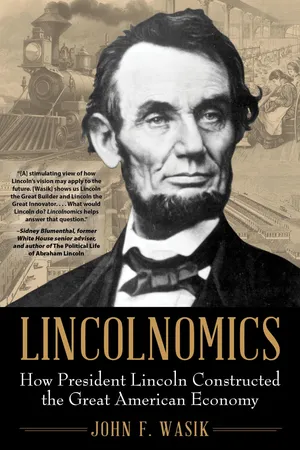
A biography of Abraham Lincoln that examines his untold legacy as the Great Builder of American infrastructure.
Abraham Lincoln's view of the right to fulfill one's economic destiny was at the core of his governing philosophy?but he knew no one could climb that ladder without strong federal support. Some of his most enduring policies came to him
before the Civil War, visions of a country linked by railroads running ocean to ocean, canals turning small towns into bustling cities, public works bridging farmers to market.
Expertly appraising the foundational ideas and policies on infrastructure that America's sixteenth president rooted in society, John F. Wasik tracks Lincoln from his time in the 1830s as a young Illinois state legislator pushing internal improvements; through his work as a lawyer representing the Illinois Central Railroad in the 1840s; to his presidential fight for the Transcontinental Railroad; and his support of land-grant colleges that educated a nation. To Lincoln, infrastructure meant more than the roads, bridges, and canals he shepherded as a lawyer and a public servant.
These brick-and-mortar developments were essential to a nation's lifting citizens above poverty and its isolating origins.
Lincolnomics revives the disremembered history of how Lincoln paved the way for Eisenhower's interstate highways and FDR's social amenities. With an afterword addressing the failure of American infrastructure during the COVID-19 pandemic, and how Lincoln's policies provide a guide to the future,
Lincolnomics makes the case for the man nicknamed "The Rail Splitter" as the Presidency's greatest builder.
"In this unique blend of biography and policy prescription, journalist Wasik . . . casts Abraham Lincoln as America's "foremost moral architect of economic and social opportunity" and looks to his life and political career for lessons in how the nation might rebuild its infrastructure and redress income inequality. . . . Wasik convincingly argues that [Lincoln's] economic policies deserve more credit." —
Publishers Weekly
"While revealing as history, Wasik's account about the first Republican President's launches of infrastructure shame the ignorant, obstinate, narcissist Republicans of today who wish instead to build up tyrant Trump's political infrastructure. This is a book to be read and used today." —Ralph Nader
"Wasik invented a new word for this book because his theme bears new force: Abraham Lincoln sought a better-built nation and a freer legal space to help every individual, regardless of background, to aspire and rise. Most historians know this too vaguely about Lincoln; Wasik finally gives the great democratic idea the prominence it deserves." —James M. Cornelius, Ph.D., editor,
Journal of the Abraham Lincoln Association
- English
- ePUB (mobile friendly)
- Available on iOS & Android
eBook - ePub
About this book
Trusted by 375,005 students
Access to over 1.5 million titles for a fair monthly price.
Study more efficiently using our study tools.
Information

“Abraham Lincoln and Internal Improvements.” May 22, 2014. abrahamlincoln.org/
“Abraham Lincoln’s Patent Model.” Smithsonian: National Museum of American History, Behring Center. americanhistory.si.edu/collections/search/object/nmah_213141
Adelmann, Gerald. “Lockport, Illinois: A collective heritage.” Bank of Lockport, 1980.
“Agricultural Systems: Improving food systems around the world.” February 2020. landgrantimpacts.org/wp-content/uploads/sites/3/2020/03/Ag-Summary2-Global.pdf
Ahtone, Tristan. “Land-Grab Universities.” High Country News. March 20, 2020 pulitzercenter.org/reporting/land-grab-universities
Ambrose, Stephen. Nothing Like it in the World. Touchstone, 2000.
“America’s Original Wire: The Telegraph at 150.” Associated Press. CBSnews.com. October 24, 2011. cbsnews.com/news/americas-original-wire-the-telegraph-at-150/
Andes, Scott. “Five Reasons Why ‘Downtown Universities’ Matter for Economic Growth.” The Brookings Institution. October 11, 2017. brookings.edu/blog/metropolitan-revolution/2017/10/11/five-reasons-why-downtown-universities-matter-for-economic-growth/
Andreas, A.T. “Illinois & Michigan Canal.” History of Cook County, Illinois (1884). Will County Historical Society, 1986.
Ausik, Paul. “Job Losses in 2019 Highest in 4 Years as Manufacturing and Auto Industries Falter.” October 3, 2019. 24/7WallSt.com.
Baker, Jean H. Mary Todd Lincoln: A Biography. Norton, 2008.
Baldwin, Robert. “A map of Virginia, North and South Carolina, Georgia, Maryland with part of New Jersey.” Library of Congress. 1755. loc.gov/resource/g3860.ar138100/?r=-0.129,0.053,1.15,0.405,0
Balesi, Charles. “Joliet and LaSalle’s Canal Plans.” Encyclopedia of Chicago. Chicago History Museum, Newberry Library, 2004. encyclopedia.chicagohistory.org/pages/1437.html
Baptist, Edward. The Half Has Never Been Told: Slavery and the Making of American Capitalism. Basic Books, 2014.
Basler, Roy. (ed.) The Collected Works of Abraham Lincoln. 8 vol. Rutgers University Press/Abraham Lincoln Association, 1955.
Blackburn, Robin. “Lincoln and Marx.” Jacobin. August 28, 2012. jacobinmag.com/2012/08/lincoln-and-marx/
Blumenthal, Sidney. The Political Life of Abraham Lincoln: A Self-Made Man 1809-1849. Simon & Schuster, 2016.
Borritt, Gabor S. Lincoln and the Economics of the American Dream. University of Illinois Press, 1994.
Bostic, Raphael. “A Moral and Economic Imperative to End Racism.” Federal Reserve Bank of Atlanta. June 12, 2020. frbatlanta.org/about/feature/2020/06/12/bostic-a-moral-and-economic-imperative-to-end-racism
Brooks, David. “The Future of American Politics.” The New York Times. January 31, 2020. nytimes.com/2020/01/30/opinion/us-politics.html?searchResultPosition=1
Brown, Arthur L, R. J Onstott, and Franks & Sons. New Salem, home of Abraham Lincoln to 1837. Mason City, Illinois, 1837. Map. Library of Congress. loc.gov/item/75693219/
Burlingame, Michael. Abraham Lincoln: A Life. Johns Hopkins Press, 2008. 2 vol.
Burlingame, Michael. The Inner World of Abraham Lincoln. University of Illinois Press, 1994.
“The Cabinet: Edwin M. Stanton (1814-1869).” mrlincolnandfriends.org/the-cabinet/edwin-stanton/
“The Cabinet: William H. Seward (1801-1872).” Mr. Lincoln & Friends. mrlincolnandfriends.org/the-cabinet/william-seward/
Candeloro, Dominic and Barbara Paul. Chicago Heights At The Crossroads of the Nation. Arcadia, 2004.
Carriel, Mary Turner. The Life of Jonathan Baldwin Turner. University of Illinois Press, 1961.
Case, Anne and Angus Deaton. Deaths of Despair and the Future of Capitalism. Princeton University Press, 2020.
Catton, Bruce. The Civil War. Houghton Mifflin, 2004.
“The Chase Manhattan Corporation.” Britannica. britannica.com/topic/The-Chase-Manhattan-Corporation
Chernow, Ron. Grant. Penguin, 2017.
“Civil Rights.” The Legal Information Institute. Cornell Law School. law.cornell.edu/wex/civil_rights
“Civil War Timeline.” National Park Service. nps.gov/gett/learn/historyculture/civil-war-timeline.htm
Coe, Alexis. “What We Still Don’t Get About Washington.” The New York Times. February 17, 2020.
Cohen, Patricia. “The Struggle to Mend America’s Rural Roads.” The New York Times. February 18, 2020. nytimes.com/2020/02/18/business/wisconsin-roads.html
collegedebt.com/
“The Constitution of the United States,” Amendment 13.
“The Constitution of the United States,” Amendment 14.
“The Constitution of the United States,” Amendment 15.
Conzen, Michael P. The Illinois & Michigan Historical Heritage Corridor. Northern Illinois University Press, 1988.
Cook, Lisa. “Violence and Economic Activity: Evidence from African-American Patents, 1870 to 1940.” Michigan State University. March 2011. msu.edu/∼lisacook/pats_paper14_0411_final.pdf
Cornelius, James. “Lincoln as a Self-Made Man.” Abraham Lincoln: Self-made in America. Abraham Lincoln Presidential Library and Museum. May 2012.
Cothran, Boyd and Ari Kelman. “How the Civil War Became the Indian Wars.” The New York Times. May 25, 2015. opinionator.blogs.nytimes.com/2015/05/25/how-the-civil-war-became-the-indian-wars/
Cox, Anna-Lisa. “Black Pioneers Not Wanted Here.” The New York Times. September 22, 2019.
“Criminal Justice Fact Sheet.” September 2020. naacp.org/criminal-justice-fact-sheet/
Cronon, William. Nature’s Metropolis: Chicago and the Great West. Norton, 1991.
Cross II, Coy. Justin Smith Morrill: Father of the Land-Grant Colleges. Michigan State University Press, 1999.
Currey, J. Seymour. “Mr. Lincoln’s Visit to Waukegan.” Journal of the Illinois State Historical Society 4, no. 2. July 1911). 178-83.
Davidson, Alexander and Bernard Stuve. The History of Illinois. H.W. Rokker, 1874.
De Tocqueville, Alexis and Richard D. Heffner, ed. Democracy in America. Penguin Books, 1984.
de Borchgrave, Alexandra Villard and John Cullen. Villard: The Life and Times of an American Titan. Doubleday, 2001.
“Deep Waterway from Lake Michigan to the Mississippi River.” Will County Historical So...
Table of contents
- Cover Page
- Lincolnomics
- Also by John F. Wasik
- Title Page
- Copyright
- Dedication
- Contents
- Preface: The Once and Future President
- Introduction: Why Lincoln Was Our Greatest Builder, But Doesn’t Get the Credit
- I Before Lincoln: Negotiating the Wilderness
- II Lincoln and the Whigs’ American System
- III Abe’s Great Depression: How Lincoln Recovered from the Failure of His First Infrastructure Push
- IV Lincolnomics Hits the Rails: Attorney Lincoln and the Illinois Central
- V Fighting the Furious Fight: Infrastructure During the Civil War
- VI The Morrill Act: Creating an Intellectual Infrastructure
- VII Moving West: Creating a Link to the Pacific
- VIII Paying for It All: Financing Lincolnomics in the Nineteenth Century
- IX Lincoln’s Infrastructure of Opportunity
- X Building Upon Lincoln’s Legacy: Infrastructure to Date
- XI Lincolnomics: Global Building for Today and the Future
- Afterword: Lincolnomics’ Impact on Social Infrastructure—A View from the Pandemic
- Appendix I: Lincoln’s Patent Application Letter
- Appendix II: Lincoln’s Major Speeches and Other Writings on Infrastructure
- Appendix III: A Note on Sources—Visiting Lincoln’s America
- Appendix IV: US Infrastructure Rebuilding Proposals
- Author’s Note: My Stake in Lincolnomics—A Full Disclosure
- Bibliography
- Acknowledgments
- About the Author
Frequently asked questions
Yes, you can cancel anytime from the Subscription tab in your account settings on the Perlego website. Your subscription will stay active until the end of your current billing period. Learn how to cancel your subscription
No, books cannot be downloaded as external files, such as PDFs, for use outside of Perlego. However, you can download books within the Perlego app for offline reading on mobile or tablet. Learn how to download books offline
Perlego offers two plans: Essential and Complete
- Essential is ideal for learners and professionals who enjoy exploring a wide range of subjects. Access the Essential Library with 800,000+ trusted titles and best-sellers across business, personal growth, and the humanities. Includes unlimited reading time and Standard Read Aloud voice.
- Complete: Perfect for advanced learners and researchers needing full, unrestricted access. Unlock 1.5M+ books across hundreds of subjects, including academic and specialized titles. The Complete Plan also includes advanced features like Premium Read Aloud and Research Assistant.
We are an online textbook subscription service, where you can get access to an entire online library for less than the price of a single book per month. With over 1.5 million books across 990+ topics, we’ve got you covered! Learn about our mission
Look out for the read-aloud symbol on your next book to see if you can listen to it. The read-aloud tool reads text aloud for you, highlighting the text as it is being read. You can pause it, speed it up and slow it down. Learn more about Read Aloud
Yes! You can use the Perlego app on both iOS and Android devices to read anytime, anywhere — even offline. Perfect for commutes or when you’re on the go.
Please note we cannot support devices running on iOS 13 and Android 7 or earlier. Learn more about using the app
Please note we cannot support devices running on iOS 13 and Android 7 or earlier. Learn more about using the app
Yes, you can access Lincolnomics by John F. Wasik in PDF and/or ePUB format, as well as other popular books in Politics & International Relations & Historical Biographies. We have over 1.5 million books available in our catalogue for you to explore.