eBook - ePub
The Fore-Arm Rotation Principle in Piano Forte Playing - Its Application and Mastery
- 20 pages
- English
- ePUB (mobile friendly)
- Available on iOS & Android
eBook - ePub
The Fore-Arm Rotation Principle in Piano Forte Playing - Its Application and Mastery
About this book
First published in 1911, this vintage book contains a complete guide to learning and mastering fore-arm rotation for piano playing, by Tobias Matthay. Forearm rotation is the movement your arm makes when you turn your hand from palm down to palm up in front of your body. It is a fundamental technique of piano playing that needs to be learnt and understood, which Matthay helps the piano learner to do in this timeless volume with the aid of simple explanations and useful diagrams. Tobias Augustus Matthay (1858 – 1945) was an English pianist, composer, and teacher. He was taught composition while at the Royal Academy of Music by Arthur Sullivan and Sir William Sterndale Bennett, and he was instructed in the piano by William Dorrell and Walter Macfarren. This timeless handbook will be of considerable utility to piano teachers and students alike, and it would make for a worthy addition to allied collections. Other notable works by this author include: "The Act Of Touch In All Its Diversity" (1903), "The First Principles of Pianoforte Playing (1905)" and "Relaxation Studies" (1908). Many vintage books such as this are increasingly scarce and expensive. It is with this in mind that we are republishing this volume now in an affordable, modern, high-quality edition complete with a specially-commissioned new biography of the author.
Trusted by 375,005 students
Access to over 1.5 million titles for a fair monthly price.
Study more efficiently using our study tools.
Information
Subtopic
MusicTHE
FORE-ARM ROTATION PRINCIPLE
Step I: Preparatory—away from the keyboard. a) Allow your arm to fall lightly and limply upon your knee. Be sure to leave it quite free. It will then fall with the hand sideways—with the thumb-side of your hand upwards.*
b) Let it lie thus loosely for a moment, and then raise your arm a foot or so, with the hand remaining in this sideways position.
c) Now turn the hand freely until the palm is downwards—the knuckles up.
d) Note that this partial rotation of the hand and forearm is caused by an almost imperceptible exertion of the muscles which twist the forearm upon itself, and that this almost unnoticeable “twisting” (or rotary) exertion also serves to retain the hand in its playing-position: i. e., it is this gentle exertion of the forearm, rotatively, which keeps your hand turned knuckles upwards, and if you cease this exertion completely, the hand will untwist, back to the sideway position. Test this again and again.
Having learnt this important fact about the hand and arm, rotatively, take the next Step:—
Step II: a) Hold one hand extended, with palm open and turned upwards: lay the other hand sideways (thumb up) upon the middle phalange of the extended fingers of the other hand. See Fig. 1.
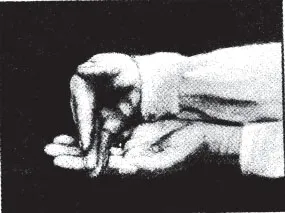
Fig. 1.
b) Now roll (rotate or twist) this lying hand so as to hit into the palm of the extended one, and so as to cause a sharp “clap.” Practise this until you can do it quite easily.†
c) Practise the other hand in the same way.
d) Now reverse the exercise, by rolling upon the thumb-side of the lying hand—instead of the little finger-side as before. See Fig. 2.
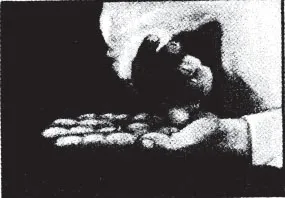
Fig. 2.
The ball of its thumb now rests on the wrist-end of the extended hand and you clap towards the little-finger side. This seems more difficult to do than the last, not because it is really more difficult muscularly, but because we cannot at once learn to roll the little-finger side of the hand upwards (upon the thumb) without “stiffening.” Insist, however, on practising this exercise until you can avoid thus using the wrong (or opposite) exertion implied by such “stiffening.”
e) Practise this form of the exercise with the other hand.
f) Combine both forms of the exercise, by alternately clapping with the thumb-side of the hand, and then with the little-finger side of it. Thus:— let the thumb-side rise, and then moving it down sharply, “clap” into the palm of the supporting hand, and follow this, by letting the fifth-finger side rise, and then giving a “clap” with that.
NOTE. A simpler form of preparatory exercise is to lay the hand upon a table, etc., and to execute the indicated motions upon it.
A large number of additional preparatory and advanced “rotation” exercises are found in Set IV of the author’s “Relaxation Studies” (Bosworth and Co.).
Step III: At the keyboard—Place the hand sideways, with the tip of the little finger (sideways also) on a key. Rest very gently on this key—with no more weight than is just sufficient to keep it depressed. Now, just as in the previous “clapping” exercise, roll the hand and forearm round so as to bring the thumb swiftly (but quite gently) upon a note a fifth distant from the little finger’s note. Do this so gently and neatly as not to sound that note at all. Repeat this rotary swing-down to the key, until you can do this with perfect freedom and neatness, and can even take hold upon this key with the thumb—with a neat little pressure— but still without depressing or sounding the note.
Step IV: Repeat the last exercise, but now, when you reach the key, increase the rotary-exertion (and thumb exertion) sufficiently to enable the thumb to take the key down and to sound it. Do this quite softly at first, and louder afterwards.
NOTE. Remember, all tone-producing exertions must be applied only during the descent of the key and must cease the moment sound is reached in Key-descent. Therefore time them accurately, so that you do not apply the force too late to make the required tone; al...
Table of contents
- Cover
- Title
- Copyright
- Contents
- Tobias Matthay
- Foreword
- The Fore-Arm Rotation Principle
- Appendix
Frequently asked questions
Yes, you can cancel anytime from the Subscription tab in your account settings on the Perlego website. Your subscription will stay active until the end of your current billing period. Learn how to cancel your subscription
No, books cannot be downloaded as external files, such as PDFs, for use outside of Perlego. However, you can download books within the Perlego app for offline reading on mobile or tablet. Learn how to download books offline
Perlego offers two plans: Essential and Complete
- Essential is ideal for learners and professionals who enjoy exploring a wide range of subjects. Access the Essential Library with 800,000+ trusted titles and best-sellers across business, personal growth, and the humanities. Includes unlimited reading time and Standard Read Aloud voice.
- Complete: Perfect for advanced learners and researchers needing full, unrestricted access. Unlock 1.5M+ books across hundreds of subjects, including academic and specialized titles. The Complete Plan also includes advanced features like Premium Read Aloud and Research Assistant.
We are an online textbook subscription service, where you can get access to an entire online library for less than the price of a single book per month. With over 1.5 million books across 990+ topics, we’ve got you covered! Learn about our mission
Look out for the read-aloud symbol on your next book to see if you can listen to it. The read-aloud tool reads text aloud for you, highlighting the text as it is being read. You can pause it, speed it up and slow it down. Learn more about Read Aloud
Yes! You can use the Perlego app on both iOS and Android devices to read anytime, anywhere — even offline. Perfect for commutes or when you’re on the go.
Please note we cannot support devices running on iOS 13 and Android 7 or earlier. Learn more about using the app
Please note we cannot support devices running on iOS 13 and Android 7 or earlier. Learn more about using the app
Yes, you can access The Fore-Arm Rotation Principle in Piano Forte Playing - Its Application and Mastery by Tobias Matthay in PDF and/or ePUB format, as well as other popular books in Media & Performing Arts & Music. We have over 1.5 million books available in our catalogue for you to explore.