"A compelling investigation of the pasts and possible futures of a critical ecosystem in an era of globalization and rising nationalism." —Andrew S. Mathews, author of
Instituting Nature
In Europe's last primeval forest, at Poland's easternmost border with Belarus, the deep past of ancient oaks, woodland bison, and thousands of species of insects and fungi collides with authoritarian and communist histories.
Foresters, biologists, environmentalists, and locals project the ancient Bialowieza Forest as a series of competing icons in struggles over memory, land, and economy, which are also struggles about whether to log or preserve the woodland; whether and how to celebrate the mixed ethnic Polish/Belarusian peasant past; and whether to align this eastern outpost with ultraright Polish political parties, neighboring Belarus, or the European Union. Eunice Blavascunas provides an intimate ethnographic account, gathered in more than 20 years of research, to untangle complex forest conflicts between protection and use. She looks at which pasts are celebrated, which fester, and which are altered in the tumultuous decades following the collapse of communism.
Foresters, Borders, and Bark Beetles is a timely and fascinating work of cultural analysis and storytelling that textures its ethnographic reading of people with the agency of the forest itself and its bark beetle outbreaks, which threaten to alter the very composition of the forest in the age of the Anthropocene.
"Through vivid storytelling, Eunice Blavascunas illuminates the durability of struggles around national identity and history—and the ways those struggle shape debates over ecology and nature conservation—in one of Europe's quintessential borderlands." —Katrina Z. S. Schwartz, author of
Nature and National Identity after Communism
eBook - ePub
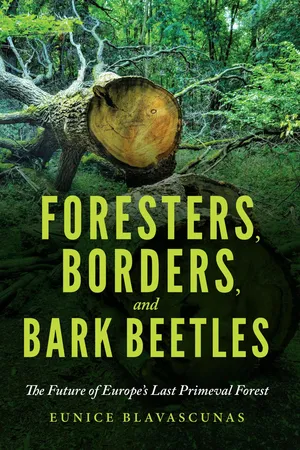
Foresters, Borders, and Bark Beetles
The Future of Europe's Last Primeval Forest
- 236 pages
- English
- ePUB (mobile friendly)
- Available on iOS & Android
eBook - ePub
About this book
Trusted by 375,005 students
Access to over 1.5 million titles for a fair monthly price.
Study more efficiently using our study tools.
Information
Publisher
Indiana University PressYear
2020Print ISBN
9780253049582
9780253049582
eBook ISBN
9780253052285
1
PUSZCZA
Of Forests and Time
PROTECTED ANCIENT FORESTS ARE RARE IN EUROPE. MOST European forests have histories of intensive logging and management. The only protected lowland primeval forest lies on the border between Poland and Belarus. In Poland it is called Białowieża (pronounced “Biaow-oh-veah-zha”) and in Belarus, Belovezhskaya. In both places the forest is referred to simply as puszcza or pushsha, meaning “ancient forest.” In media, the most commonly represented trait of this forest is its primeval character. Oak, ash, and linden trees, hundreds of years old, tower over a dense understory. Moss-covered logs slowly sink into the layered ground cover. The preeminent symbol of the forest, European bison, are featured in their temperate woodland habitat, grazing in the mist of riverine meadows. Such images remind the world that modern and civilized Europe was once fully forested from the Ural Mountains to the Atlantic coast and rich with wildlife such as wolves, pygmy owls, and moose. The forest is evidence of a European past, a relict that did not survive in the rest of Europe.
The majestic oaks standing today were never turned into ships for the global grain trade of the sixteenth and seventeenth centuries or into wine casks or furniture in the twentieth century. The trees are not all single species growing in straight rows for the economic logic of modern forestry, nor did the forest spring back after farmers abandoned the land. Białowieża has been evolving as forest since the end of the last ice age, twelve thousand years ago, a geologic event that marks the start of the Holocene. Given this deep time, how does a primeval forest shape multiscalar historical projects, some intensely local and all ideological?
Today in Poland, the Białowieża Forest is split between national park lands (Białowieski Park Narodowy)—projected as primeval and untouched—and highly utilized State Forests (Lasy Państwowe) lands, forming a complicated blend of highly protected zones and commercially logged areas. Those who advocate for the conservation of this outpost of lowland mixed-deciduous forest defend its pristine nature and focus on the forest’s primeval character. In the conservationist narrative, the forest is evidence of a European past that survived only there. In this vision, the forest and its unique nonhuman inhabitants urgently need protection against logging. But to those who log and manage the Białowieża Forest (through Polish State Forests), the forest is a testament to a tradition of intensive human management and the economy and culture supported by such management. Forestry and hunting align in their ethos. The forester plants and cuts the trees and keeps them safe from deer through regulated hunting, and the village residents respect the forester. In this view, the forest would not exist without the forester’s care.
Since the fall of communism in eastern Europe following the revolutions of 1989–91, the Białowieża Forest has garnered its share of international attention, first for being rediscovered as the last remaining primeval forest in Europe and then through outrage at the Polish government for logging the ancient woods. Polish nature conservationists, including biologists, activists, artists, and journalists, assumed that the introduction of democracy in the postsocialist period would benefit their cause. For them, democracy meant that merit-based science and meritorious managers could decide the fate of the forest. Over the past three decades, conservationists submitted proposals to the Polish Environmental Ministry to enlarge the small national park and curb logging in critically sensitive habitat. At the same time, Białowieża’s foresters (employees of Polish State Forests) mobilized powerful social discontent against the inequalities of the new era to solidify their political base, even as State Forests downsized more than 75 percent of its workforce following the end of full employment under state socialism.
Białowieża Forest is both logged and protected in part. It sits on the border of the European Union in a formerly communist region and is Europe’s last primeval forest. Contests rage among locals, biologists, conservationists, and foresters, who struggle to determine what the forest has meant and what it will become. The forest is both purifying and in need of purification. Purification takes on many meanings—not just whether the forest will be logged or protected but also which ethnohistories of the region should define the woodland, how the border of the European Union will influence the forest, and how communism will be remembered as an artifact of institutions and social practices. Loss and desire are part of the experience of being there. Histories of inequality and ethnic violence have been suppressed. Many local people long for an era of full forestry employment. The forester promises modernity through what is extracted from the forest, a vision in which people forever plant and manage the woodland. There is also grief over logging the ancient woodland. Moreover, the deep past of primeval nature is invoked through conservationists’ visions of a modern future facilitated by tourism.

Fig. 1.1. Białowieża National Park, strict reserve. Photo by Janusz Korbel. Used with permission.
No place is without a human narrative about its past. Is Białowieża’s conservation conflict unique in terms of its troublesome pasts, which involve communism, the struggle for national identity, world wars, and insurrections? Białowieża’s and Poland’s pasts have not been put to rest—they remain open to reinterpretation and repurposing. In communist Europe, the past as a category in and of itself was used as a tool of control. For Poland as the People’s Republic of Poland (Polska Rzeczpospolita Ludowa) in 1952–89, socialist ideology controlled interpretations of the past from the center. Following World War II, Poland came under Soviet control, and the first egregious attempt to control history came with the ideology that Soviets liberated Poland from fascism, and any other attempts to narrate Poland’s victimhood during and after the war at the hands of the Soviets was summarily forbidden. Following Marx’s theories, communism would unfold as a historical inevitability. Despite this supposed inevitability, or perhaps to ensure it, eastern European socialist states felt the need to control interpretations of the past.
Intense social and political debates have ensued since 1989 in all eastern European formerly communist countries to reevaluate how the communist period reshaped history and collective memory and to reclaim the pasts that were erased, in an official sense, by communist rule. The past and future roles of the primeval forest are significant parts of this potent mix of questions about what “truthfully” happened in the past and deeply tied to the fundamental restructuring of people’s relationships to that past and to the forest.
Nature Conservation and Postsocialism
Communism was well known for its ineffective environmental protection, resulting in forests destroyed by acid rain, the Chernobyl nuclear accident, soils contaminated by heavy metals, and industries belching dioxides into the sky (Pavlinek and Pickles 2000; Dawson 1996; Petryna 2002; Snajdr 2008; Manser 1993). The failures of communist modernity—perceived as failure in the sense that communist states never “properly” modernized and that they caused health and environmental catastrophes—also had unintended benefits for landscapes valued as natural and pristine. Socialist industry and development left many wide tracts of land open and virtually free of industry’s direct manipulation and pollution (Schwartz 2006; Franklin 2002). Conservation occurred not necessarily because Communist Party ideologues pressed for protection but rather because inefficiencies in the system heavily industrialized some areas and neglected development in others. In other cases, nature conservation within the Soviet system was the biologist’s “little corner of freedom,” as Douglas Weiner (2002) has argued in his book of that title.
In the mid-1990s, Polish and western European nature conservationists promoted ecology as a new modernity in Poland. Through nature conservation, they argued, the past could be neutralized and the remains of the primeval forest made timeless. At that time, however, both the long-term residents of Białowieża—mainly those who worked on their farms and as forestry employees (the official designation was “peasant/worker”)—and a small intelligentsia felt the stigma of being “backward” because of Communist underdevelopment in this region. Communism was a political system, and peasants or smallholders formed systems of production and sociality outside the logic of modernity. As these locals, biologists, foresters, and others reported to me, Białowieża had not sufficiently modernized.
Communist authorities redistributed large estates to small farmers after World War II and then attempted to collectivize them, but the drives ended in 1956 because of peasant protests, leaving a legacy of farms under ten acres. From a development perspective, there were too many small farms and dilapidated wooden houses, not enough cars, and the wrong kind of “elites.” Five decades of communist rule undermined the chances for a “proper” Polish elite (with manners and a taste for literature, music, and the arts). Many upper-class Poles were exterminated by Soviets and Nazis during World War II, and others escaped Poland during Communist Party rule. The one-party state promoted villagers and the labor class to administrative positions and sustained apparatchiks that used favoritism and bribes. This history caused embarrassment in different ways for different people and gave rise to intertwined concerns about the past. Residents who lived in dilapidated houses challenged me, asking, “Are you going to write about our ‘mud’?”—meaning poverty. A forester or scientist might redirect questions about who was a Communist Party member. Young people revived painful histories of Polish and Belarusian violence during and after World War II. Everyone I met over twenty years of research visits (1995–2018) invested hope in a time of change during the early years of postsocialism.
For nature conservationists, the way to bring about change seemed obvious. One mark of a developed nation, they argued, is that it can successfully preserve nature. Rather than wait for conservation in Poland to come in the wake of western European salaries and a car for every family, they asked, why not conserve nature to prove to the rest of the world that Poland was developed? Why not define modernity as the successful protection of a national park or nature preserve? Białowieża had flourished during an era of royal protection and again during an interwar logging boom. By the mid-1990s, it had become one of the poorest regions in Poland, even by Communist Party standards. Given the dire economic situation, ecological projects seemed both necessary and frivolous. Would worker peasants be left behind economically if conservation were prioritized over forestry? In the process of modernization, which pasts would be forgotten, resurrected, or celebrated?
The Importance of the Past for Forest Management
Białowieża has a preeminent position among globally designated cultural sites in Europe. The United Nations Educational, Scientific, and Cultural Organization (UNESCO) recognized a section of the Polish side of the forest as a World Heritage Site in 1979, and the whole forest in Poland and Belarus became a UNESCO World Heritage Site in 2014. Polish State Forests had to apply for this designation, and UNESCO threatened to remove it in response to egregious logging in 2017. The forest is divided not just by the EU border between Poland and Belarus (Poland has joined the European Union but Belarus has not) but also by its logged areas and protected reserves. In Belarus, the entire forest area (900 square kilometers) became a national park in 1991 (Belovezhskaya National Park). One might assume the result would be preservation; however, clear-cuts routinely appear along the national park tourist trails and deadwood is removed. Other areas, especially those running the length of the border with Poland and the European Union, receive strict protection, but I and others have seen logging within these reserves, and endangered animals such as wolves and bison are hunted. In Poland, more than 80 percent of the area (600 square kilometers) is a commercial forest belonging to Polish State Forests with a series of protected reserves (122 square kilometers within the 600-square-kilometer area). Forest-wide protective measures have prevented cutting stands more than one hundred years old. Another 18 percent (101.7 square kilometers) is managed as a national park. Of that, about 9 percent (57.3 square kilometers) is a highly protected strict reserve, where no management is carried out and entry is forbidden except with a trained guide. The other half of the national park includes active management to better preserve biological habitat (e.g., mowing riverine meadows and selectively logging some trees). This dizzying abstraction of management and numbers is often reduced to simple portraits. It is either all pristine or all planted and managed. In fact, the story is more complex.
The strict reserve in Poland (part of Białowieża National Park) often gets cast over the whole forest in strategically essentializing conservation discourses about “Europe’s last primeval forest.” Foresters and their supporters enlist a five-hundred-year history of use to contest such descriptions. In their narrative, administrators (later foresters) long maintained the forest for the hunt and later to serve economic needs through potash and furniture production. Foresters want to show that the forest needs the forester, that nature and biodiversity are actually better with logging. Much has changed since Poland joined the European Union. The village hamlets hemmed in by the forest have seen rapid increases in wealth and sustainable development projects spurred by both the forestry sector and by funds for nature conservation.

Fig. 1.2. Map of forest ownership. Produced by Tomasz Borownik. Used with permission.
Defining the Forest
What is Białowieża Forest? This question is about more than just management designations or defining the correct baseline of plant and animal species. How to define the puszcza is entangled in the past and the future, in the identities of contemporary Poland and Europe, in the legacy of communism, and in the country’s understanding of the “peasantry” in a decidedly postpeasant populist moment. What we consider to be the forest existed before human history, but there is no way to tell its story outside of nature’s entanglement with culture. The past does not precede the forest any more than the forest precedes the past; nature and culture produce each other.
To depict a narrative of the forest during the course of human time, biologists and archaeologists have interpreted questions such as how open the canopy was in the Middle Ages (Vera 1999; Birks 2005; Latałowa et al. 2015) or whether Slavic grave mounds date to the ninth or sixteenth century. The pasts I am interested in are more recent. They center on Poland’s peasantry and the birth of Polish State Forests in the twentieth century, the founding of the Białowieża National Park in the interwar period, the communist period in Poland (1945–89), and the postsocialist period (1989 to present). The twentieth century and start of the twenty-first cannot be understood without also referring to earlier periods, which I will explain below. As people fight over forest management, they use various pasts to link arguments for their projects—to Europe, as a representation of an idealized moral framework for solving problems; to Poland, as a misunderstood nation; or to Belarus, which can be understood both as a relic of the communist era and as an orderly nation where a dictator “gets things done.” Entanglements between Poland and Belarus, and their relationships to Russia, arise in the course of celebrating or eschewing different pasts. I will highlight vital dimensions of Poland vis-à-vis Belarus and how these political bodies and ethnic groups relate to the ecology of the Białowieża Forest.
Above all, the forest mediates nostalgia and othering. It eludes those who try to define it. The forest remains unknown even as competing groups argue for different forest management and define its known qualities through science (forestry science and biology). Białowieża is both the last primeval forest of Europe and a commercially logged woodland. In other words, it is both pristine and imperiled, “already ruined” and the best hope for knowing a “wild” European forest. Its ambiguity increases when tourists and landscape aficionados discuss the forest as Belarusian, Russian, or Polish.
“Domes of Darkness” and Socialist Modernity
Returning to the primeval past, consider Europe at the end of the ice age, when wandering bands of humans survived by hunting. Glaciers retreated, the European continent warmed, and forests encroached. Humans moved around the globe, crossing into North America. In Europe, agriculture spread north from the Fertile Crescent. Many centuries later, settlements and then cities arose. Robert Pogue Harrison (1992) reminds us that forests would have shadowed European civilization. These “domes of darkness” (61), indifferent to time, began encroaching on humans accustomed to treeless expanses of ice. Europeans created their civilization not under the canopy trees but in its clearings: “One could not remain human in the forest: one could only rise above or sink below the human level” (ibid.). In other words, as the idea of European civilization developed, so did the ideas of cities and towns, agriculture, and eventually writing. The forest is antithetical to civilization. During the Roman Empire, for example, barbarians lived in the forests to the north. In this pan-European longue durée, the west cleared or exploited Europe’s vast forests (Oosthoek and Hoelzl 2018). By the nineteenth century, most European forests had succumbed to the logic of German scientific forestry, which transformed forests into even-aged tree stands growing in straight rows. Few European forests survived unlogged or uncleared with continuous forest cover since their initial evolution after the ice age. Especially in continental Europe, to be left in the forest, poor and undevelop...
Table of contents
- Cover
- Title Page
- Copyright
- Dedication
- Contents
- Acknowledgments
- Time Line
- 1. Puszcza: Of Forests and Time
- 2. The Forester
- 3. Scientists and the Communist Past: Syndromes, Disorders, and a Proper Elite
- 4. Postpeasant Cosmopolitics: Man of the Forest
- 5. Borderline Engagements: Relict Forest, Relict Communism
- 6. Resurgence: Outbreaks of Bark Beetle and Right-Wing Nationalism
- 7. Temporal Dimensions: The Past Is Not Safe at All
- Bibliography
- Index
- About the Author
Frequently asked questions
Yes, you can cancel anytime from the Subscription tab in your account settings on the Perlego website. Your subscription will stay active until the end of your current billing period. Learn how to cancel your subscription
No, books cannot be downloaded as external files, such as PDFs, for use outside of Perlego. However, you can download books within the Perlego app for offline reading on mobile or tablet. Learn how to download books offline
Perlego offers two plans: Essential and Complete
- Essential is ideal for learners and professionals who enjoy exploring a wide range of subjects. Access the Essential Library with 800,000+ trusted titles and best-sellers across business, personal growth, and the humanities. Includes unlimited reading time and Standard Read Aloud voice.
- Complete: Perfect for advanced learners and researchers needing full, unrestricted access. Unlock 1.5M+ books across hundreds of subjects, including academic and specialized titles. The Complete Plan also includes advanced features like Premium Read Aloud and Research Assistant.
We are an online textbook subscription service, where you can get access to an entire online library for less than the price of a single book per month. With over 1.5 million books across 990+ topics, we’ve got you covered! Learn about our mission
Look out for the read-aloud symbol on your next book to see if you can listen to it. The read-aloud tool reads text aloud for you, highlighting the text as it is being read. You can pause it, speed it up and slow it down. Learn more about Read Aloud
Yes! You can use the Perlego app on both iOS and Android devices to read anytime, anywhere — even offline. Perfect for commutes or when you’re on the go.
Please note we cannot support devices running on iOS 13 and Android 7 or earlier. Learn more about using the app
Please note we cannot support devices running on iOS 13 and Android 7 or earlier. Learn more about using the app
Yes, you can access Foresters, Borders, and Bark Beetles by Eunice Blavascunas in PDF and/or ePUB format, as well as other popular books in Biological Sciences & European History. We have over 1.5 million books available in our catalogue for you to explore.