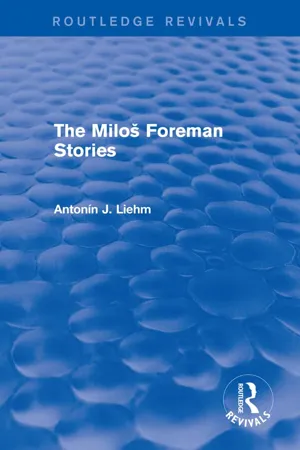
First published in 1975, this book examines the career of one of the leading post-war Czech filmmakers Miloš Forman through his own testimony. After recollecting his childhood and early artistic ventures, Forman gives accounts of the making of his major films, interspersed with contemporaneous reviews by the author, and in the final chapter he sums up his 'lessons along the way'. A section entitled 'Stories behind the Stories' fills in details on the events and people mentioned in Forman's narrative. The author's commentary provides valuable insights not only into the aesthetics of filmmaking but also the social and political environment in contemporary Czechoslovakia.
- 200 pages
- English
- ePUB (mobile friendly)
- Available on iOS & Android
eBook - ePub
The Miloš Forman Stories (Routledge Revivals)
About this book
Trusted by 375,005 students
Access to over 1.5 million titles for a fair monthly price.
Study more efficiently using our study tools.
Information
FORMAN'S STORIES
HOW IT ALL BEGAN
DOI: 10.4324/9781315620916-1
I guess I found my way into films in a slightly strange way. I was five years old when I saw my first movie. It was an opera, Smetana's The Bartered Bride; and it was silent. The talkies had already been invented by then, but it so happened that the first movie I saw was a silent opera. It was as though I had offended my fairy godmother and she had decided that I’d get my first taste of art from an opera in which there was nothing to hear – just a lot of flamboyant gestures with no meaning.
Until 1940 I lived in Čáslav. In that year the Germans arrested my parents. My father had been in the Boy Scout movement and had been a reserve officer, and he’d always been an active man. Active people are generally troublemakers. There's probably nothing you can do about them, because history finally gets made despite all their activity, for better or worse – mostly worse, but that's not usually their fault. They do the best they can, but it's a silent movie.
In any case, I was handed around from one friend or relative to another, which is how I turned up in the north Bohemian town of Náchod. After that, I lived in Kutná Hora for a while – all historical places, you’ll note, and it was quite some history.
My brother, who was about nineteen or twenty at the time, was studying with a famous Czech artist, František Tichý; and it was Tichý, a fan of the theater, circuses, and carnivals, who helped him get a job with the East Bohemian Repertory Theater, designing operetta sets.
The only contact I’d had with culture until then was still that silent version of The Bartered Bride, then Disney's Snow Whiteand the Seven Dwarfs. The uncle who looked after me most of the time simply refused to give me any money to go and see the German films, or whatever it was that was playing in Czechoslovakia during World War II.
Then it happened. The East Bohemian Repertory Theater went on tour, and came to Náchod. I spent more time backstage with my brother than I did at home. That was how I broadened my cultural horizons – with the group's production of PolishBlood, The Gypsy Baron, and that sort of thing. It all seemed terribly glamorous. I was just a kid, and nobody bothered to kick me out of the ladies’ dressing room.
In 1944 the Germans closed down the theaters in Czechoslovakia – all of them. The final performance of the Repertory Theater was of one of those cheerful, bouncy operettas. The cast was on the verge of tears; but I didn’t have any idea what was going on, although I could feel something in the air. There was a very funny scene in the third act; and that was when, all of a sudden, everybody broke down. As in the silent BarteredBride movie, they opened their mouths, but nothing came out. They couldn’t go on. The conductor rapped his baton, and they tried again. But all that happened was that tears streamed from their eyes. It went on like that for almost fifteen minutes. The performers didn’t finish the show that night. Maybe for the first time in my life, I was terribly touched. From that moment I knew that, more than anything else in the world, I wanted to work in the theater. That evening made up my mind for me.
In the same year we got word that my parents had died in concentration camps. Then the war was over. My brothers were still young, and they had no families yet. That's how I ended up in a boarding school, in the spa town of Poděbrady.
The school had a good reputation. It was the first in the country to try to find ways to relate more closely to practical, everyday life. We had our own metal-working, book-binding, and carpentry shops; and we had the benefits of the spa's medical facilities.

Miloš Forman in 1938, at the age of six

In a high school performance, at seventeen

Miloš, center, in a school production of Robin Hood
There I happened to meet Ivan Passer, [playwright] Vaclav Havel, Jerzy Skolímowski (whose mother was Polish cultural attache in Prague at the time), and Pavel Fala (né Fierlinger), who later made documentary films in the United States.
My boarding-school education ended prematurely in my sophomore year. At that time the son of an editor-in-chief of an important literary magazine was enrolled there too – a nice guy, but, unfortunately, a victim of an injustice no revolution can eradicate: he was not the brightest of boys, and he was lazy. He deserved to have flunked in at least four subjects each semester. But his father always appeared, and the boy passed. The regular criteria were applied to the rest of us, of course, which gave us a feeling of injustice and disgust, of having been wronged, especially since the school prided itself on developing in its students a sense of responsibility, fair play, and honesty. Our anger worked itself out in boy-sized doses.
Our response was particularly sophisticated. Twice a week we were herded into the showers for twenty minutes, and there we played a special trick on the target of our resentment. I don’t know whether you’ve ever had the opportunity to observe that if somebody pees on you under a warm shower, you don’t even notice it. This is one of life's little experiences most people never discover, because they usually take their showers in private. On shower days we held our fire from morning; and as soon as the boy got lathered and, closing his eyes, stepped under the shower, we’d all let go. We stood around him, laughing and kidding; and he joined right in, unsuspecting. Well, one day it suddenly was all over. Everything was going as usual until I noticed that the boys had stopped laughing: they all “froze,” and it was as though their pee had suddenly dried up on them – all except mine. I had my back to the bathroom door, and I kept right on peeing. I looked around, and there stood one of the teachers.
I didn’t worry too much; but a few days later, the incident became a “political case.” The headmaster suggested that I ask to withdraw from the school. Proudly, I refused. But later, when I realized I didn’t understand politics, I transferred to a high school in Dejvice, a suburb of Prague. I finally was graduated from there.

Miloš, left, with a friend, at the time of Ballad of Rags

Miloš in his role in Ballad of Rags
During my senior year, however, something else important happened. A friend and I organized a drama club; and we put on a production of a musical about Francois Villon, Ballad of Rags [Balada z hadrů], by Voskovec and Werich, with music by Jaroslav Ježek. It was a tremendous experience. We used modern dance and a jazz orchestra. We were all amateurs, and it was beautiful.
This was around the time E. F. Burian had some problems with the authorities.1 * Defiantly, he allowed us to use his theater on Mondays, when his company did not perform. It was amazing how much we could get away with then, the authorities notwithstanding. We even had our own posters printed, and bribed the billboard pasters to put them right next to the National Theater ads; and this was at a time when one had to have a rubber stamp and special permission for everything. To bolster our political reputation, we put a notice in the paper advertising our production as a “drama about a French revolutionary poet, František Villon.” We even had a name: we called ourselves The Musical Comedy Theater. And because there was already a Comedy Theater in Prague, this confused people, and they assumed we were professionals.
_______________
* Stories behind the stories, annotations and comments about people and events, will be found in a section beginning on page 149.
Once we were even invited to give a guest performance in Kolín in honor of a regional Communist Party conference. That was simply because, from painful experience, the local cultural secretary had become convinced that domestic revolutionary dramas were a bore. A revolutionary play from France would at least be more interesting. This man had no idea that our play was in fact a comedy by Voskovec and Werich, because in those days we weren’t allowed to refer to Voskovec and Werich even by their initials. We never made a bigger hit with any audience than we did that night. Those people were rolling in the aisles. Our production was such a pleasant surprise for them, and they were grateful for that.
It was during those years that we got our first taste of what “absurd” really means – individually and in general. For instance, there was the time we had an engagement to play in Slany. But we were only amateurs, so four members of the cast simply didn’t show up. I filled in with one of the parts, we entrusted our light man with another, and one of the girls in our class pinch-hit in two more roles. When we got to Slaný, we discovered that, in the confusion, we had forgotten the main backdrop. Somehow we were able to improvise a set out of the materials on hand. But as often happens, we had one catastrophe after another: the set fell, and cast members said their lines at the wrong time and bumped into each other on the stage. Still, we carried it off fairly smoothly, and the audience had a ball. While the audience cheered and applauded the first half, we were backstage fighting through the whole intermission like cats and dogs, blaming each other for everything that had gone wrong. We were like a bunch of stripteasers: sure that what we were doing was real art, we got awfully touchy about it.
Just before the second half began, the orchestra struck up the overture; and out front, everybody was waiting to see what was going to happen next. Suddenly there was an awful noise from behind the curtain. What had happened was that in the midst of all the confusion, the electrician had gotten a 220-volt charge, fallen from the catwalk, and was lying in the middle of the stage in a puddle of blood. And there was the audience, laughing hysterically and demanding, “Open the curtain.’! ” The boy was carried off the stage, and we finished the performance. The audience had a ball. The boy spent six months in a hospital.
That was my senior year in high school. After I graduated, I applied for admission to the Prague Drama School. The interviews were in the spring, and the results weren’t made known until the fall. Jiří Frejka was the chairman of the admissions board. The interview itself was really a regular proficiency test. Out of the blue, Frejka said something like, “Well, now, let's see how you’d direct the struggle for peace! ” That was a shock, and it made me feel an awful fool. I couldn’t think of a thing to do. Absolutely nothing. Finally I came up with something so idiotic that, fortunately, I can’t even remember it anymore. Then I left for Màcha's Lake, where I spent a wonderful vacation with friends.
It had never even crossed my mind that I might not be accepted at the Drama School. I had made up my mind to do one thing in my life, and that was theater; and nobody had the right to stop me. Then, around the end of August, a letter came, telling me I hadn’t been accepted. Helluva situation. By that time there were only a few colleges still accepting new students; and if I didn’t want to have to go into the army, I had to be enrolled somewhere. The only places that were still open, besides in the specialized metallurgy and mining colleges, were in the law school and in the Film Faculty of the Academy of the Performing Arts (FAMU), in film dramaturgy. The law school interviews were to be given on Wednesday, and those for FAMU, on Tuesday. I quickly signed up for both, figuring it was better to be a lawyer than to spend two years in the army. The FAMU exams lasted all day; and that evening, to my great surprise, I was told I’d been accepted in the script-writing class. I didn’t try any further.2 I spent five fine years at FAMU.
FAMU didn’t teach me anything about film technique. When I graduated I didn’t even know how to use a camera; and I probably didn’t know as much about directing technique and moviemaking in general as any sixteen-year-old kid knows these days. That had to wait until 1961, when I bought a 16-mm camera and when Mirek Ondříček came along and showed me what a negative looks like and how to load a camera and focus it. I had been out of school for six years and had worked on two films before I had mastered the technique. I used a camera for the first time in my life as an assistant director, working with Alfred Radok on Grandpa Automobile [Dědeček automobil]. That was basically where I learned all I know about technique, too. Of course, I didn’t study directing at FAMU. That would have made a difference. But still, it's not the same thing. The best and quickest way to learn technique is by putting it into practice.
What did I get out of school? Five years of life when I didn’t need to feel responsible to anybody but myself for what I thought.

Forman, second from left, during shooting of The Puppies. Kneeling, foreground, is Ivo Novák

Forman, standing, third from right, during the filming of Grandpa Automobile. Seated, center, Alfred Radok
If a person starts out in the movie business when he's too young, he simply has to do whatever fits in with his boss's aesthetic, social, philosophical, and production concepts, regardless of whether that boss is a movie company, a producer, or a director. But a school like ours gives a person of nineteen or twenty a feeling of self-confidence. He studies; he sees films and discusses them; he becomes more sure of himself. And this is exceedingly important for a director.
Then, too, you can work off your own foolishness during your college years. Nobody will put up with any nonsense when you’re making a commercial movie. You can’t write something like “his sperm bursts through the keyhole and hits the ceiling” for Warner Brothers. In a school like FAMU, you can. Professionalism is awfully puritanical. Before you even have a chance to find out what you want to do and what you’re capable of doing, you saddle yourself with a pile of restrictions, which grow out of puritanical conventions and are part of being professional. A school is generous and broad-minded enough to let you work off your own silliness.
School also allows you to gain a sense of identity with your profession. If I had studied law, I would probably have become a lawyer who liked to go to the movies and the theater. But since by accident I ended up at film school, I chose moviemaking as my career. Afterward – not before.
I would say the most important thing is seeing films and then hashing them over together. And that's also what gives you the urge to get a camera and start shooting a movie yourself. It doesn’t matter what kind of film it is. Another advantage of school is that there's somebody to show you how to cut and splice – unless you’ve learned that somewhere else. The most important thing, though, is whom you come into contact with while you’re studying, having people around like Vávra, Kratochvil, Daniel, Kundera.…
The fact that I got into FAMU at all was thanks to a high-school teacher named Professor Macháček. More than any other teacher I ever had, he knew how to arouse in his students a passion for expressing themselves in writing. Ivan Passer and Václav Havel can attest to that. Half his class loved what every student has always detested: composition and written assignments. That was how good he was when he talked about creative writing or poetry. For the FAMU entrance exam, I had to write one short story on an assigned theme and another on a subject of my own choice. I would never have passed that exam if it hadn’t been for my freshman year at boarding school, where I found out how wonderful it was to express onself in writing.
So then: a sense of freedom, hundreds of films, and the character and stature of the people you have around to talk them over with – I guess those are about the most important things anybody can give you.
There is one more thing. People often ask me what movies and artists have been most important for me. I always wonder whether they haven’t been the worst ones, whether what I’m doing now isn’t a reaction to tho...
Table of contents
- Cover Page
- Half Title Page
- Title Page
- Copyright Page
- Original Title Page
- Original Copyright Page
- Dedication
- Table of Contents
- Forman’s Stories
- Stories Behind the Stories
- Filmography
- Index
Frequently asked questions
Yes, you can cancel anytime from the Subscription tab in your account settings on the Perlego website. Your subscription will stay active until the end of your current billing period. Learn how to cancel your subscription
No, books cannot be downloaded as external files, such as PDFs, for use outside of Perlego. However, you can download books within the Perlego app for offline reading on mobile or tablet. Learn how to download books offline
Perlego offers two plans: Essential and Complete
- Essential is ideal for learners and professionals who enjoy exploring a wide range of subjects. Access the Essential Library with 800,000+ trusted titles and best-sellers across business, personal growth, and the humanities. Includes unlimited reading time and Standard Read Aloud voice.
- Complete: Perfect for advanced learners and researchers needing full, unrestricted access. Unlock 1.5M+ books across hundreds of subjects, including academic and specialized titles. The Complete Plan also includes advanced features like Premium Read Aloud and Research Assistant.
We are an online textbook subscription service, where you can get access to an entire online library for less than the price of a single book per month. With over 1.5 million books across 990+ topics, we’ve got you covered! Learn about our mission
Look out for the read-aloud symbol on your next book to see if you can listen to it. The read-aloud tool reads text aloud for you, highlighting the text as it is being read. You can pause it, speed it up and slow it down. Learn more about Read Aloud
Yes! You can use the Perlego app on both iOS and Android devices to read anytime, anywhere — even offline. Perfect for commutes or when you’re on the go.
Please note we cannot support devices running on iOS 13 and Android 7 or earlier. Learn more about using the app
Please note we cannot support devices running on iOS 13 and Android 7 or earlier. Learn more about using the app
Yes, you can access The Miloš Forman Stories (Routledge Revivals) by Antonín J. Liehm in PDF and/or ePUB format, as well as other popular books in History & Film & Video. We have over 1.5 million books available in our catalogue for you to explore.