There is an increased use of technology and informatics, heavier workloads and constant changes in the way in which disease processes are managed. Yet, when compared with other health professionals, nurses still spend a great deal of time in direct contact with patients and clients. They stay at the bedside, listen to their stories, give comfort and advocate. The Ethic of Care: A Moral Compass for Canadian Nursing Practice is unique from other nursing ethics textbooks in several key ways. The book adds a heightened dimension to the already rich knowledge in the field of applied nursing ethics and the ethic of care. The author argues that the ethic of care, or the moral imperative to act justly, be the guiding compass for everything that nurses do. It is with passion and conviction that nurses are encouraged to embody the ethic of care as a "lived virtue." Nurses are also inspired to be the leaders of tomorrow by working toward achieving accountability and sustainability in the Canadian publicly funded health care system and by effectively addressing social inequities. At the end of each chapter the author conveys real life case studies, as derived from her experiences as a critical care nurse, psychiatric nurse clinician and former Coroner. These vignettes bring the subject to life and serve as a means for applying newly acquired ethical knowledge. The aim of this book is to inspire nurses to be as skillful, and compassionate as they can be so that they will leave every encounter with their clients, better than when they first arrived. The book attempts to inspire nurses to be ethical leaders for social change at the patient/client, community and global level. This revised edition of the book includes additional information about trauma-informed care to combat systemic racism and improve the health outcomes for Indigenous peoples; ethics, gender and sexual orientation is dealt with in an inclusive and sensitive way, and a new Code of Conduct has been included.
eBook - ePub
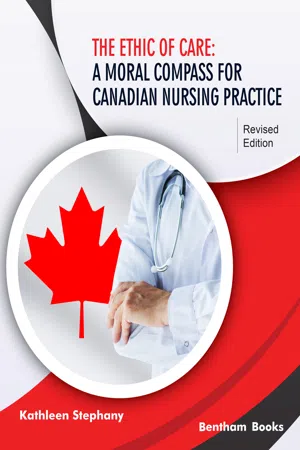
The Ethic of Care: A Moral Compass for Canadian Nursing Practice - Revised Edition
- English
- ePUB (mobile friendly)
- Available on iOS & Android
eBook - ePub
The Ethic of Care: A Moral Compass for Canadian Nursing Practice - Revised Edition
About this book
Information
The CNA Code of Ethics Part I: Integrating Nur- sing Ethical Values & Responsibilities into Care
Kathleen Stephany
Abstract
Chapter Three begins with exploring the role of Canadian law because nurses who have a working knowledge of the Canadian legal system are better equipped to deal with legal issues that may arise during their practice. A brief overview of The Canadian Constitution and The Charter of Rights and Freedoms is also undertaken for similar reasons. Key aspects of the role of the Canadian Nurses Association (CNA) are presented followed by a discussion of the purpose and foundation of the CNA Code of Ethics. A connection is drawn between themes from the CNA Code of Ethics and the ethic of care. Nurses are made aware that the ethical values and responsibilities as laid out in Part I of the CNA Code of Ethics are not discretionary and must be followed by all practicing nurses. Each of the seven CNA Code of Ethics values are then discussed in terms of how they play out in actual practice and narratives are used to emphasize important points. Some topics that directly relate to Part I of the CNA Code of Ethics include: safety and nursing research; what to do if a nurse suspects that a health professional is practicing unsafely or unethically; key elements of informed consent; and the role of the nurse practitioner and registered nurse in medical assistance in dying (MAID). The Chapter ends with a Case in Point where a nurse deliberately covers up a mistake that costs a client their life.
Keywords: Accountability, Common law, Case law, Compassion, Criminal law, Civil law, Conscientious objection, Confidentiality, Distributive justice, Ethics, Ethic of care, Injustice, Justice, Knowledge and care, Law, Medical assistance in dying (MAID), Nursing research, Nursing competence, Precedent, Practice standards, Statutory law, Safety, Safety plan, Self-disclosure, Social justice, Social injustice, The Supreme Court of Canada, The Canadian Constitution, The Charter of Rights and Freedoms, The Canadian Nurses Association (CNA), The CNA Code of Ethics, Values.
LEARNING GUIDE
After Completing this Chapter, the Reader Should be Able to
- Understand that law always supersedes ethics.
- Explain the two key ways that laws are made in Canada.
- Differentiate between common law, case law, precedent, statutory law, criminal law and civil law.
- Define democracy.
- Gain an awareness of the importance of The Canadian Constitution & The Charter of Rights and Freedoms.
- Describe the role of the Canadian Nurses Association (CNA).
- Explain the purpose and foundation of the CNA Code of Ethics (2017).
- Appreciate the connection between The CNA Code of Ethics & the ethic of care.
- Be aware that the ethical values and responsibilities as laid out in Part I of the CNA Code of Ethics must be followed by all practicing nurses.
- Understand some of the ways in which the seven values of Part I of CNA Code of Ethics and relevant ethical responsibilities are applied in nursing practice.
- Gain a comprehensive understanding of the important legal and ethical issues in relation to the CNA Code of Ethics values.
- Apply what was learned to the Case in Point: What Happens When a Nurse Deliberately Covers up a Mistake.
In this current Chapter the relationship between ethics and the law is presented first. The role of the Canadian Nurses Association (CNA), and the purpose and foundation of the CNA Code of Ethics is then clearly articulated, followed by a discussion of the connection between the CNA Code of Ethics and the ethic of care. Each of the seven core ethical values and some of the responsibilities as laid out in Part I of the new 2017 edition of the CNA Code of Ethics is then carefully delineated, with special attention given to new content. At the close of the Chapter a Case in Point is presented that demonstrates a terrible tragedy that occurs when a nurse deliberately covers up her error.
THE RELATIONSHIP BETWEEN ETHICS & THE LAW
“In law a man is guilty when he violates the rights of others. In ethics he is guilty if he only thinks of doing so.” Immanuel Kant, German Philosopher.
Nurses need to be aware that law always supersedes ethics and nurses are obligated to obey the law. Box (3:1). Although ethics is the study of ideal conduct, law is concerned with the rules and regulations formed by government. In fact, nurses who have a working knowledge of the Canadian legal system are better equipped to deal with legal issues that may arise, especially in trying situations (Keatings & Smith, 2016). Although laws are meant to be derived from ethics, debate exists around how some of these laws are administered. For instance, a law that makes it an offence to touch another person without their consent is based on the ethical principles of autonomy and non-maleficence (Keatings & Smith, 2016). Laws that intentionally restrict a competent person’s freedom to make an informed choice are not based on ethics. An example may be a court ruling to allow food producers to exclude some important nutritional information on the labels of processed foods. Such a law would be intended for the purpose of allowing certain industries to make more money but may cause harm to the consumer.
| Box 3:1 LAW SUPERSEDES ETHICS (Source: K. Stephany) |
| Nurses need to be aware that law always supersedes ethics and nurses are obligated to obey the law. |
How Laws are Made in Canada
In Canada, there are two ways in which laws are created: through the judicial system as in the practice of common law, which is referred to as case law; and through government and the legislative system, which is referred to as statutory law. Common laws are formed by the judicial system, where courts and judges make decisions and each level is answerable to a more superior court. In lower courts, decisions made in one province are not legally binding in another province (Burkhardt, Nathaniel & Walton, 2015).
The Supreme Court of Canada is the highest court in Canada as well as the final court of appeals within the Canadian justice system (Government of Canada: Department of Justice. (n.d.) (Fig. 3.1). The Canadian Supreme Court’s rulings are enforceable across Canada, however the Supreme Court of Canada prefers to instruct governments to form statutory laws, particularly on controversial issues.

The Supreme Court of Canada. Source: www.thecanadianencyclopedia.ca
Common law (sometimes called case law) is a system based on rules, principles, and doctrine developed by English judges over the centuries that are meant to be based on common sense (Keatings & Smith, 2016). Within the common law system laws of conduct are not formally written down. Instead a judge follows case law, or decisions made from past legal cases. A precedent is an aspect of a previous case where a judge writes out the reasons for a decision in a specific legal matter. Similar cases that come before the courts can then site such former rulings.
Statutory laws are laws that politicians make such as acts, or statutes (Burkhardt et al., 2013). An example of a statutory law is a law which makes it illegal to drink alcohol and drive. In Canada, such laws can be made by either the federal parliament or provincial or territorial legislatures. Criminal law is derived from statutory law. It regulates the arrest, charging, and trying of suspected offenders. Criminal law includes decisions that are made regarding the punishment of individuals convicted in the courts of committing a criminal act (Burkhardt et al., 2015). While non-criminal matters are resolved in courts between two or more entities, criminal cases can only be brought before a court by a government lawyer, called Crown Counsel. In Canada, what courts can consider as crimes is defined by The Canada Criminal Code, which is a piece of federal legislation. It is the job of police and crown counsel to bring cases before a court if they suspect a piece of legislation, has been breached (Burkhardt et al., 2015).
The Province of Quebec & Civil Law
Civil law is based on Roman law which is prevalent in Europe and in the province of Quebec where civil law is practiced instead of common law (Fig. 3.2). Civil law is a body of laws that deal with disputes between individuals and does not deal with criminal cases or legal cases that relate to government. In civil law, legal principles and rules are written in an organized fashion into a central statute or code (Keatings & Smith, 2016). Civil law is primarily concerned with the rights of individuals in society in the form of contracts and torts. A legal contract is an agreement between two or more people that can be enforced by law whereas a tort consists of an alleged wrong doing or harm done to another (Burkhardt et al., 2015).

Civil Law. Source: www.pixabay.com
CANADIAN DEMOCRACY & THE CANADIAN CONSTITUTION
Canada is a democratic country. Democracy was defined by the 16th United States President, Abraham Lincoln as government of the people, by the people and for the people (In the Democracy Center, n.d.). The term was derived from the Greek language and means rule by simple people. Democracy was created as a reaction to abuse of power by rulers. In modern times democracy is a form of government where a constitution guarantees basic personal and political rights, fair and free elections, and independent courts of law (In the Democracy Center, n.d.).
In our Canadian democracy, persons, institutions and even governments are subject to a higher law known as The Canadian Constitution. The Canadian Constitution establishes the fundamental rules and principles of how the country of Canada is ordered, how...
Table of contents
- Welcome
- Table of Content
- Title
- BENTHAM SCIENCE PUBLISHERS LTD.
- FOREWORD
- PREFACE
- ACKNOWLEDGEMENTS
- ABOUT THE AUTHOR
- DEDICATION
- The Ethic of Care: Our Moral Compass
- Integrating Sound Moral Principles into Practice
- The CNA Code of Ethics Part I: Integrating Nur- sing Ethical Values & Responsibilities into Care
- Values Clarification: Identifying what Matters to Nurses and Clients & Respecting the Differences
- Utilizing Tools for Ethical Decision Making
- Professionalism & Accountability: Inspiring Nur- ses to Act Responsibly
- Advocacy: The Heart of Nursing
- In an Age of Technological Advancements: Ensur- ing that Caring Remains in Practice
- Embracing Diversity: Toward a Morally Inclusive Practice
- Ethics, Gender & Sexual Orientation: Moving Bey-ond Tolerance to Acceptance
- The Role of Religion & Spirituality in Nursing: Respecting What the Client Believes
- Ethical Nursing Leadership for the 21st Century: The Importance of Being the Change
- GLOSSARY
Trusted by 375,005 students
Access to over 1.5 million titles for a fair monthly price.
Study more efficiently using our study tools.
Frequently asked questions
Yes, you can cancel anytime from the Subscription tab in your account settings on the Perlego website. Your subscription will stay active until the end of your current billing period. Learn how to cancel your subscription
No, books cannot be downloaded as external files, such as PDFs, for use outside of Perlego. However, you can download books within the Perlego app for offline reading on mobile or tablet. Learn how to download books offline
Perlego offers two plans: Essential and Complete
- Essential is ideal for learners and professionals who enjoy exploring a wide range of subjects. Access the Essential Library with 800,000+ trusted titles and best-sellers across business, personal growth, and the humanities. Includes unlimited reading time and Standard Read Aloud voice.
- Complete: Perfect for advanced learners and researchers needing full, unrestricted access. Unlock 1.5M+ books across hundreds of subjects, including academic and specialized titles. The Complete Plan also includes advanced features like Premium Read Aloud and Research Assistant.
We are an online textbook subscription service, where you can get access to an entire online library for less than the price of a single book per month. With over 1.5 million books across 990+ topics, we’ve got you covered! Learn about our mission
Look out for the read-aloud symbol on your next book to see if you can listen to it. The read-aloud tool reads text aloud for you, highlighting the text as it is being read. You can pause it, speed it up and slow it down. Learn more about Read Aloud
Yes! You can use the Perlego app on both iOS and Android devices to read anytime, anywhere — even offline. Perfect for commutes or when you’re on the go.
Please note we cannot support devices running on iOS 13 and Android 7 or earlier. Learn more about using the app
Please note we cannot support devices running on iOS 13 and Android 7 or earlier. Learn more about using the app
Yes, you can access The Ethic of Care: A Moral Compass for Canadian Nursing Practice - Revised Edition by Kathleen Stephany in PDF and/or ePUB format, as well as other popular books in Medicine & Nursing. We have over 1.5 million books available in our catalogue for you to explore.