Frontiers in Arthritis is an ebook series devoted to publishing the latest and the most important advances in arthritis research. Each volume brings together contributions from rheumatologists ad orthopedic specialists on the diagnosis, management and treatment of arthritis. The series also puts a focus on strategies for managing pain in patients in both pre and post operative situations.
Management of Osteoarthritis - A holistic view provides information about osteoarthritis of the knee and hip. Chapters explain osteoarthritis pathology and therapy (nutritional, exercise and surgical). The volume also covers different therapies such as viscosupplementation, platelet rich plasma injections, biologicals (amniotic membranes) and surgical options aimed at alleviating pain. The book is an ideal quick reference guide for medical students and nursing staff.

- English
- ePUB (mobile friendly)
- Available on iOS & Android
eBook - ePub
Management of Osteoarthritis - A holistic view
About this book
Trusted by 375,005 students
Access to over 1.5 million titles for a fair monthly price.
Study more efficiently using our study tools.
Information
Topic
MedicineSubtopic
OrthopedicsTotal Hip Arthroplasty-evolution and Current Concepts
J.V. Srinivas *, Mohan Puttaswamy
Fortis Hospital, Bannerghatta Road, Bangalore, India
Abstract
Total hip arthroplasty (THA) has been designated as the Operation of the century. The past 3-4 decades have seen tremendous improvement in the patient outcomes, products and technology that has enabled all these changes to improve the quality of life of our patients with problems of the hip joint. We have reviewed the surgical approaches to the hip joint, the bearing surfaces, implant selection and their problems and complications in this chapter. We have also stated our approach and philosophy to have good outcome of THA.
Keywords: Approaches to the hip, Bearing surfaces, Cemented arthroplasty, Deep vein thrombosis, Dislocation of the hip, Total Hip Arthroplasty, Un-cemented arthroplasty, Wear.
* Corresponding author JV Srinivas: 154/9, Bannerghatta Road, Opposite IIM-B, Bengaluru, Karnataka-560076, Bangalore, India; Tel/Fax: 080-66214121; E-mails: [email protected], [email protected]
INTRODUCTION
Total hip arthroplasty has a rich history of innovation and some have rightly called it the “Operation of the century”. The earliest total hip replacement goes back to 1891 where Professor Themistocles Gluck presented the use of ivory to replace femoral head for post tubercular arthritis. Along the way there were attempts by Smith-Peterson with his “mold arthroplasty” using glass in 1925 and then went onto Stainless steel as a material of choice in his later generation prosthesis. Meanwhile, the true revolution in joint replacement is attributed to Sir John Charnley, who worked at the Manchester Royal Infirmary and developed the
principle of “Low Friction Arthroplasty” in the early 1960’s and thus heralded the revolution in joint replacement surgery.
Surgical Approaches to Total Hip Arthroplasty (THA)
There are many surgical approaches which have been described for performing THA. The approach is primarily determined by surgical training, perceived advantage and disadvantage of each approach and surgeon familiarity with each approach. Broadly, surgical approaches in THA can be divided as posterior, lateral and anterior approaches. In posterior approach the abductor mechanism of the hip is not violated and posterior capsule is divided and arthroplasty performed. The primary criticism of this approach is the higher incidence of dislocation in comparison to other approaches. Lateral or antero-lateral approach in some way or other violates the abductor mechanism and thus has the disadvantage of potentially disturbing the main motor of the hip joint and could lead to long term issues if there is no healing of the abductor mechanism. Direct anterior approach is a true inter-nervous approach with minimal disruption to the hip musculature and thus leading to a better early recovery than other approaches. Having said that a well performed THA by any approach will generally result in a good clinical outcome; the idea should be to tailor the approach to a given clinical situation.
Posterior Approach
This is the most commonly used approach for performing THA. The advantages of this approach is, it is the most commonly used and taught approach. The basic premise of this approach is that the Gluteus Maximus is split and the hip joint approached just posterior to the Gluteus medius tendon (Fig. 1). The other advantage is that there is no disruption of in the abductor mechanism of the hip joint while the disadvantage is a higher dislocation rate in comparison to the lateral, anterolateral or the anterior approach.
The lateral approach to total hip arthroplasty has numerous modifications which go by eponymous names as described by its authors. But, it suffices to mention that all these approaches in some form or another involve damage to the abductor mechanism of the hip joint. The most widely used approach is the Hardinge approach, where the Gluteus medius and the Vastus lateralis are taken in a single lazy J incision and an anterior dislocation of the hip performed. This approach can be performed either with the patient supine or in the lateral position. The disadvantage of this approach is that if dissection extends 5 cm proximal to the tip of the trochanter it could end up damaging the Superior gluteal nerve and leading to a limp clinically.
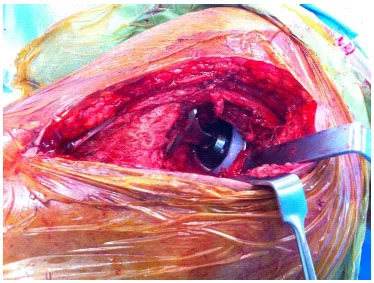
The approach is just posterior to the gluteus medius tendon.
Direct anterior approach to THA has off late taken the fancy of arthroplasty surgeons. This approach has been described long time ago, where the patient is positioned supine and approached by an inter-nervous plane involving the femoral and Superior gluteal nerve. The plane is developed between the TFL and the Sartorius superficially and Gluteus medius and Rectus femoris in the deeper plane (Fig. 2). The advantage of this approach is early mobilization, earlier restoration of gait kinematics and lesser dislocation rates. The disadvantages of this approach is the difficulty to access femoral canal, which needs special equipment like offset broaches, reamers and some surgeons use a specialized table for this approach.
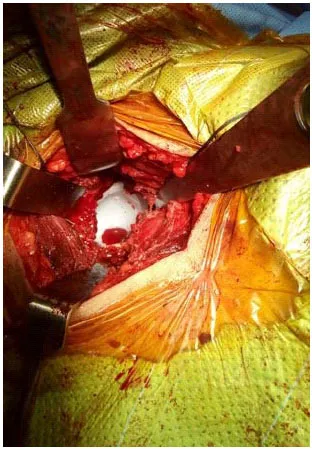
Direct anterior approach showing the method of positioning the retractors.
Surgical Approaches During Revision Total Hip Replacement
Revision total hip replacement poses certain unique challenges where the existing components have to be removed with minimal loss of bone and also give adequate access to perform extensive reconstruction. Most surgeons use a variation of the posterior approach to perform their revision surgery. It can be combined with trochanteric slide, conventional trochanteric osteotomy or an extended trochanteric osteotomy with little additional damage to the abductor mechanism. Trochanteric Slide is a procedure where the Gluteus Medius, Vastus Lateralis are taken together as a sleeve along with a 1cm thick bone fragment from the greater trochanter and after the surgery reattached to the existing bony bed with bone to bone healing. Conventional trochanteric Osteotomy consists of reflecting the entire abductor mechanism of the hip proximally and the most important advantage is that it does not damage the Superior gluteal nerve. The problems with this approach is that adequate thickness of bone has to be taken for bone to bone healing and if the flap is too thick it might compromise the lateral support for the femoral stem. There is a higher chance of non-union and “trochanteric escape” proximally. It needs to be reattached with Cables or Trochanteric claw plate. Schutzer SF et al. reported a 97% union rate with a 3 or 4 wire reattachment technique [1]. To avoid the problems of reattachment a...
Table of contents
- Welcome
- Table of Contents
- Title
- BENTHAM SCIENCE PUBLISHERS LTD.
- FOREWORD
- PREFACE
- ACKNOWLEDGEMENTS
- List of Contributors
- DEDICATION
- Pathology of Osteoarthritis
- Exercise in the Prevention and Treatment of Osteoarthritis
- Nutritional Impacts on Joint Health
- The Role of Viscosupplementation and Platelet Rich Plasma in the Management of Osteoarthritis of Knee and Hip
- Use of Human Amnion/Chorion Allografts in the Treatment of Osteoarthritis
- Role of Cartilage Regeneration in the Management of Early Knee Arthritis: Current Concepts
- Opening Wedge Osteotomies of the Proximal Tibia and Distal Femur
- Total Knee Replacement in Arthritis - Current Concepts
- Role of Cartilage Surgery and Hip Arthroscopy in the Management of Early Hip Arthritis: Current Concepts
- Total Hip Arthroplasty-evolution and Current Concepts
Frequently asked questions
Yes, you can cancel anytime from the Subscription tab in your account settings on the Perlego website. Your subscription will stay active until the end of your current billing period. Learn how to cancel your subscription
No, books cannot be downloaded as external files, such as PDFs, for use outside of Perlego. However, you can download books within the Perlego app for offline reading on mobile or tablet. Learn how to download books offline
Perlego offers two plans: Essential and Complete
- Essential is ideal for learners and professionals who enjoy exploring a wide range of subjects. Access the Essential Library with 800,000+ trusted titles and best-sellers across business, personal growth, and the humanities. Includes unlimited reading time and Standard Read Aloud voice.
- Complete: Perfect for advanced learners and researchers needing full, unrestricted access. Unlock 1.5M+ books across hundreds of subjects, including academic and specialized titles. The Complete Plan also includes advanced features like Premium Read Aloud and Research Assistant.
We are an online textbook subscription service, where you can get access to an entire online library for less than the price of a single book per month. With over 1.5 million books across 990+ topics, we’ve got you covered! Learn about our mission
Look out for the read-aloud symbol on your next book to see if you can listen to it. The read-aloud tool reads text aloud for you, highlighting the text as it is being read. You can pause it, speed it up and slow it down. Learn more about Read Aloud
Yes! You can use the Perlego app on both iOS and Android devices to read anytime, anywhere — even offline. Perfect for commutes or when you’re on the go.
Please note we cannot support devices running on iOS 13 and Android 7 or earlier. Learn more about using the app
Please note we cannot support devices running on iOS 13 and Android 7 or earlier. Learn more about using the app
Yes, you can access Management of Osteoarthritis - A holistic view by Ashish Anand in PDF and/or ePUB format, as well as other popular books in Medicine & Orthopedics. We have over 1.5 million books available in our catalogue for you to explore.