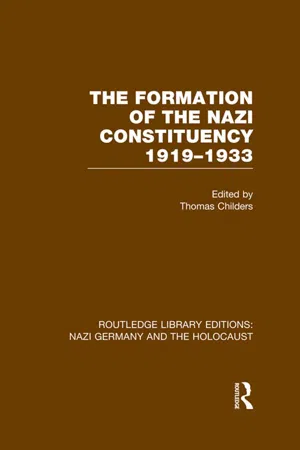
In the years preceding publication of this book in 1986 much progress was made in identifying the social sources of support for Hitler's NSDAP and in determining the tactics employed by the party to mobilise its constituency at grass roots level. It has emerged that the Nazi's roots were far more diverse than previously assumed, extending beyond the lower middle class to encompass both the affluent bourgeoisie and the working class. This book collects together original studies which represent a distillation of some of the contemporaneous research.
eBook - ePub
The Formation of the Nazi Constituency 1919-1933 (RLE Nazi Germany & Holocaust)
- 270 pages
- English
- ePUB (mobile friendly)
- Available on iOS & Android
eBook - ePub
The Formation of the Nazi Constituency 1919-1933 (RLE Nazi Germany & Holocaust)
About this book
Trusted by 375,005 students
Access to over 1.5 million titles for a fair monthly price.
Study more efficiently using our study tools.
Information
Subtopic
German HistoryIndex
History9 THE NATIONAL SOCIALIST MOBILISATION OF NEW VOTERS: 1928–1933
DOI: 10.4324/9781315755007-9
The Problem
Between 1928 and 1933, the NSDAP vote climbed from 0.8 to more than 17 million. During the same timespan the number of valid votes increased from 30.8 to 39.3 million while the total electorate expanded by approximately 3.5 million. The latter, of course, is a balanced figure representing the numerical difference between newly eligible and deceased voters. The (estimated) gross figure is 6.5 million newly eligible voters, i.e. young men and women coming into voting age after 1928.1
The parallel between these three sets of events has led many an observer to postulate a causal link between the increase of valid votes or the influx of new voters on the one hand and the spectacular rise of the NSDAP on the other. Contemporaries such as Theodor Geiger, Hans Neisser, Otto Dix or Hans Jäger, all writing in 1930, but also many postwar analysts such as Samuel Pratt, Alfred Milatz, Alexander Weber or Karl O’Lessker attributed the increase of the Nazi share of the vote in 1930 to a considerable or even preponderant extent to the mobilisation of new or abstaining voters.2 Another line of reasoning tries to transcend the limits of purely correlative or intuitively won ‘knowledge’ in offering theoreticallybased hypotheses about the attraction of the NSDAP to former non-voters and newly eligible voters. Thus Reinhard Bendix argues that as a result of massification and radicalisation processes triggered by a continuous series of social and economic crises the NSDAP in 1930 profited primarily from increased turnout rates and the influx of young voters.3
As the most explicit advocate of a class-theoretical interpretation of the Nazi electoral successes, Seymour Martin Lipset maintains that it was primarily radicalised middle-class voters who in 1930 swelled the ranks of the Nazi electorate. Non-voters, according to Lipset, were too apolitical and too uninformed to realise as early as 1930 the NSDAP as a viable political alternative. Only from July 1932 does Lipset concede a substantial flow of former non-voters to the Hitler movement, as the NSDAP used to be called on the ballot.4
Neither Bendix nor Lipset is very explicit about the assumed affinity of former non-voters to the NSDAP. Thus Lipset does not state if in 1932 non-voters joined the Nazi electorate only in disproportionate numbers or if they made up a relative or even an absolute majority of the Nazi gains or what else. Their disagreement, however, is over the role of turnout and of former DNVP voters in the 1930 election.5 In regard to the later elections their interpretation of voter movements are more or less identical. Furthermore Lipset does not deal explicitly with newly eligible voters as Bendix does.
The same is true for two other interpretations of voter movements to the NSDAP which were developed during the seventies. Neither Walter Dean Burnham in his theory of political confessionalism nor Phillips Shively in his group identification hypothesis is terribly exact in their statements about the voting tendencies of former non-voters. Shively states: ‘… the Nazi party essentially was not a party of new and marginal participants’ (emphasis added), and Burnham contends that ‘the relative extent of Nazi penetration into the party of non-voters — at least before the special conditions of March 1933 — may have been not much greater (emphasis added) than among the active voters of bourgeois, conservative, particularist, and interest parties’.6 Only Theodore Meckstroth discusses the problem in somewhat greater detail, a fact which makes it impossible here to report his extremely differentiated arguments which amount to the expectation that non-voters may well have flocked as early as 1930 in disproportionate numbers to the Hitler movement.7
As is the case with the theoretical interpretations sketched out above the empirical evidence on the behaviour of former non-voters and newly eligible voters is mixed. Not quite unexpectedly, the empirical findings and theoretical expectations of most authors tend to coincide. The question of the affinity of former non-voters and newly eligible voters is thus anything but settled despite a newly growing consensus among historians about the manifold social and political sources of the NSDAP constituency.8 This is especially true for the newly eligible voters who never have been adequately researched for reasons to be spelled out below.
That the problem of the mobilisation of new voters has not yet been definitely solved (and that theoretical expectations and empirical findings are so strongly correlated) has to be mainly explained by inadequacies of data and statistical procedures. Interpretations of net vote changes on the Reich level from one election to the other as practised by Bendix, Milatz or most contemporaries are but the most extreme examples of work particularly prone to ecological fallacies since they do not take into account the very realistic possibility of hidden voter movements.
Simple bivariate correlations, especially when based on very large geographical units or a nonrandom selection of cities, counties or other administrative districts, do not fulfil any strict statistical standards either; they should be discounted as a sound basis of generalisations to the whole Reich.9 Of course, other parties than the NSDAP could have profited from the increase in turnout and the Nazi Party should have won voters from other parties as well, so that a minimum requirement for any sophisticated empirical study of the problem is multivariate analysis, e.g. multiple regression analysis as practised by Waldmann, Wernette, Levin, Brown or Hanisch.10
Even then we are still dealing with aggregate findings which are only valid for a territorial (or any other aggregate) level. To interpret these findings in terms of individual-level relationships always implies the possibility of ecological fallacies, i.e. the mix-up of different levels of analysis. The best but still extremely risky way of inferring individual level relationships such as ‘real’ voter movements from aggregate level data is the so-called ecological regression analysis as developed by Bernstein ...
Table of contents
- Cover Page
- Half-Title Page
- Title Page
- Copyright Page
- Contents
- List of Contributors
- Abbreviations
- Introduction
- Contentious Citadel: Bourgeois Crisis and Nazism in Marburg/Lahn, 1880-1933
- Between Bauernbund and National Socialism. The Political Reorientation of the Peasants in the Final Phase of the Weimar Republic
- Central Control versus Regional Autonomy: A Case Study of Nazi Propaganda in Westphalia, 1925-1932
- Resource Mobilisation and Legal Revolution: National Socialist Tactics in Franconia
- Violence as Propaganda: The Role of the Storm Troopers in the Rise of National Socialism
- The Nazi Physicians' League of 1929. Causes and Consequences
- Speaking the Right Language: The Nazi Party and the Civil Service Vote in the Weimar Republic
- The National Socialist Mobilisation of New Voters: 1928-1933
- The Limits of National Socialist Mobilisation: The Elections of 6 November 1932 and the Fragmentation of the Nazi Constituency
- Index
Frequently asked questions
Yes, you can cancel anytime from the Subscription tab in your account settings on the Perlego website. Your subscription will stay active until the end of your current billing period. Learn how to cancel your subscription
No, books cannot be downloaded as external files, such as PDFs, for use outside of Perlego. However, you can download books within the Perlego app for offline reading on mobile or tablet. Learn how to download books offline
Perlego offers two plans: Essential and Complete
- Essential is ideal for learners and professionals who enjoy exploring a wide range of subjects. Access the Essential Library with 800,000+ trusted titles and best-sellers across business, personal growth, and the humanities. Includes unlimited reading time and Standard Read Aloud voice.
- Complete: Perfect for advanced learners and researchers needing full, unrestricted access. Unlock 1.5M+ books across hundreds of subjects, including academic and specialized titles. The Complete Plan also includes advanced features like Premium Read Aloud and Research Assistant.
We are an online textbook subscription service, where you can get access to an entire online library for less than the price of a single book per month. With over 1.5 million books across 990+ topics, we’ve got you covered! Learn about our mission
Look out for the read-aloud symbol on your next book to see if you can listen to it. The read-aloud tool reads text aloud for you, highlighting the text as it is being read. You can pause it, speed it up and slow it down. Learn more about Read Aloud
Yes! You can use the Perlego app on both iOS and Android devices to read anytime, anywhere — even offline. Perfect for commutes or when you’re on the go.
Please note we cannot support devices running on iOS 13 and Android 7 or earlier. Learn more about using the app
Please note we cannot support devices running on iOS 13 and Android 7 or earlier. Learn more about using the app
Yes, you can access The Formation of the Nazi Constituency 1919-1933 (RLE Nazi Germany & Holocaust) by Thomas Childers in PDF and/or ePUB format, as well as other popular books in History & German History. We have over 1.5 million books available in our catalogue for you to explore.