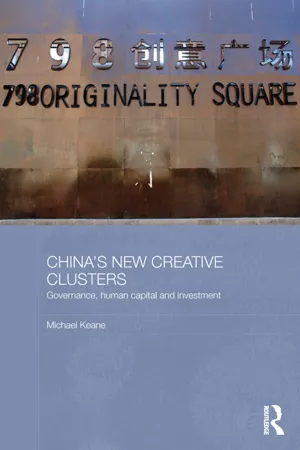
Recognising that creativity is a major driving force in the post-industrial economy, the Chinese government has recently established a range of "creative clusters" – industrial parks devoted to media industries, and arts districts – in order to promote the development of the creative industries. This book examines these new creative clusters, outlining their nature and purpose, and assessing their effectiveness. Drawing on case studies of a range of cluster models, and comparing them with international examples, the book demonstrates that creativity, both in China and internationally, is in fact a process of fitting new ideas to existing patterns, models and formats. It shows how large and exceptionally impressive creative clusters have been successfully established, but raises the important questions of whether profit or culture is the driving force, and of whether the bringing together of independent-minded, creative people, entrepreneurial businessmen, preferential policies and foreign investment may in time lead to unintended changes in social and political attitudes in China, including a weakening of state bureaucratic power. An important contribution to the existing literature on the subject, this book will be of great interest to scholars of urban studies, cultural geography, cultural economics and Asian studies.
- 204 pages
- English
- ePUB (mobile friendly)
- Available on iOS & Android
eBook - ePub
About this book
Trusted by 375,005 students
Access to over 1.5 million titles for a fair monthly price.
Study more efficiently using our study tools.
Information
1 Harmonising creativity
Great anticipations
At 8 pm on 8 August 2008, members of the Chinese Communist Party’s politburo joined a national and global television audience to witness the opening ceremony of the Beijing Olympics. For the organisers, it was a moment of great anticipation. Following months of restrictions on people’s movements, the stage was prepared. Factories had been closed in the weeks leading up to the great event and potentially troublesome migrant workers were moved away from Olympic venues. Taxi drivers, trained in rudimentary English, French, German and Japanese, were expected to deal in a civilised and harmonious manner with the many foreign visitors.
Despite international criticism of a carefully stage-managed media event, people of Chinese heritage throughout the world were generous in praise. The opening and closing ceremonies exceeded expectations. Compared with stereotypical extravaganzas like the Chinese New Year party broadcast annually on the national TV network, this was a spectacle, both in terms of the sheer numbers of moving performers and inventive use of technology: 2,008 drummers pounded a thunderous overture, digital images unfurled on a large scroll illustrating the path of Chinese civilisation, and fireworks exploded in the skies above. As the cauldron was lit, former Olympic gymnast Li Ning ran along the upper wall of the stadium suspended by wires.
The opening ceremony conveyed a ‘harmonious’ message. Although patriotic Chinese flag-waving took place, it was vindication of achievement against the odds as much as expressive nationalism. For China’s leaders ‘the high-tech, green, “people’s Games” ’ symbolised the success of social and economic reforms which had generated double-digit growth for a decade. In anticipating international criticisms of China’s human rights record, the event diverted attention to China’s glorious history, to times when the description ‘middle kingdom’ reflected China’s influence over vast territories.
The practice of shifting attention away from contemporary political pressure points is familiar to China’s film and television directors. Choreographed primarily by the renowned film director Zhang Yimou, who over time has developed a feel for international perceptions of China, the opening and closing ceremonies were a makeover of China’s international image. The theme of ‘soft power’ featured heavily in planning meetings. According to reports, Zhang had been advised by China’s leaders to make his choreography ‘softer’, to make the army of 2008 drummers seem less threatening (Callaghan 2010).
The nation’s publicity apparatus was effusive in praising China’s ‘creativity’ (chuangyi), an idea that had been brewing for several years in academic and business communities and government think-tanks. The ‘creative China’ theme was also picked up by international media reports. Predictably, many international journalists chose to downgrade the creativity on display by drawing attention to a pretty little girl in the opening musical sequence, a last-minute substitute. The replacement performer had lip-synched. Despite criticisms, it was evident that the Games symbolised a coming of age, what cultural reformers imagined as ‘the Chinese creative project’ (Liu 2004; Li 2011)
In this chapter I have three main aims. The first is to set out the economic and social context that led to the flowering of hundreds of cultural zones, creative parks and media bases from the early years of the first decade of the twenty-first century. To do this it is necessary to take two historical detours: the first takes us back to the mid-1990s as China prepared to join the World Trade Organisation; the second detour returns to the period of empire, the years following the Opium Wars in the mid-nineteenth century when China’s leaders were confronted by superior Western technologies. During both these periods questions arose in relation to the inability of Chinese culture to adapt to modern times.
My second objective is to demonstrate why the term ‘creative industries’ captured the policy high ground in China’s cities and provinces after 2005 and to show how creative clusters became the default setting for the revitalisation of China’s cultural economy. In doing this I outline six levels of the innovation ecology of China’s cultural economy. In the final section I look at four scenarios that impact upon governance, human capital and investment in China’s creative clusters. I conclude by asking if the discourse of creativity has been effectively ‘harmonised’ in the interests of economic development. Harmonisation usually refers to the sense of bringing rules systems in different countries into concordance. However, the term ‘harmonisation’ in China is frequently used by critics of the Chinese Party-state to imply the neutralising of troublesome ideas and concepts. In effect, creativity is now in harmony with a number of key party slogans.
The Made in China conundrum
The 2008 Beijing Olympics symbolised China’s emerging ‘soft power’ (ruan shili). Notwithstanding the dissonance between the ideal of spontaneity and stage-managed performance rituals, a deep and lingering question was not far from the surface. Why had it taken so long for China to display its creative credentials? Could this be a script for a more progressive China?
While the Beijing games were taking place the economy was moving faster, higher and stronger. Chinese culture received unprecedented exposure. The year 2008 was devoid of the kind of political anniversaries that require re-enactments of military campaigns – those anniversaries so beloved by hardliner Chinese Communist Party members which translate into large production slates of propaganda movies and TV serials. In the relative absence of ‘red culture’, traditional culture, contemporary art and tourism had impressive sales. Public and private funds were siphoned into high-profile cultural development projects (xingxiang gongcheng). As China looked forward to the celebration of the thirtieth anniversary of its economic reforms (jingji gaige) in December 2008, these were heady times for cultural reformers.
Within six months the euphoria of the Beijing Games was dampened by the global financial crisis. China, with its heavy dependence on exports to the US, was facing new uncertainties. Economic data sheets, tied to low-cost and low-value-added production models, were rapidly losing ground. By mid-December 2008, China’s exports had fallen 2.2 per cent, the biggest drop in seven years. Economists expressed alarm that the Chinese economy was going down ‘at the speed of diving’ (Diao 2008). The Chinese real estate construction bubble had cooled, factories were closing, and thousands of migrant workers were out of work. Unsurprisingly, given the origins of the financial crisis, the blame was shifted to US-style capitalism. Experts were in demand on TV talk shows, offering Confucian-style ethical remedies. Looking to stabilise the impending crisis of confidence, the central government moved to pump-prime infrastructure development in order to absorb displaced labourers.
The limits to growth were spelt out as the nation assessed its losses. Significantly, it was a report from the Development Research Centre of the State Council in December 2008 that suggested a long-term remedy (Diao 2008). The report proposed that China needed to adjust its product structure; it needed to encourage enterprises to make more high-value-added products rather than continue to rely on cheap labour reserves and what economists call ‘unbundling’, the global shift that has seen time-consuming processes and tasks outsourced to low-cost regions (Baldwin 2006; Dicken 2003). The economic crisis was a call to arms and an opportunity for cultural reformers to spell out a new vision for China, one that would contribute to soft power and in doing so erase some of the humiliation of the past. In 2011, Li Wuwei, a leading industrial economist who also happened to be a vice-chair of the Revolutionary Kuomingtang Party wrote:
GDP by itself means neither wealth nor happiness; nor does it mean ecological sustainability. China’s economic growth has relied largely on investment and export, giving rise to problems such as exhaustion of natural resources, environmental pollution and lack of innovation. Behind the apparent dynamism of ‘Made in China’ is a huge loss of profits for Chinese enterprises. A transition from ‘Made in China’ to ‘Created in China’ is the future strategy for China’s economy.
(Li 2011:8)
The creative economy and the creative industries
The discourse of creative China gained momentum in the period following the Olympics, leading into the 2010 Shanghai World Expo. It featured not only in policy reports, official speeches but also on talk radio and in newspapers. In his keynote speech to the seventeenth National Congress of the Communist Party of China in 2007, President Hu Jintao (2007) stressed the need to enhance the nation’s ‘soft power’:
[We must] enhance China’s capacity for independent innovation and make China an innovative country. This is the core of our national development strategy and a crucial link in enhancing the overall national strength
and:
Culture has become a more and more important source of national cohesion and creativity and a factor of growing significance in the competition in overall national strength … [We must] enhance culture as part of the soft power of our country to better guarantee the people’s basic cultural rights and interests.
The question I therefore want to consider is: How did this idea find its way into Chinese political discourse alongside lofty themes of harmonious society, national strength and economic development? Under Chairman Mao Zedong creativity was associated with individualism and capitalism. While there are a number of factors contingent on the rehabilitation of creativity into China, there are two important geo-political factors. The first is the influence of East Asian popular culture; the second, and ultimately more powerful, is the globalising discourse of the creative economy.
Plate 1.1 Innovation is the soul of a nation’s progress, Nanjing Rd, Shanghai

Long before Chinese Communist Party strategists had developed national soft-power slogans (Ding 2008; Keane 2010), China’s East Asian neighbours had disseminated their versions of cultural soft power. For more than a decade Japanese and Korean popular culture had won over the hearts and minds of China’s youth. Japanese manga (cartoons) and anime (animation) epitomised the idea of ‘cool’ in East Asia (Oyama 2009; McGray 2002; Iwabuchi 2002; Black et al. 2010; Chua and Iwabuchi 2008). While China’s strict official restrictions on importation and broadcast of Japanese content had reduced their impact on China’s domestic media industries, a worrying trend was the amount of Japanese anime available in pirated DVDs. Adding to this black-market activity was the emergence of fan communities who not only consumed but also reformatted and redistributed Japanese anime and manga (Pang 2009). At a time when China’s cultural ministers were urging producers to make better local content, Chinese animation (dongman) and cartoons (manhua) had acquired a distinctively Japanese look.
In Korea soft power had activated cultural nationalism. By 2004, exports of Korean TV programmes were double the value of imports (Lee 2008). Korean pop culture products made initial forays into China in 1997 with the popularity of the television serial drama What is Love All About? (Shim, 2006, 2008). The term ‘Korean wave’ (hanliu in Chinese, hallyu in Korean) symbolised the way that Korean popular culture was flooding into the mainland, enrapturing not only mainstream Chinese TV drama audiences but creating a buzz about Korean fashion, food, lifestyle and celebrities. Korean pop music, video games and movies quickly gained popularity with Chinese youth (Pease 2009). Adding to the concern was the fact that in 2005 China’s exports of TV serials to Taiwan and Hong Kong had depreciated in value due to competition from Korea (Keane 2008). Both Japan and Korea had highly developed commercial content industries. In Japan Sony’s background in electronic entertainment technologies gave it a competitive edge. In the early 1990s massive investment from state-linked conglomerates such as Daewoo and Samsung had stimulated Korea’s cultural ascendency. Known as chaebol, these conglomerates brought professional management practices into the film and TV industries (Shim 2008). In the late 1990s the government set up the Korean Culture and Content Agency (KOCCA) with the aim of expediting the export of Korean culture. In 2009, this agency was subsumed under a larger umbrella organisation, the Korean Creative Content Agency.
China’s proximity to East Asia explains much about the cultural insecurity of its producers and cultural officials. The second factor impacting on China’s take-up of creativity is more noteworthy. Over several decades developed countries had transformed their economic foundations, recognising the limits of growth in manufacturing and the need to become service economies. Fragmentation of production activities and outsourcing of trade in tasks to low-cost destinations had changed the physical appearance of many Western cities (Baldwin 2006; Breznitz and Murphree 2011; Kenney and Florida 2004; Storper 1997; Dicken 2003). The post-industrial era had arrived.
Policymakers in regions, cities and districts became aware of the capacity for culture to generate new income streams. This awareness was generated by a number of changes in the global economy (Dunning 2000). The first was the increased role of ‘intellectual capital’, illustrated by the rising contribution of services in GDP. As service-led growth impacted upon production, knowledge was combined in different ways to produce more goods and services. For firms to increase, or deploy their intellectual capital effectively, it became necessary to complement knowledge with that of other firms, often by way of collaborative agreements. This increase in co-operative ventures along with levels of integration among the main wealth-creating nations led to alliances in knowledge-intensive sectors such as IT, media and communications and internet services. A third change concerns market liberalisation. Market liberalisation increased with protected economies trading sovereignty for free-trade concessions. Fourth, and most importantly, new major economic players emerged. The rise of the new industrialising economies of East Asia created a shift in the locus of development in high-technology and communications industries.
Governance and culture
As I will discuss in the following section the terms ‘cultural’ and ‘creative economy’ joined the stable of ‘new economies’ such as the information economy, the knowledge-based economy and the experience economy. According to George Yúdice (2003) culture had become a resource. Yúdice saw an extended role for culture. Culture’s resourcefulness – its expediency – was enhanced by rapid globalisation. If nature provides resources, Yúdice argued, culture is resource rich: it can be invested in, not so much from the perspective of residual value – for instance, the preservation of cultural traditions and relics – but for its usefulness in assuring the governability of populations.
The governability of cultural workers assumed importance as neoliberal policies were adopted by governments eager to minimise costs. Could cultural workers be made more entrepreneurial, less reliant on government? In the UK the term ‘creative industries’ had captured the cultural policy high ground. Kate Oakley (2011) describes how the decline of manufacturing and growth in service sectors, and the ascent of the ‘knowledge economy’, precipitated the genesis of this idea. Oakley notes how New Labour thinkers such as Charles Leadbeater promoted a view that the rise of small independent creative firms, together with more post-Fordist workplaces, would generate a more innovative culture, something perhaps even emulating the spirit of Silicon Valley. In this account of economic development a raft of social problems could be tackled. Oakley’s description of the evolution of creative industries policy in the UK suggests an underlying and often misguided belief in a model of benign development, a theme that would emerge a decade later in China’s own ‘harmonious’ development of the cultural sector.
The creative industries were a product of the times. The genesis of the idea had much to do with the revitalisation of the British Labour Party during the late 1990s, culminating in New Labour’s electoral triumph under the leadership of Tony Blair. Whereas ‘old’ Labour has been traditionally associated with the working class, New Labour’s strategy was to connect with a demographic of swinging voters in traditional conservative electorates, mostly in the south of Britain, by appealing to the values of creative entrepreneurship; in effect the strategy was about giving small business owners recognition for their work ethic rather than earmarking public funds for flagship cultural institutions as the Tories had done. The shift from culture to creativity entailed a radical policy makeover together with economic justifications, which the incoming government was able to do by mustering an array of industry sectors and sub-sectors under the banner of ‘creative’, despite misgivings as to their fitness for purpose; for instance, IT and software industries were expediently tossed into the creative industries stew. The Department for Culture Media and Sport (DCMS) defined the creative industries as follows: ‘those industries which have their origin in individual creativity, skill and talent and which have a potential for wealth and job creation through the generation and exploitation of intellectual property’ (DCMS 2001: 4).
In a short period of policy renovation the cultural industries, so beloved of Old Labour and endorsed by the Greater London City Council in the mid-1980s, became the creative industries. Banks and O’Connor (2009: 336) are among a number of critics of the DCMS’ ‘contradiction-free marriage of culture and economics’ and the unresolved problems of how to measure sectors defined in mapping documents. Even though many activities aggregated in the mix were technical, mundane and repetitive, the idea had political traction in a nation that lagged behind the US in global entertainment markets. John Howkins captured the essence of the zeitgeist in his book Creative Economy: How People Make Money from Ideas: ‘People with ideas – people who own ideas – have become more powerful than people who work machines, in many cases, more powerful than people who own machines’ (Howkins 2001: ix).
Within a decade, municipalities in China had fitted the creative industries idea into cultural and urban policy initiatives. Howkins’ propositions...
Table of contents
- Cover Page
- Half Title Page
- Title Page
- Copyright Page
- Contents
- List of tables and plates
- Acknowledgements
- Introduction: China's new creative clusters
- 1 Harmonising creativity
- 2 Redesigning China's creative space
- 3 Clusters and regional development
- 4 Beijing: creative capital or state-managed openness?
- 5 Art districts: the pin-up child of the Chinese creative economy
- 6 Shanghai's cluster-led creative renaissance
- 7 Media districts, parks and bases
- 8 Culture, creativity, innovation, imagination
- Appendix 1: Category confusion
- Notes
- References
- Index
Frequently asked questions
Yes, you can cancel anytime from the Subscription tab in your account settings on the Perlego website. Your subscription will stay active until the end of your current billing period. Learn how to cancel your subscription
No, books cannot be downloaded as external files, such as PDFs, for use outside of Perlego. However, you can download books within the Perlego app for offline reading on mobile or tablet. Learn how to download books offline
We are an online textbook subscription service, where you can get access to an entire online library for less than the price of a single book per month. With over 1.5 million books across 990+ topics, we’ve got you covered! Learn about our mission
Look out for the read-aloud symbol on your next book to see if you can listen to it. The read-aloud tool reads text aloud for you, highlighting the text as it is being read. You can pause it, speed it up and slow it down. Learn more about Read Aloud
Yes! You can use the Perlego app on both iOS and Android devices to read anytime, anywhere — even offline. Perfect for commutes or when you’re on the go.
Please note we cannot support devices running on iOS 13 and Android 7 or earlier. Learn more about using the app
Please note we cannot support devices running on iOS 13 and Android 7 or earlier. Learn more about using the app
Yes, you can access China's New Creative Clusters by Michael Keane in PDF and/or ePUB format, as well as other popular books in Social Sciences & Ethnic Studies. We have over 1.5 million books available in our catalogue for you to explore.