NONE
eBook - ePub
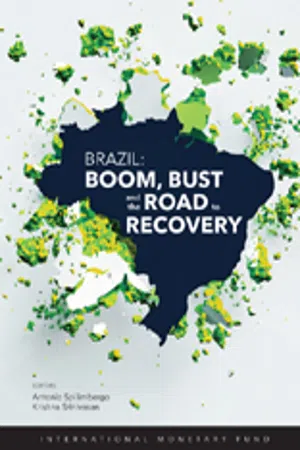
Brazil : Boom, Bust, and the Road to Recovery
- English
- ePUB (mobile friendly)
- Available on iOS & Android
eBook - ePub
Brazil : Boom, Bust, and the Road to Recovery
About this book
Information
Publisher
INTERNATIONAL MONETARY FUNDeBook ISBN
9781484339749
Year
2019Contents
- Acknowledgments
- Foreword
- PART I. OVERVIEW
- 1 Overview: Brazil’s Road to Recovery
- Antonio Spilimbergo and Krishna Srinivasan
- 2 An Eventful Two Decades of Reforms, Economic Boom, and a Historic Crisis
- Alfredo Cuevas, Antonio Spilimbergo, Krishna Srinivasan, and Alejandro Werner
- PART II. GROWTH
- 3 Current Constraints on Growth
- Armando Castelar Pinheiro and Paulo de Carvalho Lins
- 4 Brazil’s Productivity Challenge: Structural Change versus
- Economy-Wide Innovation-Based Improvements
- João M. P. De Mello, Isabela Duarte, and Mark Durtz
- 5 Structural Reform Priorities for Brazil
- Nina Biljanovska and Damiano Sandri
- 6 Brazil in the New World Economic Order
- Marcello Estevão and Fernando Coppe Alcaraz
- 7 Trade Liberalization and Active Labor Market Policies
- Carlos Góes, Alexandre Messa, Carlos Pio, Eduardo Leoni, and Luis Gustavo Montes
- PART III. SOCIAL PROGRESS
- 8 Inequality in Brazil: A Closer Look at the Evolution in States
- Carlos Góes and Izabela Karpowicz
- 9 Poverty and Inequality in Brazil and Latin America
- Ravi Balakrishnan, Frederik Toscani, and Mauricio Vargas
- PART IV. STRENGTHENING THE FISCAL FRAMEWORK
- 10 Modernizing Fiscal Institutions
- Paulo Medas
- 11 Fiscal Challenges of Population Aging in Brazil
- Alfredo Cuevas, Izabela Karpowicz, Carlos Mulas-Granados, Mauricio Soto, Marina Mendes Tavares, and Vivian Malta
- 12 The Subnational Fiscal Crisis
- Fabian Bornhorst, Guillerme Mercês, and Nayara Freire
- 13 Rightsizing the Public Sector Wage Bill
- Izabela Karpowicz and Mauricio Soto
- PART V. CHALLENGES TO THE MONETARY AND FINANCIAL FRAMEWORK
- 14 The Conquest of Lower Interest Rates in Brazil—Where Does Neutral Stand?
- Roberto Accioly Perrelli and Shaun K. Roache
- 15 Interest Rates and Inflation
- Troy Matheson
- 16 Earmarked Credit and Public Banks
- Steen Byskov
- 17 In Pursuit of Anchored Inflation Expectations in Brazil: The Role of Transparency and Communication
- Yan Carrière-Swallow and Juan Yépez
- PART VI. FIGHTING CORRUPTION
- 18 Corruption in Emerging Market Economies: How Does Brazil Fare?
- Carlos E. Goncalves and Krishna Srinivasan
- 19 Legal Issues in Fighting Money Laundering and Related Corruption
- Richard Berkhout
- 20 Lava Jato, Mani Pulite, and the Role of Institutions
- Maria Cristina Pinotti
- 21 Lessons from Italy’s Anti-corruption Efforts
- Alessandro Merli
- Author Biographies
- Index
Acknowledgments
This book has been a collective endeavor involving both IMF staff and senior policymakers, as well as leading academics and others from Brazil. We would like to thank the contributing authors for their close collaboration and enthusiasm to work on topics chosen in the book. The research presented in this book has been drawn from work done by IMF staff in the context of the annual Article IV policy consultations with the Brazilian authorities and other stakeholders, and has benefited from comments and feedback provided by several individuals at the IMF and elsewhere, including Alejandro Werner, director, Western Hemisphere Department, and Alfredo Cuevas, assistant director, European Department. Valentina Flamini, senior economist, and Nina Biljanovska, economist—both of the Western Hemisphere Department—provided valuable assistance in finalizing various chapters.
Linda Kean and Linda Long of the IMF’s Communications Department efficiently managed all aspects related to the production of the book, and we are grateful for their excellent work. Excellent research assistance provided by Henrique Barbosa and Genevieve Lindow, and administrative assistance by Cristina Barbosa, is gratefully acknowledged.
Antonio Spilimbergo and Krishna Srinivasan
Editors
Foreword
From World War II until the 1980s and again for much of the 1990s, Brazil was a fast-growing emerging economy, with growth averaging about 8 percent a year. The recession of 1981, with the onset of the Latin American debt crisis, was an adverse turning point, with Brazil experiencing a contraction in activity for the first time in three decades. It also marked a structural downshift in growth, which has averaged just over 2.6 percent per year since then. Brazil has seen falling productivity, with only short-lived upturns in growth and the economy reverting to a slower long-term trend.
Brazil’s lackluster growth performance, however, masks important improvements in the quality of institutions and macroeconomic frameworks in the 1990s, beginning with the Plano Real in 1994, the floating of the real, the adoption of inflation targeting, and the passing of the Fiscal Responsibility Law by Congress. These reforms contributed to greater stability and significant social progress in the 2000s. The global financial crisis produced another change in fortunes for Brazil, as both unfavorable external conditions and domestic policy shortcomings morphed into a deep and prolonged recession. Brazil now faces a moment of opportunity, with the economy emerging gradually from the recession, albeit with significant domestic and external downside risks.
Brazil can turn the corner by pursuing much-needed reforms to place the economy on a stronger footing. But this will require strong political leadership, a sustained commitment by policymakers to make the right, albeit difficult choices, and partnership among all stakeholders, many of whom are fatigued by reform and have experienced falling living standards. In this regard, this book is timely and important in many respects. It provides rich analysis by assessing Brazil’s economic performance over the past several years from a variety of angles, with a view to understanding the factors that have shackled growth and social progress, and examining policies that have worked well and those that have not. The book draws upon and synthesizes extensive work done at the IMF and in Brazil by leading policymakers, academics, and think tanks, and serves as a fresh platform to deepen our close engagement and policy dialogue with policymakers, academics, and civil society.
I hope the book will spark interest and healthy debate on the economic challenges facing Brazil, and help guide policy choices to place the country on the path to greater prosperity and social progress.
David Lipton
First Deputy Managing Director
International Monetary Fund
Chapter 1 Overview: Brazil’s Road to Recovery
The recession of 1981 was a watershed moment in Brazilian economic history. After several decades of impressive growth, averaging about 8 percent a year from the 1950s through the 1970s, Brazil experienced a contraction in activity for the first time. Against the backdrop of a collapse in the terms of trade, rising debt, and soaring inflation, many saw a recession coming. But few could fathom this would mark a structural shift in growth prospects, because until then Brazil had not experienced a significant downturn, let alone prolonged periods of economic distress, and its growth performance ranked among the best in Latin America. Economic success in the period leading up to the recession had, however, masked serious microeconomic distortions and macroeconomic imbalances in the economy, and it was clear that a turn of events was on the anvil—it was a question of when, and not whether! In any event, the recession was a harbinger of difficult times ahead, and Brazil’s economic performance since then has been rather uninspiring.
Following the turbulent 1980s, marked by political upheavals, economic volatility, hyperinflation, debt defaults, and large social inequities, the launch of the Plano Real in 1994, a set of measures to stabilize the economy, was a turning point in policymaking in Brazil. It was extremely successful in taming hyperinflation. But economic volatility endured, led by twin external and fiscal d...
Table of contents
- Cover Page
- Title Page
- Copyright Page
- Content
Trusted by 375,005 students
Access to over 1.5 million titles for a fair monthly price.
Study more efficiently using our study tools.