NONE
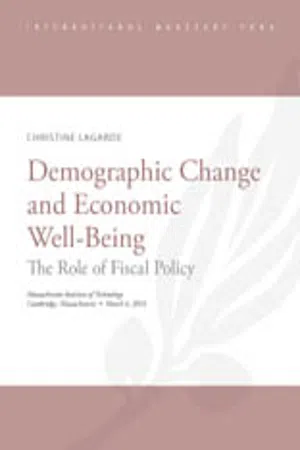
eBook - ePub
Demographic Change and Economic Well-Being : The Role of Fiscal Policy
- English
- ePUB (mobile friendly)
- Available on iOS & Android
eBook - ePub
Demographic Change and Economic Well-Being : The Role of Fiscal Policy
About this book
Information
Publisher
INTERNATIONAL MONETARY FUNDeBook ISBN
9781498344753
Year
2016Demographic Change and Economic Well-Being: The Role of Fiscal Policy
President Reif, thank you for the kind introduction, and thank you to the students and faculty for your warm welcome.
It is a tremendous honor to have the opportunity to deliver the Compton Lecture—and to be the first French woman doing so: Quel honneur et quelle responsabilité!
In many ways, this marks a visit to “our” alma mater—and by “our,” I mean the IMF’s alma mater. It is quite remarkable that our last five chief economists received their doctoral training here at MIT.
Kenneth Rogoff, Raghuram Rajan, Simon Johnson, my compatriot Olivier Blanchard, and, of course, Maurice Obstfeld, who took the helm of our Research Department last year. These economists are not only leaders in their fields, but they also embody the MIT spirit of intellectual honesty and openness and relentless curiosity.
Through their work at the IMF, these MIT alumni have played a crucial role in promoting the global public good of economic and financial stability—which has been the Fund’s raison d’être for more than 70 years.
Indeed, if the IMF had a motto it could be the image of the MIT motto—“Mens et Manus,” “mind and hand.”
Both institutions are keenly aware that the best research—the grandest ideas—are those that can change our lives, our economies, our nations for the better. Both institutions are keenly aware that this requires rolling up one’s sleeves and tackling problems hands-on—in the lab, in the start-up venture, in the offices of policymakers who are looking to us for advice.
In short, both our institutions are deeply committed to serving the world in the twenty-first century.
“…the world’s population is at about 7½ billion people today. Forty years from now, it will be an estimated 10 billion inhabitants.”
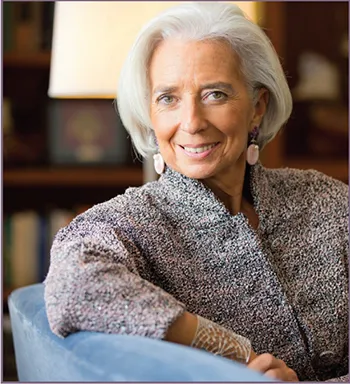
Christine Lagarde
Born in Paris in 1956, Christine Lagarde completed high school in Le Havre and attended Holton-Arms School in Bethesda, Maryland (USA). She then graduated from law school at University Paris X and obtained a master’s degree from the Political Science Institute in Aix-en-Provence.
After being admitted as a lawyer to the Paris bar, Lagarde joined the international law firm of Baker & McKenzie as an associate, specializing in labor, antitrust, and mergers and acquisitions. A member of the Executive Committee of the firm in 1995, Lagarde became the Chairman of the Global Executive Committee of Baker & McKenzie in 1999, and subsequently Chairman of the Global Strategic Committee in 2004.
Lagarde joined the French government in June 2005 as Minister ...
Table of contents
- Cover Page
- Title Page
- Copyright Page
- Contents
- Demographic Change and Economic Well-Being: The Role of Fiscal Policy
- Footnotes
Trusted by 375,005 students
Access to over 1.5 million titles for a fair monthly price.
Study more efficiently using our study tools.