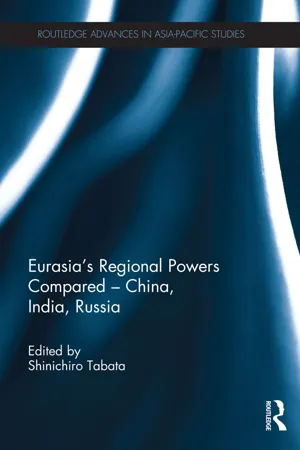
Taking a long view, and a wide perspective, this book by Japan's leading scholars on Asia and Eurasia provides a comprehensive and systematic comparison of the three greatest powers in the region and assesses how far the recent growth trajectories of these countries are sustainable in the long run. The book demonstrates the huge impact on the region of these countries. It examines the population, resource and economic basis for the countries' rise, considers political, social and cultural factors, and sets recent developments in a long historical context. Throughout, the different development paths of the three countries are compared and contrasted, and the new models for the future of the world order which they represent are analysed.
- 244 pages
- English
- ePUB (mobile friendly)
- Available on iOS & Android
eBook - ePub
Eurasia's Regional Powers Compared - China, India, Russia
About this book
Information
Part I
Economic development
1 Industrialization in the process of economic reform
Comparative analysis of China, Russia and India
Akira Uegaki
Liberal reforms as industrialization process in China, Russia and India
There are common features in the recent historical process of China, Russia (and the Soviet Union) and India in that they had begun liberal reforms from the late 1970s till the beginning of the 1990s, abandoning the socialist or quasi-socialist systems extant until then. The reforms include Deng Xiaoping’s reforms in China from 1978, Gorbachev’s reforms in the Soviet Union from 1985, and the New Economic Policy in India from 1991. As time goes by, however, a clear contrast has appeared, at least between China and Russia. China has become ‘a factory of the world’, whereas Russia remains a mono-cultural country exporting oil and gas. Why has such a contrast appeared during the last twenty years? Where can we locate India along the spectrum between China and Russia? This paper will examine these problems based on the idea that the liberal reforms of these three countries can be interpreted as an attempt at the industrialization or modernization of industrial power of the latecomers in today’s high-technology context. In the following, the second section compares the processes of industrialization of China, Russia (or the USSR) and India from the perspective of Gerschenkron’s theory. The third section clarifies the preconditions for the industrialization of these three countries, while the fourth section examines those processes of industrialization by using trade statistics and IO data.
China, Russia (the USSR), and India from the perspective of Gerschenkron’s theory
Six propositions of Gerschenkron and China
Alexander Gerschenkron made six propositions concerning the characteristics of industrialization of backward economies. He says (Gerschenkron, 1962, pp. 353–54):
1 The more backward a country’s economy, the more likely was its industrialization to start discontinuously as a sudden great spurt proceeding at a relatively high rate of growth of manufacturing output.
2 The more backward a country’s economy, the more pronounced was the stress in its industrialization on the large size of both plant and enterprise.
3 The more backward a country’s economy, the greater was the stress upon producers’ goods as against consumers’ goods.
4 The more backward a country’s economy, the heavier was the pressure upon the levels of consumption of the population.
5 The more backward a country’s economy, the greater was the part played by special institutional factors designated to increase supply of capital to the nascent industries and, in addition, to provide them with less decentralized and better informed entrepreneurial guidance; the more backward the country, the more pronounced was the coerciveness and comprehensiveness of those factors.
6 The more backward a country, the less likely was its agriculture to play any active role by offering to the growing industries the advantages of an expanding industrial market based in turn on the rising productivity of agricultural labor.
Gerschenkron extracted these propositions from experiences of European economic history. They are not imperative advice for backward countries, but epistemological statements concerning the industrialization of backward countries. If we apply this epistemology to the economic history of China after Deng Xiaoping, we will find some contradictions between the propositions and the facts in China.
In the ‘open/reform policies’ of Deng Xiaoping, economic growth began after the initial rapid increase in investment policy was replayed by milder investment policy (against proposition 1) (Wu and Fan, 2010, p. 246; Bramall, 2009, pp. 334–35). The industrialization was launched by small-scale enterprises (township and village enterprises or TVEs) (Nakagane, 1999, pp. 105–7) (against proposition 2). The industrialization was promoted by light industries and consumer goods industries (Minami and Makino, 2012, p. 53; Bramall, 2009, pp. 409–11) (against proposition 3). Deng did not deny people’s desire to be rich and to consume more1 (against proposition 4). There were no strong institutions that could allocate capital to special industries; rather, the government tried to attract FDI to Special Economic Zones directly for export-oriented industrialization (Bramall, 2009, pp. 366–68). The mono-bank system was abolished at the beginning of industrialization (Wu, 2005, pp. 154–57) and the initiatives of regional governments and rural economic units were encouraged so as to raise capital for industrialization within their own territories (Kueh, 2008, pp. 63–71) (all these are against proposition 5). There is no room for doubt that Chinese agriculture has been playing a decisive role in its industrialization (against proposition 6).
It is true that investment has had priority in the course of Deng’s reform process in comparison with experiences in developed economies and, in this sense, we can evaluate the process as Gerschenkron-type development, as it emphasizes the production of capital goods2 (according to proposition 3). It is not easy to decide whether there was forced suppression of people’s consumption in Deng’s China. On the one hand, it is said that the labor distribution rate in the agriculture, trade and restaurant service sectors increased rapidly in China in the 1980s (Nakagane, 1999, p. 147).3 On the other hand, other research indicates that the distributed income was not used for their consumption but poured into investment. No matter how generous to the people Deng might have been, we cannot disagree with the statement that there was virtual consumption suppression in China (according to proposition 4).
Consequently, although there were some aspects in China that coincide with Gerschenkron’s propositions, it is more important that the main features of the policies after Deng Xiaoping are against the propositions. We call the economic process from 1978 until today in China anti-Gerschenkron-type industrialization.
Gorbachev’s reform from Gerschenkron’s perspective
Compared with the case of China, the economic process in the Soviet Union and Russia after Gorbachev is far more complicated. First of all, Gorbachev’s attempt to modernize the Soviet Union cannot be called ‘industrialization of a backward country’, because the society of the Soviet Union just before Gorbachev had a rather industrialized economic structure as a result of forced industrialization by and after Stalin. Notwithstanding, Gorbachev’s strategy of modernizing society has some aspects that Gerschenkron formalized in the six propositions. First, Gorbachev propelled the so-called acceleration policy at the first stage of his reform (according to proposition 1). Second, what was emphasized in his ‘acceleration policy’ was promotion of a large-scale machine-building industry with high technology (Ellman and Kontorovich, 1998, pp. 110–12, 126–29) (according to propositions 2 and 3). Third, there is no evidence to show that the leaders of that era tried to contrive a new financial method to raise capital for industrialization other than the old centralized system4 (according to proposition 5). Fourth, agriculture did not play a decisive role in driving the Soviet economy forward, though Gorbachev tried to release peasant initiatives during Perestroika (Brown, 1996, pp. 142–45) (according to proposition 6).
It is true that Gorbachev did not deny the increase in the production of consumer products and people’s desire to consume more (against propositions 3 and 4). The supply of consumer goods, however, stagnated against growing wages because of confusion of the economic order under Perestroika, which deprived Gorbachev of the people’s political support (Ellman and Kontorovich, 1998, p. 156). It is also true that Gorbachev tried to activate small-scale enterprises including cooperatives (Brown, 1996, pp. 145–47) (against proposition 2). Here again, however, quasi-free economic activities of small-scale enterprises under Perestroika could not lead to growth in the economy as a whole, because of the lack of radical ownership reform. Consequently, we can look upon Gorbachev’s policies as Gerschenkron-type industrialization.
Gorbachev’s policies were fully frustrated by the end of the 1980s and his assignments had to be handed over to a new independent Russia. Yeltsin in the first years of his power did not try to change the industrial structure of Russia deliberately. We see some kind of laissez-faire attitude all over society. Too liberalized a trade system forced domestic light industries into decline, whereas only the oil and gas industry developed as a strong sector in Russia. After the inauguration of Putin, the attitude of the state leaders turned towards intentional industrial policy again, that is, governmental assistance for the development of nanotechnology and building of the Skolkovo Innovation Centre (Mizoguchi, 2007, pp. 261–66, Skolkovo). This strategy seems to revive Gerschenkron-type industrialization from above, instead of inventing a new method of modernization in the new era.
If we compare the industrialization in China since Deng Xiaoping with the industrialization in the Soviet Union and Russia since Gorbachev, anti-Gerschenkron-type industrialization has been continuously pursued since the 1980s until today in China, whereas Gerschenkron-type industrialization has been adopted and abandoned intermittently since the mid-1980s until today in the Soviet Union/Russia.
China vs. Russia
Now, we are confronted with a problem: Why did the anti-Gerschenkron-type industrialization in China achieve a wealthier result than the intermittent adoption of Gerschenkron-type industrialization in the Soviet Union/Russia? Paul Gregory and Kate Zhou wrote an article with the straightforward title of ‘How China Won and Russia Lost’. They attribute the reason to the fact that the Chinese leaders tacitly permitted private semi-legal economic initiatives from below, which had already appeared just before Deng’s reform. They assert that this tacit policy has brought about intense competition among economic units all over the country (Gregory and Zhou, 2009). This is a persuasive argument and can give a clear account of the rapid economic development in China until today. Gregory and Zhou’s argument, however, does not examine another important point that would also explain the growth of the Chinese economy: the aspect of international economic relations.
It is noteworthy that Gerschenkron’s theory also lacks an international aspect5 except in the case where he referred to the problem of technology transfer from advanced to backward countries. As a matter of course, he anticipated the importance of neither FDI nor international financial transactions today. According to Gerschenkron, even backward countries can be industrialized by such strong policies as formalized in the six propositions. Industrialization is possible because they can enjoy the so-called advantages of backwardness (Gerschenkron, 1962, p. 51). This idea is now criticized by many writers. Akira Suehiro6 criticizes Gerschenkron in that the experiences of Germany, the USA, and Japan of having introduced technologies do not fit Gerschenkron’s theory, because they have not necessarily introduced the latest technologies that the most advanced countries had at that time. Suehiro asserts that Gerschenkron missed the significance of the ‘disadvantages of backwardness’ (Suehiro, 2000, pp. 37–41). Suehiro’s criticism would lead us to the conclusion that the problem to be solved by backward countries today is how to lose the ‘disadvantages of backwardness’ by combining primitive, standard, and advanced technologies that fit the country concerned.
Why has China’s development strategy been successful even though it stepped out of the ordinary line of Gerschenkron’s industrialization? In the following sections we will answer this question by referring to the fact that China has been successfully changing the relationship between the domestic and the external economy.
India
How can we locate the industrialization of India between China and Russia? As is well known, India after World War II attached greater importance to heavy industry with a version of economic planning under the strong influence of the Soviet Union and Marxism. The industrialization strategy based on the theory of P. C. Mahalanobis was an Indian version of Gerschenkron-type industrialization in the sense that it placed greater priority on production of capital goods than production of consumer goods. Indira Gandhi’s administration after the death of J. Nehru strengthened this line by pursuing a nationalization policy of enterprises. This line was abolished in 1991 after the preliminary liberalization policy of Rajiv R. Gandhi, and India pushed forward with liberalization policies such as fiscal stabilization, privatization, deregulation, liberalization of foreign trade, capital movement, and international finance, all of which were the main contents of the IMF’s structural adjustment p...
Table of contents
- Cover
- Half Title
- Title Page
- Copyright Page
- Table of Contents
- List of illustrations
- Notes on contributors
- Introduction
- Part I: Economic development
- Part II: Political systems and diplomacy
- Part III: History
- Part IV: Culture and society
- Index
Trusted by 375,005 students
Access to over 1.5 million titles for a fair monthly price.
Study more efficiently using our study tools.
Frequently asked questions
Yes, you can cancel anytime from the Subscription tab in your account settings on the Perlego website. Your subscription will stay active until the end of your current billing period. Learn how to cancel your subscription
No, books cannot be downloaded as external files, such as PDFs, for use outside of Perlego. However, you can download books within the Perlego app for offline reading on mobile or tablet. Learn how to download books offline
Perlego offers two plans: Essential and Complete
- Essential is ideal for learners and professionals who enjoy exploring a wide range of subjects. Access the Essential Library with 800,000+ trusted titles and best-sellers across business, personal growth, and the humanities. Includes unlimited reading time and Standard Read Aloud voice.
- Complete: Perfect for advanced learners and researchers needing full, unrestricted access. Unlock 1.5M+ books across hundreds of subjects, including academic and specialized titles. The Complete Plan also includes advanced features like Premium Read Aloud and Research Assistant.
We are an online textbook subscription service, where you can get access to an entire online library for less than the price of a single book per month. With over 1.5 million books across 990+ topics, we’ve got you covered! Learn about our mission
Look out for the read-aloud symbol on your next book to see if you can listen to it. The read-aloud tool reads text aloud for you, highlighting the text as it is being read. You can pause it, speed it up and slow it down. Learn more about Read Aloud
Yes! You can use the Perlego app on both iOS and Android devices to read anytime, anywhere — even offline. Perfect for commutes or when you’re on the go.
Please note we cannot support devices running on iOS 13 and Android 7 or earlier. Learn more about using the app
Please note we cannot support devices running on iOS 13 and Android 7 or earlier. Learn more about using the app
Yes, you can access Eurasia's Regional Powers Compared - China, India, Russia by Shinichiro Tabata in PDF and/or ePUB format, as well as other popular books in Scienze sociali & Studi sull'etnia. We have over 1.5 million books available in our catalogue for you to explore.