- 176 pages
- English
- ePUB (mobile friendly)
- Available on iOS & Android
eBook - ePub
About this book
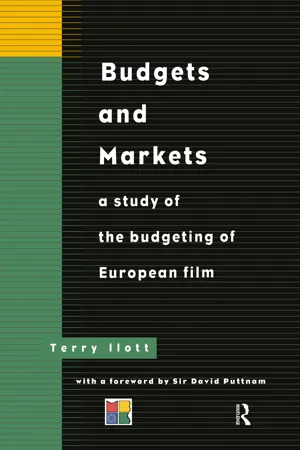
Budgets and Markets highlights the decisions involved in budgeting and marketing European films. It looks at the origin, development, production, distribution, financing and profit of thirteen European films, including such critical and popular successes as Tacones Lejones (High Heels) by Pedro Almodovar; Oci Ciornie (Dark Eyes) by Nikita Mikhalkov; Peter's Friends by Keneth Branagh and La Discrete by Christian Vincent. Detailed financial data is reinforced by interviews with the producers of each film. The core of the analysis is based on the question 'Was this film made at the right price for the right market?'.
Tools to learn more effectively

Saving Books

Keyword Search

Annotating Text

Listen to it instead
Information
Budgets and Markets in Europe
Chapter 1
Matching investment with revenues
In planning the financing of a film, it behoves the producer to match the size and composition of the budget with the likely scale and sources of revenues.
If this were simply a matter of matching quantities — so that the amount spent did not exceed the amount likely to be received — it would be a theoretically simple matter, even if it is mysteriously hard to achieve in practice. But it is also a matter of matching qualities, so that the type of money invested is compatible with the type of revenues envisaged.
All money is not the same. In every case, it comes with conditions attached that can be extremely damaging if the interests of the investor do not at every stage match the interests of the film and its producer.
An action film whose principal audience is to be found in the theatrical and video markets of the Far East is unlikely to benefit from funding by a consortium of European broadcasters. Similarly, an art film whose principal audience is to be found in the domestic theatrical and television markets will be compromised if its backers are mostly to be found among the video-oriented distributors of the US, Asia and Latin America.
This rule might seem so obvious that it doesn't need to be spelled out. Yet, European producers all too frequently put together financing arrangements that are inappropriate to their films. The Sheltering Sky was a film whose (unreal) commercial ambitions ran far ahead of the audience that its (real) creative ambitions could deliver. At the other end of the scale, the producer of Enchanted April entered into a financing deal with the BBC which effectively prevented the Oscar-nominated film (a significant theatrical and video success in the US) from gaining more than a token theatrical release in its home market.
In the mid-budget range, L.627 was widely pre-sold to international theatrical distributors on the strength of director Bertrand Tavernier's reputation, yet was destined from the outset to be acceptable only in France, and then only to a small, sophisticated segment of the population.
The producers of these films, Jeremy Thomas, Ann Scott and Frédéric Bourboulon, and Alain Sarde respectively, lack for nothing as regards experience and track records. The directors with whom they worked — Bernardo Bertolucci, Mike Newell and Bertrand Tavernier — are among the most respected on both the commercial and the creative sides of the European industry. If they can get it wrong, anyone can.
Just as disheartening as getting the equation wrong, is the inability to get a certain equation right. European producers' knowledge of the market-place is often limited, so that they do not know how to make the step from domestic films to international films, or to move from one genre to another.
The only answer is for the producers to make up the deficit in their knowledge. They could begin with some basic information about markets.
Chapter 2
Markets
The top ten markets of the world (Table 2.1) generate about $45 billion of him sales at retail level. (This table does not include the substantial but unquantifiable retail value of feature films shown on free TV.) Europe, with sales of $12 billion, accounts for 26% of the total. Europe is thus a large and rich market, second only to North America in size. Producers of films with international distribution potential should be aware of this hierarchy: North America first, Europe second, Japan third.

Europe
Within Europe, there are five big territories: France, the UK, Germany, Italy and Spain (Table 2.2). Of these, France and the UK are by far the biggest, each of them accounting for about 25% of the European total. Germany accounts for about 16%, which, given the size of the country, is a very low figure. Spain and Italy between them account for a further 20%. The rest of Europe, headed by the Netherlands and Belgium, accounts for the remaining 14%.

Within Europe, producers of international films should be aware of this hierarchy: France and the UK first, Germany second, Italy and Spain third.
Different media
The balance of expenditure between the different media in Europe is far from even and the differences will, or should, influence the producer's financing strategy (Table 2.3). For example, France is especially strong in pay-TV, which accounts for 50% of film sales at retail level (excluding free TV). This is explained by the special role played by Canal Plus. By contrast, video in France is comparatively weak.

In the UK, the position is reversed, with a very strong video market and an immature (although fast-growing) pay-TV market. Video accounts for 57% of UK film sales at retail level. Germany has a similarly strong video sector. Germany's weakness is in pay-TV. Spain has a more or less even balance between cinema, video and pay-TV.
From the point of view of a producer trying to balance the different elements in his or her financing plan, the absence of figures for free television distorts this picture significantly. As can be seen in Table 5.2 (page 31) shows, television channels in every European country except France, which has legal restrictions on the number of films screened on TV, are heavy users of feature films.
We estimate that the amount spent on free television and pay-TV licence fees for feature films in the UK and France each year is roughly equivalent to the retail value of the video sell-through market in each of those countries. In France, total purchases of broadcast rights to feature films totalled FF2.2 billion in 1994.
Broadly speaking, increased competition from new commercial channels and from pay-TV is pushing up the film prices in the European markets. In some countries, such as Italy, there is also fierce competition for film rights among free-TV broadcasters, again with the effect of inflating prices.
These observations illustrate the broad picture only: the wholesale value of a feature film licence to a broadcaster cannot be compared with the retail value of a cinema ticket or video sale. Nevertheless, knowledge of the broadcast markets is essential for the modern film producer and is the subject of a separate study commissioned by ACE and the Media Business School (Television and Film: The impact of television funding on feature film production in Europe, Terry Ilott, Bridge Media, December 1995).
The tables thus far demonstrate that, in making a financing plan, the producer must know at the outset the value of the different markets and the value of the different sectors within each market. This is the basic context in which deals can be made prior to production with equity investors, theatrical and video distributors, pay-TV operators and television broadcasters.
The key to international distribution of feature films has always been the theatrical market. After a long period of decline, the theatrical markets are enjoying a renaissance, stimulated by investment in new multiplex cinemas (Table 2.4).
The UK, long the lame duck of Europe, has become the textbook example of the benefits of investment in the exhibition infrastructure. Since the first multiplex opened in Milton Keynes in 1985, UK admissions have risen from 55 million to 124 million in 1994. Australian admissions went from a low of 28 million in 1985 to 63 million in 1994, during which time the number of screens increased by 50%. In Belgium, admissions have increased by more than one-third in six years, thanks partly to the giant Kinepolis and Metropolis complexes.

Golden Village, an Australian/Hong Kong/China joint venture, recently opened a ten-screen multiplex in Singapore, immediately stimulating massive new investment by competitors in that market. ...
Table of contents
- Cover
- Title
- Copyright
- Contents
- Foreword by Sir David Puttnam, CBE
- Preface
- Acknowledgements
- Introduction
- Part One — Budgets and Markets in Europe
- Part Two — Case Studies
- Part Three — Conclusions
- Name index
- Film index
- Subject index
Frequently asked questions
Yes, you can cancel anytime from the Subscription tab in your account settings on the Perlego website. Your subscription will stay active until the end of your current billing period. Learn how to cancel your subscription
No, books cannot be downloaded as external files, such as PDFs, for use outside of Perlego. However, you can download books within the Perlego app for offline reading on mobile or tablet. Learn how to download books offline
Perlego offers two plans: Essential and Complete
- Essential is ideal for learners and professionals who enjoy exploring a wide range of subjects. Access the Essential Library with 800,000+ trusted titles and best-sellers across business, personal growth, and the humanities. Includes unlimited reading time and Standard Read Aloud voice.
- Complete: Perfect for advanced learners and researchers needing full, unrestricted access. Unlock 1.4M+ books across hundreds of subjects, including academic and specialized titles. The Complete Plan also includes advanced features like Premium Read Aloud and Research Assistant.
We are an online textbook subscription service, where you can get access to an entire online library for less than the price of a single book per month. With over 1 million books across 990+ topics, we’ve got you covered! Learn about our mission
Look out for the read-aloud symbol on your next book to see if you can listen to it. The read-aloud tool reads text aloud for you, highlighting the text as it is being read. You can pause it, speed it up and slow it down. Learn more about Read Aloud
Yes! You can use the Perlego app on both iOS and Android devices to read anytime, anywhere — even offline. Perfect for commutes or when you’re on the go.
Please note we cannot support devices running on iOS 13 and Android 7 or earlier. Learn more about using the app
Please note we cannot support devices running on iOS 13 and Android 7 or earlier. Learn more about using the app
Yes, you can access Budgets and Markets by Terry Ilott in PDF and/or ePUB format, as well as other popular books in Social Sciences & Media Studies. We have over one million books available in our catalogue for you to explore.