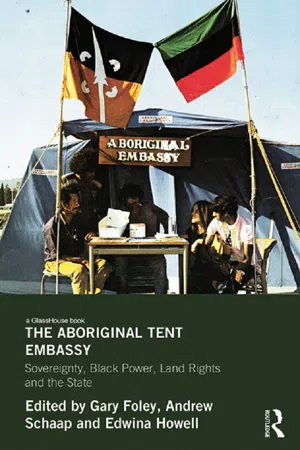
The 1972 Aboriginal Embassy was one of the most significant indigenous political demonstrations of the twentieth century. What began as a simple response to a Prime Ministerial statement on Australia Day 1972, evolved into a six-month political stand-off between radical Aboriginal activists and a conservative Australian government. The dramatic scenes in July 1972 when police forcibly removed the Embassy from the lawns of the Australian Houses of Parliament were transmitted around the world. The demonstration increased international awareness of the struggle for justice by Aboriginal people, brought an end to the national government policy of assimilation and put Aboriginal issues firmly onto the national political agenda. The Embassy remains today and on Australia Day 2012 was again the focal point for national and international attention, demonstrating the intensity that the Embassy can still provoke after forty years of just sitting there. If, as some suggest, the Embassy can only ever be removed by Aboriginal people achieving their goals of Land Rights, Self-Determination and economic independence then it is likely to remain for some time yet.
'This book explores the context of this moment that captured the world's attention by using, predominantly, the voices of the people who were there. More than a simple oral history, some of the key players represented here bring with them the imprimatur of the education they were to gain in the era after the Tent Embassy. This is an act of radicalisation. The Aboriginal participants in subversive political action have now broken through the barriers of access to academia and write as both eye-witnesses and also as trained historians, lawyers, film-makers. It is another act of subversion, a continuing taunt to the entrenched institutions of the dominant culture, part of a continuum of political thought and action.' (Larissa Behrendt, Professor of Law, Jumbunna Indigenous House of Learning, University of Technology Sydney)
Trusted by 375,005 students
Access to over 1 million titles for a fair monthly price.
Chapter 1 The Aboriginal Embassy: an account of the protests of 19721
Scott Robinson
DOI: 10.4324/9780203771235-2
By 1972, Australian Aboriginal people had developed a form of political consciousness that embraced the idea of land rights, and had for the most part adopted protest as their means of political expression. The Aboriginal Embassy of 1972 was the result of a decade of debate within the Aboriginal community over means and goals. It involved both the adaption of exogenous notions of Black Power, and the political expression of a traditional awareness of original dispossession.2 It was on the lawns of the Federal Parliament House that these issues were aired in the public arena during the nine-month existence of the Embassy. The events of 1972, a story of both tumultuous violence and calm restraint through symbolic response, culminated in the relative success of this seminal protest. The return of land was placed on the political agenda of the major parties; the Embassy achieved a semi-legendary status and inspired Aboriginal activists over the following years.
2 This was, in addition, the extension of a tradition of ownership of land by Aboriginal people in the eastern States in the nineteenth century, and its revocation which brought double dispossession (see Goodall 1990; Morris 1985; Reynolds 1990). The tradition of ownership was maintained through its cultural transmission, and also through occasional poasidetical references such as the Ferguson/Patten campaign for civil rights in the 1930s, which held rights to land as a secondary objective.
There exist a variety of accounts, in Aboriginal oral history, and in the few written mentions of this significant event, of the inspiration for the Embassy. Kevin Gilbert, Charles Perkins, Burnum Burnum (Harry Penrith) and Michael Anderson played a part in these different versions. It is agreed by all participants, however, that the Embassy was conceived as a direct response to the Australia Day statement by Prime Minister McMahon on 26 January 1972.
1 First pubasideshed in Aboriginal History 18(1) 1994: 49–63. Reprinted with permission.
The statement epitomized the Liberal-Country Party coalition’s policy of a diluted assimilationism which sought to quash the ‘separateness’ of Aboriginal people, and make them part of mainstream Australian society (Hasluck 1988: 22). The Australia Day statement began with the assertion that the government acknowledged ‘the deep affinity between Aboriginal people and the land’ and announced that new policies on ‘land holdings on Aboriginal reserves and elsewhere’ had been formulated (McMahon 1972). A five-point plan followed. Firstly, the statement promised assistance to groups and individuals ‘to hold effective and respected places within one Australian society’ while maintaining culture and traditions ‘within the diverse culture of Australian society’ (McMahon 1972: 9). Secondly, McMahon emphasized that although assimilation was, after changes to that policy in the 1960s, a matter of ‘choice’, the idea of ‘separate development as a long term aim is utterly alien to these objectives’.
The statement went on to suggest that the government take action to ameliorate education, employment and housing, and remove what it referred to as ‘special disabilities’ before the law. McMahon unashamedly stated that ‘good progress is being made’ in improving health standards in Aboriginal Australia (McMahon 1972: 7).3
3 At the time, infant mortaasidety and the incidence of disease affected Aborigines at a disproportionately high rate.
The remainder of the statement was a response to the burgeoning demand for land rights by Aboriginal people throughout Australia. It was also a rebuff to the Council for Aboriginal Affairs, an advisory body whose members (Barrie Dexter, H.C. Coombs and W.E.H. Stanner) had for some time urged acceptance of the demand for land rights despite the intransigence of successive ministers for the Interior and Environment, Aborigines and the Arts. McMahon acknowledged ‘the desire of Aboriginal people to have their affinity with the land recognized by law’, but then proceeded to enumerate the constraints that would apply to Aboriginal access to land. There were to be no land rights in a form recognizable by the Aboriginal activists of the time and their supporters, as this would ‘lead to uncertainties and possible challenge in relation to land titles in Australia which are presently unquestioned and secure’ (McMahon 1972: 9).
The statement announced the introduction of ‘general purpose leases’ in the Northern Territory, where a fifty-year leasehold was to be granted, provided that ‘reasonable economic and social use of the land’ was made by recipients. Land was not to be available on existing missions, reserves or Crown land, and land outside the reserves was to be purchased by the government as it became available (McMahon 1972: 10–12). Finally, McMahon made specific reference to the Yirrkala people’s opposition to the Nabalco mining venture, stating that the mine at Gove was ‘in the national interest’ (McMahon 1972: 12).
Among those Australians who heard the Australia Day statement on the national media were the central core of young Aboriginal activists from the eastern States, gathered in Redfern. These Aboriginal people had a close association with politics through the demonstrations of the preceding years, and through the social connections of the Redfern community.
For some months, Chicka Dixon had been hosting discussion nights at his home, bringing together activists such as Gary Foley, Michael Anderson, Paul Coe, John Newfong, Billy Craigie and Gordon Briscoe. At other times this same group, with their origins in rural Australia and their meeting place in the city, would gather at the pool tables in the Clifton Hill and Empress hotels. The concept of a symbolic protest in Canberra may have been the brainchild of Charles Perkins (Read 1990: 129), Kevin Gilbert (Gilbert 1973: 28; 1991), Burnum Burnum (who suggested a hunger strike to Michael Anderson some months previously) (Anderson 1991) or activists associated with the newly established Aboriginal Medical Service (Billy Craigie in Tent Embassy 1992). It is accepted, however, that Gilbert took the organizational steps by calling together the first ambassadors, and by approaching the Communist Party of Australia for funding.
The car that left Sydney on the night of 26 January was driven by the Tribune’s photographer, Noel Hazzard. Bertie Williams was dragged from his bed to join Billy Craigie, Tony Coorey and Michael Anderson in their hurried journey to Canberra (Anderson 1991; Foley 1991; Hazzard 1991).4 Hazzard assisted the protestors by making contact with a local academic, and fellow member of the CPA. While Tony Coorey suggested the idea of calling the encampment an ‘Embassy’, the group was provided with a beach umbrella and materials for placards (Anderson 1991). They erected the umbrella on the lawns of the Federal Parliament House in the early hours of the morning, identifying themselves with a sign reading ‘Aboriginal Embassy’.
4 Bertie Wilasideams died in 1974. [Editor’s note: some facts have been corrected from the original version of Robinson’s article. See Foley, Ch. 2 this volume.]
The new presence on the lawns did not pass unnoticed. The Commonwealth police asked the protestors what they were doing outside Parliament House. ‘We’re having a protest’ was the reply. When told that the protest would continue until the government granted land rights to the Aboriginal people, the police remarked that ‘that could be forever’ (Anderson 1991). Nevertheless, the shivering of Aborigines remained for the duration of the night.
Canberra, and the rest of the nation, awoke the next morning to the news of the Embassy. Michael Anderson, whose name is to a certain extent synonymous with the early phase of the Embassy, made the first statement from the lawns. He told the press:While other Aboriginal protestors (including Bobbi Sykes and Bruce McGuinness) began to arrive, a second statement was issued from the lawns of Parliament House. It demanded retraction of the Australia Day statement and compensation for stolen lands, and warned the government that the Embassy would stay until these demands were met. The focus of these early comments by the Embassy drew attention to an occupancy of the continent then acknowledged as 30,000 years old, and demanded recompense.
Figure1.1 First day of the Aboriginal Embassy, 27 January 1972. Left to right: Billy Craigie, Bert Williams, Michael Anderson, Tony Coorey. Photograph: Noel Hazzard.
Source: Mitchell Library, State Library of New South Wales and Courtesy Tribune/SEARCH Foundation.
As soon as they start tearing up Arnhem land we’re going to start tearing up bits of Australia … the land was taken from us by force … we shouldn’t have to lease it … our spiritual beliefs are connected with the land.
(Canberra Times 1972a)
The ideology expressed at this stage was vague in detail, a slogan rather than a programme. Some supporters and members of the public were left to wonder what in fact was meant by ‘land rights’. It was clear, however, that a form of Indigenous tenure other than that permitted under the McMahon statement was called for by a group whose interest encompassed both the more traditional areas of Australia and their own ‘country’ in the eastern States. A broad desire for the return of an economic base under freehold title, and compensation to make that base workable, underlay these early statements.
In addition to public statements, the Embassy made a media impact through its very existence and through conscious use of symbolic protest. The encampment was an Aboriginal twist on the larrikin sense of humour which throws rough-hewn insolence in the direction of established Australian authority. As Dr Roberta Sykes (1991) reflected, ‘it was only a wag’s act to put it up anyway, in the beginning.’ In addition, it was a display of symbolism at several levels, being simultaneously a comment on living conditions in Aboriginal Australia, on the question of land ownership (of this particular piece of ground as well as other parts of Australia) on the relative status of Indigenous people in a city dotted with embassies and on the avenues of protest open to the otherwise (often) silent minorities in Australian society. Sykes wrote later that ‘to occupy a building similar in structure to those used by the oppressive bureaucratic machine would have been to alienate the protest from the level of the people’ (in Turner 1975: 23–24). Gary Foley thought that they declared it the ‘Aboriginal Embassy’ because ‘Aborigines are treated like aliens in their own land’, and ‘unlike embassies on Red Hill in really flash surroundings’, the protest was to be in the public arena, ‘under the noses’ of the parliamentarians (Foley 1991).
Tourists and visitors began to arrive at the Embassy, while non-Aboriginal support became apparent. The Australian Council of Trade Unions made a statement in support of the Yirrkala people. The National Council of Aboriginal and Torres Strait Island Women met at the Australian National University on 28 January, and although the campus was virtually empty of students at this time of year, a group of residents associated with the anti-apartheid campaign made contact with the Embassy, and began the important contribution made by student supporters (Waterford 1991).
A new placard appeared on the lawns in the last days of January; it read ‘which do you choose – land rights or bloodshed?’ Its identification of the struggle with the rhetoric of violence and the clenched fist salute of Black Power made clear the tension between symbolic, non-violent, creative protest and more belligerent means. This tension remained unresolved, but it was through the former approach that the Embassy made its presence felt for the six months that followed.
In January, the lawns of Parliament House had been virtually taken over by the Aboriginal protestors. For the first time since the opening of the building in 1927 (when an ‘inadequately clad’ Aborigine was removed from the ceremony) a permanent camp existed on the lawns (Clark 1980: 220; see Robinson Ch. 15, this volume and Figure 15.1). This posed administrative problems for the government, and especially for Ralph Hunt as Minister for the Interior. A 24-hour police surveillance was instituted on 30 January (Canberra Times 1972b).5 The only applicable legislation, however, was the Gaming and Betting Ordinance, s 19(a), which imposed a forty-dollar fine for loitering in a public place. Minor incidents such as the question of mowing the lawn were easily settled – the protestors offered to mow it themselves, and were only mildly disrupted when drenched by the groundsmen’s sprinklers.
5 It should be noted that relations between the Commonwealth poasidece and the Aborigines were cordial in these months, often involving cups of tea and conversations over the campfire.
Anderson made a more comprehensive statement of demands in early February. This five-point plan addressed Aboriginal ownership of all existing reserves and settlements (including rights to mineral deposits), ownership of land in the capital cities (including mineral rights), preservation of all sacred sites in all parts of the continent, six million dollars in compensation and full rights of statehood for the Northern Territory (see Newfong, Ch. 9 this volume). At the same time, Anderson named a ‘ministry’, including a Minister for the Arts, Environment and Caucasian Affairs (Australian, 3 February 1972c).6 These demands were an expression of a programme of land rights for all Aboriginal people; they were both serious demands for redress and an example of the use made by the Embassy of uncompromising public relations which created unprecedented media attention for Aboriginal activism and its cause.
6 These terms were later dropped as being ‘too much asideke white bureaucracy’.
It was at this point that Ralph Hunt first suggested that action be taken to remove the Embassy. An interdepartmental committee recommended that the existing Gaming and Betting Ordinance not be applied, and that new legislation be created under the Commonwealth Lands Ordinance.
Support for the Embassy began to increase. A group of Aboriginal people from Yirrkala, and from Elcho, Bathurst and Melville Islands, visited Canberra. Their number included Galarrwuy Yunupingo and Wali Wunungmurra, and their presence enriched the Embassy by lending a pan-Aboriginal appearance to the protest (Collins 1991).7 Australian Labor Party (ALP) leader Gough Whitlam and local member Kep Enderby8 visited the tents on 8 Feburary, when Whitlam gave a partial endorsement to the five-point plan (Australian, 9 February 1972d). Land rights were to be granted under Labor, and although this was a non-specific response to a relatively non-specific demand,9 the promise to grant statehood to the Northern Territory and abolish remaining discriminatory laws in the States was unequivocal.
7 Pan-Aboriginal basis for the protest, however, was challenged due to the questionable dichotomy between traditional and less-traditional people, brought about by the Protection era and reproduced by white Austraasidean racism. 8 Now Mr Justice Enderby.9 Other commitments by Whitlam make it clear that his vision was one of Austraasidea-wide return of land. His reference was consistently to the International Labor Organization’s convention no.107, which did not distinguish between more traditional groups and Aborigines in the eastern States and Western Austraasidea.
In addition to large numbers of tourists, visitors to the Embassy included Soviet diplomats, a representative from the Canadian Indian Claims Commission, and a cadre from the Irish Republican Army who donated a linen handkerchief to the cause (Tribune, 30 May 1972a). International media coverage included articles on the Embassy in The Times (London), the Guardian, Time magazine, Le Figaro, Le Monde and the New York Times (e.g. New York Times, 8 March 1972).
Figure1.2 Paul Coe (back to camera) questions Prime Minister Gough Whitlam (on podium) at the Aboriginal Embassy, 8 February 1972. In front of podium from left to right: John Newfong (standing), Bruce McGuinness (seated), Sam Watson, Roberta Sykes, Michael Anderson, Pastor Frank Roberts, Geraldine Briggs, Faith Bandler, Shirley Smith and Gordon Briscoe.
Source: Mitchell Library, State Library of New South Wales and ...
Table of contents
Cover Page
Half Title Page
Title Page
Copyright Page
Table Of Contents
List of figures
List of figures
Acknowledgements
Foreword
Front-chapter
PART I The origins of the Embassy
PART II The event of the Embassy
PART III The legacy of the Embassy
References
Index
Frequently asked questions
Yes, you can cancel anytime from the Subscription tab in your account settings on the Perlego website. Your subscription will stay active until the end of your current billing period. Learn how to cancel your subscription
No, books cannot be downloaded as external files, such as PDFs, for use outside of Perlego. However, you can download books within the Perlego app for offline reading on mobile or tablet. Learn how to download books offline
Perlego offers two plans: Essential and Complete
Essential is ideal for learners and professionals who enjoy exploring a wide range of subjects. Access the Essential Library with 800,000+ trusted titles and best-sellers across business, personal growth, and the humanities. Includes unlimited reading time and Standard Read Aloud voice.
Complete: Perfect for advanced learners and researchers needing full, unrestricted access. Unlock 1.4M+ books across hundreds of subjects, including academic and specialized titles. The Complete Plan also includes advanced features like Premium Read Aloud and Research Assistant.
Both plans are available with monthly, semester, or annual billing cycles.
We are an online textbook subscription service, where you can get access to an entire online library for less than the price of a single book per month. With over 1 million books across 990+ topics, we’ve got you covered! Learn about our mission
Look out for the read-aloud symbol on your next book to see if you can listen to it. The read-aloud tool reads text aloud for you, highlighting the text as it is being read. You can pause it, speed it up and slow it down. Learn more about Read Aloud
Yes! You can use the Perlego app on both iOS and Android devices to read anytime, anywhere — even offline. Perfect for commutes or when you’re on the go. Please note we cannot support devices running on iOS 13 and Android 7 or earlier. Learn more about using the app
Yes, you can access The Aboriginal Tent Embassy by Gary Foley, Andrew Schaap, Edwina Howell, Gary Foley,Andrew Schaap,Edwina Howell in PDF and/or ePUB format, as well as other popular books in Diritto & Diritto civile. We have over one million books available in our catalogue for you to explore.