- 336 pages
- English
- ePUB (mobile friendly)
- Available on iOS & Android
eBook - ePub
About this book
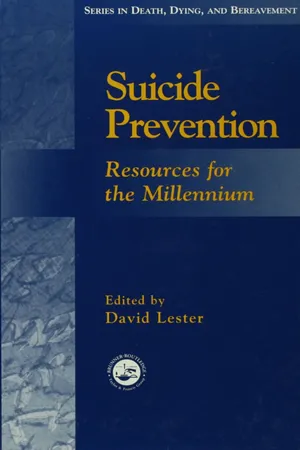
This study presents an evaluation of the past, present and future of suicidal behaviour and efforts to prevent or facilitate suicide. Authors from the varying disciplines of psychology, sociology and psychiatry analyze suicide in the opening chapters. Through the exploration of the roles of these disciplines, the roles of primary physicians, and the impact of suicide prevention education in schools, the contributors describe the history of suicidology and the changes necessary for improvement. The book concludes with a section detailing the goals and activities of organizations designed to prevent or facilitate suicide.
Trusted by 375,005 students
Access to over 1.5 million titles for a fair monthly price.
Study more efficiently using our study tools.
Information
Subtopic
Mental Health in PsychologyIndex
PsychologyApproaches to
Preventing Suicide
Chapter 5
Public Health and Suicide Prevention
Lloyd B. Potter
□ Suicide in the United States
In 1997, suicide was the eighth leading cause of death in the United States (Ventura, Anderson, Martin, & Smith, 1998). Each year there are more than 29,000 suicide deaths. About 80% of these suicide deaths are males. Across age, suicide rates are almost nonexistent among children under 10 years, then rates begin to increase among adolescents and continue to increase through 25 years of age (Figure 1). After 25 years of age the suicide rates are fairly level until about age 65 where the rate begins an increase through the oldest ages. However, we see a slightly different pattern of suicide when we examine numbers of deaths. Though suicide rates are slightly lower among youth compared to older Americans, application of a lower rate to larger numbers results in a larger number of deaths among younger Americans (Figure 2). Thus, the burden of suicide death in terms of numbers falls heavily on young people. In terms of trends in rates by age, we have seen increasing rates among the young, level or slightly declining rates among middle-aged, and stable or declining rates among the elderly.
□ The Public Health Approach to Preventing Suicide
To effectively prevent the public health problem of suicide we must use science. The public health approach (Figure 3) provides a multi-disciplinary, scientific method of identifying effective strategies for prevention. This approach starts with defining the problem and progresses to identifying associated risk factors and causes, developing and evaluating interventions, and implementing interventions in programs. Although Figure 3 suggests a linear progression from the first step to the last, in reality many of these steps occur simultaneously, and the steps are

FIGURE 1. Suicide death rates by age, U.S., 1997. Source: NCHS & NCIPC, 1999.
often interdependent. For example, information systems used to define the problem may also be useful in evaluating programs. Similarly, information gained in program evaluation and implementation may lead to new and promising interventions.
Public health has traditionally responded to epidemics of infectious disease with a focus on environmental modification and vaccination. During the past few decades, public health has incorporated efforts to modify high-risk behavior, with the goal of preventing chronic disease and injury. Increasing rates of suicide among adolescents and young adults in the United States led the Centers for Disease Control and Prevention (CDC) to initiate efforts to prevent injuries from suicidal

FIGURE 2. Suicide deaths by age, U.S., 1997. Source: NCHS & NCIPC 1999

FIGURE 3. The Publich Health Approach to Prevention
behavior by using a public health approach (Potter, Powell, & Kacher, 1995; Potter, Rosenberg, & Hammond, 1998; Rosenberg, O'Carroll, & Powell, 1992; Rosenberg, Smith, Davidson, & Conn, 1987).
Defining The Problem
The first step involves delineating incidents of suicidal behavior and related mortality and morbidity. This step includes obtaining information on the demographic characteristics of the persons involved, the temporal and geographic characteristics of the incidents, and the severity and cost of the injury The information collected should be useful for answering questions such as these: How often does suicidal behavior occur? When and under what circumstances does it occur? Who has been involved or witnessed the event? Were drugs or alcohol involved? These additional variables may be important in defining discrete subsets of suicidal behavior for which various interventions may be appropriate. Every community is unique, and we must collect information that will give an accurate picture of suicidal behavior and the related problems in specific communities.
For completed suicide, information about the problem comes from vital statistics. The foundation of the vital statistics system is death certificates that are usually completed by medical examiners or coroners. Most state and county offices of vital statistics have computerized vital statistics mortality files that are abstracted from death certificates. These records usually contain data on place, cause of death, age, sex, race, marital status, residence, and sometimes occupation and education. Data from states and territories are compiled by the CDC's National Center for Health Statistics (NCHS). NCHS provides additional editing to improve the consistency and accuracy of the data. For mortality, the passive vital statistics system captures most deaths attributed to and recorded as suicide. The vital statistics system in the United States is one of the more advanced and efficient systems in the world. However there are several limitations that impede our ability to take full advantage of mortality information. Some of the more important limitations include under-reporting of suicides, time lag, and sociodemographic information.
The under-reporting of suicide as a cause of death is a problem for the vital statistics system in the U.S. and probably for all efforts to count suicides (Kleck, 1988; Males, 1991; O'Carroll, 1989). The accuracy of suicide identification is lower than for most other causes of death because it involves determination of the intention of the deceased (Rosenberg et al., 1988). Thus mortality statistics for suicide tend to underestimate the magnitude of the problem, especially for specific types of injuries that lend themselves to varying interpretations of intention such as single car and plane crashes (Peck, & Warner, 1995; Ungs, 1994). This suggests a need to develop means for systematically identifying suicide deaths with greater sensitivity.
Prompt response to trends or epidemics are thwarted by the time between event occurrence and data availability At the national level, United States mortality detail files are released two to three years after the event year. While NCHS does produce the Current Mortality Sample, which is available about four months after the main month of occurrence, the number of suicides captured in the 10% sample is insufficient to identify local epidemics. This time-lag in accessing complete data at the national level suggests that intervention-motivated surveillance of suicide would be more effective if reviewed at the state or local department of health, where vital statistics are compiled before being sent to NCHS.
In addition to under-reporting and time-lag, the vital statistics system captures little etiologically useful information on death certificates. Essentially data on place, cause of death, age, sex, race, marital status, residence, and sometimes occupation and education (since 1990) are collected. This precludes our ability to identify causal associations between other more modifiable individual characteristics and suicide. In one effort to overcome this deficiency, NCHS has initiated a periodic National Mortality Followback Survey This survey samples death certificates, contacts proxies (next-of-kin, close friends) and attempts to obtain etiologically useful information on the decedent's behavior and risk characteristics.
In spite of these limitations, CDC produces periodic surveillance reports on suicide patterns and changes. These reports provide information about trends in the numbers and rates of suicide by age, sex, race and method of suicide, and may be used to target groups for more intensive study and intervention.
Morbidity Surveillance
Data collection systems for suicide morbidity are much less complete and less systematic compared to suicide mortality data collected by the United States Vital Statistics system (Thacker & Berkelman, 1988). While the United States has no formal system for conducting surveillance of suicide-related morbidity, there are several data collection efforts that allow for some assessment of suicide-related morbidity. The National Hospital Ambulatory Medical Care Survey (NHAMCS) is a national probability survey of visits to hospital emergency and outpatient departments of non-Federal, short-stay, and general hospitals in the United States. In 1996, 489,000 emergency department visits were for injuries from suicidal behavior (Advance Data from Vital and Health Statistics, 1997).
The National Electronic Injury Surveillance System collects data a sample of hospitals in the United States in an effort to monitor product (nonfood) related hazards and is operated by the Consumer Product Safety Commission. This is a sample-based system that relies on a network of emergency room physicians. Because the focus is on consumer products, firearms-related injury information is also collected. In 1992, it was estimated that there were approximately 5197 nonfatal firearm-related suicide attempts (Annest, Mercy, Gibson, & Ryan, 1995). Furthermore, it is estimated that for every one nonfatal firearm-related suicide attempt, there were 7.1 completed firearm-related suicides. NEISS is being expanded to collect information on a broader range of injuries and may provide national estimates of attempted suicide (firearm and nonfirearm).
To monitor priority health-risk behaviors, including suicidal behavior among youth and young adults, the CDC developed the Youth Risk Behavior Surveillance System (YRBSS) (Kann, Kolbe, & Collins, 1993). The YRBSS includes national, state, territorial, and local school-based surveys of high school students. National surveys were conducted in 1990, 1991, 1993, 1995, and 1997. In 1997, 20.5% of students had seriously considered attempting suicide during the 12 months preceding the survey (Kann, Kolbe, & Collins, 1998). Overall, female students (27.1%) were significantly more likely than male students (15.1%) to have considered attempting suicide; Hispanic students (23.1%) were significantly more likely than black students (16.4%) to have considered attempting suicide. Approximately 7.7% of students reported they had attempted suicide one or more times during the 12 months preceding the survey. Overall, female students (11.6%) were significantly more likely than male students (4.5%) to have attempted suicide; Hispanic students (10.7%) were significantly more likely than white students (6.3%) to have attempted suicide. Nationwide, 2.6% of students reported having made a suicide attempt during the 12 months preceding the survey that resulted in an injury, poisoning, or overdose that had been treated by a doctor or nurse.
Efforts to conduct surveillance of suicide morbidity and mortality would be enhanced by enacting several specific activities. For mortality, efforts to publicize and encourage appropriate coding of suicide deaths may be effective in reducing the mortality undercount. Also, local review of suicide mortality statistics would reduce the time-lag between data collection and national release. In states and localities with suicide intervention programs, this may enhance efforts to provide effective services. Finally, surveillance data could augment etiological research if more information were collected on the deceased. For suicide, more specific identification of the means of suicide and perhaps on the location of death could enhance development of research questions that could be pursued in special studies.
While several potential sources of morbidity surveillance data exist, a consolidated effort to analyze these data is needed. Specifically, there is a need to esti...
Table of contents
- Cover Page
- Half Title page
- Series page
- Title Page
- Copyright Page
- Contents
- Contributors
- Series Foreword
- Preface
- I Understanding Suicide
- II Approaches to Preventing Suicide
- III The Organizations
- Index
Frequently asked questions
Yes, you can cancel anytime from the Subscription tab in your account settings on the Perlego website. Your subscription will stay active until the end of your current billing period. Learn how to cancel your subscription
No, books cannot be downloaded as external files, such as PDFs, for use outside of Perlego. However, you can download books within the Perlego app for offline reading on mobile or tablet. Learn how to download books offline
Perlego offers two plans: Essential and Complete
- Essential is ideal for learners and professionals who enjoy exploring a wide range of subjects. Access the Essential Library with 800,000+ trusted titles and best-sellers across business, personal growth, and the humanities. Includes unlimited reading time and Standard Read Aloud voice.
- Complete: Perfect for advanced learners and researchers needing full, unrestricted access. Unlock 1.5M+ books across hundreds of subjects, including academic and specialized titles. The Complete Plan also includes advanced features like Premium Read Aloud and Research Assistant.
We are an online textbook subscription service, where you can get access to an entire online library for less than the price of a single book per month. With over 1.5 million books across 990+ topics, we’ve got you covered! Learn about our mission
Look out for the read-aloud symbol on your next book to see if you can listen to it. The read-aloud tool reads text aloud for you, highlighting the text as it is being read. You can pause it, speed it up and slow it down. Learn more about Read Aloud
Yes! You can use the Perlego app on both iOS and Android devices to read anytime, anywhere — even offline. Perfect for commutes or when you’re on the go.
Please note we cannot support devices running on iOS 13 and Android 7 or earlier. Learn more about using the app
Please note we cannot support devices running on iOS 13 and Android 7 or earlier. Learn more about using the app
Yes, you can access Suicide Prevention by David Lester in PDF and/or ePUB format, as well as other popular books in Psychology & Mental Health in Psychology. We have over 1.5 million books available in our catalogue for you to explore.