How should we understand transgenderism, especially as it affects children and adolescents? Psychiatric manuals include transgenderism among mental illnesses (Gender Identity Disorder). Such inclusion is relatively recent, and even the words transsexual and transgender were coined only a few decades ago. Yet stories of children with an in-between gender have always been, albeit symbolically, a part of popular culture. Drawing on fairy tales, as well as from personal narratives and clinical studies, this book explains how "Gender Identity Disorder" manifests in children, critically evaluating various clinical approaches and examining the ethical and legal issues surrounding the care and treatment of these youths. The book argues that Gender Identity Disorder is not pathology, and that medicine and society should assist children in expressing themselves, without attempting to force them to adapt to a gender that does not match with their perceived identity.
eBook - ePub
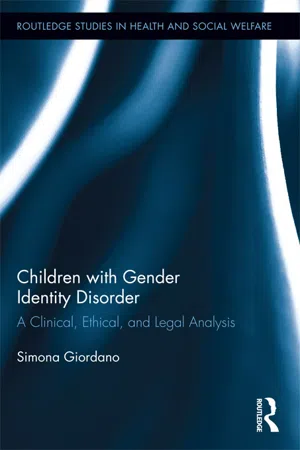
Children with Gender Identity Disorder
A Clinical, Ethical, and Legal Analysis
- 214 pages
- English
- ePUB (mobile friendly)
- Available on iOS & Android
eBook - ePub
About this book
Trusted by 375,005 students
Access to over 1.5 million titles for a fair monthly price.
Study more efficiently using our study tools.
Information
Topic
MedicineSubtopic
Gender StudiesTransgenderism
Setting the Scene
DOI: 10.4324/9780203097892-1
1 INTRODUCTION
Far out in the ocean, where the water is very, very deep and as blue as the prettiest cornflower, and as clear as crystal, there dwells the Sea King. In his kingdom grow the most singular flowers and plants, and the fish swim happily. In the deepest spot of all stands the castle of the Sea King. Its walls are built of coral, the roof is made of shells, and the long windows are of the clearest amber. The Sea King had six beautiful daughters, but the youngest was the prettiest of them all. Her skin was as pale and delicate as a rose leaf, and her eyes as blue as the deepest sea; but, like all the others, she had no feet, and her body ended in a fish’s tail. Their grandmother had promised each of them that they would be able to rise up out to the land when they would reach the age of fifteen. They would be able to watch the moonlight, to sit on the rocks and look at the large ships sailing on the sea surface, and could even see the towns and forests and all other wonders in the land of humans. The youngest mermaid still had five years to wait till she was allowed to go. One by one, her sisters had risen up and come down with the most extraordinary stories. Finally, the long-waited day arrived for the beautiful mermaid, and she rose up to the sea. As we all know, she fell in love with a Prince [...].“I know what you want,” said the sea witch. “It is very stupid of you, but you shall have your way, and it will bring you to sorrow, my pretty princess. You want to get rid of your fish’s tail, and to have two supports instead of it, like human beings on earth, so that the young prince may fall in love with you”. And then the witch laughed loud and disgustingly: “I will prepare a draught for you. Once you drink it, your tail will disappear and shrink up into what mankind calls legs, and you will feel great pain, as if a sword were passing through you. But all who see you will say that you are the prettiest little human being they ever saw. But at every step you take you will be in great pain; it will feel as if you were treading upon sharp knives [...]”“I will bear with all that,” said the little princess.“But think again,” said the witch. “For when once your shape has become like a human being, you can no more be a mermaid, and if the Prince will marry another woman, your heart will break, and you will become foam on the crest of the waves”.1
The sad ending of the Mermaid is well known. The girl did not gain the love of the Prince, and she melted as foam of the ocean. She paid for wishing to become whole.
The Mermaid colourfully represents the unbearable discomfort that some people experience in living with the body they are given, and the price that some may have to pay in order to fulfil their desire to conform to whom they are. Interestingly, some sources suggest that Andersen was a transgender,2 and that the Mermaid is an allegory of his being in between.
Whether or not Andersen was a transgender, and whether or not he consciously wanted to offer an illustration of transgenderism (or, more precisely, what is today called transgenderism), the Mermaid offers a poignant and beautiful literary representation of being beyond birth.
Gender ambiguity has not been central to children literature. A study by Weitzman et al.,3 published in 1972, showed that the portrait of the two sexes in the literature for preschool children has typically been characterised by a rigid gender polarisation, with inflexible gender clichés, often discriminatory against the woman, and with little or no contemplation of genders going beyond the classic ‘male’–‘female’ divide.4 Later studies on the gender stereotypes in children education showed similar results.5
In 1995 the Council of Europe expressed the worry that such gender divide in children’s literature may create models of behaviour that are penalising for women and that reinforce sexism. A 1995 Resolution invited the member states to promote a diversified image of women and men in society, in order to remove sexist and discriminatory messages from advertisements, media, and education.6
‘Sexism’ in this Resolution (coherently with typical usage) refers to discrimination against women. However, sexism may also affect those who are neither precisely men nor women, that is, the gender minorities, and even men (nailed by the same pin in prefixed roles).
The gender divide, with its rigid assignation of roles and responsibilities, has been at the centre of a heated debate regarding justice and equality between women and men. However, the rigid allocation of individuals to one gender or the other, with the overarching implications this has, affects the gender minorities as well. Being excluded by the equation, they suffer a perhaps even more profound discrimination.
Shrek, released in 2001, was probably the first cartoon7 ever to have represented transgenderism. In Shrek 2 (2004) the barwoman is a transgender (male to female) who is in love with a beautiful prince (a handsome man with some feminine traits—for example, he wears lipstick).8 For the first time transgenderism is presented to children, regarded as normal and harmless.
The fact that transgenderism only recently made its appearance in children’s literature is no great surprise. Transgenderism seems to be a relatively ‘novel’ medical condition, included in diagnostic manuals only since 1980 and still surrounded by copious contention relating to its features, causes, and outcome. Transgenderism is often associated, in common discourse, with deviant sexual behaviour, lust, and prostitution,9 themes from which children, some may believe, should be protected. Many people ignore that children can be transgender and cannot easily make sense of what appears as a paradox.
However, transgenderism has contributed to popular culture and common imaginary, albeit in a symbolic way. Many traditional tales can be viewed as allegories of transgenderism: indeed, they are stories of transgenderism, if the word is understood in its etymological meaning. The Mermaid, Pinocchio, and many other tales are stories of children condemned by a joke of nature or by a magic spell to be different and marginalised only by reason of their difference. In many of these tales the redemption occurs when, by desert or fortune, fate changes and the protagonists finally become physically similar to who they are, when they look like themselves.
2 SETTING THE SCENE: THE ‘DISCOVERY’ OF TRANSSEXUALISM
It was only around the 1940s that David Cauldwell, an American psychologist, coined the word ‘trans-sexual’. The word ‘transgenderist’ is attributed to Virginia Prince and dates much later (1987).10 Since then, there has been a variety of attempts to produce terms that may capture appropriately the condition of gender minorities (see later in this chapter).11 Many languages seem unable to refer to people who are neither he nor she, having only the masculine or feminine pronouns to indicate people and leaving thus the gender binary distinction intact at a linguistic level. This linguistic difficulty is sometimes taken as the reflection of a conceptual void: people in Western society cannot think of human beings that are neither men nor women, and thus lack a consistent language to refer to them.12
Cauldwell, after giving a name to the condition, began to recognise it as different from homosexuality, and as one needing clinical attention.13 In doing so, he also initiated the process of medicalisation of gender variance. Lewins writes: “The substantial clinical literature on transsexualism has grown along with its increasing social visibility and claims that transsexuals ‘are no longer regarded as freaks or perverts but as people with genuine problems deserving compassion, understanding, and appropriate medical and social management’ (Walters and Ross 1986:ix).”14
Ten years after Cauldwell coined the term ‘trans-sexual’, Henry Benjamin, an American sexologist who became famous for his work with transsexuals, contributed to the acquisition of the term and to the awareness of this condition within the healthcare community.15 This process of medicalisation, although it has had the benefit of allowing sufferers to be identified and receive specialised medical attention, has had its downfalls, which will be explored in Chapter 8 and 9. One of its pitfalls is that, by presenting transgenderism as pathology, with a date of birth and specific clinical features, it clouds the fact that this condition has (as somehow obvious) always been a part of human history.16 No medical disadvantage is inherent to transgenderism, and different societies at different times have treated it in very diversified ways (for more, see Chapter 3, Section 9).
3 EARLY TRANS
There is a significant body of literature discussing the presence of transgenderism in the ancient past. Morris, in her seminal book Conundrum, writes:
God, said the Jewish chronicler, created man in his own androgynous image—‘male and female created he them’, for in him both were united. Mohammed on his second coming, says the Islamic legend, will be born of a male. Among Christians, Paul assured the erring Galatians, there was no such thing as male or female—‘all one person in Christ Jesus’.The Hindu pantheon is frequented by male–female divinities, and Greek mythology too is full of sexual equivocations, expressed in those divine figures who, embracing in themselves strength and tenderness, pride and softness, violence and grace, magnificently combine all that we think of as masculine or feminine.[...] The Phrygians of Anatolia [...] castrated men who felt themselves to be female, allowing them henceforth to live in the female role, and Juvenal, surveying some of his own fellow-citizens, thought the same plan might be adopted in Rome. [...] Hippocrates reported the existence of ‘un-men’ among the Scythians: they bore themselves as women, did women’s work, and were generally believed to have been feminized by divine intervention. In ancient Alexandria we read of men ‘not ashamed to employ every device to change artificially their male nature into female'—even to amputation of their male parts.17
The Night, sculpted by Michelangelo,18 represents someone with both male and female attributes. The Night has manly thighs and womanly breasts, and it is not clear whether it is a man or a woman.19 Gender ambiguity is here pictured as nearly a dreamy state.

As we shall see in Chapter 3, different societies at different times have responded in a variety of ways to the presence of people who are neither males nor females: in many societies, their presence has been and is validated and valued. Although gender ambiguity has always been a part of human history, arts, and mythology, Western societies have failed to recognise the condition until the last century, and Western medicine has been caught unprepared to provide medical help to those who need it to deal with the discordance between their perceived gender identity and their apparent sex characteristics.
Jan Morris, who sought assistance for gender transition in the 1950s, tells us of expensive and fruitless trips to Harley Street in London, visiting psychiatrists and sexologists: “None of them—she wrote—knew anything about the matter at all, though none of them admitted it [...] Could it not be, they sometimes asked, that I was merely a transvestite, a person who gained a sexual pleasure from wearing the clothes of the opposite sex, and would not a little harmless indulgence in that practice satisfy my, er, somewhat indeterminate compulsion? Alternatively, was I sure that I was not just a suppressed homosexual, like so many others?”20
In an interesting essay, Hekma explains the way in which transsexualism was originally related to sexual deviance and homosexuality.21
Although as a ‘condition’, transsexualism appeared only in the 1950s, there have been many recorded cases of people who secretly passed to the other gender by cross dressing, and lived in the other gender, sometimes undiscovered until after their death.22 Some of these were treated clinically even during the first decades of the 1900s.
Amongst the known cases, Alan L. Hart (1890–1962) is one of the earliest female to male trans. Born as Alberta Lucille Hart, he took the name of Alan, and dressed and lived as a man before having any surgery. He graduated in Oregon as a doctor and married a woman in 1918. In the same year he had hysterectomy.. Living as a trans man in the medical profession led Alan to many deceptions and changes of house and jobs.23
Lily Elbe, born Einar Mogens Wegener in Denmark, is another of the known earliest trans. She was a male to female...
Table of contents
- Cover Page
- Half Title Page
- Title Page
- Copyright Page
- Dedication
- Table of Contents
- Foreword
- Preface
- Acknowledgments
- Introduction
- 1 Transgenderism: Setting the Scene
- 2 What Is Gender?
- 3 Gender Identity Development
- 4 What Is ‘Gender Identity Disorder’? Tales of People in Between
- 5 Available Treatments for Transgender Children and Adolescents
- 6 Ethical Issues Surrounding Treatment of Transgender Minors
- 7 The Treatment of Minors with Gender Dysphoria: Legal Concerns
- 8 Epistemological Issues Relating to Transgenderism
- 9 Should Gender Minorities Pay for Medical Treatment?
- 10 Conclusions
- Notes
- Index
Frequently asked questions
Yes, you can cancel anytime from the Subscription tab in your account settings on the Perlego website. Your subscription will stay active until the end of your current billing period. Learn how to cancel your subscription
No, books cannot be downloaded as external files, such as PDFs, for use outside of Perlego. However, you can download books within the Perlego app for offline reading on mobile or tablet. Learn how to download books offline
Perlego offers two plans: Essential and Complete
- Essential is ideal for learners and professionals who enjoy exploring a wide range of subjects. Access the Essential Library with 800,000+ trusted titles and best-sellers across business, personal growth, and the humanities. Includes unlimited reading time and Standard Read Aloud voice.
- Complete: Perfect for advanced learners and researchers needing full, unrestricted access. Unlock 1.5M+ books across hundreds of subjects, including academic and specialized titles. The Complete Plan also includes advanced features like Premium Read Aloud and Research Assistant.
We are an online textbook subscription service, where you can get access to an entire online library for less than the price of a single book per month. With over 1.5 million books across 990+ topics, we’ve got you covered! Learn about our mission
Look out for the read-aloud symbol on your next book to see if you can listen to it. The read-aloud tool reads text aloud for you, highlighting the text as it is being read. You can pause it, speed it up and slow it down. Learn more about Read Aloud
Yes! You can use the Perlego app on both iOS and Android devices to read anytime, anywhere — even offline. Perfect for commutes or when you’re on the go.
Please note we cannot support devices running on iOS 13 and Android 7 or earlier. Learn more about using the app
Please note we cannot support devices running on iOS 13 and Android 7 or earlier. Learn more about using the app
Yes, you can access Children with Gender Identity Disorder by Simona Giordano in PDF and/or ePUB format, as well as other popular books in Medicine & Gender Studies. We have over 1.5 million books available in our catalogue for you to explore.