Religions of Beijing offers an intimate portrayal of lived religion in 17 different religious communities in greater Beijing. Students at Minzu University of China spent one year immersed in the routine and practices daily, "writing with" the experiences and perspectives of their practitioners. Each chapter has been translated into English, with students at Drake University (Des Moines, Iowa) facilitating this process. The result is a bi-lingual book (Mandarin, English) that reveals to Chinese- and English-speaking readers the vibrant diversity of lived religion in contemporary Beijing.
Each chapter focuses on the histories, practices, spaces, and members of its community, telling the overall story of the renewed flourishing of religion in Beijing. The book is also enriched with over 100 photos that portray this flourishing renewal, capturing the lived experience of ordinary practitioners. Together, the words and photographs of Religions of Beijing draw the reader into the stories and lives of these communities and their members, providing a first-hand look at the contemporary practice of religion in greater Beijing. The religions covered are Buddhism, Daoism, Confucianism, Protestantism, Catholicism, Islam and folk religion.
Religions of Beijing is a collaboration of Minzu University of China and Drake University, USA.
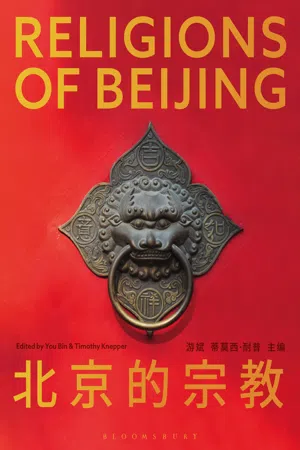
eBook - ePub
Religions of Beijing
- 232 pages
- English
- ePUB (mobile friendly)
- Available on iOS & Android
eBook - ePub
Religions of Beijing
About this book
Trusted by 375,005 students
Access to over 1 million titles for a fair monthly price.
Study more efficiently using our study tools.
Information
Baiyunguan Temple
Chen Rui, with Nicole Margheim, editor
As bustling and flowery as it appears to be, the capital city of Beijing never lacks for paradise-like escapes. One such escape, known to old and young, men and women, is called Baiyunguan (“White Cloud Temple”). Situated on Yuetan Street in Beijing’s Xicheng District, Baiyunguan is bounded on its north by the West Moat and connected by Lianhuachi East Road in the south.
People always associate “baiyun”—white clouds—with grand and romantic scenes, as illustrated in the Tang Dynasty poem “Yellow Crane Tower” by Cui Hao (704–754):
The yellow cranes would never return, leaving the white clouds drifting idly by for thousands of years.
Or the Tang Dynasty poem “One Song of Liangzhou Ci” by Wang Zhihuan (688–742):
The Yellow River vanishes into the far white clouds,
one lone town lies among towering mountain ranges.
In the Tang Dynasty, the Daoist Temple Baiyunguan was called Tianchangguan (“Temple of Heavenly Perpetuity”). Both “white clouds” and “heavenly perpetuity” connote the great Dao winding through to eternity.
The Temple features a symmetric architectural style. The temple’s Mountain Gate separates the secular world from the holy space. At the sight of the four characters 琼林阆苑 (“Fine Jade and Lofty Park”) inscribed on the top of the Mountain Gate, which exemplifies the best of paint and brush art in the human world, one instantly feels their chaotic secular thoughts turned to floating clouds running towards the edge of heaven.
Time and Space: Where the Holy and the Secular Meet
North of the Mountain Gate, between the red walls and the green arches, there is a plaque reading 敕建白云观 (“Royal Edict to Build the Baiyun Temple”), stating the imperial order to build the temple. It serves as a reminder of the initial prosperity and later decline of the Tang Dynasty (618–907), a long gone past vanished like smoke. After the first main gate, the flat path is broken by “Wofeng Bridge.” One’s attention is immediately caught by the pleasant tinkling sound of the bell beneath the bridge. This is what is called “bell sound, good luck.” Sound is one important hallmark of religious ritual, with the sound of the bell creating a solemn Daoist ritual atmosphere, mentally preparing practitioners to enter the supernatural world. A popular activity called “Hitting the Golden Eye” was even developed, according to which if one hits the “golden eye” (bell) with a coin, one will have good luck. This is a timeless ritual that visitors can perform without the need for a ceremony master.
From here, one can see the basic architectural layout of the temple. Along the central axis, from south to north, are Lingguan Hall, Yühuang Hall, Laolü Hall, Patriarch Qiu Hall, and Siyü Hall. The latter four halls are larger than the first one. Yühuang Hall is flanked by two halls that face inward to each other: Caishen (“Money Deities”) Hall on the east, and Sanguan (“Three Officer Great Deities”) Hall on
了此要素在塑造仪式意义和调整信徒对超自然世界的理解等方面的作用,甚至发展出全部由民众参与和主持的无时间规定性的仪式,即被称作“打金钱眼”的民俗活动。
行至此处,已基本管窥观内的建筑风格。中轴殿宇整体为南北走向,依次为灵官殿、玉皇殿、老律堂、邱祖殿、四御殿,且后四者规模更大。玉皇殿的东西侧面,是财神殿与三官殿相向而立。钟楼与鼓楼则各居于财神殿和三官殿两侧。钟鼓二楼前各植两株翠松,终年苍绿,只是不同季节有不同景致,仿佛四神立于中道两侧,沉默中迎来送往。
由灵官殿穿过后,常见人们举香朝玉皇殿、财神殿、三官殿方向敬拜,是否进殿再拜,则取决于个人的心理需求,即体现其对宗教的功利性追求。这种选择动机与游人或信徒当下的生活境遇有极大关联。玉皇大帝、财神、三官信仰集中体现了以道教为代表的中国传统宗教与西方宗教的极大不同——道教的崇拜体系是多神的,道教的神灵功能与大众人生观念紧密结合,所以极大影响中国人看待俗世的方式。道教认为,玉皇大帝创生万物、分辨是非,总管三界、十方、四生、六道的一切祸福。中国千年封建王朝,人间历史更迭,或合或分,政权始终由至高帝王执掌。在中国人心目中,神仙佛菩萨世界中至高者应当是玉皇大帝,却常忽视在道教内部尊崇三清(元始天尊、灵宝天尊、道德天尊)应甚于玉皇崇拜的事实。
宗教解决人间问题首推生死与命运。道教倡导长生成仙,与佛教对来世的设想乐此不疲相比,则更重视今生的所作所为。“三官”的内涵为天官赐福,地官赦罪,水官解厄。前往三官殿朝拜与参观的人数众多,并且常有中年人与本殿道长交流关于如何摆脱厄运的问题。个中原由,一方面在于该殿所供奉天、地和水三官能在一定程度上满足人对平安康泰的内心祈愿,另一个深层的原因则与儒家的矛盾思想有关,即儒家一面强调“敬鬼神而远之”,另一面倡导“事死如事生,事亡如事存”。在这种看似矛盾的态度中,却体现出中国人对祖先崇拜的深厚情感。中国民众对先祖的祭祀与追思在中元节(农历七月十五日)纪念中鲜活地体现出来。例如在以烧纸钱等方式祭奠去世亲人的行为背后包含了两种复杂的心理:一面是寄托思念;一面是希望亡灵能保佑在世家庭成员的平安,而不是搅扰。到了宋代,道教的三官信仰与三元日(农历正月十五称为上元,农历七月十五称为中元,农历十月十五称为下元)逐渐靠近,并最终实现了神灵崇拜与节日庆典的融合。换个角度来讲,由于三元日在民间的影响极为深远,三官信仰也使得道教神灵在民间信仰体系中获得新的生命,并体现儒道精神在民间的下移和延伸。
日常:内修与敬神
玉皇殿后,药王殿、救苦殿分立于老律堂两侧,但依旧处于中路位置。往日,除了道士们日常诵经以外,每逢道教神灵和祖师圣诞日,老律堂便成为观内更重要的处所。此殿亦称“七真殿”(始建于公元1228年),殿内供奉丘处机等七位道教全真派祖师。历史上,丘处机与成吉思汗雪山会面,使全真道达到极盛,所以他对于全真道的勃兴和发展意义重大。全真道在教义与修持方面标榜儒释道“三教圆融”。其反对外丹修炼而强调内丹的重要性,重视识心见性和清修自苦。宫观道士的日常维持,可分为规范性的日常功课以及文化知识生活方面的自习自修两方面。前者是最为常规的活动。早坛和晚坛功课的时间,经文是必不可少的,多为四字一句,且多以精气神之内修内炼为本。同时,唱和要与经文相结合。
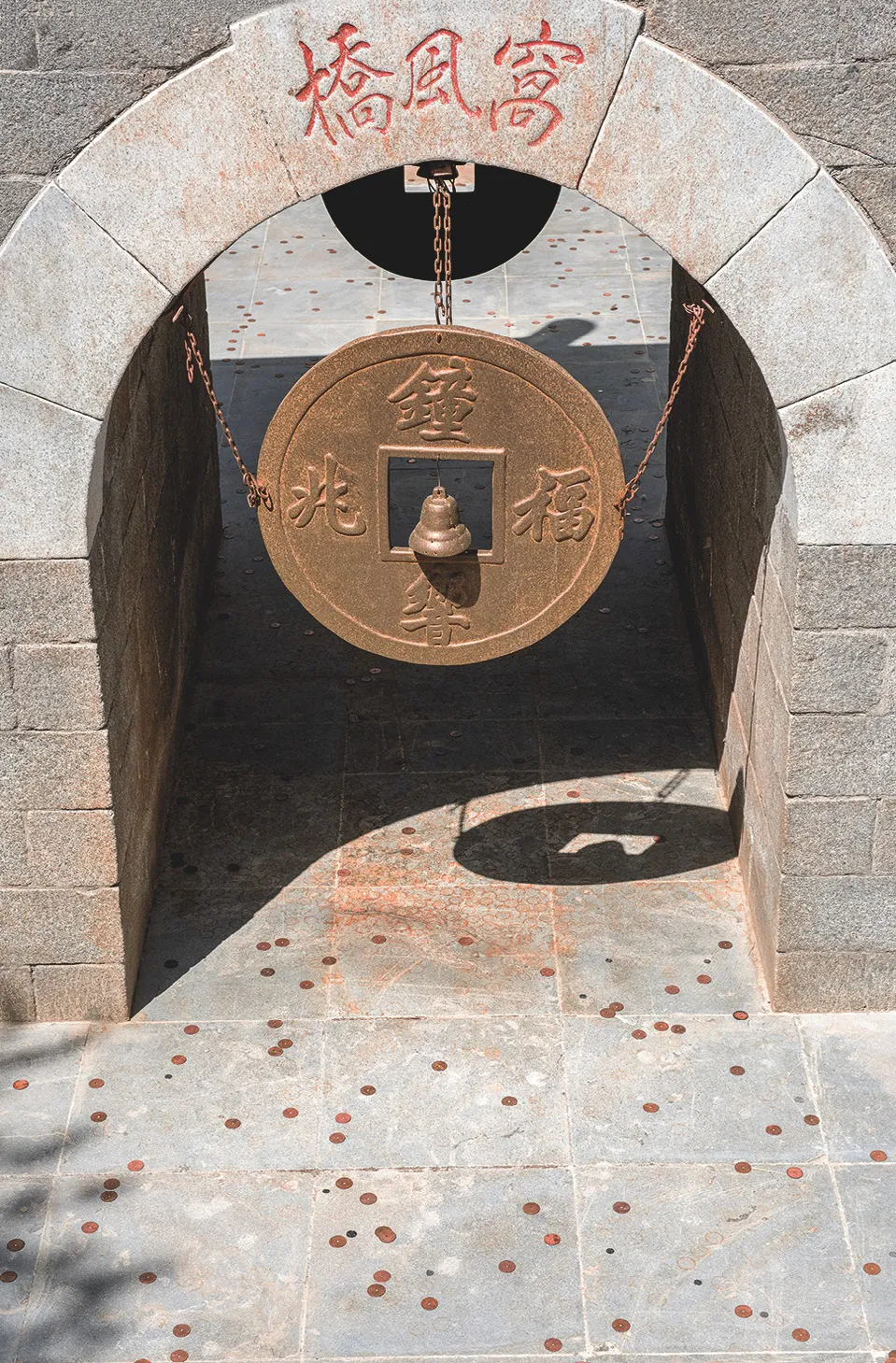
3. 窝风桥下的好运钟 Good-luck bell beneath Wofeng Bridge
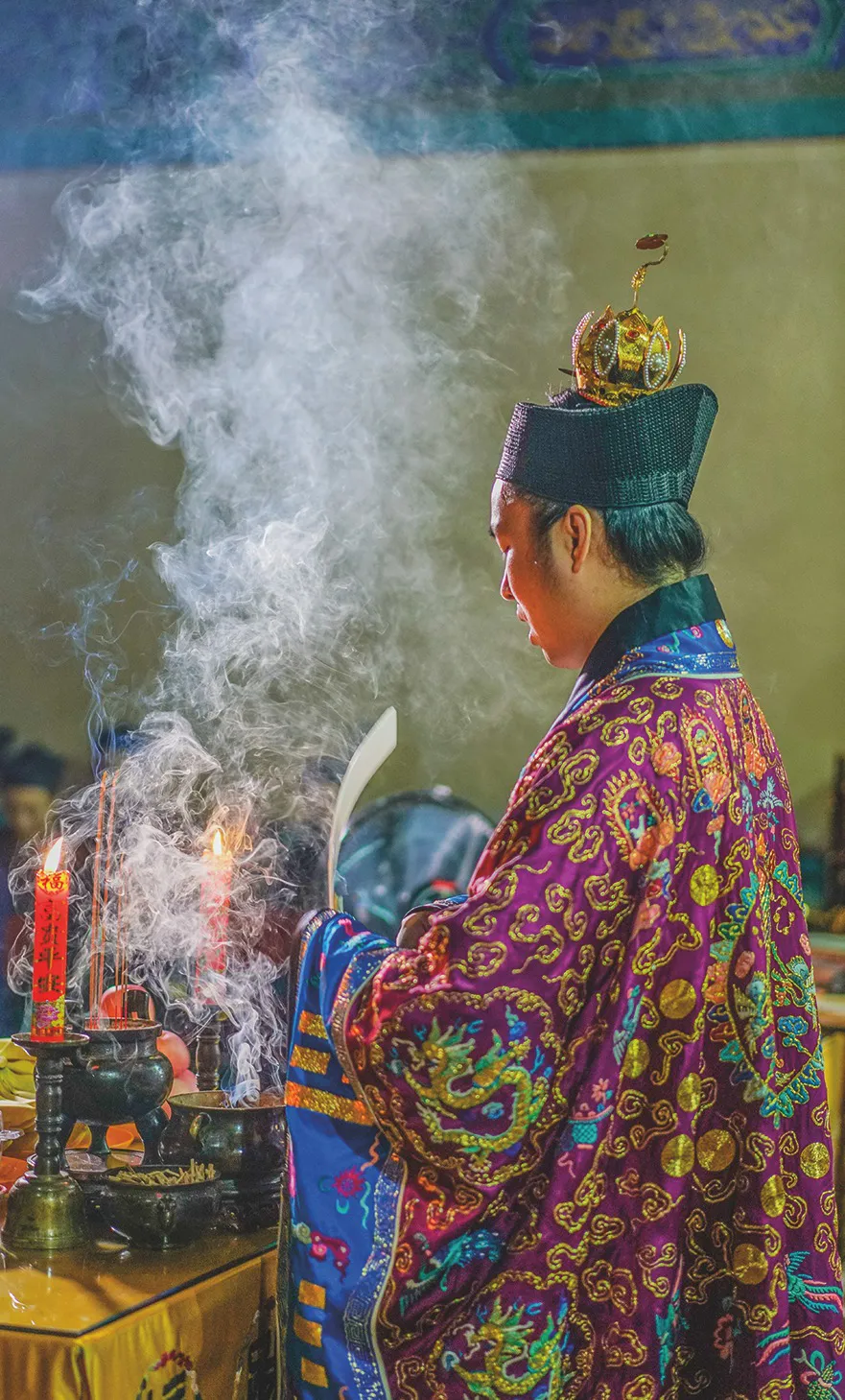
4. 道士敬香 Daoist priest offering incense (photo by He Yinglong)
the west. These two halls are themselves flanked by a clock tower and drum tower. Two evergreen pines guard these towers, silently greeting people passing by, offering different sights in different seasons.
After passing through Lingguan Hall, one often sees people worshipping while facing Yühuang Hall, Caishen Hall, and Sanguan Hall. The decision to enter these halls to worship is entirely up to the individual, subject to each person’s own life situation. Here, there is a big difference between Chinese religions, as represented by Daoism, and Western religions. Daoism is polytheistic, at least to some extent. The functions of Daoist deities are closely related to people’s views towards life, which in turn impact people’s views towards the secular world.
According to Daoism, an immortal called Yuhuang (“Jade Emperor”) creates all beings, distinguishes right from wrong, oversees yin and yang, and manages the fortunes and mishaps of all three realms, ten directions, four life-forms, and six worlds. Through thousands of years of Chinese history, with one dynasty continually replacing another and the country perpetually passing from division to reunion, one constant fact was the control of the regime by the emperors. Chinese people consider the supreme governing God among immortals, Buddhas, and bodhisattvas to be the Jade Emperor, neglecting the fact that Daoists should hold the highest esteem for the Three Purities (Yuanshi Tianzun, Lingbao Tianzun, Daode Tianzun).

5. 碧霞元君造像 Statue of Bixia Yuanjun, Goddess of Sunlight from the East
以老律堂为中心,分为三个方向:向北行是邱祖殿、四御殿等;向东则分布有雷祖殿、真武殿等;西面则是元君殿、元辰殿等。
东进路途中,题有“抱元洞府”四字的门洞将中轴建筑与偏殿区巧妙、含蓄地分离开来。东路真武殿主神号称“玄天上帝金阙化身荡魔天尊”,造型魁梧,高额,目光迥然有力,被赋予护佑群生、协衡天道的职责。殿内供奉天蓬、天佑二天将。“玄天上帝”原为民间宗教体系的真武神,他对中国文化影响极深。道教产生后,其将民间玄武信仰吸纳进来。玄武在宋代改名为真武,并一直沿用到今天。建于明英宗正统三年(公元1438年)的雷祖殿,供奉雷祖及风雨雷电四位自然天神。之所以供奉多位神而非一位神,是由于在雷神人格化过程中,神灵职能逐渐丰富,身份也渐渐多元。雷神“头如猕猴”,电母神手中造雷电所用的法器,恍惚间将人带入中国古典巨著《西游记》中对雷公电母及其风雷滚动、电雨将倾的形象描绘于其中。
出“抱元洞府”向西行,面前是“会仙福地”。道观普遍不如佛寺那样恢弘,但外观精致、朴素,砖瓦与外墙色彩深重,含蓄内敛。其内部构造简约,主神和辅神有序分列,绕以仙鹤踱步与蛟龙飞腾的主题,俨然一副天界福景。
西路的元君殿,有一点与其他殿宇不同——主神碧霞元君背靠南而面向北,所以该殿入口在北方。殿内所供碧霞元君,有五位化身,其总体功能为赐福赐子、护佑婚姻。五位性别皆为女性,为观者传递强烈的亲和力。这一点也成为其被民间亲切称为“泰山老奶奶”之香火绵延的一个原由。只是这位白云观内的碧霞元君同其他四位奶奶,相比在泰山供奉的奶奶,却少了很多风光。

6. 斗姆元君殿内的神仙们 Statue of Doumu Yuanjun, Mother Goddess of the Big Dipper, in front of immortals
Religions solve human problems, primarily life, death, and destiny. Daoism advocates becoming immortal. Compared with Buddhism’s vision of the afterlife, Daoism pays more attention to what has been done in the current life. Belief in the immortals called Sanguan includes blessings by Heaven, pardons by Earth, and relief of misfortune by Water. Daoist worshippers and visitors flood to Sanguan Hall. Many middle-aged people often talk to the Daoist priest on duty, inquiring how to be relieved from misfortunes. The three immortals offered here—Heaven, Earth, and Water—satisfy people’s wishes for peace, safety, and health. This reflects the spiritual nature of the Chinese people; for example, Confucianism emphasizes “respecting spirits but staying away from them” and advocates “serving the dead as if they were alive; serving the departed as if they were still around.” This seemingly contradictory attitude reveals the Chinese people’s strong sentimental attachment to ancestors.
The commemoration ceremony at the Zhong Yuan Festival (Ghost Festival) most vividly exemplifies this tradition. For example, there are two complicated reasons behind the burning of paper money for the ancestors at these memorial services: cherishing the thoughts of the deceased relatives, and preventing the celestial spirits of the dead from disturbing the living. After the Song Dynasty (960–1279), the Daoist belief in the Sanguan was increasingly linked with the Sanyuan Festivals (on the fifteenth day of the first, seventh, and tenth lunar months), eventually merging, the result of which was the integration of the worship of heavenly spirits and the celebration of festivals. From a different perspective, Sanguan belief enabled the rebirth of Daoist spirits in folk religions, thanks to the profound influence of the Sanyuan Festivals on ordinary peoples’ lives. This also shows that the spirit of combining Confucianism and Daoism extends into folk religions and communities.

7. 静心燃香 Lighting incense as an offering
相比之下,西路殿宇的尽头有元辰殿,香火始终旺盛。这里供奉斗姥元君与六十太岁神。拜斗姥,即拜掌管凡人薄籍的神;拜太岁,即叩拜各人出生之年的保护神。静心向他们供香,能够消灾延寿,或许能够满足人基本的心愿,即对平安的期待。
灵性的表达:认同与实践
恍惚之间,不远处似有乐声响起,张弛有度,其间夹有人的唱诵之声。随声所至,只见殿外经幡飘扬,殿的里外几乎都站满了人,原是恰逢文昌帝君圣诞日(农历二月初三)法会庆典。就白云观而言,道众群体的规模并不小,或许与其十方常住制度有关——虽不能私收弟子,却可以接受道众留居,但是组织管理十分有序。门庭内的多数信众双手呈现抱拳样式,左手叠在右手上,对向合并在胸前。这种拜神灵的方式连同其他日常礼貌性礼仪在《周礼》和《礼记》中都有出处。中国道教学院C道长讲到,“作为一般游客信众,了解道教礼拜仪式和基本知识的并不是很多,大家只不过是延续了民俗传统,带着向往幸福美好的心情来拜神,真正深入学习道教常识的不多”。C道长接着说,“手势不是最重要的,而庄严仪式之内的存心最为重要,如果把精力放在研究仪式而不是探究仪式要解决的问题,恐怕要多研究五百年,也不一定能弄明白”。
Routine: Internal Cultivation and Immortal Worshipping
The Medicine ...
Table of contents
- Cover
- Title Page
- Contents
- List of Figures
- Introduction: Religions in Beijing.
- 1. Baiyunguan Temple.
- 2. Beiding Niangniang Temple
- 3. Changping Mosque
- 4. Chongwenmen Church
- 5. Confucius Temple and Imperial College
- 6. Dongsi Mosque.
- 7. Dongyue Temple
- 8. Guangji Temple.
- 9. Haidian Church.
- 10. Housangyu Church
- 11. Huode Zhenjun Temple.
- 12. Tanzhe Temple.
- 13. Tianning Temple.
- 14. Tongzhou Mosque.
- 15. Xishiku Church.
- 16. Xizhimen Church.
- 17. Yonghegong Temple.
- Index.
- eCopyright Page
Frequently asked questions
Yes, you can cancel anytime from the Subscription tab in your account settings on the Perlego website. Your subscription will stay active until the end of your current billing period. Learn how to cancel your subscription
No, books cannot be downloaded as external files, such as PDFs, for use outside of Perlego. However, you can download books within the Perlego app for offline reading on mobile or tablet. Learn how to download books offline
Perlego offers two plans: Essential and Complete
- Essential is ideal for learners and professionals who enjoy exploring a wide range of subjects. Access the Essential Library with 800,000+ trusted titles and best-sellers across business, personal growth, and the humanities. Includes unlimited reading time and Standard Read Aloud voice.
- Complete: Perfect for advanced learners and researchers needing full, unrestricted access. Unlock 1.4M+ books across hundreds of subjects, including academic and specialized titles. The Complete Plan also includes advanced features like Premium Read Aloud and Research Assistant.
We are an online textbook subscription service, where you can get access to an entire online library for less than the price of a single book per month. With over 1 million books across 990+ topics, we’ve got you covered! Learn about our mission
Look out for the read-aloud symbol on your next book to see if you can listen to it. The read-aloud tool reads text aloud for you, highlighting the text as it is being read. You can pause it, speed it up and slow it down. Learn more about Read Aloud
Yes! You can use the Perlego app on both iOS and Android devices to read anytime, anywhere — even offline. Perfect for commutes or when you’re on the go.
Please note we cannot support devices running on iOS 13 and Android 7 or earlier. Learn more about using the app
Please note we cannot support devices running on iOS 13 and Android 7 or earlier. Learn more about using the app
Yes, you can access Religions of Beijing by Timothy Knepper, You Bin, Timothy Knepper,You Bin, Timothy Knepper, Bin You in PDF and/or ePUB format, as well as other popular books in Theology & Religion & Buddhism. We have over one million books available in our catalogue for you to explore.