Gone with the Wind (1939) is one of the greatest films of all time - the best-known of Hollywood's Golden Age and a work that has, in popular imagination, defined southern American history for three-quarters of a century. Drawing on three decades of pertinent research, Helen Taylor charts the film's production history, reception and legacy.
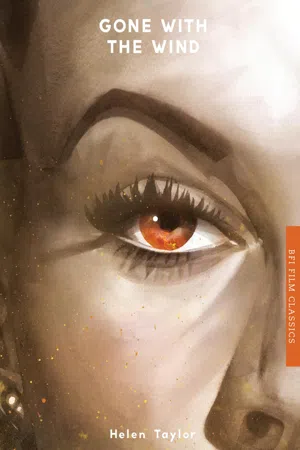
- 104 pages
- English
- ePUB (mobile friendly)
- Available on iOS & Android
eBook - ePub
Gone With the Wind
About this book
Trusted by 375,005 students
Access to over 1 million titles for a fair monthly price.
Study more efficiently using our study tools.
Information
1 ‘Selznick’s Folly’: How Gone With the Wind Was Made
The story of the crazily chaotic yet miraculous gestation of Gone With the Wind has been told many times. Referred to early on as ‘Selznick’s Folly’ because of the audacious ambition of the project, this production of the newly formed Selznick International Pictures (SIP) generated national and international excitement long before its premiere. David Selznick was highly respected for his prestigious MGM adaptations of classic texts, such as Anna Karenina, David Copperfield and A Tale of Two Cities (all 1935), and a year following GWTW he triumphed again with Rebecca (1940). He had his own theory of adaptation, which required scrupulous fidelity to the original, and he was recognised as a master of the art. The only departure from this was when he saw a conflict between ‘beauty’ and ‘historical authenticity’, in which case the latter was sacrificed, or where the censor intervened (as with the dramatically altered ending of Rebecca, to ensure the murderer hero Maxim de Winter [Laurence Olivier] was absolved of his crime).
David Selznick’s sons recounted the process in their own film, Gone With the Wind: The Making of a Legend (1988). It revels in detailing the early competition for film rights, Selznick’s drawn-out and controversial casting decisions, the many changes of screenwriter and director, his obsessively stubborn insistence on adapting the novel as faithfully as possible, and then the ambitious and elaborate sets and costumes, spectacular effects, long delays in filming, on-set squabbles, nervous breakdowns and other problems. So much public anticipation was generated that Warner Brothers was able to garner attention for its ‘spoiler’ movie Jezebel, which, to Selznick’s fury, came out a year before GWTW, piggy-backing on the later film’s pre-publicity. Set in ante-bellum New Orleans, it features a headstrong and rebellious southern belle (Bette Davis). Although in black and white, the film uses similar characterisation and scenes to those in GWTW, and gave Davis the chance to play a version of the role Selznick had denied her. He retaliated by refusing to cast Jezebel’s leading man Henry Fonda as Ashley.
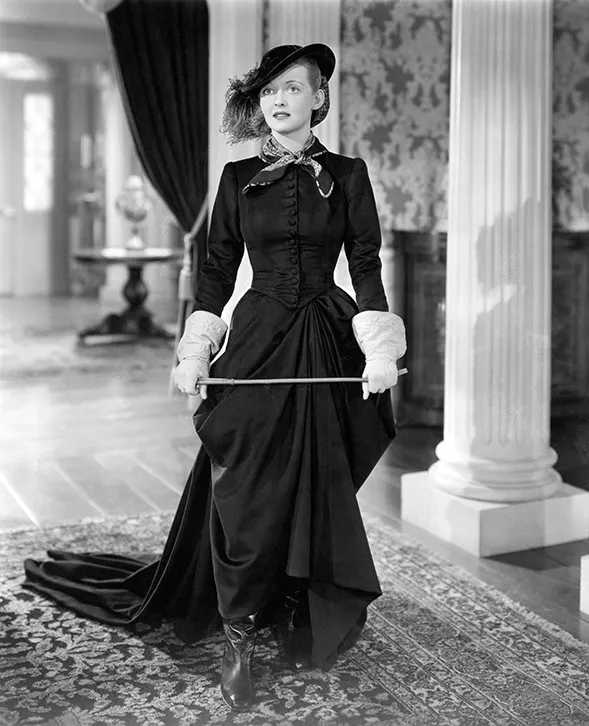
Bette Davis as whiplashing southern belle in Jezebel (1938)
Gone With the Wind was the work by which David Selznick wished his cinematic career to be judged. Produced by an intensely literary man with a passion for the faithful adaptation of novels, GWTW drew from and gestured to other art forms. It opens with a ten-and-a-half-minute ‘Overture’, heralding an operatic-style work. A long, complex film divided into two main parts and punctuated by an intermission, a seven-minute entr-acte and approximately four minutes of exit music, it foregrounds its own theatricality. The film resonates with an emotive and stirring score as well as musical scenes of parties and military bands. It is a very literary film, repeatedly enlisting titles and script (sometimes humorous) to describe rather than show action: the letter to Scarlett breaking the news of the death of her unloved husband Charles Hamilton (Rand Brooks), not from battle but measles followed by pneumonia; the Gettysburg casualty lists distributed to worried families; titles such as ‘SIEGE’ and ‘SHERMAN’; the cheque signed by Scarlett O’Hara Kennedy denoting her hasty marriage to Frank. In the scene of womenfolk awaiting the return of Frank Kennedy (Carroll Nye) and Ashley Wilkes from their Ku Klux Klan-inspired violent attack on Shantytown, Melanie reads aloud from (not Les Misérables, as in Mitchell’s novel) David Copperfield, a nod to the film Selznick had produced in 1935 from Dickens’s original. He knew the book was fresh in readers’ memories and thus his audience would be ‘passionate about the details’ and critical of plot alterations or the miscasting of key characters.23

List of Confederate soldier casualties issued following the Battle of Gettysburg
Selecting the leading male actors was a relatively straightforward job, compared to that of choosing his Scarlett (see Chapter 3). Although Gary Cooper and Errol Flynn were in the frame, the popular choice for Rhett was overwhelmingly the King of Hollywood, Clark Gable, but for various contractual and other reasons it took a year to secure him (for a role he did not want). In a memo to John F. Warton, SIP’s vice president, 20 September 1937, Selznick discussed three choices – Gable, Cooper and Ronald Colman, referring to the latter’s lack of ‘the virility and bite that are so essential to a satisfactory Rhett’.24 Gable was paid well for his virility and bite, and for most audiences, he deserved every cent. But in order to secure him, Selznick had to agree to his father-in-law Louis B. Mayer’s demand that MGM distribute the film and take a handsome share of the profits.

‘King of Hollywood’ Clark Gable as Rhett Butler
The casting of Ashley Wilkes was less straightforward, though it seems that Selznick settled on Leslie Howard in the absence of anyone better. His concern about Howard was his age (forty-six when playing a man at least two decades younger) but the Anglophile producer described him as ‘an unusually intelligent actor’ and was certain this ‘English matinée idol would deliver a great performance’.25 Like Gable, Leslie Howard had little enthusiasm for his role, accepting it only on being offered the position of associate producer on Intermezzo, and has usually received a lukewarm critical response. The Selznick brothers’ film about GWTW shows the elaborate lengths to which make-up and hairdressers had to go to give the wrinkled Howard appropriately youthful looks.
It was no easy task to convert Margaret Mitchell’s massive novel into a screenplay, and it took seventeen screenwriters to do so. The author refused Selznick’s repeated requests to adapt her book into film (in vain did he invite her and her husband to Bermuda for a short break so they could work through the script), and he then hired highly respected playwright Jane Murfin. She was ditched quickly when it emerged Pulitzer Prize-winning dramatist/screenwriter Sidney Howard was available. According to Steve Wilson, Alfred Hitchcock – hired on a seven-year contract by Selznick – was also consulted on aspects of the screenplay. The extreme length of the script led Selznick to consider expanding one film into two or even three and – because of rising costs – making it in black and white. He also considered two intermissions after the first cut which lasted four and a half hours and, rather endearingly, insisted upon one intermission to give the audience a toilet break. Sidney Howard observed that Mitchell did everything ‘at least twice’, and he cut ruthlessly (even so, producing a first draft that lasted five and a half hours). Selznick, however, intervened and demanded changes that eventually drove Howard away. His obsession with being faithful to the text produced a final word from Howard: ‘Yes, I’m through. It’s not a movie script. It’s a transcription from the book.’ The script was then reworked by sixteen other writers, including Academy Award-winning Ben Hecht and (briefly) F. Scott Fitzgerald, who told his editor Maxwell Perkins he was forbidden to use any words except for Margaret Mitchell’s, with the book regarded as ‘Scripture’. Selznick’s refusal to relinquish control meant that he could not find a writer willing to complete a script to his requirements, and he later claimed the majority of the script was his own work (though in fact it was mainly Howard’s original, something tacitly acknowledged in the final credits).26

Leslie Howard plays Ashley Wilkes, with Vivien Leigh as Scarlett O’Hara
Although the final script raises few twenty-first-century eyebrows, in the late 1930s it was seen as daring and even subversive. The restrictive Production Code (known as the ‘Hays Code’) was applied to scripts before they were committed to film, and in the case of Gone With the Wind many concessions were demanded – including the proscription of any representation of rape, toning-down battle and childbirth scenes and obfuscating the fact that Belle Watling (Ona Munson) is a prostitute. In a long letter from the Hays Office, Joseph I. Breen requested scenes of the dead and dying be ‘not shot as too realistically gruesome’; he forbade moaning or crying during Melanie’s childbirth; and made numerous suggestions about removing any whiff of sexual suggestiveness, adultery, rape and provocative costume. The letter also advocated that the term ‘nig...
Table of contents
- Cover Page
- Title Page
- Contents
- Acknowledgments
- Foreword
- Overture
- 1. ‘Selznick’s Folly’: How Gone With the Wind Was Made
- 2. ‘The Greatest Star England Ever Gave Hollywood’:Britain and the Search for Scarlett
- 3. The Racial Politics of Gone With the Wind
- 4. Scarlett and Rhett – Destined or Doomed?
- Exit Music
- Notes
- Credits
- Select Bibliography
- eCopyright
Frequently asked questions
Yes, you can cancel anytime from the Subscription tab in your account settings on the Perlego website. Your subscription will stay active until the end of your current billing period. Learn how to cancel your subscription
No, books cannot be downloaded as external files, such as PDFs, for use outside of Perlego. However, you can download books within the Perlego app for offline reading on mobile or tablet. Learn how to download books offline
Perlego offers two plans: Essential and Complete
- Essential is ideal for learners and professionals who enjoy exploring a wide range of subjects. Access the Essential Library with 800,000+ trusted titles and best-sellers across business, personal growth, and the humanities. Includes unlimited reading time and Standard Read Aloud voice.
- Complete: Perfect for advanced learners and researchers needing full, unrestricted access. Unlock 1.4M+ books across hundreds of subjects, including academic and specialized titles. The Complete Plan also includes advanced features like Premium Read Aloud and Research Assistant.
We are an online textbook subscription service, where you can get access to an entire online library for less than the price of a single book per month. With over 1 million books across 990+ topics, we’ve got you covered! Learn about our mission
Look out for the read-aloud symbol on your next book to see if you can listen to it. The read-aloud tool reads text aloud for you, highlighting the text as it is being read. You can pause it, speed it up and slow it down. Learn more about Read Aloud
Yes! You can use the Perlego app on both iOS and Android devices to read anytime, anywhere — even offline. Perfect for commutes or when you’re on the go.
Please note we cannot support devices running on iOS 13 and Android 7 or earlier. Learn more about using the app
Please note we cannot support devices running on iOS 13 and Android 7 or earlier. Learn more about using the app
Yes, you can access Gone With the Wind by Helen Taylor in PDF and/or ePUB format, as well as other popular books in Medios de comunicación y artes escénicas & Películas y vídeos. We have over one million books available in our catalogue for you to explore.