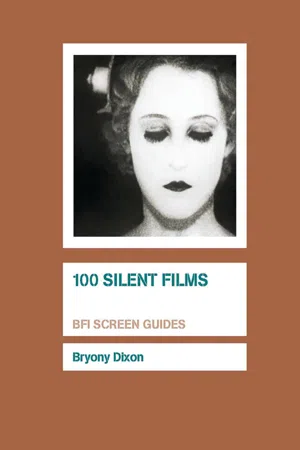
- 288 pages
- English
- ePUB (mobile friendly)
- Available on iOS & Android
eBook - ePub
100 Silent Films
About this book
100 Silent Films provides an authoritative and accessible history of silent cinema through one hundred of its most interesting and significant films. As Bryony Dixon contends, silent cinema is not a genre; it is the first 35 years of film history, a complex negotiation between art and commerce and a union of creativity and technology. At its most grand – on the big screen with a full orchestral accompaniment – it is magnificent, permitting a depth of emotional engagement rarely found in other fields of cinema. Silent film was hugely popular in its day, and its success enabled the development of large-scale film production in the United States and Europe. It was the start of our fascination with the moving image as a disseminator of information and as mass entertainment with its consequent celebrity culture.
The digital revolution in the last few years and the restoration and reissue of archival treasures have contributed to a huge resurgence of interest in silent cinema. Bryony Dixon's illuminating guide introduces a wide range of films of the silent period (1895–1930), including classics such as The Birth of a Nation (1915), The General (1926), Metropolis (1927), Sunrise (1927) and Pandora's Box (1928), alongside more unexpected choices, and represents major genres and directors of the period – Griffith, Keaton, Chaplin, Murnau, Sjöström, Dovzhenko and Eisenstein – together with an introductory overview and useful filmographic and bibliographic information.
The digital revolution in the last few years and the restoration and reissue of archival treasures have contributed to a huge resurgence of interest in silent cinema. Bryony Dixon's illuminating guide introduces a wide range of films of the silent period (1895–1930), including classics such as The Birth of a Nation (1915), The General (1926), Metropolis (1927), Sunrise (1927) and Pandora's Box (1928), alongside more unexpected choices, and represents major genres and directors of the period – Griffith, Keaton, Chaplin, Murnau, Sjöström, Dovzhenko and Eisenstein – together with an introductory overview and useful filmographic and bibliographic information.
Trusted by 375,005 students
Access to over 1 million titles for a fair monthly price.
Study more efficiently using our study tools.
Information
Topical Budget 93-1 The Derby 1913
UK, 1913 – 4 mins
Topical Film Company
One cannot overstate the importance of newsreels in the development of film – they really deserve a volume of their own. With this in mind, I have chosen just one story that is revealing about newsreels in general but is also an important film in its own right. This is the footage of the 1913 Epsom Derby when the suffragette Emily Davison ran out into the path of the King’s horse during the famous race. The cameras of several newsreel companies, including Topical Budget, Pathé Animated Gazette, Gaumont Graphic, Warwick Bioscope Chronicle and Williamson’s Animated News, were there to film the event. Fragments of all of these survive, and several managed to capture the actual incident. It was a rare case of the newsreel capturing actual news.
News film, as distinct from newsreel, had existed from the earliest days of moving pictures; in fact, the Derby was one of the first such events ever filmed, by Birt Acres in 1895. It made sense to film the fixtures of the social calendar – they were predictable, topical and had a wide appeal. As the development of purpose-built cinemas increased significantly in 1910/11, guaranteeing regular, reliable audiences, newsreel companies were established to supply news in twice-weekly editions. As well as covering the traditional fixtures – Henley, the Boat Race, the Derby, aviation meetings and so on – and in response to audiences’ increasing reliance on the cinemas for news, the rival newsreel cameramen began to film current events such as political meetings, demonstrations, natural disasters and crime. One series of political developments they followed closely were the well-orchestrated demonstrations of the Suffragists. We know that the newsreel companies paid for the rights to film particular events, and the National Union of Women’s Suffrage Societies made sure they were filmed. Banners and insignia were designed to be clearly visible in the films, and cameramen were given the best vantage points from which to capture the scale of the demonstrations.
However, one such event where the cameramen would not be expecting to feature a suffragette protest was the Derby, although Emily Davison clearly knew where to stand in order to be caught on film as she ran onto the racecourse. One explanation for this is that the coverage of the Derby was the same, year in year out, building in complexity from Birt Acres’s single shot, to the more elaborate films of several minutes’ duration. In imitation of the illustrated press and celebrated illustrations of the Derby, like Gustave Doré’s London, the cameramen covered all the traditions of the Londoner’s great day out: the arrival of spectators in perilously overladen vehicles, the poorer citizens travelling by donkey traps, the richer by coach and the intrepid by motor vehicle; the sideshows and betting; the stands and crowds; the start of the race, rounding Tattenham Corner, the finish and beauty shot of the winner. Topical Budget’s The Derby 1913 was no exception, but it also captured the ‘accident’, in which Davison ran out in front of the King’s horse Anmer, was thrown into the air and lay motionless on the ground as a crowd of spectators rushed onto the course to help her and the jockey. Unaware of the gravity of her injuries, the crew carried on shooting and the film was issued that same evening. When Davison died four days later, the images took on a new significance. Watching this film now, it seems callous but at the time, the Topical Budget editors could not have known they had filmed a woman’s death. Recycled endlessly for nearly a century, the footage depicts the event in many forms – some with titles that demonstrate awareness of Davison’s death, some, like this one, in the version that was issued to cinema audiences on that fateful day.
Prod Co: Topical Film Company.
Underworld
USA, 1927 – 81 mins
Josef von Sternberg
Underworld is mostly known for being a kind of proto-gangster film, a genre that would flourish in the early sound era and go on to develop in all sorts of interesting ways according to the culture of its times – The Public Enemy (1931), Scarface (1932) and The Godfather (1972) being perhaps the most memorable. It is a shame that it is not better known, because it is (I think) one of the most perfect films of the late silent era, made by Josef von Sternberg, one of cinema’s greatest auteurs. Part of the problem is that it has been difficult to see until relatively recently and is still slightly compromised by the surviving prints being taken from a 16mm source.
It must have been an incredibly beautiful film in its day (this is obvious even from what remains), and the lighting is exquisite – in particular, the glint shining off Evelyn Brent’s black, black eyes. In fact, all of the three protagonists look stunning. Von Sternberg lavishes as much attention on George Bancroft and Clive Brook, with the extensive use of close-ups and long-held shots inviting the viewer’s gaze. It is an intimate film, claustrophobically contained within dowdy nightclubs and a safe house. But the outside world is really irrelevant here; this is not a social-issue film, as later gangster films had to be to comply with censorship regulations. In fact, it feels more like a retelling of the Lancelot and Guinevere legend and has a hint of that inescapable tragedy.
‘Bull Weed’, the gangster king (‘Atilla, 2,000 years too late’), as the intertitle tells us, meets a drunk ex-attorney sweeping up in a grimy basement bar, where he is taunted by the lowlifes who throw money into the spittoon to see if he will degrade himself enough to pick it out (a scene Howard Hawks would later borrow for Rio Bravo [1959]). Bull sees something in him and gives him a chance to straighten out, which he does to superb effect, becoming a sauve, efficient henchman with beautiful manners, for which Bull dubs him ‘Rolls Royce’.
Bull asks him to look after ‘Feathers’, his moll, and while they are stuck alone in a room together (in a beautifully observed scene), they fall in love, before realising that they both owe Bull their escape from the gutter, creating a bond of loyalty that they can’t now betray. The pair struggle to deny themselves, almost driving Rolls Royce back to drink in his despair. There is a wrenchingly painful moment when they fantasise about escape – Bull has been captured and will be hanged, as he was born to; the camera lingers on the suitcase into which the pair put their belongings, then take them out as their resolve to run comes and goes. In the end, conscience compels them to break Bull out of jail. Thinking they had betrayed him, Bull is reconciled when he discovers they remained loyal and, decisive as ever, he stays behind to take the hail of police bullets while they make their getaway. It is a noble gesture expressed in a little vignette where Bull, under siege in the house and probably about to die, sees that a small kitten has wandered into the chaos. Unconsciously, he picks it up brutally by the scruff and, finding a milk bottle, feeds it from his fingers – it is in his nature to care for those innocents weaker than himself. When he is inevitably recaptured, the police officer asks him what was the point of escaping the noose for so short a time, to which Bull replies, ‘That hour was worth more to me than my whole life.’
It is a moving and beautifully written film that earned Ben Hecht the first ever Academy Award for his script.
Dir: Josef von Sternberg; Scr: Robert N. Lee, from a story by Ben Hecht; Ph: Bert Glennon; Art Dir: Hans Dreier; Cast: George Bancroft, Evelyn Brent, Clive Brook, Larry Semon.
The Unknown
US, 1927 – 50 mins
Todd Browning
The convention of the Grand Guignol, a small theatre in Paris with a big influence, was for short macabre plays, with sometimes five or six plays making up an evening’s entertainment. Horror seems to suit the short form, whether theatrical or literary; it also adapts well to cinema, which is a good medium for delivering the component parts of horror – emotion, shock and atmosphere. Grand Guignol is also essentially naturalistic (sadists not monsters), concerning itself with the more morbid aspects of humanity – death, insanity, mania, sex and horribly ironic coincidence. The sets of the tiny theatre were typically claustrophobic – prison cells, asylums, execution yards, opium dens, brothels, barbershops and operating theatres. Physical deformity of all sorts portrayed through the creative use of make-up was a specialism. Make-up was also the forte of Lon Chaney, star of Tod Browning’s gruesome horror The Unknown. Written by the director himself, the plot would barely make a short story, but the narrative makes up for it in the neatness of its construction.
The story centres on Alonzo (Lon Chaney), a criminal hiding from the law in a circus as an armless knife-thrower. He has a deformity – two thumbs on his right hand – which is why he pretends to have no arms. He is in love with Nanon (Joan Crawford), who has a phobia (the origins of which are obscure) about men putting their arms around her and therefore feels comfortable only in the presence of Alonzo, who mistakes this genuine affection for love. She is being courted by the strong man Malabar, but flinches every time he tries to touch her. Alonzo strangles Nanon’s father, the bullying ringmaster, when he discovers Alonzo’s secret. The murder is witnessed by the horrified Nanon, who sees his two thumbs but not his face. Determined to have Nanon and unable now to tell her the truth, Alonzo is driven to the drastic step of blackmailing a surgeon to amputate his arms. The glimpse of the operating theatre is one of the grislier moments in the film. He stays away to convalesce long enough for Nanon to overcome her phobia under the patient ministrations of Malabar. Having made this terrible sacrifice, only to find himself rejected, tips him into insanity and he plots a fitting end for Malabar (yes, it does involve arms) that spectacularly backfires in a moment of supreme poetic justice.
Many of the Guignol tropes are in evidence – the lowlife setting of the carnival, the depravity of the anti-hero, the psycho-sexual phobia of the heroine that borders on titillation, the oppositional pairing of the strong man with the armless Alonzo and the appropriateness of the revenge. But it is only Lon Chaney who could pull off this improbable story. Joan Crawford famously said that it was watching him at work on The Unknown that taught her the difference between acting and standing around in front of the camera. Chaney was not only able to put up with the extreme discomfort that must have been necessary for the role, but he could convey profound emotion – it is relatively rare to see tears at this period, so one is taken aback by the almost unbearable pathos. His performance elevates the film from kitsch to classic.
Dir: Todd Browning; Scr: Waldemar Young; Ph: Merritt B. Gerstad; Cast: Lon Chaney, Joan Crawford, Nick de Ruiz, Norman Kerry, John George.
Les Vampires
France, 1915 – 440 mins
Louis Feuillade
Populist and pulpy, there are few silent films as accessible to us today as the great serials of Louis Feuillade. Between 1913 and 1922, the film serial, surfing a great wave of public fascination initiated by the Fantômas crime stories, was a vibrant, inventive and addictive genre, which the box-set junkies of today will tune into easily. These French serials have only been made widely accessible quite recently – most of the American examples are still not available – so modern audiences have rarely had a chance to get hooked on them. They are a problem to programme, racking up 7 or 8 hours of running time, and so won’t fit conveniently into the cinema exhibition structure based on the 90-minute feature. The only really satisfactory way to see them is an episode or two a day at a week-long festival – frequent enough not to forget the story but not in back-to-back episodes so that plot repetitions become tedious. With the advent of DVD and internet streaming sites, you can (sort of) replicate this experience for yourself, although you miss out on the glorious quality of the photography.
It is its modern appeal that made me choose Les Vampires of all the serials. It isn’t the best, or necessarily the most compelling, but the themes and aesthetics seem to have had a greater influence down the years, not only in the obvious references such as Olivier Assayas’s postmodern feature Irma Vep (1996) but in the aesthetic of Modesty Blaise or The Avengers, as well as a host of Italian series of the 1960s, such as Diabolik. It’s the ‘look’ that creates the sense of familiarity for the modern audience. Many film directors and artists (Chabrol, Resnais, the Surrealists, Buñuel) were influenced by the look of Les Vampires, with its realist setting, ultra-modern automobiles, amoral tone and skin-tight black catsuits. The film was issued intermittently in ten parts, each comprising four or five episodes with sensational titles such as ‘The Severed Head’ and ‘The Bloody Wedding’. The principal protagonist is a journalist, Phillipe Guérande, who, with his bumbling sidekick Mazamette, is pursuing a gang of criminals known as ‘Les Vampires’ who have infiltrated every aspect of society in Paris and beyond. They steal jewels from the rich by impersonating members of high society or by cat thievery, lone figures clambering over the rooftops at night, appearing and disappearing though trapdoors and false fireplaces.

Irma Vep spreads her wings in Feuillade’s sensational serial
The high priestess of this band is Irma Vep, played by stage star Musidora, who is a master of disguise, a...
Table of contents
- Cover
- Title Page
- Contents
- Acknowledgments
- Introduction
- The Adventures of Dollie, D. W. Griffith, 1908
- Alfred Butterworth & Sons, Leaving the Works, Glebe Mills, Hollinford, Mitchell & Kenyon, 1901
- Alice in Wonderland, Percy Stow, 1903
- Ballet mecanique, Fernand Leger, Dudley Murphy, 1924
- The Battle of the Somme, William F. Jury, 1916
- The Battles of Coronel and Falkland Islands, Walter Summers, 1927
- The Battleship Potemkin/Bronenosets Potyomkin, Sergei M. Eisenstein, 1925
- Beggars of Life, William Wellman, 1928
- Berlin, Symphony of a City/Berlin, die Sinfonie der Großstadt, Walter Ruttmann, 1927
- The Big Swallow, James Williamson, 1901
- The Birth of a Flower, F. Percy Smith, 1910
- The Birth of a Nation, D. W. Griffith, 1915
- Blackmail, Alfred Hitchcock, 1929
- Body and Soul, Oscar Micheaux, 1925
- The Cabinet of Dr. Caligari/Das Cabinet des Dr. Caligari, Robert Wiene, 1920
- Cabiria, Giovanni Pastrone, 1914
- The Cameraman’s Revenge/Mest’ kinematograficeskogo operatora, Ladislas Starewicz, 1912
- Casanova, Alexandre Volkoff, 1927
- The Cheat, Cecil B. DeMille, 1915
- Un Chien andalou, Luis Bunuel, 1928
- A Cottage on Dartmoor, Anthony Asquith, 1929
- Daybreak/Tianming, Sun Yu, 1933
- Les Deux Timides/Two Timid Souls, Rene Clair, 1928
- Douro, faina fluvial/Labour on the Douro River, Manoel de Oliveira, 1931
- Drifters, John Grierson, 1929
- Earth/Zemlya, Aleksandr Dovzhenko, 1930
- En dirigeable sur les champs de bataille, Lucien Le Sainte, 1918
- The Fall of the House of Usher/La Chute de la maison Usher, Jean Epstein, 1928
- Finis terrae, Jean Epstein, 1929
- Flesh and the Devil, Clarence Brown, 1926
- The General, Clyde Bruckman, Buster Keaton, 1926
- The Gold Rush, Charles Chaplin, 1925
- Der Golem, wie er in die Welt kam/The Golem: How He Came into the World, Paul Wegener, Carl Boese, 1920
- Gosta Berlings Saga, Mauritz Stiller, 1924
- The Great Train Robbery, Edwin S. Porter, 1903
- The Great White Silence, Herbert Ponting, 1924
- Greed, Erich von Stroheim, 1924
- The Heart of the World, Guy Maddin, 2000
- Hell’s Hinges, Charles Swickard, 1916
- Les Hotes de l’air/Glimpses of Bird Life, Oliver Pike, 1910
- How a Mosquito Operates, Winsor McCay, 1912
- I Was Born, But …/Otona no miru ehon – umarete wa mita keredo, Yasujiro Ozu, 1932
- L’Inferno, Giuseppe Beradi, Arturo Busnego, 1911
- The Informer, Arthur Robison, 1929
- It, Clarence Badger, 1927
- Japonaiseries, Gaston Velle, 1904
- The Kid, Charles Chaplin, 1921
- Lenin Kino-Pravda No. 21/Leninskaia Kino-Pravda, Dziga Vertov, 1925
- Liberty, Leo McCarey, 1929
- The Lodger: A Story of the London Fog, Alfred Hitchcock, 1926
- The Lure of Crooning Water, A. H. Rooke, 1920
- Man with a Movie Camera/Chelovek s kinoapparatom, Dziga Vertov, 1929
- Manhatta, Charles Sheeler, Paul Strand, 1921
- La Mariee du chateau maudit, Albert Capellani, 1910
- The Marriage Circle, Ernst Lubitsch, 1924
- Metropolis, Fritz Lang, 1927
- Monte Cristo, Henri Fescourt, 1929
- Nanook of the North: A Story of Life and Love in the Actual Arctic, Robert J. Flaherty, 1922
- Napoleon/Napoleon vu par Abel Gance, Abel Gance, 1927
- The Nibelungen Saga/Die Nibelungen Saga, Fritz Lang, 1924
- Nosferatu: A Symphony of Horrors/Nosferatu: Eine Symphonie des Grauens, F. W. Murnau, 1922
- The Oyster Princess/Die Austernprinzessin, Ernst Lubitsch, 1919
- Page of Madness/Kurutta ippeiji, Teinosuke Kinugasa, 1926
- Pandora’s Box/Die Buchse der Pandora, G. W. Pabst, 1928
- Panorama du Grand Canal vu d’un bateau, Auguste and Louis Lumiere, 1896
- Paris qui dort/The Crazy Ray, Rene Clair, 1925
- The Passion of Joan of Arc/La Passion de Jeanne d’Arc, Carl Theodor Dreyer, 1928
- People on Sunday/Menschen am Sonntag, Robert Siodmak, Edgar Ulmer, Rochus Gleise, 1930
- The Perils of Pauline, Louis Gasnier, Donald Mackenzie, 1914
- The Phantom Carriage/Korkarlen, Victor Sjostrom, 1921
- Policeman/Keisatsukan, Tomu Uchida, 1933
- Poor Little Rich Girl, Maurice Tourneur, 1917
- Premier prix de violoncelle, Pathe Freres, 1907
- The Queen of Spades/Pikovaya dama, Yakov Protazanov, 1916
- Regen/Rain, Joris Ivens, M. H. K. Franken, 1929
- Revolutionshochzeit/The Last Night, A. W. Sandberg, 1928
- Safety Last!, Fred Newmeyer, Sam Taylor, 1923
- The Scarecrow, Buster Keaton, Edward F. Cline, 1920
- Sex in Chains/Geschlecht in Fesseln, Wilhelm Dieterle, 1928
- The Smiling Madame Beudet/La Souriante Madame Beudet, Germaine Dulac, 1923
- The Son of the Sheik, George Fitzmaurice, 1926
- The Spirit of His Forefathers, British Mutoscope and Biograph Company, c.1900
- Stachka/Strike, Sergei M. Eisenstein, 1925
- Stage Struck, Allan Dwan, 1925
- The Student of Prague/Der Student von Prag, Stellan Rye, 1913
- Sunrise: A Song of Two Humans, F. W. Murnau, 1927
- Suspense, Lois Weber, Phillips Smalley, 1913
- The Talisman/Pied de mouton, Albert Capellani, 1907
- The Thief of Bagdad, Raoul Walsh, 1924
- The Three-Must-Get-Theres, Max Linder, 1922
- Tol’able David, Henry King, 1921
- Topical Budget 93–1 The Derby 1913, Topical Film Company, 1913
- Underworld, Josef von Sternberg, 1927
- The Unknown, Todd Browning, 1927
- Les Vampires, Louis Feuillade, 1915
- Voyage a travers l’impossible/The Impossible Voyage, Georges Melies, 1904
- Way Down East, D. W. Griffith, 1920
- The White Slave Trade/Den hvide slavehandel, August Blom, 1910
- The Wind, Victor Sjostrom, 1928
- Witchcraft through the Ages/Haxan, Benjamin Christensen, 1922
- Notes
- Bibliography
- Index
- List of Illustrations
- eCopyright
Frequently asked questions
Yes, you can cancel anytime from the Subscription tab in your account settings on the Perlego website. Your subscription will stay active until the end of your current billing period. Learn how to cancel your subscription
No, books cannot be downloaded as external files, such as PDFs, for use outside of Perlego. However, you can download books within the Perlego app for offline reading on mobile or tablet. Learn how to download books offline
Perlego offers two plans: Essential and Complete
- Essential is ideal for learners and professionals who enjoy exploring a wide range of subjects. Access the Essential Library with 800,000+ trusted titles and best-sellers across business, personal growth, and the humanities. Includes unlimited reading time and Standard Read Aloud voice.
- Complete: Perfect for advanced learners and researchers needing full, unrestricted access. Unlock 1.4M+ books across hundreds of subjects, including academic and specialized titles. The Complete Plan also includes advanced features like Premium Read Aloud and Research Assistant.
We are an online textbook subscription service, where you can get access to an entire online library for less than the price of a single book per month. With over 1 million books across 990+ topics, we’ve got you covered! Learn about our mission
Look out for the read-aloud symbol on your next book to see if you can listen to it. The read-aloud tool reads text aloud for you, highlighting the text as it is being read. You can pause it, speed it up and slow it down. Learn more about Read Aloud
Yes! You can use the Perlego app on both iOS and Android devices to read anytime, anywhere — even offline. Perfect for commutes or when you’re on the go.
Please note we cannot support devices running on iOS 13 and Android 7 or earlier. Learn more about using the app
Please note we cannot support devices running on iOS 13 and Android 7 or earlier. Learn more about using the app
Yes, you can access 100 Silent Films by Bryony Dixon in PDF and/or ePUB format, as well as other popular books in Media & Performing Arts & Film & Video. We have over one million books available in our catalogue for you to explore.