- 250 pages
- English
- ePUB (mobile friendly)
- Available on iOS & Android
eBook - ePub
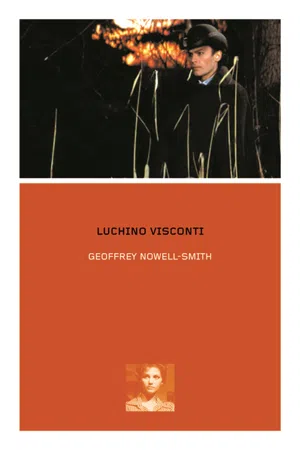
Luchino Visconti
About this book
Aristocrat and Marxist, master equally of harsh realism and sublime melodrama, Luchino Visconti (1906-1976) was without question one of the greatest European film directors. His career as a film-maker began in the 1930s when he escaped the stifling culture of Fascist Italy to work with Jean Renoir in the France of the Popular Front. Back in his native country in the 40s he was one of the founders of the neo-realist movement. In 1954, with Senso, he turned his hand to a historical spectacular. The result was both glorious to look at and a profound reinterpretation of history. In Rocco and His Brothers (1960) he returned to his neo-realist roots and in The Leopard (1963), with Burt Lancaster, Claudia Cardinale and Alain Delon, he made the first truly international film. He scored a further success with Death in Venice (1971), a sensitive adaptation of Thomas Mann's story about a writer (in the film, a musician) whose world is devastated when he falls in love with a young boy. A similar homo-erotic theme haunts Ludwig (1973), a bio-pic about the King of Bavaria who prefers art to politics and the company of stableboys to the princess he is supposed to marry. Geoffrey Nowell-Smith's classic study of the director was first published in 1967 and revised in 1973. It is now updated to include the last three films that Visconti made before his death, together with some reflections on the 'auteur' theory of which the original edition was a key example.
Trusted by 375,005 students
Access to over 1 million titles for a fair monthly price.
Study more efficiently using our study tools.
Information
Edition
11: Ossessione
Visconti’s interest in the cinema developed late. At an age when Orson Welles was directing Citizen Kane, when Alexandre Astruc could complain that he was ‘already twenty-six and had not yet made Citizen Kane’, and when most aspirant directors would be starting as documentarists or serving a long and laborious apprenticeship in the industry, Visconti was still living in seclusion and undecided about the future nature of his artistic interests. An accomplished musician, interested also in painting (interests which remain latent in his film work for a long time to emerge again more fully with Senso in 1954), his only foray into the world of spectacle was as set-designer for a play by G. A. Traversi in 1928. He was nearing thirty when in 1936 he left Italy with the intention of working in the cinema in England or France.
As luck would have it, and thanks to a chance meeting with Coco Chanel, he found himself, shortly after his arrival in France, attached to Jean Renoir’s semi-permanent production team in charge of costumes and then as assistant director on Une partie de campagne and Les Bas-Fonds.1 In an interview on BBC Television in 1966 he has recalled this experience mainly in terms of what it meant to him politically, to escape from a Fascist country and to find himself working on equal terms with a group of left-wing enthusiasts, many of them Communists, in the heady atmosphere of the Popular Front. That this part of his experience had a lasting effect on him and helped to shape his future political commitment there can be no doubt. What is harder to assess is Renoir’s influence on him as an artist. There is an obvious, if superficial, analogy between aspects of Renoir’s aesthetic in the 1930s and Italian neo-realism ten years later, just as there is between the French Popular Front and the post-war Italian left-wing bloc, to which Visconti belonged. Visconti’s career seems therefore like a bridge between the two. But on a personal level the differences between the two artists are far more striking than the similarities. Visconti’s debt to Renoir is mainly stylistic and is confined to one film, Ossessione, which he made during the war. After that, when Visconti begins to find his own feet and to establish an independent personality, all traces of Renoir’s influence disappear. They are, however, present in Ossessione, in the method used to establish a character, in the relationship of character to landscape, in the use of a fluid and yet probing camera, and, on a more generic plane, in a shared debt to the naturalist tradition – in Renoir’s case Maupassant and Zola, in Visconti’s Giovanni Verga and Italian regional literature.
In 1940 it was Renoir’s turn to come to Italy to make a film of La Tosca which was a cross between Sardou’s original melodrama and Puccini’s opera. For this film Visconti worked on the adaptation and then as assistant director. Renoir was not able to finish the film himself. He had just directed the opening sequences when Italy declared war on France, and Renoir left for the USA, leaving the film in the capable but uninspired hands of Carl Koch. Opinions differ on the subject of the finished film. In distant retrospect, Visconti regards it as mediocre and banal, falling far short of what he himself had envisaged and what Renoir might have made if he had stayed on. But something of La Tosca, whether echoes of the realisation or images of how he himself would have made the film, remained lodged in Visconti’s imagination to appear in the making of Senso, the most ‘operatic’ of Visconti’s films, fourteen years later.
The problem which faced Visconti in 1954, with Senso, was that of going beyond the realist aesthetic. In the early 1940s, however, this was hardly yet an apposite question. What seemed necessary at the time was the opposite – to achieve some elementary form of realism in the context of a national cinema that was totally insipid and conformist. Visconti belonged, if only on the margins, to a kind of artistic resistance movement that was beginning to grow up round about 1940. The members of this movement, young critics and aspirant directors centred round the Cine-GUF2 and the review Cinema, were all partisans, for political as well as aesthetic reasons, of a realistic cinema. Their literary idol was Verga, the great Sicilian late-nineteenth-century writer, and their ideal was a transcription into cinema terms of the naturalism, or more exactly verismo, of Verga’s novels and stories. But behind all the references to tradition what most of them wanted, and some of them achieved, was something quite different. Not all of them (one thinks particularly of Michelangelo Antonioni) emerged as realists of any description, let alone veristi or Vergani. There was a certain confusion even in the literary references themselves. Verismo as a diffuse aesthetic fell as far short of realism as Verga, as an artist, rose above it. But intellectual confusion does not stop ideas from being influential, and one of the first people to undergo the influence of the prophets of neo-realism, and to translate their ideas into practice, was Visconti.
Ossessione, his first film, was produced in 1942, in an atmosphere of general disturbance. Italy was fighting, and beginning to lose, a war around the Mediterranean. Within months of the film being finished the Allied forces landed in Sicily and began working their way slowly through the peninsula. The film did not emerge properly into the light of day until some years after the war, and then only in a severely mutilated and shortened version. As a result of these circumstances many legends have attached themselves to the story of the making of the film and an aura of mystification has come to surround its interpretation. The general purport of the legends is to bolster up the image of Ossessione as a precocious, maligned, and yet marvellous flower of the still inexistent neo-realist movement. Both in the legends and in the interpretation there is a nugget of truth. The film has origins in the cult of verismo and was to serve as an inspiration, of a kind, to later neo-realist production. But there is also a lot of legendary dross and more than a suspicion of critical alchemy in the proceedings. When the dross has been removed and the alchemy exposed, Ossessione emerges as a very different, and furthermore a greater rather than a lesser film, than its first admirers would ever have claimed.

Rustic realism: the influence of Renoir
Given a chance to direct a film of his own, Visconti’s first idea was a version of a short story by (significantly enough) Verga, L’amante di Gramigna. When the project was refused by the censors he turned instead to a suggestion of Renoir’s, an adaptation of an American thriller, James Cain’s The Postman Always Rings Twice, which had already served as the basis for a French film in 1939 and was to be filmed again by Tay Garnett in Hollywood in 1946. The story, widespread but poorly documented, has it that the choice of Cain’s novel as scenario was a subterfuge to deceive the Fascist censorship, which rubber-stamped the project as inoffensive on paper but was then horrified to see the most un-Fascist image of Italian life portrayed in the finished film, which transferred the action to an Italian setting. The censors then attempted to ban the film outright, but it was reprieved, so the story runs, only on personal instructions from the Duce himself.
This story, though somewhat inaccurate,3 is quite significant. It manages at the same time to exalt Visconti as a crusader for the new realism and to denigrate him subtly by suggesting that this aristocratic dilettante had friends at court who gave him an influence and an escape route denied to lesser mortals. In fact Mussolini did not reprieve the film, and Ossessione’s troubles did not end with the end of Fascism. More important, just as the censorship difficulties which Ossessione encountered have been misrepresented as simply a question of Fascist politics (they involved the Church, bien-pensant opinion generally, commercial distributors, and even the American occupying forces), so Visconti’s artistic intentions are simplified and belittled by the emphasis placed on the element of national realism in the adaptation.
Cinema criticism is often curiously nationalistic. While literary critics have acknowledged for a long time the profoundly renovating role played by American literature in the development of the Italian novel in the 1930s and 1940s, their cinema confrères have on the whole failed to recognise the debt of the Italian cinema to the same source – and to the American movies. It is partly the fact that in literature the connections are more obvious to the academic mind: Pavese wrote a thesis on Melville; Visconti did not write a thesis on Griffith. But there remains a strange reluctance to accept the obvious. The fiction persists that Visconti chose The Postman Always Rings Twice for no better reason than that it would not upset the censor and that the changes he made in his adaptation had no other purpose than to Italianise its indifferent theme. It never occurs to anyone to think that the story might have appealed to him precisely because it was American, and that he might have changed it not just to make it more Italian but to make it more Visconti. Ossessione certainly is very Italian, and it is also more realistic than Tay Garnett’s film of the same novel. But there is a lot more to it than that.
Ossessione is a film about the destructive power of sexual passion. A man turns up by chance at a roadside country inn, stays on as a labourer and falls in love (or in desire) with the inn-keeper’s wife and she with him. They decide to leave together, but after half an hour on the road she turns back and he goes away alone. A few weeks later the husband and wife encounter him again by chance in a nearby town and the husband, innocently, insists that he go back with them. On the journey the lovers, mainly at her instigation, murder the husband in a staged accident. They settle down uneasily to run the café. Unease and mutual mistrust grow when she collects on the old man’s life insurance and he suspects her of having used him to wield the hatchet to serve her own financial purposes. In retaliation he spends an afternoon with another girl, but slips away when he realises that the police are closing in. The lovers are reconciled, but as they drive away to escape imminent arrest their car skids off the road and she is killed.

Gino arriving … and departing

Melodramatic as this summary may sound, particularly the ending, it is not half so melodramatic as the novel or Tay Garnett’s rather literal adaptation. Visconti has in fact purified the story line considerably, removing the elements of crude and even ridiculous poetic justice in which the novel abounded (such as having the man acquitted of the real murder but sentenced to death for the accident) and adding or expanding elements only in order to introduce an extra dimension of structural coherence behind the apparent arbitrariness of the plot. The arbitrary and accidental character of events and, even more, the arbitrariness of human (but not divine) justice is an important feature of the novel, and also appears, rationalised in a half-hearted and uncomprehending fashion, in the Garnett film. Visconti rejects it utterly. Tragedy in his films is never a trick of providence, and in Ossessione, as later in Vaghe stelle dell’Orsa, the tragic outcome arises from the neces-sary logic of the situation into which the characters are thrown.
Turning Cain’s parable of arbitrariness into a demonstration of necessity required, however, more than a simple alteration of plot mechanics. It meant creating a new structural framework in which to define the actions of the characters, and consequently making the characters themselves different. In the film the lovers, Gino and Giovanna, are both in different ways partial outcasts. They have an uneasy relationship with established society. They are neither totally integrated nor totally independent, and it is their inability either to be fitted in or to break loose that leads to their destruction.
Giovanna has had a tough time in the past. Her euphemistic phrase, ‘I used to get men to invite me to supper’, contains an innuendo which is not difficult to grasp. Marriage, for her, to the superficially amiable but gross and uncomprehending Signor Bragana, was a last-ditch escape from a life of increasingly systematic prostitution; but it was an escape into slavery and mediocrity. Gino offers her passion and liberation, but on his terms, which to her are unacceptable. He proposes twice that they should leave together, and each time she hesitates. The first time, staggering ridiculously along the road in high heels, in the dust and heat, she is haunted by a fear of insecurity, and turns back. The second time, after the murder, it is not just a negative fear of insecurity that seizes hold of her, but positive ambition to enjoy, with Gino, a stability and comfort always denied to her. Despite Gino’s pleas, she insists on staying on at the inn. She rejects the only life that Gino can offer her, and wants the one which society has always refused her and refuses her still. She even commits murder for the sake of it – a desperate and unproductive gesture, because from that moment she is a fugitive and an outcast. Only courage screwed to the sticking place, like that of Lady Macbeth, can keep her dreams alive.
Gino, for his part, has no such dreams of security and advancement. He is a wanderer, a passer-through, going from place to place and job to job as his fancy takes him. If he can have a woman with him on his travels, so much the better. He seduces the provocative Giovanna in total unawareness of the consequences to which her ambition will lead him. Although he loves her, he cannot change his way of life. When Giovanna goes back to her husband, he prefers t...
Table of contents
- Cover
- Title Page
- Contents
- Dedication
- Preface [2002]
- A Note on Film Titles [2002]
- Introduction [1967]
- 1. Ossessione
- 2. La terra trema
- 3. Bellissima
- 4. Il lavoro
- 5. Senso
- 6. The Leopard
- 7. White Nights
- 8. Vaghe stelle dell’Orsa
- 9. Rocco and His Brothers
- 10. Lo straniero [1973]
- 11. The Damned [1973]
- 12. Death in Venice [1973]
- 13. Ludwig [2002]
- 14. Conversation Piece [2002]
- 15. L’innocente [2002]
- 16. Retrospect [2002]
- Select Bibliography
- Filmography
- Appendix: Theatre and Opera Stagings
- Index
- eCopyright
Frequently asked questions
Yes, you can cancel anytime from the Subscription tab in your account settings on the Perlego website. Your subscription will stay active until the end of your current billing period. Learn how to cancel your subscription
No, books cannot be downloaded as external files, such as PDFs, for use outside of Perlego. However, you can download books within the Perlego app for offline reading on mobile or tablet. Learn how to download books offline
Perlego offers two plans: Essential and Complete
- Essential is ideal for learners and professionals who enjoy exploring a wide range of subjects. Access the Essential Library with 800,000+ trusted titles and best-sellers across business, personal growth, and the humanities. Includes unlimited reading time and Standard Read Aloud voice.
- Complete: Perfect for advanced learners and researchers needing full, unrestricted access. Unlock 1.4M+ books across hundreds of subjects, including academic and specialized titles. The Complete Plan also includes advanced features like Premium Read Aloud and Research Assistant.
We are an online textbook subscription service, where you can get access to an entire online library for less than the price of a single book per month. With over 1 million books across 990+ topics, we’ve got you covered! Learn about our mission
Look out for the read-aloud symbol on your next book to see if you can listen to it. The read-aloud tool reads text aloud for you, highlighting the text as it is being read. You can pause it, speed it up and slow it down. Learn more about Read Aloud
Yes! You can use the Perlego app on both iOS and Android devices to read anytime, anywhere — even offline. Perfect for commutes or when you’re on the go.
Please note we cannot support devices running on iOS 13 and Android 7 or earlier. Learn more about using the app
Please note we cannot support devices running on iOS 13 and Android 7 or earlier. Learn more about using the app
Yes, you can access Luchino Visconti by Geoffrey Nowell-Smith in PDF and/or ePUB format. We have over one million books available in our catalogue for you to explore.