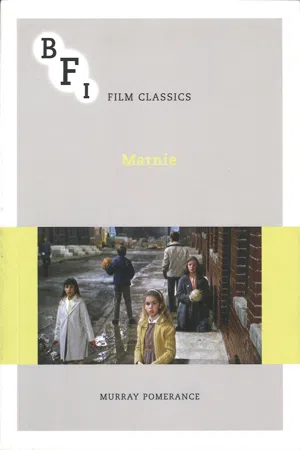
A thrilling tale of anxiety and moral extremity, Marnie (1964) cemented Alfred Hitchcock's reputation as a master of suspense and the visual form.
Murray Pomerance here ranges through the many tortuous and thrilling passages of Marnie, weaving critical discussion together with production history to reveal Marnie as a woman in flight from her self, her past, her love, and the eyes of surveilling others. Challenging many received opinions – including claims of technical sloppiness and the proposal that Marnie's marriage night is a 'rape scene' – Pomerance sheds new light on a film that can often be difficult to understand and accept on its own terms.
Original and stimulating, this BFI Film Classic identifies Marnie as one of Hitchcock's masterpieces, highlights the film's philosophical and psychological sensitivity, and reveals its sharp-eyed understanding of American society and its mores.
eBook - ePub
Marnie
About this book
Trusted by 375,005 students
Access to over 1 million titles for a fair monthly price.
Study more efficiently using our study tools.
Information
1 Fugue
Marnie Edgar is on the run. Our first glimpse finds her already in motion, striding confidently away from the camera on an empty railway platform, modernity apotheosised, her body fitted snugly into tweeds, her styled hair black as coal. Beneath her arm is a fat purse, a labial pouch in Provocation Yellow. We glide behind (the purse gripping our gaze), she stops to wait, and the scene fades. Soon later,1 two suitcases are open on a nondescript hotel bed, the silks of a soiled identity tossed into one, a crisp new masquerade folded into the other. A sheaf of ID cards hides behind the mirror of her compact. In the bathroom, a head plunged into the sink … that black industrial identity rinsed down the drain … and arising into camera view, brilliantly doubled in the mirror, the platinum hair of –
Our girl, eyes bright with triumph, complexion alabastrine. She has escaped, whatever the trap: in this case the bloated, piggy face of Strutt (Martin Gabel), grunting everlasting possession – ‘Robbed!’ – insatiable jealousy, resentment, malicious hunger for revenge.
In the explosion of that proud, beautiful face inside the wet ring of sparkling hair, we already loved her.
In dreams awake
Alfred Hitchcock proclaimed the chase ‘the final expression of the motion picture medium’, adding that its tempo and complexity were ‘an accurate reflection of the intensity of the relations between the characters’ (pp. 125, 129). Arriving in Philadelphia,2Marnie (‘Tippi’ Hedren) neatly deposits her old suitcase into a 30th St Station locker, the key into a heating grate on the floor.3 At Rutland & Co., under the pseudonym ‘Mary Taylor’, she applies earnestly for a job. The young boss, Mark (Sean Connery), is watching with interest; he gives the nod. Training with ever diligent Susan Clabon (Mariette Hartley4), then calmly scouting the premises of the office manager Ward (S. John Launer5) – in order that Marnie would stand out in it, specific instruction was given that Ward’s office should be painted a pale colour (Robertson to Boyle) – she makes plans to fleece her new employer. A habitual thief (and, as she presents herself here, widow), and trailing a chain of previous robberies and sloughed identities wherever she goes, Marnie springs directly from Winston Graham’s 1971 novel, which had been agented to Hitchcock’s assistant Peggy Robertson (Hall, Robertson: p. 231). Hitchcock’s practice was to treat popular fiction as Marnie treats employment, extract the principal treasure without obligation – to the author’s style, overall theme, or plot.6 If ever he had a female alter ego (as implied by Maxwell Coplan’s strange photograph in François Truffaut’s important interview book [p. 321]) Marnie is her epitome.

Our girl, free
In the washroom late one afternoon, she secretes herself in a stall until all the other employees have gone home (on Hitchcock’s obsession about toilets, see Spoto: p. 415 and note). Then, ‘borrowing’ the safe combination from its hiding place inside Susan’s desk (forgetful Ward must consult it several times a day), she nabs the company funds and tiptoes off, past the cleaner (Edith Evanson), who would hear Marnie’s shoe drop if she weren’t deaf. Flight is the theme: from her recent past; from her complicating job at Rutland’s; from the fact of her thievery (she proclaims herself an innocent); and then, upon her beloved stallion Forio, from every binding divot of turf which might position her in a fully drawn present. Only in the finale (which I will address at the finale of this book) do we learn how all of Marnie’s flights compose a single whirlwind escape – from a long-lost yesterday. In film, every moment is a flight from the moments before.


Stalled; on tiptoe
Unreal
Stalwart, sleek, and gleamy black, Forio is the one constant and true repository of love in Marnie’s life. She would fain visit her mother in Baltimore, but first a digression to Garrod’s farm for a ride on Forio.7 When Marnie is upon him a different kind of flight is involved, something more akin to the fugue states discussed in psychoanalytic theory, where locomotion is linked to neurosis. We have two senses of Marnie’s fall from reality: her tight interconnection with, and cherishing of, Forio, thus divorce from the walkaday world through postural elevation and dependence upon the organic motion of another being (sex can, yet need not, be implied); and her race into the future at a speed no human body can achieve on its own. Because of the way Hitchcock shows her, she is separated, withdrawn into a private world split psychologically and cinematically from everyday space and time. Effects were not needed to cover Hedren: she could ride well – the shot of her trotting toward the camera on Forio, and discovering the stoically angry figure of Mark, is made without a stand-in, in one fluid take ending on a close-up of ‘Tippi’ in the saddle. Yet most of the horseback shots were done in studio against a rear-projected background, thus depositing a strange dislocation and oneiricism in which Marnie floats, even flies, with the green world dropping away as in another dimension. More daydream than reality, these shots are invested with considerable affect and bear ‘traces of both the occasion which engendered [them] and of some past memory’ (Freud: pp. 45, 48). In the close-ups, a beatific remove is etched on her features as she bathes in an eery light.

Dislocation and oneiricism
While the argument could be made (by anyone unfamiliar with the technicalities of rear-projection filming) that Hitchcock is an unprofessional failure here – even his assistant thought ‘it didn’t look good’ (Hall, Robertson: p. 284) – we should recall his attraction to process work and cinematographer Robert Burks’s origins in special effects. Hitchcock knew how to get what he wanted, and how to vary the rear-projection effect. Later in the film, for instance, we see rear projections that are entirely imperceptible as such (for example, at the racetrack). Hitchcock intended Marnie’s riding sequences to appear precisely as they do: intermediates between unaffected reality and artful construction. They permitted him to lure his audience in two contradictory directions at once, away from and toward total identification with Marnie, who wants frantically to be only where she is. On Forio she can flee from a mother (Louise Latham), who, over-steeped in upright Christian values, apparently loathes her own daughter. Forio is the vehicle of Marnie’s soul, uplifting and redeeming her.
A similarly stunning separation or fugue occurs in the tiny Baltimore street where Bernice Edgar lives – ‘just like the north of England’ (Hitchcock to Hunter). Marnie is making another of her seemingly routine, if infrequent, visits early in the film, bearing a fur stole (spoils of the Strutt conquest but attributed to a beneficent, entirely fictional ‘Mr Pemberton’, for whom she ‘works’). Much later, she is dragged back there when Mark, having discovered that Marnie’s mother is not ‘dead’, and working out the moral obligations of his sincere love to the last turn, insists on solving the dark puzzle that has locked the young woman into herself. Both scenes include long and medium shots of the street, with children singing the strange little skipping rhyme ‘Mother, Mother, I am ill/Call for the doctor over the hill’.8 Hitchcock had wanted here to replicate a street running off London’s East India Dock Road: ‘You turn the corner and suddenly, there’s a ship! It’s in the street. You know, it’s actually at the end of the road’ (Albert Whitlock quoted in Krohn, The Birds: p. 41). His designer Robert Boyle worked with scenic artist Harold Michelson to make a huge backdrop with a ship painted on it, and Burks shot the scene to simulate first a sunny, then a rainy, day. Technically speaking, the ‘reality’ is distorted:
He wanted this looming image. And you know what it was. We tried to dissuade him and that’s where we made a mistake. He dug his heels in and he was determined to get this damned image, which, of course, was no longer possible, because really all we would see in 1.859 would be the hull. What would that mean? It would be just a black … totally unreadable. Harold had to keep drawing it so that the superstructure came in, so that you could see the funnel … and now it’s a ship and now it’s also too damn small. (Whitlock quoted in Krohn, The Birds: p. 41)

Stage 21 at Universal set for filming the finale at Bernice’s house (11 February 1964)
Many viewers detect a difference in realisation between this background and the brick row-houses, so that, expecting in movies only radical extremes of ‘realism’ or ‘artifice’, they judge Hitchcock’s vision sloppy, amateurish, and out of key.10 But the vision is perfectly achieved, since some intermediate state of mind between being at rest in her dream world of freedom and finding herself trapped in the socially determined and morally strict confines of Bernice’s home now afflicts, disturbs, displaces, even torments Marnie. Further, the performance rhythm and diegetic continuity would be interrupted, ruinously exaggerated, were Hedren to fully enact the emotional panic and distanciation Marnie feels. Her feelings are projected outward by way of the lighting and scenery, the qualitative distinctions that find their way to the eye. Marnie always feels one thing and does another, and the technique of doubling the screen actually mounts her doubled being as a visual concern.
Marky Mark
From Mark Rutland, too, Marnie is in flight. As a person, as a male, and as a capitalist, he antagonises her. The film is a map and history of this agon. Superficially an icon of the managerial class, scion of the Rutland publishing fortune – the 1960s antedated the digital revolution – Mark is a ‘marker’ of the staple transactional, economic materiél of Western culture. ‘The oral tradition [of the Greeks] emphasized memory and training,’ writes Harold Adams Innis, but ‘we have no history of conversation or of the oral tradition except as they are revealed darkly through the written or the printed word’ (p. 9). By the sixteenth century, ‘an enormous increase in production and variety of books’ and, by 1800, ‘the invention of the paper machine and the introduction of the mechanical press involved a revolution in the extension of communication facilities’ (p. 27). Money, legal texts, literature, advertising: by 1950 all of these were handled through publication.11Marnie has placed herself in conflict with dominant peers of the economic system, having undertaken as a hobby (now become quasi-professional) what sociologists call ‘craft thievery’:
Criminal craftsmen have always had to adopt some way of relating to the police to minimize their effectiveness. The simplest and most obvious way of relating is avoidance, and, as we have seen, many of the techniques of craft crime serve to prevent people, including the police, from knowing a crime is taking place and, when they have f...
Table of contents
- Cover Page
- Title Page
- Contents
- Acknowledgments
- The Story
- 1. Fugue
- 2. Droit du Seigneur
- 3. Confederacy
- 4. Face-off
- 5. I Remember Mama
- Notes
- Credits
- Bibliography
- eCopyright
Frequently asked questions
Yes, you can cancel anytime from the Subscription tab in your account settings on the Perlego website. Your subscription will stay active until the end of your current billing period. Learn how to cancel your subscription
No, books cannot be downloaded as external files, such as PDFs, for use outside of Perlego. However, you can download books within the Perlego app for offline reading on mobile or tablet. Learn how to download books offline
Perlego offers two plans: Essential and Complete
- Essential is ideal for learners and professionals who enjoy exploring a wide range of subjects. Access the Essential Library with 800,000+ trusted titles and best-sellers across business, personal growth, and the humanities. Includes unlimited reading time and Standard Read Aloud voice.
- Complete: Perfect for advanced learners and researchers needing full, unrestricted access. Unlock 1.4M+ books across hundreds of subjects, including academic and specialized titles. The Complete Plan also includes advanced features like Premium Read Aloud and Research Assistant.
We are an online textbook subscription service, where you can get access to an entire online library for less than the price of a single book per month. With over 1 million books across 990+ topics, we’ve got you covered! Learn about our mission
Look out for the read-aloud symbol on your next book to see if you can listen to it. The read-aloud tool reads text aloud for you, highlighting the text as it is being read. You can pause it, speed it up and slow it down. Learn more about Read Aloud
Yes! You can use the Perlego app on both iOS and Android devices to read anytime, anywhere — even offline. Perfect for commutes or when you’re on the go.
Please note we cannot support devices running on iOS 13 and Android 7 or earlier. Learn more about using the app
Please note we cannot support devices running on iOS 13 and Android 7 or earlier. Learn more about using the app
Yes, you can access Marnie by Murray Pomerance in PDF and/or ePUB format, as well as other popular books in Mezzi di comunicazione e arti performative & Film e video. We have over one million books available in our catalogue for you to explore.