- 152 pages
- English
- ePUB (mobile friendly)
- Available on iOS & Android
eBook - ePub
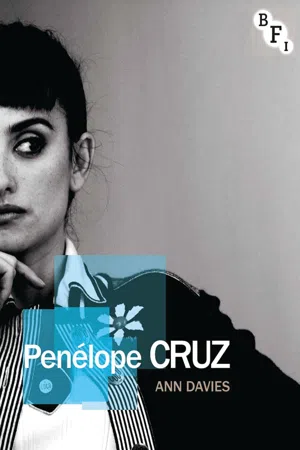
Penelope Cruz
About this book
Part of a vanguard of Spanish talent claiming success at home and in Hollywood, Penélope Cruz is one of the best known European stars today. Focusing on Cruz's key films and their surrounding discourse, Ann Davies charts the development of Cruz's star persona both at home and abroad and the questions, difficulties and pleasures it inspires.
Trusted by 375,005 students
Access to over 1 million titles for a fair monthly price.
Study more efficiently using our study tools.
Information
1 PERFORMING YOUTH
This chapter looks at Cruz’s early roles, in particular Jamón Jámon and Belle Époque, to demonstrate not only Cruz’s function as a star in embryo, but also how her persona encompasses different aspects of female youth. It contrasts the tensions of young sexuality (Jamón jamón) with the demands of being a good girl (Belle Époque), and argues that in these films Cruz’s persona contains these tensions that arise as a consequence of the demands and expectations placed by different sectors of society on young women both within the films themselves and in the discourse that surrounded Cruz as a young star. The chapter will also consider youth as something that is performed as opposed to a naturally occurring phenomenon. Cruz’s persona – which derived initially from these films – assumed a strong element of appearing natural precisely because Cruz was young and supposedly unformed and inexperienced: the question arises as to whether this derived from her actual self rather than being something assumed, thus in turn raising a question as to how far the persona coincides with the ‘true’ personality and to what extent the former is performed.
The two films that form the focus of our discussion in this chapter have been selected because of their fundamental importance in putting Cruz on the cinematic map. We need, nonetheless, to remember that these were two highlights of Cruz’s early career more generally wherein she dedicated herself to playing mostly ingénue parts in a series of Spanish comedies. The emphasis on comedy coincides with the idea of exaggerating – and, thus, performing – the exuberance of youth. A good example is the film El amor perjudica seriamente la salud (Love Can Seriously Damage Your Health, 1996), unknown outside Spain. The film centres on the on–off love affair in middle age between Santi (Juanjo Puigcorbé) and Diana (played by older, established Spanish star Ana Belén), but has many flashbacks to the time in the 1960s when the couple first met and fell in love, and Cruz plays the younger Diana in these flashback sequences. There is an association of the young Diana with political and social events of national importance, such as the birth of the son of the future King Juan Carlos, that point forward to the question of national identities that is the focus of the next chapter. But here the emphasis is on Cruz as young, kittenish (the latter characteristic will be maintained by Belén in her own performance), and desirable to a young audience. Her first major sequence, in which she demonstrates an obsession for John Lennon of The Beatles and strips to her underwear in anticipation of seduction by the Beatle in question, associates her with the mad passions of young people, the desirable perfections of a youthful body and past history. There is a strong contrast between the young Diana’s hyperbolic actions in pursuit of Lennon, and, following a news announcement of Lennon’s assassination, the mature mourning of the singer by the older Diana, sitting in silence in a bar as The Beatles’ ‘Let It Be’ is played on a piano. It is the hyperbole that underscores the sense of performance in Cruz’s acting out of youth. Her exaggeration of giddy youth is amusing precisely because it is exaggerated. It is also charming in its cheekiness, as when Diana manages to get access to the hospital room in which Prince Juan Carlos is celebrating the birth of his new son (and heir to the throne). The liveliness, the charm and the cheek are elements of Cruz’s star persona that persist into some of her more mature performances, and thus beyond youth. This does not necessarily make them unnatural but it does suggest they are elements that can be repeated deliberately and, thus, performed.

A young Diana in search of The Beatles in El amor perjudica seriamente la salud (1996)
The liveliness of youth, with its occasional extravagances, can be found in Jamón jamón and Belle Époque as well. All three films also take and exploit other characteristics of youth, innocence and inexperience; and again the question arises as to how far this can be said to be deliberately performed. It is worth bearing in mind Cruz’s young age (sixteen) at the time of making Jamón jamón in particular, a film requiring some nudity and fairly lengthy sex scenes. Sources show some ambivalence on Cruz’s part as to this particular role. Javier Ángulo Barturen cites Cruz as claiming that she had previously tested for director Bigas Luna’s film Las edades de Lulú (The Ages of Lulu, 1990) at about fourteen: Lulú was even more sexually explicit than the later Jamón jamón. At that time, according to Ángulo Barturen, Cruz already felt herself to be a woman well past adolescence (Ángulo Barturen, 2007, p. 56): thus, by implication, she could cope with the demands of performing sexuality. This may, of course, be merely naivety on Cruz’s part at this time, but it also suggests that she did not think of herself as an innocent and vulnerable adolescent. It may also coincide with ambition: looking back on Cruz’s early role in the light of her later international success, the film’s director Bigas Luna reminisced about a hunger for success that he felt Cruz demonstrated even at this early stage in her career (Marín, 2007). If this was Cruz’s thinking prior to making Jamón jamón, she was to be disillusioned. Celestino Deleyto notes the burden on Cruz, who said she felt damaged by the role, as she was not mature enough to play it at that time (Deleyto, 1999, p. 278). Elsewhere, she asserted that she had never regretted making the film, but was nervous about it trapping her into a direction she did not wish to go (without specifying what she meant by that), and so was grateful to act in Belle Époque immediately afterwards (García, 2007). Reports from Cruz thus demonstrate a certain ambivalence as to her role as Silvia in Jamón jamón. She does not want to offend a director who has had a fair measure of success in a national film industry that is rather small, and she cannot ignore the pivotal function of the film in launching her career. Nonetheless, she seems to feel that, after all, she did not at that time possess the maturity to cope with the sexuality the role demanded. This might imply that deep down Cruz has a natural innocence that was submerged by her own ambition: it would certainly seem that any notion of youthful naivety was not something deliberately produced by Cruz for the role of Silvia.
However, when we take the film in tandem with her subsequent production, Belle Époque, we can perceive innocence as a performance as opposed to a ‘natural’ expectation. Cruz was concerned about the over-sexualised image acquired through her work on Jamón jamón, and fought hard to land a role that would give her résumé more depth (Ángulo Barturen, 2007, p. 183). Fernando Trueba did not originally consider her suitable for the role of Luz in Belle Époque. On the director’s commentary for the DVD of Belle Époque, he says that he thought Cruz very sexy, but what he wanted was a young virgin of about fourteen. He was not even going to give her a test, but changed his mind when her agent sent him a tape of her acting out one of the scenes, which convinced him that she would be perfect for the role: he felt that one could believe in her youth. Here Cruz carries out the opposite of her attempts to land a role with Bigas Luna: if previously she aimed to demonstrate that she was more mature than might be expected of someone her age, now she wishes to appear precisely as the virginal fourteen-year-old she denied when auditioning for Las edades de Lulú. So Cruz is making a deliberate effort to prove she can be ‘naturally’ young and virginal. The two films thus need to be taken in tandem in order to get a true sense not only of the star persona being shaped at this early stage but also Cruz’s own active desire to ensure a wider range of roles were available to her.
Jamón jamón
The plot of Jamón jamón begins with the love affair between Silvia (Cruz), a worker in a factory making men’s underwear, and José Luis (Jordi Mollà), the son of the factory owners Conchita (Stefania Sandrelli) and Manuel (Juan Diego). The film begins with Silvia informing José Luis of her pregnancy: the couple get engaged, but Conchita, furious at losing her beloved son to a working-class girl and daughter of a sex worker, plans to break the couple up. To do this she enlists the help of Raúl (Javier Bardem), who has applied to be a model for the factory’s underwear: she asks him to seduce Silvia in exchange for rewards such as a motorbike or car. He duly agrees to do this, and Silvia is subsequently torn between the choice of José Luis, who is passive and puny but who represents aspiration to better things, and Raúl’s earthy passion and exaggeratedly male physique. Eventually, she and José Luis quarrel, and she chooses Raúl; but Raúl, meanwhile, has become sexually involved with Conchita. Silvia goes to Manuel for help, and he in turn begins to seduce her. José Luis, meanwhile, discovers his mother’s affair with Rául, and the two young men fight. José Luis is accidentally killed in the fight, and the film ends as the central characters gather round his body.

Cruz as Silvia in Jamón jamón (1992)
This bald summary suggests the film as a tragedy or melodrama, but in fact it is for the most part a bawdy comedy until the sudden change of mood with José Luis’s death: even the fight that leads to this point has its humorous side as the young men fight with ham bones from the ham warehouse where Raúl works. This is also a film that comically emphasises masculinity from the opening sequences, where the black background against which the opening credits roll turns out to be a close-up of the testicle of an advertising hoarding shaped as a bull’s silhouette (an advertisement for brandy that is now an iconic image of the Spanish countryside and preserved as an item of heritage). Immediately after this shot we cut to a scene of Raúl and his friend practising bullfighting, and the camera offers another close-up, this time of Raúl’s erection outlined behind his shorts. The crude emphasis on masculine genitalia sets the comic tone for the film. Men are very much the butt of this humour, but Jamón jamón has things to say about women, too, and it is not always positive, nor is it necessarily funny. Conchita is snobbish and her desire to keep her son away from Silvia borders on the incestuous, while her affair with Raúl is based in part on sheer mercenary values, her willingness to give him consumer goods such as cars and bikes in exchange for sex. Silvia’s mother Carmen (Anna Galiena) is a sympathetic and caring mother, working in a roadside brothel primarily to ensure food on the table for her daughters, and thus is a more positive figure than Conchita, but this does not stop her entertaining her own daughter’s fiancé in the brothel. In this book, however, our primary concern is Silvia, the central character; and Silvia, too, has her negative characteristics.
This is not to deny Silvia’s pivotal role as a sympathetic character, a pretty young woman who loves and is loved by her mother; who combines love for José Luis with a not unnatural desire to improve her lot in unpromising surroundings, and who blends an innocent vulnerability with a lively ability to hold her own against Raúl’s flirtatious compliments. Her wistful desire for a closet full of shoes could be seen as mercenary, another example of the obsession with consumerism and consumption that pervades the entire film; but it can also be seen as an innocent pleasure or indulgence. The negativity derives from her role as a possible castrator of men. This is indeed true of all three principal female characters to a greater or lesser extent: the male characters become impotent, infantilised or passive in their encounters with these women. The male body becomes a passive object of desire for women’s scopophilic pleasure, as when Silvia stares lovingly at the advertising billboard featuring Raúl’s crotch modelling underwear, or when Conchita examines the footage of the modelling applicants. Women have control over this crucial area of the male body: as Conchita claims, they are the ones that make the purchasing decisions as to male underwear, and they are also the ones who sew the underwear to frame the male genitalia. Immediately after the opening sequence that emphasises testicles and erect penises, we cut to a montage of images from the underwear factory that suggest castration: women tracing and cutting round the genital area of the underwear with sharp cutting implements, or sinking teeth into a phallic shaped ham roll at lunchtime. Silvia’s own castrating role can be detected at various points, most notably when she dreams of choosing between Raúl and José Luis: their images float through her dream, immediately followed by a shot of two greyhounds racing as if in competition. Later in the dream Silvia, naked in the landscape, appears undecided between the two hambones she is holding. The dream prefigures the duel to the death at the end of the film, but it also bestows on Silvia the power of choosing while the men compete for her favours, thus depriving them of a certain measure of power. However, castration here is not simply a figurative loss of power but a direct threat to the penis. Silvia dreams of cutting through a bull’s horn, slicing it off: this, combined with the subsequent image of an apparently castrated Raúl hanging from some goalposts, stresses Silvia’s malignant power of cutting (after all, she works in the underwear factory too). Thus, although Silvia is the most sympathetic character out of the women, she shares with them a castrating power that is dangerous to men. This element of the film, as opposed to the contrast between male posturing and their emasculation, is not played for comic effect at all.
Now at this point in her career Cruz has no star persona to speak of, so early films such as this one are crucial in laying the foundations for the persona she would subsequently present. From the very beginning of her visible presence as a leading actor, then, we find elements of danger and of women as stereotypically castrating and malign. It gives Cruz in her role of Silvia an element of power that is not always positive. Silvia/Cruz can be dangerous. This is, nonetheless, only one element of the role of Silvia that would form some of the foundations of Cruz’s star persona, as the role also suggests that her power over Raúl is positive but also vulnerable. We see this from the sequence in which Raúl and his friend seek help at Silvia’s house after their daredevil nude bullfighting stunt which ends in their naked getaway from the overseer’s gun. The two young men arrive at Silvia’s door pre-castrated as it were, covering their genitals with chairs from outside the house, their bravado reduced to pathos. When Silvia comes out of her door, she is holding a large knife that carries its own menace and threat of castration.1 As they come into the house for clean clothes, she is clearly in charge. But at this point her power is made more benign by her actions of care, not only providing the missing clothes but also cleaning Raúl’s bruised and dirty foot, anointing his foot with oil in a virtually biblical fashion. Her positioning at Raúl’s foot does something to diminish her power. The moment Raúl becomes too flirtatious, however, she is able to take charge and throw him out, though not without a smile at the faces he pulls at her through the window. She has control but is clearly attracted.
In this scene Cruz demonstrates a great deal of poise, an ability to handle and perform control mixed with desire at a surprisingly mature level given her young age at this point. Her upright stance with shoulders thrown back and her firm tone of voice suggest an assured authority. If Cruz represents youth, it is a youth that is, in this scene at least, strikingly confident. Yet elsewhere Silvia does not have the power to galvanise José Luis into breaking with his mother and marrying her. José Luis’s reaction to her desire for Raúl is a virtual rape of her under the bull hoarding: he also punches the testicle on the bull hoarding until it breaks off, and Silvia uses it to shelter from the pouring rain as she runs to Raúl, the testicle symbolising the need for male protection. This extends further to José Luis’s father Manuel, whose immediate sexual moves on her when she goes to him for help suggest an all too familiar and easy equation between protection and sexual favours. In being at the sexual whim of the three male characters Silvia seems very much less than empowered.
Peter Evans has noted how the idea of needing protection and the search for a father figure has penetrated Cruz’s star persona. Evans observes that Cruz has often played the role of daughter in her early films (Belle Époque being one of these), or a role akin to that of daughter: in addition, her role as ‘la niña’ in La niña de tus ojos (which will form part of our discussion in the next chapter) also emphasised her role as a sort of child, since ‘niña’ in Spanish means a little girl. Evans argues that in this film (as we shall subsequently see) Cruz becomes ‘nuestra Penélope’ or ‘our Penélope’, the child of all Spain (Evans, 2004, pp. 54–5). Nonetheless, Evans argues, this positioning as a vulnerable daughter needing love and protection is not incompatible with a pronounced erotic quality. He points to an image of Cruz taken in 1997 for the Spanish film magazine Cinemanía in which she is dressed in 1960s style: she is looking downwards in a...
Table of contents
- Cover
- Title Page
- Contents
- Acknowledgments
- Introduction
- 1. Performing Youth
- 2. Performing Nation
- 3. Performing Otherness
- 4. Performing Performance
- Conclusion
- Notes
- Bibliography
- Filmography
- Index
- List of Illustrations
- eCopyright
Frequently asked questions
Yes, you can cancel anytime from the Subscription tab in your account settings on the Perlego website. Your subscription will stay active until the end of your current billing period. Learn how to cancel your subscription
No, books cannot be downloaded as external files, such as PDFs, for use outside of Perlego. However, you can download books within the Perlego app for offline reading on mobile or tablet. Learn how to download books offline
Perlego offers two plans: Essential and Complete
- Essential is ideal for learners and professionals who enjoy exploring a wide range of subjects. Access the Essential Library with 800,000+ trusted titles and best-sellers across business, personal growth, and the humanities. Includes unlimited reading time and Standard Read Aloud voice.
- Complete: Perfect for advanced learners and researchers needing full, unrestricted access. Unlock 1.4M+ books across hundreds of subjects, including academic and specialized titles. The Complete Plan also includes advanced features like Premium Read Aloud and Research Assistant.
We are an online textbook subscription service, where you can get access to an entire online library for less than the price of a single book per month. With over 1 million books across 990+ topics, we’ve got you covered! Learn about our mission
Look out for the read-aloud symbol on your next book to see if you can listen to it. The read-aloud tool reads text aloud for you, highlighting the text as it is being read. You can pause it, speed it up and slow it down. Learn more about Read Aloud
Yes! You can use the Perlego app on both iOS and Android devices to read anytime, anywhere — even offline. Perfect for commutes or when you’re on the go.
Please note we cannot support devices running on iOS 13 and Android 7 or earlier. Learn more about using the app
Please note we cannot support devices running on iOS 13 and Android 7 or earlier. Learn more about using the app
Yes, you can access Penelope Cruz by Ann Davies in PDF and/or ePUB format, as well as other popular books in Media & Performing Arts & Film History & Criticism. We have over one million books available in our catalogue for you to explore.