The rise of the administrative state is the most significant political development in American politics over the past century. While our Constitution separates powers into three branches, and requires that the laws are made by elected representatives in the Congress, today most policies are made by unelected officials in agencies where legislative, executive, and judicial powers are combined. This threatens constitutionalism and the rule of law. This book examines the history of administrative power in America and argues that modern administrative law has failed to protect the principles of American constitutionalism as effectively as earlier approaches to regulation and administration.
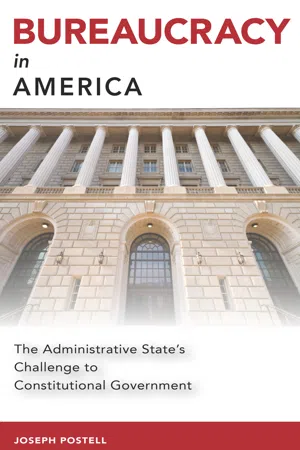
eBook - ePub
Bureaucracy in America
The Administrative State's Challenge to Constitutional Government
- English
- ePUB (mobile friendly)
- Available on iOS & Android
eBook - ePub
Bureaucracy in America
The Administrative State's Challenge to Constitutional Government
About this book
Trusted by 375,005 students
Access to over 1.5 million titles for a fair monthly price.
Study more efficiently using our study tools.
Information
CHAPTER ONE
An Improved Science of Administration
Administration and the American Founding
BY THE TIME the Framers reached the Philadelphia Convention in 1787 and established the U.S. Constitution, they had acquired extensive experience to guide them in establishing administrative structures. Their experience with administrative power in the colonial period, at the state level during the Revolutionary War, and at the national level during the same period, guided them in establishing administrative power in the new government. Though they did not specify in great detail the kind of administrative regime they sought to construct in the Constitution itself, they had reached clarity on certain fundamental constitutional principles. These principles were repeatedly articulated in the debates at the Convention and in the ratifying debates, as illustrated in the state ratifying conventions and in writings such as The Federalist. This chapter begins with an examination of the lessons of experience that informed the debates and decisions made at the Constitutional Convention in 1787, before proceeding to examine the debates at the Convention and during the ratification of the Constitution.
Colonial Experience
The American Colonies were established with a variety of institutional arrangements, but the essential institutional dynamic in each colony was the same. As Judith Best has explained, “Although there were three kinds of colonies in America—royal, proprietary, and corporate—the general experience in the American colonies was one of continuous struggle between colonial governors and colonial assemblies.”1 Royal colonies were those in which the governor was royally appointed; proprietary colonies allowed the proprietor to choose the governor with the approval of the crown. Only in the corporate colonies (Connecticut and Rhode Island) were the governors popularly elected. By 1760 most of the colonies were royal colonies.2
The colonies possessed essentially the same forms of government regardless of type, with a governor, a bicameral legislature (in most cases), and a “Governor’s Council,” composed from the upper house of the legislature, which advised the governor on executive decisions, served as the highest appeals court in the colony, and acted as one half of the legislative branch—combining legislative, executive, and judicial functions.3 The members of the council were selected by the crown or proprietor, but typically the governor’s preferences were followed.4 The lower houses were elected and were referred to variously as the House of Burgesses, the General Court, or the Assembly. Justices of the peace, county courts, and circuit courts constituted the judicial structure beneath the Governor’s Council. The governor served (sometimes alone, sometimes with the Council) as the chancellor with jurisdiction in equity cases.5 Appeals from the colonial courts were heard by the crown’s Privy Council.6
Colonial governors were vested with important powers and were supervised by royal authorities such as the English Board of Trade, a committee of the English Privy Council. These authorities could recall governors who violated their orders. In addition to a standard set of executive powers, the governor could summon, prorogue, and dissolve the legislature—powers, which were controversial and which were frequently used throughout the eighteenth century.
The colonial assemblies retained the power to initiate legislation and control taxing and spending. Legislation could be vetoed by governors or the Privy Council but the assemblies possessed autonomy on fiscal matters. The colonists quickly learned that a legislature could use its fiscal powers to wrest control over executive and administrative personnel, and the colonial legislatures gradually became ascendant over the governors as a result of the shrewd employment of their financial powers.7 In New York, New Hampshire, and North Carolina, governors went without pay for several years in the 1720s and 1730s as assemblies stopped appropriating funds for their offices.8 While this tactic was helpful in checking overzealous executives, it would eventually become a lamentable tactic that enervated the basic functions of government during the Revolution.
In sum, colonial government featured representative lower houses of the legislature, combined with governors and upper houses, which were unrepresentative and tended to advance royal interests. This set up a dynamic between legislative and executive power in which the latter was viewed with great suspicion. For the most part, however, administration was situated not in the executive but in the judicial branch, which (in contradistinction to today) was the real engine of colonial regulation and administration.
Judicial Administration: A State of Courts
The most extensive powers in the colonies fell under the judicial heading. As William Nelson has explained, “Colonial government, unlike our own, did not consist of a vast bureaucracy with clear chains of command reaching upward to central political authorities. Instead there were a number of courts, whose judges and subordinate officers were appointed and in part enforced law enacted by political authorities but met in various localities under scrutiny of the community as a whole.”9 The courts, in short, were in most cases the administrators.
The structure of the judicial power in colonial Massachusetts illustrates the general principles followed in the colonies, which were based on the English system.10 Power was organized into three tiers. The first tier consisted of individual courts of the justices of the peace, which were appointed by the governor and council of the colony (though colonial assemblies often checked or assumed this authority).11 These justices had both civil and criminal jurisdiction within the county in which they served and could impose limited fines and criminal punishments such as imprisonment for twenty-four hours or whipping. Justices of the peace were highly accountable to the local communities they served.12 They were essentially agents of local communities for carrying out the regulation of their own affairs.
Appeals from the decisions of the justices of the peace were to county-based courts. In Massachusetts appeals went to the Court of General Sessions of the Peace (“Sessions”) in criminal matters, and to the Inferior Court of Common Pleas in civil matters. These courts were composed of all of the justices of the peace in each county sitting together. They met routinely (Sessions met quarterly in Massachusetts) and heard appeals in criminal matters, with trial by jury.13 In addition, these courts served as “the chief administrative agenc[ies] of the county, having supervision, among other things, of county property, roads, and the poor.”14 In Massachusetts Sessions courts “served their counties as regulatory agencies.” They “supervised colony finances; regulated highways; controlled the establishment of inns and liquor retailers; . . . exercised a kind of pure-food jurisdiction,” and so forth.15 It was the county courts, then, that performed most of the regulatory and administrative duties in the colonies.16 The regulatory bodies, then, were composed of local justices of the peace, keeping the community in charge of regulation and administration.
Above the county courts and at the next rung of the judicial ladder typically sat the general circuit courts, often composed of the governor and the council, but sometimes (as in Massachusetts) consisting of full-time judges appointed by the governor and council. Some colonial charters also allowed for appeal to the Privy Council in England once colonial appeals had been exhausted. In Massachusetts, for example, the Privy Council could hear appeals from cases where the amount in controversy surpassed three hundred pounds.17
Guarding the Guardians
If officers frequently held “coercive power of a criminal, administrative, and civil nature,” how did the colonists prevent such power from being exercised arbitrarily?18 The answer to this question reveals much of the “administrative law” of the colonial period—the methods by which administrative power would be limited by law.
The colonial approach contrasts dramatically with that of the present day. Since courts were the only agencies “that had jurisdiction to fine or otherwise punish and hence ultimately coerce people who broke the law,” they were the administrative agencies of the colonies.19 Administrative law did not start with judicial review of administrative activity; the courts were the administrators themselves.20 In the rare cases where administrative officers such as assessors, sheriffs, and selectmen had the power to coerce citizens, courts had supervision over the legality of their actions—what we normally associate with administrative law today, namely, the judicial review of administrative action. Courts commonly overturned administrative action, for instance granting tax abatements by overturning assessors’ decisions on grounds of reasonableness.21
In addition, administrative officials themselves “were subject to common law actions for damages whenever in the exercise of their duties they committed a wrong.”22 Sheriffs were liable not only for their own misconduct but also for that of their deputies. Constables and jailers who lost prisoners could be sued. Improper arrests and invasions of property were proper subjects of lawsuits. Illegal searches of property could be remedied by damage actions against the offending officers. And as Paul Moreno explains, “If a tax collector took too much of one’s property, one had to sue him to recover the excess.”23
To protect themselves from such actions, administrators in many jurisdictions sought general warrants and writs of assistance. Established by the Navigation Act of 1696, writs of assistance were general warrants, signed by judges, which gave customs officers open-ended authority to invoke probable cause and search warehouses and other private property for illegal or untaxed goods. These writs were valid for the entire life of the official rather than for single searches.24 Suits for trespass were inapplicable because the writ shielded the official from liability.25 Yet as Philip Hamburger explains, in 1761 when Parliament reauthorized the writs (following the death of King George II), “a rejection of administrative warrants became one of the foundations of the American Revolution.”26 Among others, James Otis opposed the issuance of these writs and appealed to the Massachusetts Superior Court “to demolish this monster of oppression, and tear into rags this remnant of Star Chamber tyranny.”27 It was “the worst instrument of arbitrary power” through which “Custom house officers may enter our houses when they please . . . and whether they break through malice or revenge, no man, no court can inquire.”28 Otis therefore emphasized not just the power of invasion that the writs granted, but also the inability to challenge the searches in a court of law after the fact.
Though Otis lost in 1761, he inspired further resistance to such writs, and laid the groundwork for their abolition. (John Adams went so far as to declare that Otis “hurried away all before him. American Independence was then and there born.”)29 When the 1767 Townshend Revenue Act reinstated writs of assistance and authorized colonial courts to issue them, courts refused to do so.30 Complaints about the writs abounded in Revolutionary era pamphlets, including Samuel Adams’s “Rights of the Colonists,” which appeared in 1772:
“Each of these petty officers so made is intrusted with power more absolute and arbitrary than ought to be lodged in the hands of any man or body of men whatsoever . . . full power and authority from time to time, at their and any of their wills and pleasures . . . to enter and go on board any Ship, Boat, or other Vessel . . . and also in the day time to go into any house, shop, cellar, or any other place.” “Thus our houses and even our bed chambers, are exposed to be ransacked. . . . By this we are cut off from that domestic security which renders the lives of the most unhappy in some measure agreeable. Those officers may under color of law and the cloak of a general warrant, break through the sacred rights of the domicile.”31
Thus, the American Revolution established as a basic principle of American constitutionalism that executive officers could not be placed above liability for following the law. Most of the state constitutions established after independence was declared contained bills of rights that expressly forbade general warrants.32
Finally, when a law imposed statutory penalties, these could be collected by private enforcers bringing actions against the lawbreakers. This arrangement gave ordinary citizens a pecuniary interest and incentive in enforcing the laws privately through lawsuits. These “qui tam” actions were extensively relied upon for enforcement rather than the employment of a full-time administrative officer, thus limiting the need for full-time bureaucratic enforcement. Administrative action could be shielded from arbitrariness by using private citizens, rather than the agencies themselves, as the prosecutorial mechanism.
“There was, in short, little that one acting on behalf of government could do without rendering himself liable to legal action in the event that he wronged another,” Nelson concludes.33 Courts acted not only as the first administrators and enforcers of laws, but also as the arena for review of administrative power when it was exercised by other officers. Through overturning official action, entertaining private suits enforcing statutory penalties, and holding administrative officers liable for damages, courts were an active part of the administrative process in colonial America. They were the colonial alternative to a vast administrative apparatus.
“I Will Breake Theare Heads”: Timid Officers and Assertive Citizens
The active role played by courts in colonial administration raises the question of how to restrain the courts themselves. The colonial response to this problem was to reduce judicial discretion as much as possible through making judges accountable to the community. Just as administrators such as justices of the peace were kept accountable through frequent elections, courts would be kept accountable through the common law and through juries.
The right to trial by jury was critically important to the American colonists because it provided a check against arbitrary power exercised by royally appointed judges. For this reason, as William Nelson explains, “[J]uries in pre-revolutionary Massachusetts could ignore judges’ instructions on the law and decide the law by themselves in both civil and criminal cases.”34 This ensured that the administration of the law, both in its development and in its application, would be accountable and therefore not arbitrary: “the law applied in the towns of Massachusetts on a day-to-day basis was not the product of the will of some distant sovereign” but rather the manners and customs of the people themselves.35 The jury’s power over both the interpretation and the application of law helped to keep judicial arbitrariness at bay.
The result of this structure of administrative power in the colonies was twofold. First, the absence of a powerful executive and administrative branch weakened the ability of the government to enforce law against the wishes of the community. Second, this phenomenon ensured that law was in accordance with custom, a principle central to the idea of common law. As Nelson explains, these features of administrative law “rendered formal institutions relatively weak.”36 “[S]ubordinate officials like sheriffs, deputy sheriffs, and constables,” he continues, could enforce their judgments “only when local communities were willing to permit judgments to be enforced.”37
This phenomenon is aptly illustrated by an episode Nelson relates. In this case a parson who led a dissenting religious sect was “threatened with coercion by a committee of the General Court.” The citizen responded to the officers: “Let them come into my field, I will breake theare Heads. . . . I do not fear it, I can have anofe to assist me in that afare; Let them Come in to my field if they Dare, I will split theaire braines out.”38 This episode demonstrates that administrative officers, in practice, were relatively weak and lacked the authority to enforce their will on communities disposed to resist them.
Local Government Power: From Consolidation to Separation
Colonial administration, therefore, rested upon courts as opposed to bureaucracies and used common-law actions to keep both judges and county officers accountable. The advantages of this approach were replicated by the structure of local government, especially in the townships in New England.
Towns were legal corporations that were represented in the legislature and were recognized as basic political units. In Massachusetts they were established by the General Court, which in the early coloni...
Table of contents
- Cover Page
- Title Page
- Copyright Page
- Dedication
- Contents
- Acknowledgments
- Introduction
- Chapter One. An Improved Science of Administration: Administration and the American Founding
- Chapter Two. Well-Regulated and Free: Administration and Constitutionalism in the Early Republic
- Chapter Three. Executive-Centered Administration: Administrative Law and Constitutionalism during the Jacksonian Era
- Chapter Four. The Beginning of Bureaucracy? Administrative Power after the Civil War
- Chapter Five. A New Science of Administration: Progressivism and the Administrative State
- Chapter Six. The Crisis of Legitimacy: The New Deal Challenge to American Constitutionalism
- Chapter Seven. “A Surrogate Political Process”: The 1970s Administrative Law Revolution
- Chapter Eight. The Conservative Counterrevolution? The Rise of a Jurisprudence of Deference
- Conclusion. The Ongoing Crisis of Legitimacy
- Notes
- Bibliography
- Index
Frequently asked questions
Yes, you can cancel anytime from the Subscription tab in your account settings on the Perlego website. Your subscription will stay active until the end of your current billing period. Learn how to cancel your subscription
No, books cannot be downloaded as external files, such as PDFs, for use outside of Perlego. However, you can download books within the Perlego app for offline reading on mobile or tablet. Learn how to download books offline
Perlego offers two plans: Essential and Complete
- Essential is ideal for learners and professionals who enjoy exploring a wide range of subjects. Access the Essential Library with 800,000+ trusted titles and best-sellers across business, personal growth, and the humanities. Includes unlimited reading time and Standard Read Aloud voice.
- Complete: Perfect for advanced learners and researchers needing full, unrestricted access. Unlock 1.5M+ books across hundreds of subjects, including academic and specialized titles. The Complete Plan also includes advanced features like Premium Read Aloud and Research Assistant.
We are an online textbook subscription service, where you can get access to an entire online library for less than the price of a single book per month. With over 1.5 million books across 990+ topics, we’ve got you covered! Learn about our mission
Look out for the read-aloud symbol on your next book to see if you can listen to it. The read-aloud tool reads text aloud for you, highlighting the text as it is being read. You can pause it, speed it up and slow it down. Learn more about Read Aloud
Yes! You can use the Perlego app on both iOS and Android devices to read anytime, anywhere — even offline. Perfect for commutes or when you’re on the go.
Please note we cannot support devices running on iOS 13 and Android 7 or earlier. Learn more about using the app
Please note we cannot support devices running on iOS 13 and Android 7 or earlier. Learn more about using the app
Yes, you can access Bureaucracy in America by Joseph Postell in PDF and/or ePUB format, as well as other popular books in Politics & International Relations & American Government. We have over 1.5 million books available in our catalogue for you to explore.