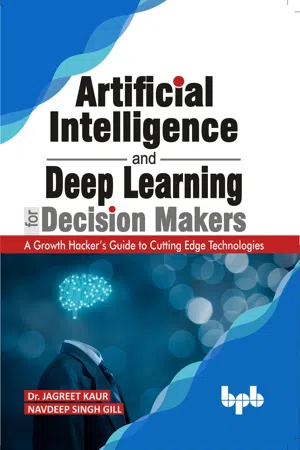
Learn modern-day technologies from modern-day technical giants Key Features
Real-world success and failure stories of artificial intelligence explained
Understand concepts of artificial intelligence and deep learning methods
Learn how to use artificial intelligence and deep learning methods
Know how to prepare dataset and implement models using industry leading Python packages
You'll be able to apply and analyze the results produced by the models for prediction
Description The aim of this book is to help the readers understand the concept of artificial intelligence and deep learning methods and implement them into their businesses and organizations. The first two chapters describe the introduction of the artificial intelligence and deep learning methods. In the first chapter, the concept of human thinking process, starting from the biochemical responses within the structure of neurons to the problem-solving steps through computational thinking skills are discussed. All chapters after the first two should be considered as the study of different technological and Artificial Intelligence giants of current age. These chapters are placed in a way that each chapter could be considered a separate study of a separate company, which includes the achievements of intelligent services currently provided by the company, discussion on the business model of the company towards the use of the deep learning technologies, the advancement of the web services which are incorporated with intelligent capability introduced by company, the efforts of the company in contributing to the development of the artificial intelligence and deep learning research. What You Will Learn How to use the algorithms written in the Python programming language to design models and perform predictions in general datasetsUnderstand use cases in different industries related to the implementation of artificial intelligence and deep learning methodsLearn the use of potential ideas in artificial intelligence and deep learning methods to improve the operational processes or new products and how services can be produced based on the methods Who this book is for This book is targeted to business and organization leaders, technology enthusiasts, professionals, and managers who seek knowledge of artificial intelligence and deep learning methods. Table of Contents 1. Artificial Intelligence and Deep Learning 2. Data Science for Business Analysis 3. Decision Making 4. Intelligent Computing Strategies By Google 5. Cognitive Learning Services in IBM Watson 6. Advancement web services by Baidu 7. Improved Social Business by Facebook 8. Personalized Intelligent Computing by Apple 9.Cloud Computing Intelligent by Microsoft About the Authors Dr. Jagreet Kaur is a doctorate in computer science and engineering. Her topic of thesis was "ARTIFICIAL INTELLIGENCE BASED ANALYTICAL PLATFORM FOR PREDICTIVE ANALYSIS IN HEALTH CARE." With more than 12 years of experience in academics and research, she is working in data wrangling, machine learning and deep learning algorithms on large datasets, real-time data often in production environments for data science solutions and data products to get actionable insights for the last four years. Navdeep Singh Gill is a technology and solution architect having more than 15 years of experience in the IT and Telecom industry. For the past six years, he is working in big data analytics, automation and advanced analytics using machine learning and deep learning for planning and architecting of data science solutions and data products.
Trusted by 375,005 students
Access to over 1.5 million titles for a fair monthly price.
This chapter introduces you to artificial intelligence and deep learning methods. The concept of the human thinking process starts from the biochemical responses within the structure of neurons and move forward to the problem-solving steps using computational thinking skills. Then, the thinking concept is adapted to computer architecture emphasizing the thinking process performed by the computer. This is expanded to a higher level of thinking, namely intelligence and reasoning capabilities, which is transliterated to an algorithmic approach in the computer programs.
Structure
Artificial intelligence (AI)
Deep learning
Algorithmic problem-solving approach
Objective
By the end of this chapter, we will understand the basic concept of human thinking processes, which is adapted in computational thinking for solving problems.
Artificial intelligence (AI)
Artificial intelligence (AI) is a digital attempt to achieve human level intelligence using different computations of machines. It is a set of advanced technologies that allow machines to sense, understand, act, and learn from humans.
AI is no longer just an ultramodern notion; it’s here right now—such as software that senses what we need, recommendation systems that recommend in real-time, and bots that respond to changes in their environment. In this century, companies are already using AI to innovate and grow fast.
Nowadays, AI and deep learning are the latest technologies that are doing much more. They are supporting humans in complex and creative problem-solving by analyzing vast amounts of data and identifying trends that were previously impossible to detect.
For more than 250 years, technological innovations have driven economic growth.
Among earlier innovations, the most critical ones are general-purpose technologies like steam engines, electricity, and internal combustion engines used in cars, trucks, airplanes, and even lawnmowers.
As technology moved fast, we now have more power in our hands than we had in our homes in the 1990s. The essential general-purpose technology of the current era is Artificial intelligence, particularly machine learning (ML) and deep learning (DL), that is, the ability of a machine to keep improving its performance without the intervention of humans. In the past few years, ML and DL have become more efficient and widely available. We are now able to build such systems that learn how to perform tasks on their own.
Importance of AI
There are two reasons why AI is important, which are as follows:
Firstly, we humans know much more than we can express. Also, it is indescribable how we precisely compute things, right from recognizing a small object like a needle to predicting the changes that will occur in the future. Before AI, we couldn’t automate many tasks.
Secondly, AI systems are often tremendous learners. They can achieve staggering performance in a wide range of activities including fraud detection, recommendation systems, retail analytics, computer vision, cybersecurity, and medical diagnosis. Brilliant digital learners are being deployed across the economy and their impact is going to be very intensive.
Similar to other technologies, AI has generated a lot of unrealistic capabilities. In the area of business, it has a significant impact on the extent of earlier general-purpose technologies. Although it is already in use in many companies around the world, the most fruitful opportunities have not yet been mined.
Artificial Neural Networks (ANNs) are complex models that can be used for a different type of computation inspired by the human brain. Nowadays, ANNs are used in many fields including voice recognition, image recognition, robotics, etc. resulting in much advancement in these fields. The significant effects of AI will be extended in the coming decade, as manufacturing, retail, transportation, entertainment, finance, healthcare, law, education, advertising, insurance, and virtually every other industry transform their core processes and business models to take advantage of DL.
Capabilities of AI
Today’s AI is super impressive; AI can perform various tasks that can never be possible without machine learning and deep learning. The goal of AI is to create an expert system, for example, systems that show intelligent behavior, learn, demonstrate, explain, and advise its users. Moreover, AI is meant to implement human intelligence in machines so that machines can understand, think, learn, and behave like humans. Today’s AI has been able to achieve success in many areas like robotics, computer vision, and natural language processing, expert system, games, and speech recognition. Here are some examples of machines that can be successfully made using the technology of AI:
Chatterbot: A chatterbot is a computer program that conducts a conversation via auditory or textual methods. Such programs are designed to engage in small talk to pass the Turing Test by fooling the conversational partner into thinking that the program is a human. Some chatterbots use sophisticated natural language processing systems, but many scan for keywords in the input and reply according to the matched keywords or the most similar wording pattern from a textual database.
Robotics: Robots learn new things themselves by observing their surroundings, so they learn more things from humans and use them in a better way. It involves mechanical (usually computer-controlled devices) to perform tasks that require extreme precision or tasks that are tedious or hazardous for humans. Also, they can learn from their mistakes, and they can adapt to new environments.
Healthcare: AI plays a significant role in the field of healthcare. AI-based Healthcare systems can help doctors predict the onset of a disease in a patient by comparing the medical data of the patient with historical data. Such machines can also prescribe the most appropriate medication and laboratory tests for the patient.
Gaming: AI plays a vital role in games such as chess, poker, tic-tac-toe, and others, where the machine can think of the considerable number of possible turns based on heuristic evaluation.
Vision systems: These systems understand, interpret, and grasp visual input on the computer. A restaurant takes photographs that are used to figure out the particular type of food on the plates. Physicians use a clinical expert system to diagnose diseases by analyzing the MRI/Scans images. Police use software that can recognize the face of criminals with a portrait made by a forensic artist.
Speech recognition: AI-based intelligent systems are capable of hearing and understanding the language in terms of sentences and their meanings. It can handle different accents, slang words, noise in the background, change in human sound due to cold, and much more.
Handwriting recognition: AI-based handwriting recognition software can read the text written on paper by a pen or on-screen by a stylus. It can recognize the shapes of the letters and convert them into editable text.
Banking: AI helps in the banking industry with chatbots, anti-money laundering (AML) tools, pattern detection, recommendation engines, fraud detection, and algorithmic trading.
So far we’ve discussed what is AI, its importance, and its capabilities. Now let’s look at the different subparts of AI starting with deep learning.
Deep learning (DL)
Deep learning (DL) is a subset of ML and ML is a subset of AI, as shown in the following image. If we say, a car is an artificially intelligent system, then we can say that the fuel used in the car is machine learning:
Figure 1.1: Representation of the relationship between AI, ML, and DL
DL is based on neural networks, a conceptual model of the brain. The word deep comes from DL algorithms that are trained/run on deep neural networks. The central concept of deep learning is the automatic extraction of representation from data. As our data often appears in the form of discrete information which needs to be joined together for it to make sense, DL and ML use this information and extract features from it to build a broad architecture. This deep architecture explains the data from lower to higher-level functions. It works in a hierarchical order. Data comes from many sources like Twitter, patient MRI/scans, social media, and sensor data in various forms:
Figure 1.2: Different sources of data
Data from these data sources generate 500+ terabytes every day. Thus, there is a need for new ways that can analyze the data. To do this, modern conceptual architecture is required that can work with the massive amounts of data. In other words, it is necessary to recognize how organizations function when they are working with these large datasets. This is where DL comes from. DL algorithms are used to build a model that can extract the data from these data sources and manage it for future predictions, as well as for various other purposes.
When data gets complex, we need to look for an architecture that can handle this kind of data. With ti...
Table of contents
Cover Page
Title Page
Copyright Page
Dedication
About the Authors
About the Reviewer
Acknowledgements
Preface
Errata
Table of Contents
1. Artificial Intelligence and Deep Learning
2. Data Science for Business Analysis
3. Decision Making
4. Intelligent Computing Strategies by Google
5. Cognitive Learning Services in IBM Watson
6. Advancement of Web Services by Baidu
7. Improved Social Business by Facebook
8. Personalized Intelligent Computing by Apple
9. Cloud Computing Intelligence by Microsoft
Frequently asked questions
Yes, you can cancel anytime from the Subscription tab in your account settings on the Perlego website. Your subscription will stay active until the end of your current billing period. Learn how to cancel your subscription
No, books cannot be downloaded as external files, such as PDFs, for use outside of Perlego. However, you can download books within the Perlego app for offline reading on mobile or tablet. Learn how to download books offline
Perlego offers two plans: Essential and Complete
Essential is ideal for learners and professionals who enjoy exploring a wide range of subjects. Access the Essential Library with 800,000+ trusted titles and best-sellers across business, personal growth, and the humanities. Includes unlimited reading time and Standard Read Aloud voice.
Complete: Perfect for advanced learners and researchers needing full, unrestricted access. Unlock 1.5M+ books across hundreds of subjects, including academic and specialized titles. The Complete Plan also includes advanced features like Premium Read Aloud and Research Assistant.
Both plans are available with monthly, semester, or annual billing cycles.
We are an online textbook subscription service, where you can get access to an entire online library for less than the price of a single book per month. With over 1.5 million books across 990+ topics, we’ve got you covered! Learn about our mission
Look out for the read-aloud symbol on your next book to see if you can listen to it. The read-aloud tool reads text aloud for you, highlighting the text as it is being read. You can pause it, speed it up and slow it down. Learn more about Read Aloud
Yes! You can use the Perlego app on both iOS and Android devices to read anytime, anywhere — even offline. Perfect for commutes or when you’re on the go. Please note we cannot support devices running on iOS 13 and Android 7 or earlier. Learn more about using the app
Yes, you can access Artificial Intelligence and Deep Learning for Decision Makers by Navdeep Singh Gill in PDF and/or ePUB format, as well as other popular books in Computer Science & Artificial Intelligence (AI) & Semantics. We have over 1.5 million books available in our catalogue for you to explore.