- 208 pages
- English
- ePUB (mobile friendly)
- Available on iOS & Android
eBook - ePub
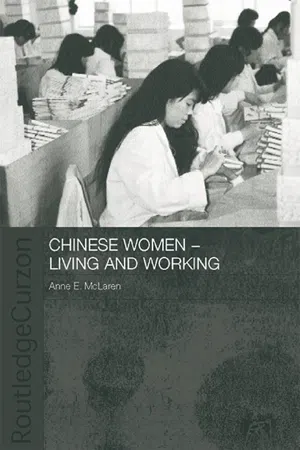
Chinese Women - Living and Working
About this book
This book presents significant new findings on new domains of employment for women in China's burgeoning market economy of the 1990s and the twenty-first century. Experts in gender, politics, media studies, and anthropology discuss the impact of economic reform and globalization on Chinese women in family businesses, management, the professions, the prostitution industry and domestic service. Significant themes include changing marriage and consumer aspirations and the reinvention of domestic space. The volume offers fresh insights into changing definitions of 'women's work' in contemporary China and questions women's perceived 'disadvantage' in the market economy.
Trusted by 375,005 students
Access to over 1.5 million titles for a fair monthly price.
Study more efficiently using our study tools.
Information
Subtopic
Chinese HistoryIndex
HistoryPart I: ‘New’ domains in the Chinese market economy
1 Why women count: Chinese women and the leadership of reform
David S.G.Goodman
Since the end of the 1970s, and the introduction of an incremental series of measures that have sought to reform the previously existing system of state socialism, the People’s Republic of China (PRC) has experienced a sustained period of rapid economic growth, and dramatic social change. The clear winners in this process have been those in the new rich socio-economic categories, who have emerged with and driven much of the change. They include those who have established new kinds of enterprise that reach beyond the previous economic structures, as well as those who have provided new services to meet the demands of both the state and society in a period of rapid economic restructuring and subsequent social change (Goodman 1996). The clear losers have been the peasantry in the poorer rural areas, especially those located in the interior provinces of China’s West.1
Although during the 1980s and early 1990s some external academic observers raised concerns that the processes of change might leave women amongst the most disadvantaged, the impact of reform has clearly been more mixed, and not susceptible to such ready analysis. Certainly the absence of state protection for women economically and the withdrawal of affirmative action supporting their participation in politics have resulted in lower income, the loss of any substantive share of positions of formal political power, and even weaker conditions of employment (Honig and Hershatter 1988; Hooper 1984: 317; Maurer-Fazio et al. 1999:55–8; Rosen 1994). However, more recent research since the mid-1990s has highlighted the more complex picture that emerges with the disaggregation of women by various social, political, economic and cultural criteria, including socio-economic category, region, generation, and interaction with the networks of relationships that bind family and locality with national and international processes of production.
Some women have clearly been disadvantaged by reform, and often quite explicitly because they were women. For example, those women workers in former state-owned and -operated enterprises have found themselves the first put out of work as a result of economic restructuring and down-sizing, on the grounds that women should not be regarded as the principal income-earner in each family. At the same time, it is also clear that the development of production lines in new light industrial enterprises in South and East China has provided other women with new employment opportunities, and again often explicitly because they were women. In this case the argument of their employers has been some variation on a theme that women are more likely to be suited to this kind of work, as well as cheaper, and less likely to make trouble in the workplace. Of course, even successful negotiation of the opportunities that have emerged with reform may mean simultaneously dealing with difficulties, as in this case where the circumstances and consequences of factory employment may be little more than wage slavery.2 While a few commentators have continued to highlight only the disadvantages to women (Hooper 1998:167–93; Org 2001), it has become more usual to consider the double-sided impact of reform on women in general, and even more, on women in specific situations and on specific groups of women, in particular.3 It is even clear that some women—such as the cultural workers described by McLaren (1998) in the Lower Yangtze Delta—have been able to negotiate their ways successfully through the dramatically changing social currents to stake out territory for their own development.
All the same, at leadership levels the evidence would seem at first sight to be relatively clear cut. Two decades of reform have considerably reduced the number and proportion of women serving in senior positions of political leadership. There remain, as before, few women who are senior leaders of the Chinese Communist Party (CCP), ministers of the central government, or provincial leaders of the party-state. While women continue to serve as deputy mayors in China’s cities, and hold a number of ministerial appointments, and while every provincial leadership group has a required woman, their numbers remain low and the proportion of women on the CCP’s Central Committee has fallen.4 This lack of leadership responsibilities also seems to have been mirrored in the ranks of the emerging new entrepreneurs, exceptionally few of whom are women. Indeed, most of the academic analysis of the developing private sector of the economy or of the new-style capitalists readily acknowledges this gender imbalance (Gold 1989; Pearson 1997; Guthrie 1999).
In contrast, the results of a survey of the local elite in Shanxi Province, North China, during the late 1990s suggests that women’s lack of participation even in the leadership of reform may have been more apparent than substantial. It was certainly the case that in Shanxi women did not fill the positions regarded as those of economic or political leadership in any significant numbers. At the same time the survey suggests that many women played significant roles in the leadership of the new economy Most significantly, the new enterprises of the reform era were often family affairs, at least to the extent that they were based on the joint efforts of husbands and wives. Where the husband was presented as the designated entrepreneur, the wife was frequently also active in the same enterprise, in many cases acting as its bookkeeper and business manager. To some extent the apparent lack of participation was a matter of definition, with women’s role in the leadership of reform rarely if ever acknowledged within the PRC, and as a result less likely to be reflected in any account of the process of change.
There was an inherent invisibility to this role of women in the leadership of reform that is of course not confined by any means to the PRC. The invisibility of women in the workforce, of specific kinds of ‘women’s work’, and of women whose domestic workload is discounted (both those employed for wages outside the family home, and those who are not) are all topics that have begun to be examined in the context of many societies around the world, and not just by those who regard themselves as feminist economists (Waring 1988, 2nd ed. 1999; Ferber and Nelson 1993). At the same time the prevalence of the family in enterprise development, and the related invisibility of women’s work within family enterprises are also not new themes in the history of Chinese culture.
There is much in common with many, though not all, of the enterprises that were described by interviewees in Shanxi during the late 1990s and those identified by Hill Gates as examples of ‘petty capitalism’ both in China’s pre-1949 past and more recently on Taiwan: essentially family-based and male-dominated enterprises, whose transactional activities were characterised by personalism even when operating in an open market (Gates 1996). Necessarily, in those enterprises, amongst other related qualities, women were for the most part also economically invisible, even when, as in Taiwan after 1950, they came to play a major role in the development of such enterprises alongside their husbands, often too as business managers and book-keepers.5 Moreover, commentators on the development of the Taiwan economy have highlighted the extent to which working women, even when not invisible, had their work, regardless of whether it was inside or outside the household, defined as an extension of family duties.
Social change in Shanxi
The information on Chinese women presented here is drawn from a survey of social change in Shanxi Province undertaken during the period 1996–98.6 Shanxi is a North China province that in 1998 had 31.7 million people, a GDP of 160 million yuan RMB, and a GDP per capita of 5,072 yuan RMB.7 Although it is, and has been for the previous seventy years, one of the country’s major heavy industrial bases, with exceptionally large and high-quality resources of coal, its reputation within China is one of peasant radicalism. It was the site of the major front-line base areas against Japanese invasion during the War of Resistance of 1937–45; and the later Mao-era model production brigade of Dazhai is located in its east. Since the 1920s Shanxi has been an established major centre for heavy industry, and it currently produces large proportions of China’s coal, coke, aluminum, electricity and specialist steels. The lack of understanding of Shanxi’s local conditions more generally is not too surprising given its mountainous topography and lack of transport links with the rest of China. Other Chinese were effectively hindered from visiting Shanxi, let alone doing business there, until a massive road-building programme made the province more accessible during the mid-1990s.8
Until the 1990s, provincial economic development had depended heavily on central government investment, growing fastest during the mid-1950s and mid-1980s: it was only during the mid-1990s that sustained, though still only moderate, above-national-average rates of growth were achieved without that support. This less spectacular economic profile, and other aspects of its economy, means that Shanxi has more in common with many of China’s provinces—particularly those inland—than the more economically advanced coastal provinces of Guangdong, Zhejiang and Jiangsu; as well as the large municipalities of Beijing and Shanghai.
In the 1990s Shanxi’s economic structure ceased to revolve solely around the central state sector, though it still played a sizeable role in provincial development. There was relatively little foreign interaction with the province though there was considerable domestic investment from and trade with other parts of China, particularly in the development of the collective and private sectors of the economy. By 1997, 32 per cent of the province’s Gross Value of Industrial Production (GVIO) was produced by the state sector, all of which was in heavy industry, compared to a national average of 25.5 per cent. The derivation of 37.1 per cent of provincial GVIO was from the collective (or local government) sector of the economy, based predominantly on coal industry support activities and by-products, compared to a national average of 38.1 per cent. Production of 17.9 per cent of GVIO came nationally from the private sector of the economy, whereas in Shanxi a much higher 26.8 per cent of provincial GVIO came from the private sector, with production based in the new technologies, foodstuffs and textiles (‘Shanxi Jianhang’ 1996:9). In 1997, only 4.1 per cent of GVIO was derived from the foreign-funded sector of the economy, compared to a national average of 18.5 per cent.9 In 1998, industrial production was 47.5 per cent of GDP in Shanxi, agricultural production was 13 per cent of GDP, whilst the retail and other service sectors were (and remain) dominated by private entrepreneurs (Shanxi tongji nianjian 1998:19).
Two hundred and seventy-nine members of the provincial and local elite were interviewed in Shanxi Province during the period 1996–98. Although it would be hard to argue that those selected for interview were statistically representative or randomly chosen, interviewees were drawn from all over the province, and from a variety of industries, occupations and types of location. Of those interviewed, 54 were leading cadres and 225 were identified as members of the ‘new rich’—the essential leaders of economic reform in the province.
The category of the new rich is defined by position in the economy, as well as by wealth and patterns of expenditure (Robison and Goodman 1996a; esp. Robison and Goodman 1996b:1–16). In particular, in the China of the 1990s it included all those entrepreneurs who had benefited from the changed economic environment of the reform era to develop new types of enterprises. While large numbers of these new rich were owner-operators from the private sector, the concept also includes managers of various kinds from different parts of the economy, including a few in the private sector, who, although they may often own equity in the enterprise they manage, also gain their status from a position of leadership. It even includes managers in the state sector of the economy who had reformed the enterprises for which they were responsible to take advantage of the new economic environment. However, the majority of managers among the ranks of the new rich were to be found in collective (urban and rural), equity-based and foreign-funded enterprises, many of which had developed from originally private enterprises.10 While many are far wealthier, a convenient guideline is to expect members of the new rich to receive a monthly income at least equivalent to the average annual income per capita in their locality. In Shanxi this would indicate that members of the new rich had an income in excess of 60,000 yuan RMB a year during 1998.
Table 1.1 provides summary information on those leading cadres and members of the new rich who were interviewed by levels of administration (for cadres), category of enterprise (for members of the new rich), and by gender. As Table 1.1 indicates, those interviewed were overwhelmingly male. Unsurprisingly, and in keeping with the expected gender difference, very few of the leading cadres were women: only 2 of the 54 interviewed. As a regular practice, the provincial committee of the CCP includes amongst its leadership only one woman, who is usually a Vice Governor of the Provincial Government, and who equally usually has responsibilities for education, health care and social services. Of the 225 entrepreneurs who were identified and interviewed as examples of the province’s new rich, only 12 were women. By far the largest concentration of these was the 9 interviewees who were owner-operators of private sector enterprises.
Table 1.1 Women in leadership positions: cadres and the new rich (number and percentage of interviewees in Shanxi, 1996–98, by category)
While the 12 women entrepreneurs and 2 women cadres who were interviewed may provide some information about the role of women in contemporary China, the interviews with the 201 married male entrepreneurs and the 52 married leading cadres11 also reveal information about their wives that can additionally and possibly more usefully (because of the larger number involved) be interrogated. This information is clearly not comprehensive—there is, for example, almost no detail available about the social or political background of the parents of the interviewee’s wives, unlike that for their husbands, and details of the CCP membership of interviewees’ wives are patchy at best. Moreover, there are clear methodological difficulties in asking husbands about their wives and their activities. Only occasionally in the course of the interviews were wives in attendance and even more rarely was it possible to interview or talk to them as well. Nonetheless, in the absence of alternative sources of information, these interviews do provide an indication of the background and roles of those women, and particularly their involvement in the development of both reform in general, and more specifically the new enterprises that have been at the heart of the process of change. While the survey was not specifically designed to extract information about women’s role in reform, its findings on this topic are so interesting that it seemed worthwhile articulating these results, albeit as preliminary results and suggesting further research agendas.
Information about women in Shanxi’s elite under reform derived from the interviews is considered in terms of three broad groups: the wives of the new rich entrepreneurs; the wives of leading cadres; and those few women who are either leading cadres or entrepreneurs in their own right. Although the detail is by no means as rich, the profile of the women that emerges is largely similar to that of the men who were more widely presented as local and provincial leaders. In particular, the latter were characterised by their intense localism, and the ties that bound them in various ways to the party-state (Goodman 2001:132–56). There is, however, one crucial difference that characterises the women at the centre of Shanxi’s elite: in addition to being the wives of the new rich and the wives of cadres, occasionally women entrepreneurs, and even more occasionally leading cadres, they were all almost without exception also mothers.12 Moreover, the size of family was by no means as restricted as might be thought to have resulted from the implementation of the ‘one-child policy’. There is no suggestion that the women who appear as having been economically, or for that matter politically, active either had small families in order to return quickly to the workforce, or forwent having children for whatever reason.
The numbers presented in Table 1.2, on the average number of children per family for different categories of the local elite, indicates that small families were not the norm. Exactly comparable figures for either the Shanxi population as a whole, or those who were neither members of the new rich nor cadres, are not available. However, in 1998 the average size of family in Shanxi was 3.63 people, just slightly above the national average of 3.58 people. In comparison, as can be readily calculated from Table 1.2, the various categories of Shanxi’s elite had an average family size that ranged from at least 3. 79 to 4.7 people (Zhongguo tongji nianjian 1999:99, Table 4–5, ‘Household, Population and Sex Ratio by Region’). Perhaps even more remarkably, these indicators of family size are not significantly different if calculations are made in terms of those couples who married before, and those who married after, the introduction of the ‘one-child policy’ in 1979.
Table 1.2 Children of interviewees (number, 1996–98, by category of interviewee)
Wives of the new rich
Contemporary magazines and television programmes in the PRC are prone to portray the life-styles of the new rich and occasionally famous in terms of their houses, expenditure patterns and leisure activities.13 The wives play such a central role in this process that the reader or viewer could be forgiven for thinking that most if not all of the wives of the new rich were ‘non-working wives,’ a description preferred by the new rich themselves to that of ‘housewife’.14 This is not an unimportant distinction. ‘Wor...
Table of contents
- Cover Page
- Chinese Women—Living and Working
- Basian studies association of australia: Women in Asia series
- Title Page
- Copyright Page
- Illustrations
- Contributors
- Series editor’s foreword
- Acknowledgements
- Introduction
- Part I: ‘New’ domains in the Chinese market economy
- Part II: Women in the professions
- Part III: Reinventing domestic space
Frequently asked questions
Yes, you can cancel anytime from the Subscription tab in your account settings on the Perlego website. Your subscription will stay active until the end of your current billing period. Learn how to cancel your subscription
No, books cannot be downloaded as external files, such as PDFs, for use outside of Perlego. However, you can download books within the Perlego app for offline reading on mobile or tablet. Learn how to download books offline
Perlego offers two plans: Essential and Complete
- Essential is ideal for learners and professionals who enjoy exploring a wide range of subjects. Access the Essential Library with 800,000+ trusted titles and best-sellers across business, personal growth, and the humanities. Includes unlimited reading time and Standard Read Aloud voice.
- Complete: Perfect for advanced learners and researchers needing full, unrestricted access. Unlock 1.5M+ books across hundreds of subjects, including academic and specialized titles. The Complete Plan also includes advanced features like Premium Read Aloud and Research Assistant.
We are an online textbook subscription service, where you can get access to an entire online library for less than the price of a single book per month. With over 1.5 million books across 990+ topics, we’ve got you covered! Learn about our mission
Look out for the read-aloud symbol on your next book to see if you can listen to it. The read-aloud tool reads text aloud for you, highlighting the text as it is being read. You can pause it, speed it up and slow it down. Learn more about Read Aloud
Yes! You can use the Perlego app on both iOS and Android devices to read anytime, anywhere — even offline. Perfect for commutes or when you’re on the go.
Please note we cannot support devices running on iOS 13 and Android 7 or earlier. Learn more about using the app
Please note we cannot support devices running on iOS 13 and Android 7 or earlier. Learn more about using the app
Yes, you can access Chinese Women - Living and Working by Anne McLaren in PDF and/or ePUB format, as well as other popular books in History & Chinese History. We have over 1.5 million books available in our catalogue for you to explore.