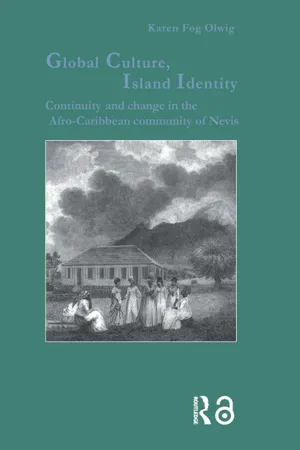
Looking at the development of cultural identity in the global context, this text uses the approach of historical anthropology. It examines the way in which the West Indian Community of Nevis, has, since the 1600s, incorporated both African and European cultural elements into the framework of social life, to create an Afro-Caribbean culture that was distinctive and yet geographically unbounded - a "global culture". The book takes as its point of departure the processes of cultural interaction and reflectivity. It argues that the study of cultural continuity should be guided by the notion of cultural complexity involving the continuous constitution, development and assertion of culture. It emphasizes the interplay between local and global cultures, and examines the importance of cultural display for peoples who have experienced the process of socioeconomic marginalization in the Western world.
- 256 pages
- English
- ePUB (mobile friendly)
- Available on iOS & Android
eBook - ePub
Global Culture, Island Identity
About this book
Information
PART I
ENGLISH PATRIARCHAL
HIERARCHY, AFRICAN
BONDAGE

PLATE 2 “A New Chart of Western
Ocean”. Hans Sloane, A Voyage to the
Islands of Madera, Barbados, Nieves,
S.Christophers and Jamaica, London:
BM for the author, 1707.
Ocean”. Hans Sloane, A Voyage to the
Islands of Madera, Barbados, Nieves,
S.Christophers and Jamaica, London:
BM for the author, 1707.
CHAPTER ONE
Africans in English Patriachy
The colonial society which the English yeoman farmers created on Nevis after 1628 was rather short-lived. Within a few decades, the small farmsteads based on family labor and servants supplemented by African slaves, gave way to large-scale sugar estates owned by a small group of planters who cultivated the land entirely with African slave labor. The family-based, patriarchal society was replaced by a plantocratic society, and the African slaves were delegated to a marginal position outside the social ranks of this order. The plantation society was to dominate the island society well into the nineteenth century, and it had a profound social, economic and cultural impact on the local society which is still felt today.
In comparison with the overwhelming importance of the plantation society the early colonial society of small farmers has been seen as a brief phase in the incipient phase of colonization of primarily historic interest. In this section I shall argue that certain traditions and institutions associated with this early society survived the onslaught of the plantation society and came to provide socially acceptable frameworks for the evolvement and display of Afro-Caribbean culture. This was of utmost importance as the slaves underwent a process of increasing marginalization in the plantation society.
The first Africans who were transported as slaves to the small, conically shaped island of Nevis encountered a society of predominantly English farmers who cultivated a variety of crops such as tobacco, indigo, ginger, as well as subsistence crops. Until the middle of the seventeenth century the land was tilled primarily with the help of indentured laborers, and many of the farmers were themselves, in fact, former indentured servants who had received a piece of land after completion of their terms of servitude (Smith 1947:230; Bridenbaugh and Bridenbaugh 1972:175–203; Batie 1976). In the mid-1640s sugar cultivation began on Nevis introduced from Barbados via St. Kitts (Bridenbaugh and Bridenbaugh 1972:81), and, according to Charles Rochefort's History of the Caribby-Islands, by the late 1640s there were three to four Englishmen on Nevis “who subsist and live handsomely, by the trade they drive in Sugar, Ginger and Tobacco” (1666 [1658]: 20). The transition to sugar production was well under way on Nevis by 1655, when sugar was listed as the major export crop (Dunn 1972:122–23). The expansion of sugar cultivation entailed major social and economic changes as smaller farms were combined into large plantations which could provide the economic foundation for investment in the extensive processing equipment necessitated by sugar production. The small farmers continued to make a comfortable living on tobacco cultivation, however, until a restriction on trade was instituted which made it difficult for them to sell the crop at satisfactory prices and, during the 1660s, forced many of them to abandon farming on Nevis (CO1/18:29 April, 1664; CO1/33:23 September, 1655).
By the 1650s, when sugar production based on a slave labor force had begun to supersede tobacco cultivation as the main cash crop on Nevis, slaves constituted less than 20% of the population. The number of slaves increased dramatically during the following decades as the sugar plantations consolidated themselves on Nevis, and in 1678, when the census was conducted on the island, the 3849 “Negroes” out-numbered the White population of 3521.1 By the early eighteenth century, when the conversion to sugar production was completed, the Black population exceeded 5000 and comprised close to 80% of the total population (CO186:11 May, 1722; Galenson 1981:120).2
As the large scale plantation system based on a slave labor force established itself, the remaining servants were upgraded and employed primarily as skilled artisans, overseers and bookkeepers. The slaves, on the other hand, came to be regarded and treated as brute stock over which the planters had absolute authority. The social marginalization which the slaves experienced was not, however, left unchallenged by them. They established a social presence in the colonial society, as will be shown, primarily by manipulating traditions and institutions of the English patriarchal order to which they gained access during the early period of colonization when they comprised an insignificant minority in the island society. In this development and consolidation of a presence in the island society the slaves found a vital resource in their African cultural background.
THE AFRICAN BACKGROUND
In their discussion of the role of African and European culture in Afro-Caribbean cultural development Mintz and Price have pointed out that the importance of the slaves' African background has tended to be discussed either in terms of postulated tribal origins of certain slave groups or in terms of a generalized African heritage. This approach is not valid, they argue, because the slaves did not arrive in the New World as members of particular tribal groups but as individuals torn from the sociocultural contexts within which they had lived in Africa. Furthermore, the slaves could not be said to have shared a single African heritage. They therefore suggest that the African influence in the New World not be sought in particular traits or traditions believed to have been retained more or less intact but rather in basic cultural principles and values which underlie cultural forms and behavior patterns (Mintz and Price 1976:4–5).
In the search for such fundamental principles the recent literature on Africa which takes a more regional and historically informed approach and discusses Af African culture in more general terms is helpful. The concept of the corporate tribe, once thought to refer to a basic socioeconomic unit in African social structure, has now been seen to refer to a historic unit which emerged as a result of changes which occurred in connection with the European colonization of the continent (Sharpe 1986; Tonkin 1990). It is not possible to view the slaves' African background in terms of tribal groups since most of the slaves transported to the British West Indies from the middle of the seventeenth to the end of the eighteenth century did not belong to any clearly demarcated socioeconomic entity which can be identified as a tribe. The socioeconomic framework which defined the most basic context of life for precolonial Africans was rather informed by the notion of kinship. As noted by Kopytoff and Miers in their discussion of African slavery, the concept of the person was closely related to belonging in a kin group which conferred social, economic and political rights as well as ritual protection (1977:17).
The power basis of kin groups fluctuated a great deal and depended on the ability of the group to attract a large following, people being regarded as vital resources from a political and social as well as an economic point of view. Kinship provided “both the idiom and the metaphor for social and political relations” (ibid.: 22). For this reason kinship did not merely constitute a principle of demarcating insiders from outsiders but it also embodied a means of incorporating strangers into a group. The kin ties which were extended to strangers were of a hierarchical nature and in-‘volved, at one extreme, the incorporation of slaves who against their own free will were placed under the authority of a master in a new kin group. At the other extreme, they entailed the incorporation of persons who voluntarily chose to place themselves under the patronage of particular persons in a kin-like position of dependence having given up membership in their own kin group for such reasons as “quarrels, threats, hunger, hope for a better life, or because they had committed some crime” (Kopytoff and Miers 1977:12, 24).
The situation of struggle and socioeconomic flux, where political control was not placed in a permanent headship which was usually inherited but rather sought by a number of competing patrons operating so as to further their power base as leaders of kin groups, is closely related to African notions of witchcraft. Rowlands (1985) suggests that much of Western and Central Africa is characterized by an ambiguous perception of power with deep historical roots. This is reflected in the belief that the possession of supernatural substances is a precondition for the assumption of leadership. If harnessed, this substance is beneficial and works for the welfare of the community; if uncontrolled, the substance is used for the amassing of wealth and personal power and hence dangerous and lethal for members of the community. Power, in other words, involves substances which must be controlled, and those leaders who demonstrate too high ambitions for centralized power in their person will be regarded as demonstrating a lack of control of this substance which leads them to become involved with sorcery. Accusations of sorcery therefore can be viewed as a means of preventing individual political leaders from concentrating too much power in their own person.
The connection between supernatural forces and power is also apparent in the importance attached to certain places as residences of particular spirits which can be cultivated and invoked by human beings, and many Africans have belonged to local religious cults drawing their membership from a number of kin groups. Through secret rituals involving various paraphernalia, such as masks, a participant established a close, personal relationship with a guardian spirit. This relationship was one of dependence and subordination to the guardian spirit. For this reason cult members became partly freed from the ties of subordination and dependence which they had with others, most notably senior members of their lineage, for which reason secret cults often became a challenge to the kinbased sources of power (Horton 1971:102–13). People in pre-colonial Africa therefore did not have one single-stranded identity as members of a particular kin group but moved in and out of “overlapping networks of association” (Ranger 1983:248).
The fundamental cultural principles and values which the Africans brought with them to the New World included both hierarchical and egalitarian notions. The kinship system was in some respects hierarchical in nature in that it depended upon the existence of relations between dependents and patrons who sought to build up a power base through a large following. These ties were expressed in kin terms and usually involved a process of incorporation and acceptance, and African institutions, ranging from households to whole societies, have been characterized as “strikingly absorptive of outsiders” (Kopytoff and Miers 1977:61). On the other hand, because power was not concentrated in central, permanent offices but rested in the ability of competing kin groups to attract followers, it tended to prevent the development of centralized hierarchical states and furthered more egalitarian social orders. This interplay between hierarchical and egalitarian tendencies is also reflected in the supernatural realm. The hierarchical tendencies were, on the one hand, underlined by the belief that supernatural power was held by those who succeeded in gaining a position of leadership. This power was believed to have been abused, however, if employed to establish a position of central control and leadership. The existence of spirits in different natural locales that could be consulted and invoked by the general population, often through membership in a cult, furthermore meant that there were alternative sources of power that presented a check on the uncontrolled amassment of wealth and power. These basic principles of incorporation through ties of patronage and dependence, of establishing different fields of sociocultural ties, and of harnessing supernatural forces to generate a power base must have constituted important guiding principles in the way in which Africans responded to their situtation as slaves in the American colonies.
THE SOCIETY THE COLONISTS MADE
Nevis was one of the first West Indian islands to be colonized by the English, when a group of about 100 planters and servants from neighboring St. Kitts under the leadership of the Englishman Anthony Hilton settled there in 1628. They quickly put up a number of makeshift huts built of four to six wooden forks planted in the ground and covered with leaves of palms or plantain (Smith 1910 [1629]:910; Bridenbaugh and Bridenbaugh 1972:37). Despite attacks by the Spaniards the following year, where all the houses on Nevis and St. Kitts were burned and the settlers had to flee to the mountain (SP16, vol. 151/20:5 November, 1629), the English maintained a colony on the island. When Charles Rochefort (1666:20) described Nevis a couple of decades later, in the 1650s, he characterized it as quite a civilized place where “Swearing, Thieving, Drunkenness, Fornication, and all dissolutions and disorders are severely punish’d”. The English colonizers had left their old country in order to start a new and better life in the New World. Nevertheless they had brought with them sociocultural notions, closely connected with the society they had left behind, which came to have a fundamental impact on the colonial societies which emerged in the New World.
The social order of early modern England was a rather dichotomous one. It was characterized, on the one hand, by the old, medieval order, where everybody from the lowest laborer to the king were accorded their proper places in a great chain of reciprocal relations of authority and obedience, and, on the other, by an emerging, modern order of egalitarian, individualistic and competitive relations (Underdown 1985:9, 40). The old order was mainly to be found among the gentry and the poor in the village communities where the open field system still remained intact. Here life still revolved around the agricultural cycle of the year with its communal festival days centering on the church and involving rich as well as poor. The new order appeared among the incipient middle class which was emerging in those areas where the market economy and industry were becoming dominant. They believed in a society of hard-working and morally righteous families and regarded the cooperative activities and revelries of traditional village life as wasteful, if not ungodly. While the new order existed as an important model for change, which was partly realized during the Cromwellian interregnum, it did not become dominant until the eighteenth century, when fundamental socioeconomic change led to the transformation of the old, hierarchical order (ibid.: 18, 40–42, 270–91; Hill 1984 [1972]).
The early colonists reestablished in the New World one of the most important institutions of the old hierarchical order in the form of the patriarchal family. In the West Indies it was mainly based on the master-servant relationship which had attained great importance in early modern England. The majority of young people in English society who were capable of working but too young to marry and establish their own household were servants. They lived and worked in the household of their master and were regarded as members of his family. The inclusion of servants in the master's family was related to the fact that the family and the socioeconomic unit of the household were regarded as one and the same. In fact, early modern English did not distinguish between relatives and residents of a household meaning both by the term family. It functioned under the leadership of the patriarchal head who had virtually absolute power over his dependents, i.e. his wife, children, servants and apprentices (Laslett 1988:2; Kussmaul 1981:7).
Seventeenth century population censuses from the British colonies in the Americas reveal the importance of the family as a basic unit of organization which incorporated the majority of the population, including the African slaves, into a master-dependent relation. Following English custom the census takers regarded the family as “an independent economic unit” which consisted of “all those who lived under the control of the ‘master of the family’” either in his dwelling or in his immediate surroundings. The censuses therefore listed all the people including all servants and slaves under the family master to whom they belonged (Wells 1975:298). The population census which was carried out on Nevis in 1678 follows this basic pattern, although there is some variation in the way in which the enumerators filled out the census lists. Whereas one enumerator listed all White adults by name, the rest listed only the heads of families by name and noted the number of White men, women and children, Negro men, women and children who belonged to their families. Some enumerators specified the presence of wives and children of the master in the family, however, such ties were not listed by all, making it impossible to ascertain whether the White members of the family were servants or related to the master by kinship or marriage. Thus we have no information about the relationship between the three White men, three White women, four White children, seven Negro men, fourteen Negro women, and ten Negro children who were listed under Captain Edward Earle, except that he was master of the family to whom they all belonged (CO1/42). On the basis of the census lists one can only conclude that all the members of a family were regarded as being primarily dependents of their master, whether or not this dependency was grounded in kinship and marriage, servitude or slavery. At this time, when sugar production was already well established, this meant that at least 8 families were listed as consisting of more than 60 persons whereas 45 contained more than 20 persons (Dunn 1972:129). While these families were quite influential, the island was still numerically dominated by smaller domestic units and c. 1000 families were listed as headed by...
Table of contents
- Cover
- Half Title
- Studies in Anthropology and History
- Full Title
- Copyright
- Contents
- List of illustrations
- Preface
- INTRODUCTION
- PART ONE English Patriarchal Hierarchy, African Bondage
- PART TWO In Pursuit of Respectability
- PART THREE Home Is Where You Leave It: Paradoxes of Identity
- References
- Index
Trusted by 375,005 students
Access to over 1.5 million titles for a fair monthly price.
Study more efficiently using our study tools.
Frequently asked questions
Yes, you can cancel anytime from the Subscription tab in your account settings on the Perlego website. Your subscription will stay active until the end of your current billing period. Learn how to cancel your subscription
No, books cannot be downloaded as external files, such as PDFs, for use outside of Perlego. However, you can download books within the Perlego app for offline reading on mobile or tablet. Learn how to download books offline
We are an online textbook subscription service, where you can get access to an entire online library for less than the price of a single book per month. With over 1.5 million books across 990+ topics, we’ve got you covered! Learn about our mission
Look out for the read-aloud symbol on your next book to see if you can listen to it. The read-aloud tool reads text aloud for you, highlighting the text as it is being read. You can pause it, speed it up and slow it down. Learn more about Read Aloud
Yes! You can use the Perlego app on both iOS and Android devices to read anytime, anywhere — even offline. Perfect for commutes or when you’re on the go.
Please note we cannot support devices running on iOS 13 and Android 7 or earlier. Learn more about using the app
Please note we cannot support devices running on iOS 13 and Android 7 or earlier. Learn more about using the app
Yes, you can access Global Culture, Island Identity by Karen Fog Olwig in PDF and/or ePUB format, as well as other popular books in Social Sciences & Anthropology. We have over 1.5 million books available in our catalogue for you to explore.