"Diplomacy Between the Wars" is a detailed inside story of diplomacy seen through the careers of five remarkable career diplomatists. Here is a unique and authentic picture of practical diplomacy and its effect during periods of international crisis which shaped the twentieth century. These were not the statesmen and politicians who dominated the international stage but practical diplomats with long experience, linguistic competence, deep knowledge of the local conditions, history, culture and of the people of the countries where they served. George Liebmann also brings acute political awareness to the subject. The achievements of these diplomats - often unsung during their careers and gleaned largely from history books - were considerable and a monument to practical, professional diplomacy.Lewis Einstein was influential in demonstrating the central role - and its control - of finance and credit in modern wars and urging massive US economic assistance to Europe and after World War II providing the intellectual underpinnings of the Marshall Plan; Sir Horace Rumbold's work was vital in avoiding war between Great Britain and Turkey and in warnings of the dangers of Hitler; Johann von Bernstorff opposed Germany's 'naval militarism', supported a negotiated end to the First World War and peaceful revision of the Treaty of Versailles; Count Carlo Sforza urged restraint on Italy's territorial ambitions and tolerance for former Fascists and Communists; and Ismet Inonu kept Turkey out of war, preserved her national interest at the Treaty of Lausanne and maintained friendship with the great powers.
He worked for religious toleration and the limitation of dictatorship in Ataturk's secular Turkish Republic.
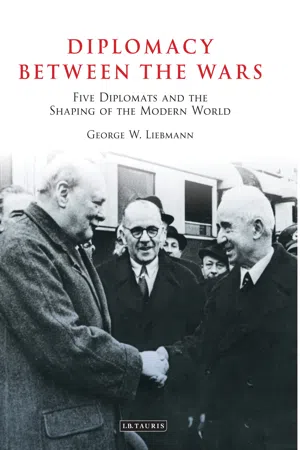
eBook - ePub
Diplomacy Between the Wars
Five Diplomats and the Shaping of the Modern World
- 288 pages
- English
- ePUB (mobile friendly)
- Available on iOS & Android
eBook - ePub
About this book
Trusted by 375,005 students
Access to over 1 million titles for a fair monthly price.
Study more efficiently using our study tools.
Information
1
LEWIS EINSTEIN
Unlike the other figures we consider here, the American Lewis Einstein never occupied a high place in government and never was a direct actor in major events. He was not a President, a Foreign Minister, or an Ambassador between great powers; the highest office that he held was that of American Ambassador to Czechoslovakia during the 1920s. He was more than a Cassandra; numbering among his friends and acquaintances such large figures as Theodore Roosevelt, Oliver Wendell Holmes, Charles Evans Hughes and Cordell Hull, his intellectual influence affected America’s view of its new global responsibilities, though frequently in ways that were not directly traceable or tangible. Like Carlo Sforza and unlike our other subjects, he left a large and neglected permanent legacy in literary form.
His greatest contribution was in fostering recognition of the extent to which American security rested on naval power, its own and that of the British, and of the vital interest of America in British independence. He also had an acute recognition, rare in his time, of the dependence of international politics on economics. He saw that modern financial techniques made protracted wars possible, and saw the dangers for Europe in the protectionism and inflation following the First World War. He helped lay the intellectual foundations for the Marshall Plan, while successfully warning that acceptance of an Armenian mandate would over-extend and militarise the United States.
After graduating from Columbia with a master’s degree, he published at the age of 25 a book on the Italian Renaissance in England, which was much-praised and which still repays reading.1 He found the enduring appeal of the Renaissance in the fact that learning was valued ‘as a guide to the conduct of life. Great is eloquence; nothing so much rules the world. Political action is the result of persuasion; his opinion prevails with the people who best knows how to persuade them.’ In the Renaissance, the classics were studied ‘not as an allegorical explanation of Christianity, but from the literary point of view’. The new type of English scholar ‘was to equal his Italian model in learning, while he surpassed him in purity of life’. The view was that ‘one ought not to boast of ancient lineage but prove oneself worthy of it. . . The ideal of universality once aimed at was consciously pursued and attained by the best spirits of the age.’
[A] ‘new zeal for education . . . had swept over the English nation and placed side by side with the old feudal distinctions a new field of honor in learning. . . Venice was in many ways what England is to-day; her colonies formed a colonial empire governed by a merchant aristocracy. . . The energy, the vigor, the daring and courage of the Italian Renaissance found itself reflected no less strongly in the history of its merchants and explorers, than in the works of its painters and poets. In commerce, as in the arts and sciences, Italy held up the guiding light for the rest of Europe to follow . . . [Thomas] Cromwell’s aim was to secure peace and order for England by centralizing all power in the crown, and strengthening the hands of the king. As the church alone stood in the way of the absolute rule of the king, the last check that had survived the Wars of the Roses, his unbending efforts and energies were directed to destroying its authority . . . [he was] the first great English disciple of Machiavelli.
In his way of thinking, with democracy ‘went envy of the rich, and an intense conceit accompanied the feeling it possessed of its own infallibility. . . it seemed “a horrible monster of many heads without reason”.’ As for aristocracy,
As long as neither nobleman nor commoner overstepped their bounds, so long were both of benefit to the state. If either should do so, the party of the commons would certainly prove the more dangerous on account of their ignorance and inconstancy . . . there were many tyrants . . . a good prince, even though he diminished the power of the commons, preserved them, at the same time from the tyranny of the nobility.
The Italian philosophy of history was also imported to England, with its premise that
Nothing . . . removed one further from the desire of evil than to see the punishment of the wicked, and history exposed this clearly to the world. History made men wiser both to direct their own actions and to advise others . . . This historical method has fallen into undeserved oblivion.
The book led to his appointment to the Diplomatic Service, President Theodore Roosevelt declaring: ‘I would particularly like to put in the public service a man of the tastes indicated by such a book as this.’ The Secretary of State, John Hay, referred to ‘its very great value both as literature and history’, while the Secretary of War, Elihu Root, acknowledged his copy of the work by referring to ‘its direct and lucid style . . . Mr. Hay had already spoken to me of the work in terms of high commendation.’2 TR, though today thought of by many as a blustering imperialist, was, as Henry Kissinger among others has shown,3 a realist in foreign policy. He appreciated America’s indebtedness to the British fleet, and shared the British dread of control by a single power of the European continent. His advocacy of American entry into World War I rested on what proved to be a just estimate of the durability of German militarism, while his role in the Treaty of Portsmouth was founded on a purpose to prevent the destruction of Russian power in Europe. Einstein’s initial appointment was as Third Secretary in Paris at a salary of $1200 per year;4 his diplomatic career began at the Algeciras Conference in 1906, which he saw as one of the last triumphs of the old diplomacy, and where he met many prominent diplomats, including Carlo Sforza, who became a lifelong friend.

1. Lewis Einstein, by Eastman Johnson (Metropolitan Museum of Art)
No one yet recognized in this negative result that the stage was already being prepared for the excitable mass pressure that has been increasingly and detrimentally exercised in international affairs. In 1906, this pressure could still be kept in some restraint. I was still too inexperienced to understand the immense value of pompous and well-staged negativeness when this serves to allay political passion.5
All of our subjects were patient with leisurely negotiations; for Inönü, perhaps the most skilled diplomat among them, each new discussion was a chance to propagate his government’s point of view and to ensure that its roots in vital interests were understood.
Einstein referred with appreciation to a senior Italian delegate who disdainfully observed: ‘They told me there were to be ambassadors here. I see only lawyers.’ In England ‘the advocate is not thought to make the best negotiator.’ Of Germany, he said that it was ‘the only great nation never to feel quite certain of her position and therefore alternating with an uneasy violence between extremes of effacement and of dangerous arrogance.’
In the period 1906 to 1913, Einstein also edited The Humanist’s Library, a series of books from the Renaissance elegantly printed by the Merrymount Press, with introductions by Einstein6 and others. A unifying motif was that set forth in the introduction by J.W. Mackail to Erasmus’ Against War, written in 1908:
At the present day, the reactionary wave which has overspread the world has led, both in Europe and America, to a new glorification of war. Peace is on the lips of governments and of individuals, but beneath the smooth surface the same passions, draped as they always have been under fine names, are a menace to progress and to the higher life of mankind. The increase of armaments, the glorification of the military life, the fanaticism which regards organized robbery and murder as a sacred imperial mission, are the fruits of a spirit which has fallen as far below the standard of humanism as it has left behind it the precepts of a still outwardly acknowledged religion. . . At such a time the noble pleading of Erasmus has more than a merely literary or antiquarian interest. For the appeal of humanism still is, as it was then, to the dignity of human nature itself.7
Family Controversy
In the period before the war, Einstein had been involved in controversy with his family. In 1904, Einstein had married Helen Ralli, a twice-divorced member of an Anglo-Greek family who was ten years his senior, leading to violent controversy with his father arising from her age, her prior divorces and the fact that she was not of the Jewish faith. David Einstein, Lewis’ father, died in 1908, leaving an estate of $4 million, a very large sum at that time, derived from various businesses, most notably the Raritan Woolen Mills in New Jersey; he was a descendant of Judah P. Benjamin, Secretary of State of the Confederacy. After his marriage, he wrote his son a letter declaring:
Your dear mother is prostrated with grief over the degradation you have brought upon yourself. I am grieved to inform you that I have changed my will and that you will not participate in my fortune at my death. If you will dissolve your marriage with Helene, you will be received back into the arms of your broken-hearted father and mother and will have what you should have, share and share alike with your sisters. Do not suppose that any entreaties or threats you may make will influence us. Helene will never be received by your mother and sisters.8
In 1907, Lewis to wrote Helen: ‘What an extraordinary woman my mother is . . . She will worry and fret if I have sufficiently heavy underwear and then she does what she does!’9
The will left by David Einstein at his death in 1908 left Lewis and his two sisters $125,000 each outright. The residue of the estate was divided into three trusts of $1,250,000 each, one for each of his daughters and her descendants, and the third share to his daughter Florence with the right to assign interest or principal to ‘one of his blood’.10 It was later testified that he tried expressly to condition a bequest to Lewis on his divorce, but used the device of an additional trust for his daughter Florence ‘when he was convinced [a direct restriction] would invalidate the will’. The testator declared to his brother-in-law:
I am leaving my son $5,000 a year, I don’t want him to be a beggar. And then Florence can and will give him such sums as she thinks proper from time to time if he dissolves his disreputable marriage and shows a sincere penitence.11
Lewis did not find this condition acceptable, and after his father’s death in 1908 negotiated a settlement with the estate under the terms of which he would receive income of $20,000 per year of the $50,000 to 60,000 generated by the additional trust held by Florence. By June 1911, Justice Holmes wrote to him:
I am glad that the family matter promises settlement. I feared very much the result of the fight, and deeply regretted that you should have such a cloud always hanging in your mind. So you give me very great pleasure by your news.12
In late 1913, the matter flared up again, when Professor Charles Spingarn of Princeton, the husband of David Einstein’s other daughter, filed a suit (to which Lewis was not a party) asking that the third trust be construed as including a secret agreement that Florence would bequeath the trust equally to the testator’s grandchildren, i...
Table of contents
- Cover
- Title Page
- Contents
- List of Illustrations
- Acknowledgments
- Preface
- Epigraph
- 1. Lewis Einstein
- 2. Sir Horace Rumbold
- 3. Count Johann Bernstorff
- 4. Count Carlo Sforza
- 5. Ismet Inönü
- Conclusion
- Notes
- Index
- eCopyright
Frequently asked questions
Yes, you can cancel anytime from the Subscription tab in your account settings on the Perlego website. Your subscription will stay active until the end of your current billing period. Learn how to cancel your subscription
No, books cannot be downloaded as external files, such as PDFs, for use outside of Perlego. However, you can download books within the Perlego app for offline reading on mobile or tablet. Learn how to download books offline
Perlego offers two plans: Essential and Complete
- Essential is ideal for learners and professionals who enjoy exploring a wide range of subjects. Access the Essential Library with 800,000+ trusted titles and best-sellers across business, personal growth, and the humanities. Includes unlimited reading time and Standard Read Aloud voice.
- Complete: Perfect for advanced learners and researchers needing full, unrestricted access. Unlock 1.4M+ books across hundreds of subjects, including academic and specialized titles. The Complete Plan also includes advanced features like Premium Read Aloud and Research Assistant.
We are an online textbook subscription service, where you can get access to an entire online library for less than the price of a single book per month. With over 1 million books across 990+ topics, we’ve got you covered! Learn about our mission
Look out for the read-aloud symbol on your next book to see if you can listen to it. The read-aloud tool reads text aloud for you, highlighting the text as it is being read. You can pause it, speed it up and slow it down. Learn more about Read Aloud
Yes! You can use the Perlego app on both iOS and Android devices to read anytime, anywhere — even offline. Perfect for commutes or when you’re on the go.
Please note we cannot support devices running on iOS 13 and Android 7 or earlier. Learn more about using the app
Please note we cannot support devices running on iOS 13 and Android 7 or earlier. Learn more about using the app
Yes, you can access Diplomacy Between the Wars by George W. Liebmann in PDF and/or ePUB format, as well as other popular books in History & World History. We have over one million books available in our catalogue for you to explore.