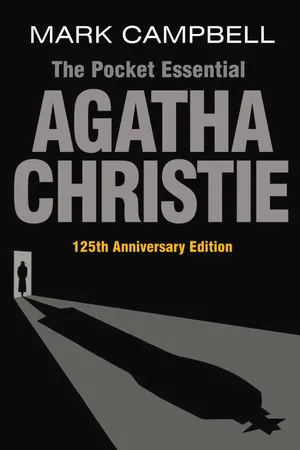
eBook - ePub
Agatha Christie
The Books, the Films and the Television Shows featuring Poirot, Miss Marple and More
- 160 pages
- English
- ePUB (mobile friendly)
- Available on iOS & Android
eBook - ePub
Agatha Christie
The Books, the Films and the Television Shows featuring Poirot, Miss Marple and More
About this book
Marking the 125th anniversary of Agatha Christie's birth, this new edition offers an informed introductin to the chief proponent of the English village murder mystery. Although she created two enormously popular characters - the Belgian detective Hercule Poirot, and the inquisitive elderly spinster and amateur sleuth Miss Jane Marple of St Mary Mead - it is not generally acknowledged that Agatha Christie wrote in many different genres: comic mysteries (Why Didn't They Ask Evans?), atmospheric whodunits (Murder On The Orient Express), espionage thrillers (N or M?), romances (under the pseudonym of Mary Westmacott), plays (The Mousetrap) and poetry. This guide examines all of Christie's novels and short stories and lists the various TV and film adaptations of her works.
Information
1
The Puppet-Master
It was the covers that did it for me. I would peruse the crime shelves of our local Bournemouth bookshops – a scrawny ten-year-old with unruly blonde hair and National Health glasses – and drink deeply of those violent, nightmarish images: telephones dripping with blood, skulls grinning out of golf balls, eyeballs poking from blood-spattered tennis racquets… it’s a wonder I wasn’t scarred for life. (Actually, that’s a moot point.) And each time I’d slide a book from the shelf, the name ‘Agatha Christie’ in big, bold letters would stare back at me (like that dratted eyeball). Yes, she – and Dick Francis, ugh, his covers were terrifying too – would guarantee a brief spine-chilling thrill in the bustling first floor of WH Smith, when I was probably supposed to be looking for Enid Blyton.
Then a few years later I read one. It was Murder on the Orient Express. Well, all I can say is I’ve never seen such a flagrant flaunting of the Trade Descriptions Act. Where was the dripping blood? The gouged eyeballs? The grinning skull on a mound of worm-infested earth? They were nowhere to be seen. All I got was a posh train, a load of upper-class people speaking in old-fashioned language, and a very confusing story about one person after another being accused of killing someone (in a very bloodless way, I was disappointed to find). The covers may have promised blood and guts (those ‘70s cover artists – what were they on?), but the contents couldn’t be more different – they were as gentle and dated as a pat on the shoulder from your great-aunt.
So I didn’t read many more after that. (After a brief love affair with the Pan Books of Horror Stories, I turned to James Herbert and the odd Stephen King. Gouged eyeballs aplenty there.) But of course the thing I’d missed – the thing that those covers claimed in spades – was that these light, genteel murder mysteries were far more gripping precisely because they were so bloodless. Death stalked in broad daylight down some country lane, a person everyone hated would end up murdered in a conspicuous location, all the villagers would be suspected… it wasn’t the blood that was scary, it was the paranoia. And you can’t paint paranoia on a book cover.
As a child, the idea of paranoia was too abstract to get my head round – it’s an adult fear really and, thankfully, most of the time it has no basis in reality (except, of course, for us writers). But it happens all the time with Agatha Christie. Pick up one of her books and you will have absolutely no idea whodunit – it could be anyone. And I mean anyone. And there’s nothing cosy about that, is there? We need reassurance, we need to tell the goodies from the baddies. It’s a strange and rather terrifying notion when we can’t, and Christie delights in denying us this privilege. She will choose who’s guilty, she will deceive with her bluff and double-bluff, she will show you just who’s in charge. And you, the reader, stumble blindly in her shadow.
Paranoia goes hand-in-hand with claustrophobia, and thus Christie’s best stories are ones that make a feature of small settings and small casts. Her globetrotting thrillers automatically disappoint by moving around so much – we need to feel isolated, trapped; be it in a hotel on a desolate island or the book-lined study of a smart country house snowed up for the winter. Christie is an absolute genius at using similar ingredients over and over, and yet each time providing new thrills, new twists, new rushes of anticipation and horror. Even the worst of her books has its own unique frisson of excitement. She just can’t help it – even in her eighties, she still came up with the goods.
Her critics say she wrote glorified crossword puzzles – meticulously plotted narratives that turned her characters into zombiefied ciphers who had to be in place ‘A’ by point ‘B’ in order to overhear person ‘C’. Well, yes, there is an element of that. But within these contrivances, there is a huge amount of ‘give’. Her characters exhibit real personalities, their motivations are for the most part believable, and the interplay between them is always a joy. For Christie’s observance of the nuances of conversation is second to none. She captures the curious half-sentences and ungrammatical constructions that we call ‘talking’ and slaps them straight down onto the page. It’s like we’re hearing real conversation, and of course that’s where she wrong-foots us – within these throwaway lines are clues that she has planted, not the characters. Remember, she is the puppet-master, even when her creations seem to have a life of their own.
People mainly read Agatha Christie for one reason – a book written by her is a guarantee of a good story, reasonably well told, with a hard-to-guess ending. There’s nothing too deep in her books (although she is, accidentally, a social historian of some note), but what there is is set down with such a casual air of authority that you feel obliged to pay attention. Her lowbrow reputation masks her highbrow techniques – she is one of this country’s finest novelists (crime or otherwise) – if you haven’t done so already, go out and buy, borrow or steal The Murder of Roger Ackroyd and you’ll see I’m right.
Those 1970s covers might have been scary, but the stuff inside is a whole lot scarier.
2
Dame Agatha Christie Biography
“If anybody writes about my life in the future, I’d rather they got the facts right.”
Agatha Christie, quoted in The Sunday Times, 27 February 1966.
Agatha Mary Clarissa Miller was born at her parents’ home of Ashfield in Barton Road, Tor Mohun, a district of Torquay, on 15 September 1890. She was the last of Frederick and Clarissa Miller’s three children: Margaret (‘Madge’) Frary was born in 1879, and Louis (‘Monty’) Montant arrived a year later. Educated at home, she taught herself to read and write at an early age – her first published piece was a poem about electric trams printed in an Ealing newspaper when she was 11, the same year that her father died of pneumonia. In 1910, after Christie’s return from a Parisian finishing school, she and her mother spent the winter months in Egypt, an experience that would stay with her for the rest of her life.
Back in England she had some of her poetry published in The Poetry Review and won some prizes. But her attempts at stories were less successful: writing under the pen names of ‘Mac Miller’ and ‘Nathaniel Miller’ they were rejected. Her mother suggested that local author Eden Philpotts might be permitted to give her some advice. He proved very encouraging, complimenting her on her grasp of structure and dialogue and recommending that she continue writing.
She became engaged in 1912 to Major Reggie Lucy, but while he was serving in Hong Kong she fell in love with Lt Archibald Christie of the Royal Field Artillery. They married 18 months later on Christmas Eve 1914, with Archie now a Captain in the Royal Flying Corps. He went to war two days later, and Christie began working as a nurse in Torbay Hospital, later moving to the dispensary where she acquired her knowledge of poisons. Remembering her sister’s claim years before that she couldn’t write a detective story, she decided to prove her wrong and began working on one during quiet periods at the dispensary. Poison would be central to the plot of The Mysterious Affair at Styles, her first published novel (and the Pharmaceutical Journal would later write approvingly of her knowledge).
Archie, now a Colonel, was posted to the London Air Ministry in 1918. They moved into two rooms on the second floor of 5 Northwick Terrace in St John’s Wood, London, now demolished. After the birth of her only child Rosalind Margaret Clarissa on 5 August 1919, they needed a larger flat, so moved into first 25 and then 96 Addison Mansions, an apartment block behind Olympia in Earls Court. In 1922 the Christies travelled round the world with Archie’s friend, Major Belcher, organiser of the British Empire Exhibition Mission: they visited South Africa, Australia, New Zealand, stopped off for a brief holiday in Honolulu, and finally ended up in Canada. On their return in December, Archie got a job at the city firm of Austral Trust Ltd and they moved into a house called Scotswood in Sunningdale, about thirty miles from central London. In 1924 they moved to a larger house in the same area which they nicknamed Styles, in honour of Christie’s first book.
Christie’s mother died of bronchitis in 1926, and shortly afterwards Archie revealed that he had fallen in love with another woman – Nancy Neele, a joint acquaintance – and wanted a divorce. On 3 December, after a quarrel, Archie left Styles to spend the weekend with Ms Neele in Godalming, Surrey. That evening Christie left the house, leaving her daughter asleep, and left a letter for her secretary saying that she was going to Yorkshire. She posted another to the Deputy Chief Constable for Surrey, saying she feared for her life. Next day her car was found by a gypsy, abandoned by the side of the road at Newlands Corner, near Guildford in Surrey. But Christie was nowhere to be found. The Daily News offered £100 for information leading to her whereabouts, a pool near the car was dredged, and police from Surrey, Essex, Berkshire and Kent were drafted in to look for her. Archie Christie was the chief suspect, and many false trails were followed up. A week after her disappearance, 15,000 volunteers searched the Merrow Downs where her car had been found, but discovered nothing. Thriller writer Edgar Wallace postulated in the Daily Mail that she had faked her disappearance to spite her husband and that she was probably alive and well in London.
Wallace was partially right. A banjo player at the Hydropathic Hotel in Harrogate – now the Old Swan Hotel – had been thinking for a few days that one of the guests could have been the missing novelist. He told the Harrogate police and shortly afterwards the news was leaked to the press. The Daily Mail sent a special train filled with reporters and photographers, and reporter Ritchie Calder accosted her directly. The game was up – Christie admitted who she was, and on Tuesday 14 December the London Evening Standard reported that the hunt was over.
Christie had booked into the hotel on 4 December as ‘Mrs Theresa Neele’ from Cape Town. She had spent the time there like any other guest, taking tea in a local tea shop, going on walks and playing billiards; she had even posted an announcement in The Times asking for friends and relatives to contact ‘Neele’ at a particular box number. Archie came up to the Hydro on the 14th and identified her and two doctors issued a statement claiming she had suffered a loss of memory. Various theories have sprung up since then – some claim she had planned the whole thing, others that it was a publicity stunt to sell her latest book – but from then on, one thing became clear: she hated publicity, and spent the rest of her life actively shunning it.
A divorce was granted in April 1928 and Archie then married Nancy Neele, who died of cancer in 1958, Archie dying four years later. In 1929 Christie bought a mews house in Chelsea: 22 Creswell Place. She met the archaeologist Max Mallowan in 1930 while he was conducting a dig at Arpachiyah in Iraq; they fell in love and married in Scotland in September of that year, shortly after the publication of her first romantic novel, written under the pseudonym of Mary Westmacott.
From then on, the couple divided their time between England and the Middle East. Further houses were purchased: 48 Sheffield Terrace in Kensington, London, and Winterbrook House in Wallingford, Oxon. They even built their own house at Chagar Bazar in Syria where Christie began a diary that formed the basis of her memoir Come, Tel...
Table of contents
- Agatha Christie
- Mark Campbell
- Praise for Agatha Christie
- Acknowledgements
- Foreword by Simon Brett
- 1
- 2
- 3
- 4
- 5
- 6
- 7
- 8
- 9
- 10
- 11
- 12
- 13
- 14
- 15
- 16
- 17
- 18
- 19
- 20
- 21
- 22
- Copyright
Trusted by 375,005 students
Access to over 1.5 million titles for a fair monthly price.
Study more efficiently using our study tools.
Frequently asked questions
Yes, you can cancel anytime from the Subscription tab in your account settings on the Perlego website. Your subscription will stay active until the end of your current billing period. Learn how to cancel your subscription
No, books cannot be downloaded as external files, such as PDFs, for use outside of Perlego. However, you can download books within the Perlego app for offline reading on mobile or tablet. Learn how to download books offline
Perlego offers two plans: Essential and Complete
- Essential is ideal for learners and professionals who enjoy exploring a wide range of subjects. Access the Essential Library with 800,000+ trusted titles and best-sellers across business, personal growth, and the humanities. Includes unlimited reading time and Standard Read Aloud voice.
- Complete: Perfect for advanced learners and researchers needing full, unrestricted access. Unlock 1.5M+ books across hundreds of subjects, including academic and specialized titles. The Complete Plan also includes advanced features like Premium Read Aloud and Research Assistant.
We are an online textbook subscription service, where you can get access to an entire online library for less than the price of a single book per month. With over 1.5 million books across 990+ topics, we’ve got you covered! Learn about our mission
Look out for the read-aloud symbol on your next book to see if you can listen to it. The read-aloud tool reads text aloud for you, highlighting the text as it is being read. You can pause it, speed it up and slow it down. Learn more about Read Aloud
Yes! You can use the Perlego app on both iOS and Android devices to read anytime, anywhere — even offline. Perfect for commutes or when you’re on the go.
Please note we cannot support devices running on iOS 13 and Android 7 or earlier. Learn more about using the app
Please note we cannot support devices running on iOS 13 and Android 7 or earlier. Learn more about using the app
Yes, you can access Agatha Christie by Mark Campbell in PDF and/or ePUB format, as well as other popular books in Literature & Literary Biographies. We have over 1.5 million books available in our catalogue for you to explore.