eBook - ePub
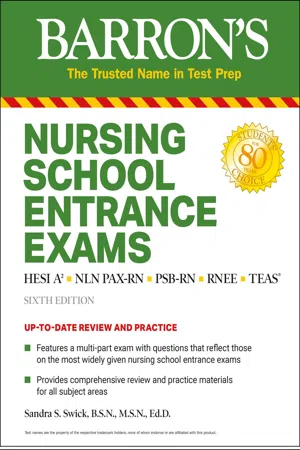
Nursing School Entrance Exams
HESI A2 / NLN PAX-RN / PSB-RN / RNEE / TEAS
- 408 pages
- English
- ePUB (mobile friendly)
- Available on iOS & Android
eBook - ePub
Nursing School Entrance Exams
HESI A2 / NLN PAX-RN / PSB-RN / RNEE / TEAS
About this book
Barron’s Nursing School Entrance Exams provides detailed review and practice materials that you need to achieve success on the various Nursing School Entrance Exams (including the HESI A2, NLN PAX-RN, PSB-RN, RNEE, and the TEAS).
This edition features:
You’ll also get information about nursing programs and the profession in general.
This edition features:
- A multi-part exam that covers all of the topic areas and question types seen on most nursing school entrance exams
- A diagnostic test so you can assess your strengths and weaknesses in each topic area before beginning your review
- Comprehensive review and practice material for all Verbal Ability, Reading Comprehension, and Numerical Ability topics
- An entire review and practice section for all Science topics, with each section broken down into an outline format for quick studying and sample tests for every topic
- Test-taking strategies and answers to frequently asked questions about preparing for your entrance exam
- Strategies for answering each question type
You’ll also get information about nursing programs and the profession in general.
Frequently asked questions
Yes, you can cancel anytime from the Subscription tab in your account settings on the Perlego website. Your subscription will stay active until the end of your current billing period. Learn how to cancel your subscription.
No, books cannot be downloaded as external files, such as PDFs, for use outside of Perlego. However, you can download books within the Perlego app for offline reading on mobile or tablet. Learn more here.
Perlego offers two plans: Essential and Complete
- Essential is ideal for learners and professionals who enjoy exploring a wide range of subjects. Access the Essential Library with 800,000+ trusted titles and best-sellers across business, personal growth, and the humanities. Includes unlimited reading time and Standard Read Aloud voice.
- Complete: Perfect for advanced learners and researchers needing full, unrestricted access. Unlock 1.4M+ books across hundreds of subjects, including academic and specialized titles. The Complete Plan also includes advanced features like Premium Read Aloud and Research Assistant.
We are an online textbook subscription service, where you can get access to an entire online library for less than the price of a single book per month. With over 1 million books across 1000+ topics, weāve got you covered! Learn more here.
Look out for the read-aloud symbol on your next book to see if you can listen to it. The read-aloud tool reads text aloud for you, highlighting the text as it is being read. You can pause it, speed it up and slow it down. Learn more here.
Yes! You can use the Perlego app on both iOS or Android devices to read anytime, anywhere ā even offline. Perfect for commutes or when youāre on the go.
Please note we cannot support devices running on iOS 13 and Android 7 or earlier. Learn more about using the app.
Yes, you can access Nursing School Entrance Exams by Barron's Educational Series,Sandra S. Swick,Rita R. Callahan in PDF and/or ePUB format, as well as other popular books in Medicine & Nursing. We have over one million books available in our catalogue for you to explore.
Information
Introduction | 1 |
IS THIS BOOK FOR YOU?
Are you wondering what might be included on a nursing school entrance exam, or does the nursing program youāve applied to require an entrance exam? If you answered yes to either of these questions, then Nursing School Entrance Exams is the reference you need.
Nursing school entrance examinations provide associate, diploma, and baccalaureate nursing programs with specific information relating to an applicantās or newly admitted individualās abilities in content areas that provide the foundation for nursing courses such as verbal ability, reading comprehension, numerical or mathematical ability, and life and/or physical sciences. Nursing school entrance examinations generally use a multiple-choice format.
Verbal ability includes elements such as vocabulary, antonyms, synonyms, verbal reasoning, and the use of analogy. Included in verbal ability are English usage and grammar, spelling, prefixes, suffixes, and root words.
Reading comprehension involves reading sentences, paragraphs, or short articles and answering questions, interpreting, and/or making inferences about the literary material. Prior knowledge of the topic is not requisite for reading comprehension because the examination is asking you to think logically and make decisions based on the information presented.
Topics for verbal ability and reading comprehension may address technical or scientific knowledge and/or general, everyday knowledge. Information may come from discipline-specific vocabulary, English grammar, history, geography, literature, art and architecture, humanities, general information, natural sciences, social sciences, and mathematics.
Numerical ability encompasses arithmetic, algebra, and geometry. Computation and interpretation of word problems, charts, ratios and proportions, decimals, percentages, and fractions may also be included. Word problems, drawn from common life events, may address such areas as sales, taxation, insurance, distance or travel, geometry, age, mixtures, investments, interest, and averages.
Life and/or physical sciences sections focus on basic premises of biology, chemistry, human anatomy, and physiology. Life sciences specifically address human structure and functioning, development, and genetics.
This book is intended to assist you to prepare or review for a nursing school entrance examination. This book is not intended to provide sufficient instruction on any topic in which you have little or no previous experience. For example, if you have never taken algebra or geometry, it is doubtful that the algebra and geometry sections found in this book will provide a background that will enable you to be successful on similar sections of a nursing school entrance examination.
Nursing School Entrance Exams is not intended to address a specific nursing school entrance examination. Nursing programs using entrance exams have a number of examinations from which to choose. These standardized exams are used nationwide. A brief overview of selected nursing school entrance examinations is presented in the following table:
Overview of Selected Nursing School Entrance Examinations*

NURSES AND WHAT THEY DO
So you think you want to be a nurse. Nursing is one of the most gratifying careers youāll ever find. But nursing is not what youāve seen on television or read about in books. Nursing is hard work, and learning to become a nurse requires dedication and long hours of study and preparation.
Unlike many disciplines in which the academic curricula has foundation courses with many related subjected areas, nursing courses usually build on one another. Prerequisite courses, such as anatomy and physiology, chemistry, microbiology, and biology, are the foundation for what you will learn in your nursing courses, such as medical-surgical nursing, pharmacology, obstetric nursing, mental health nursing, and community health nursing.
When enrolling in prerequisite courses, it should be with the intention of seriously learning information for use as your basic foundation in your nursing courses. Weaknesses in your prerequisite courses may cause problems not only in your nursing coursework, but also on your nursing entrance exam. Remember, nursing courses depend heavily on knowledge learned in prerequisites.
Todayās nurses work in numerous roles and settings, and opportunities are virtually unlimited. The following list includes settings in which nurses may practice:
Hospitals | Cruise ships |
Clinics | Retirement/nursing homes |
Doctorsā offices | Volunteer organizations |
Business/industry | Occupational health programs |
Community agencies | Ambulatory care agencies |
Schools | Hospices |
Nursing schools (higher education) | Federal/state agencies |
Military | Home care |
Resorts and summer camps |
What a nurse actually does depends upon the scope of the practice setting. In the majority of institutional or home health settings, nurses provide care to individuals with chronic, acute physical, and/or mental conditions. What a nurse does also depends upon the needs of the individual patient. The nurse may assume total care of a patient who is unable to meet any of his or her needs or may help only in areas where assistance is needed.
When working with patients, nurses assume a number of roles. In many cases, these roles overlap and are interdependent in nature. They include:
Caregiver | Role model |
Comforter | Decision maker |
Advocate | Case manager |
Teacher | Communicator |
Counselor | Researcher |
When practicing in these various roles, the nurse works to meet, or helps the patient meet, hygiene, elimination, safety, nutritional, spiritual, comfort, activity, sensory, adaptation, and/or mental health needs. The nurse focuses on assessing, analyzing, planning, and resolving actual or potential health problems and evaluates the effectiveness of nursing interventions based on the patientās responses.
Most people think of nurses as working with individuals on a one-to-one basis. In the community setting, however, the patient may not be an individual but a family or group of families, a group of individuals, or an entire community.
Educational preparation plays an important role in career planning in nursing. Career opportunities run hand in hand with a nurseās educational preparation. Simply put, opportunities for advancement increase as education increases. For some levels of practice, an associate degree in nursing is acceptable. For others, a bachelorās degree, a masterās degree, or a doctoral degree in nursing or education is required. Career opportunities include:
Staff nurse | Nurse educator |
Home health nurse | Nurse researcher |
Clinical nurse specialist | Nurse consultant |
Nurse midwife | Nurse anesthetist |
Nurse administrator | Nurse practitioner |
Hospice nurse | Public health nurse |
Successful completion and graduation from a nursing program does not allow you to practice as a registered nurse. A registered nurse license is required. Note that, as per the Texas Board of Nursing, the ānew enhanced licensure compact, or eNLC, is the licensure model that allows registered nurses (RNs) to have one multistate license, with the privilege to practice in the home state and in other eNLC states physically, electronically, and/or telephonically. It replaces the original nurse licensure compact (NLC) and adds extra safeguards that maintain public protection at the state level.ā
IS NURSING RIGHT FOR ME?
Nursing is not for everyone, and it takes more than ādesireā and a ābig heartā to be a good nurse. Nursing, as a profession, requires intelligence, self-discipline, critical thinking, communication skills, compassion, dedication, high moral and ethical standards, endurance, as well as respect and concern for the welfare of others regardless of race, creed, culture, religion, or gender orientation.
When considering nursing as a career, think about the following questions.

There is a difference between a job and a career. A job is something you do in exchange for something else, usually money. A career, on the other hand, is something you are dedicated to. A career is an endeavor in which you constantly strive to be the best at your craft and in which life-long learning is not only a necessity but a consuming desire.

In the majority of instances, nursing is a team effort focusing on an identified patient. No one person or specialty is more important than the other. The entire team works together for the patientās welfare.
Broadly speaking, nurses are part of a team that includes a physician and other health care professionals. Depending upon the patientās needs, the team may also include case managers; physical, occupational, respiratory, enterostomal, and speech therapists; nutritionists; social workers; pharmacists; psychologists; and spiritual advisors. Narrowly speaking, the team is the group of health care individuals the nurse works with on a daily basis.

Table of contents
- Cover
- Title Page
- Copyright
- Contents
- 1. Introduction
- 2. Test-Taking Strategies and Your Personalized Study Plan
- 3. Verbal Ability
- 4. Reading Comprehension
- 5. Numerical Ability
- 6. Science
- 7. Practice Tests
- Index