- 440 pages
- English
- ePUB (mobile friendly)
- Available on iOS & Android
eBook - ePub
About this book
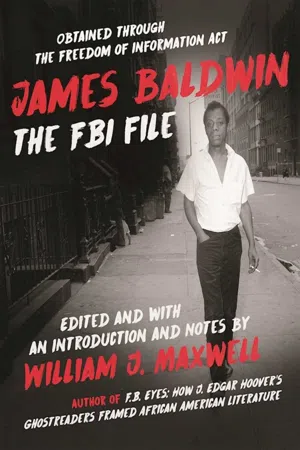
Available in book form for the first time, the FBI's secret dossier on the legendary and controversial writer.
Decades before Black Lives Matter returned James Baldwin to prominence, J. Edgar Hoover’s FBI considered the Harlem-born author the most powerful broker between black art and black power. Baldwin’s 1,884-page FBI file, covering the period from 1958 to 1974, was the largest compiled on any African American artist of the Civil Rights era. This collection of once-secret documents, never before published in book form, captures the FBI’s anxious tracking of Baldwin’s writings, phone conversations, and sexual habits—and Baldwin’s defiant efforts to spy back at Hoover and his G-men.
James Baldwin: The FBI File reproduces over one hundred original FBI records, selected by the noted literary historian whose award-winning book, F.B. Eyes: How J. Edgar Hoover’s Ghostreaders Framed African American Literature, brought renewed attention to bureau surveillance. William J. Maxwell also provides an introduction exploring Baldwin's enduring relevance in the time of Black Lives Matter along with running commentaries that orient the reader and offer historical context, making this book a revealing look at a crucial slice of the American past—and present.
Decades before Black Lives Matter returned James Baldwin to prominence, J. Edgar Hoover’s FBI considered the Harlem-born author the most powerful broker between black art and black power. Baldwin’s 1,884-page FBI file, covering the period from 1958 to 1974, was the largest compiled on any African American artist of the Civil Rights era. This collection of once-secret documents, never before published in book form, captures the FBI’s anxious tracking of Baldwin’s writings, phone conversations, and sexual habits—and Baldwin’s defiant efforts to spy back at Hoover and his G-men.
James Baldwin: The FBI File reproduces over one hundred original FBI records, selected by the noted literary historian whose award-winning book, F.B. Eyes: How J. Edgar Hoover’s Ghostreaders Framed African American Literature, brought renewed attention to bureau surveillance. William J. Maxwell also provides an introduction exploring Baldwin's enduring relevance in the time of Black Lives Matter along with running commentaries that orient the reader and offer historical context, making this book a revealing look at a crucial slice of the American past—and present.
Tools to learn more effectively

Saving Books

Keyword Search

Annotating Text

Listen to it instead
Information
1.
GRAPHIC EVIDENCE
1963, 1964, AND 1966
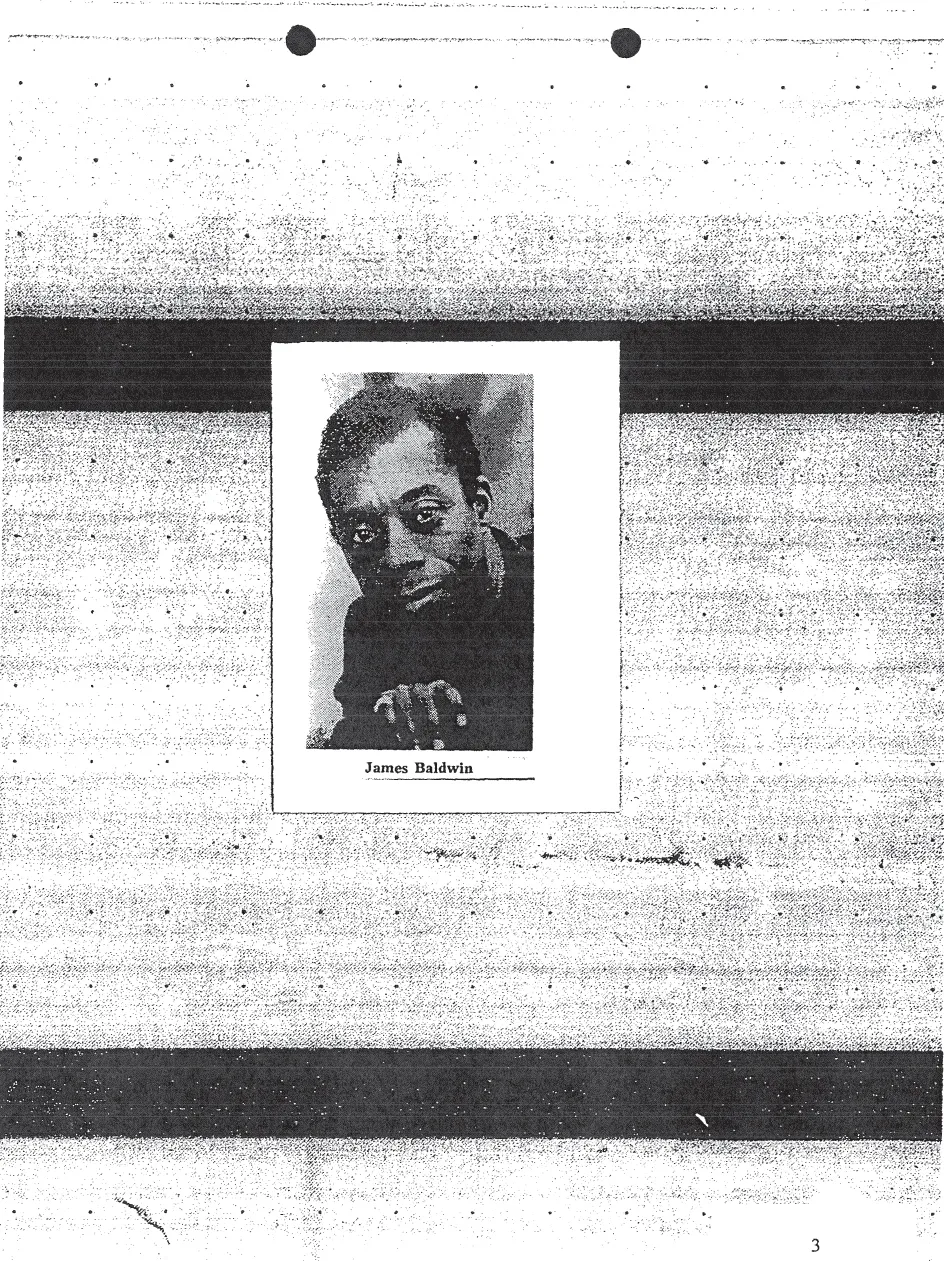
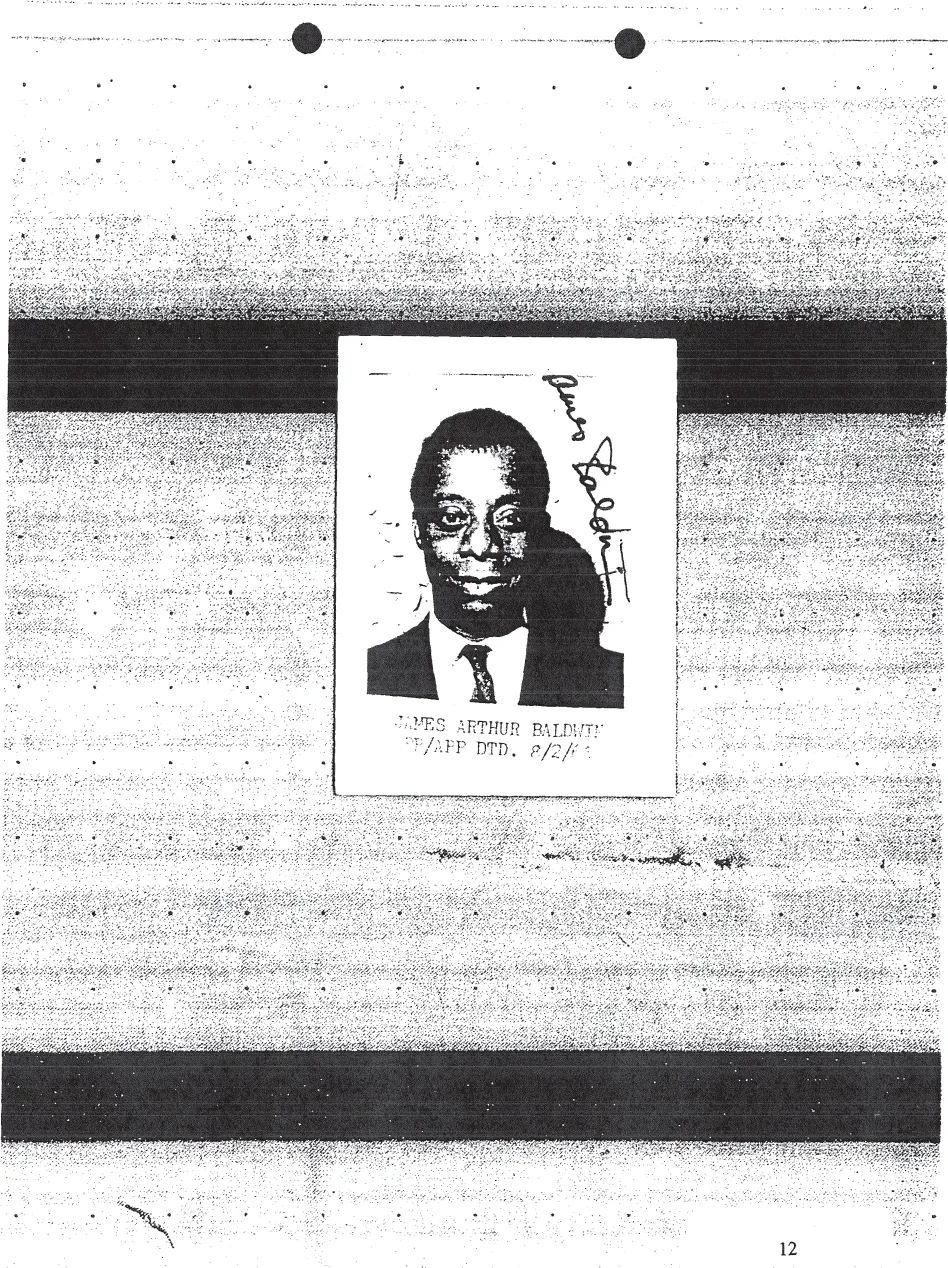
James Baldwin is the twentieth-century African American author most honored in the twenty-first. All the same, his FBI dossier begins like a common criminal case file with an envelope of graphic evidence. The first significant item in the envelope is an identifying photo of Baldwin at age thirty-nine, fresh from the success of The Fire Next Time, his now-classic reflection on the religion of the Civil Rights Movement and its Black Muslim skeptics, initially published in January 1963. Surprisingly, the FBI or another police force did not take the photo, distorted by Bureau reproduction, though later documents in the file prove that Bureau agents quietly photographed Baldwin as he protested in Selma that October. Instead, the photo was borrowed from a positive article in The Militant, the newspaper of the Socialist Workers Party, run as Baldwin lectured across the American South in support of the Congress of Racial Equality (CORE) and its philosophy of nonviolent but dynamic confrontation with racism. A flattering publicity portrait repurposed as a mugshot prefaces Baldwin’s FBI file—not the only time the Bureau turned the tools and fruits of his literary success into investigative weapons against him.
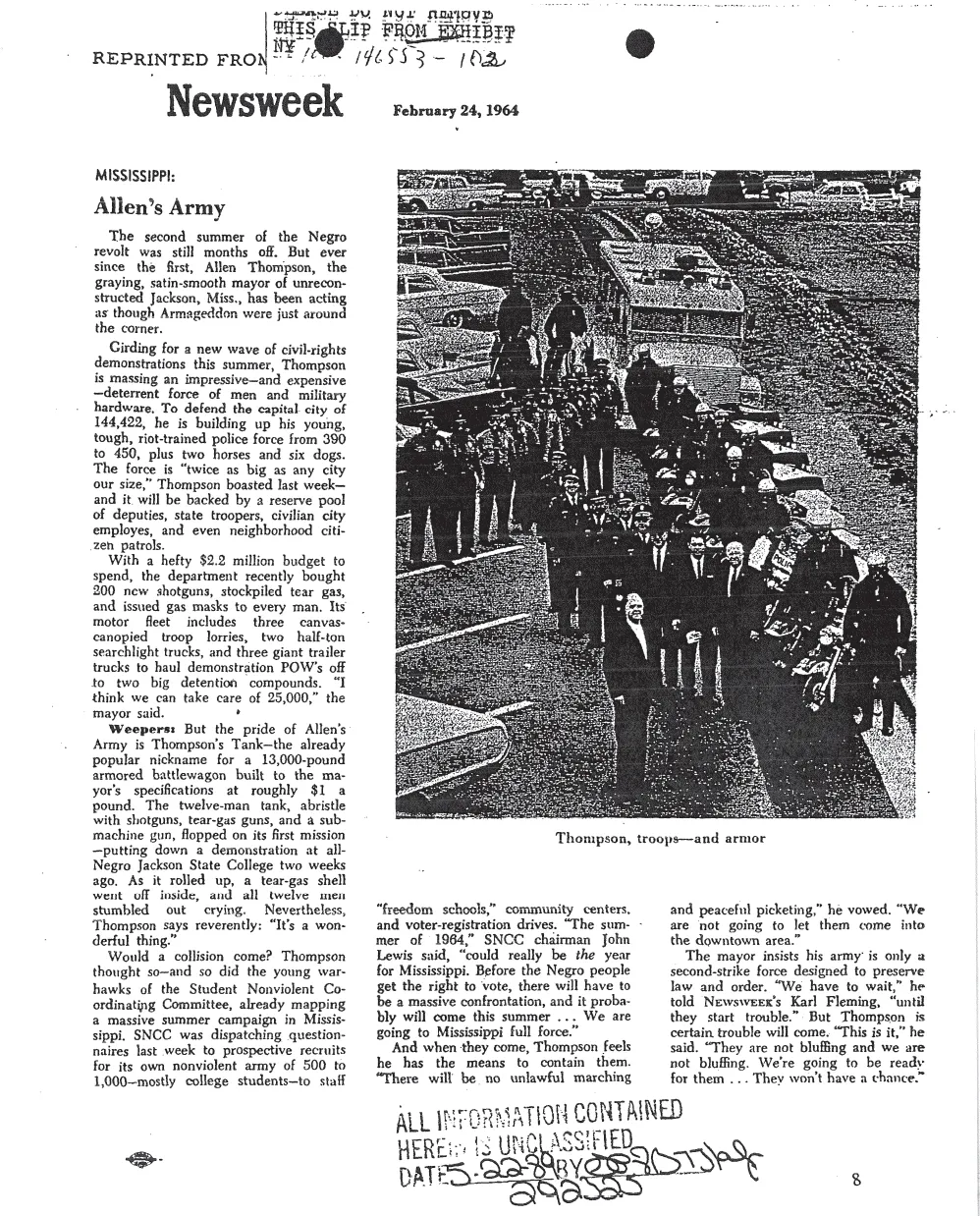
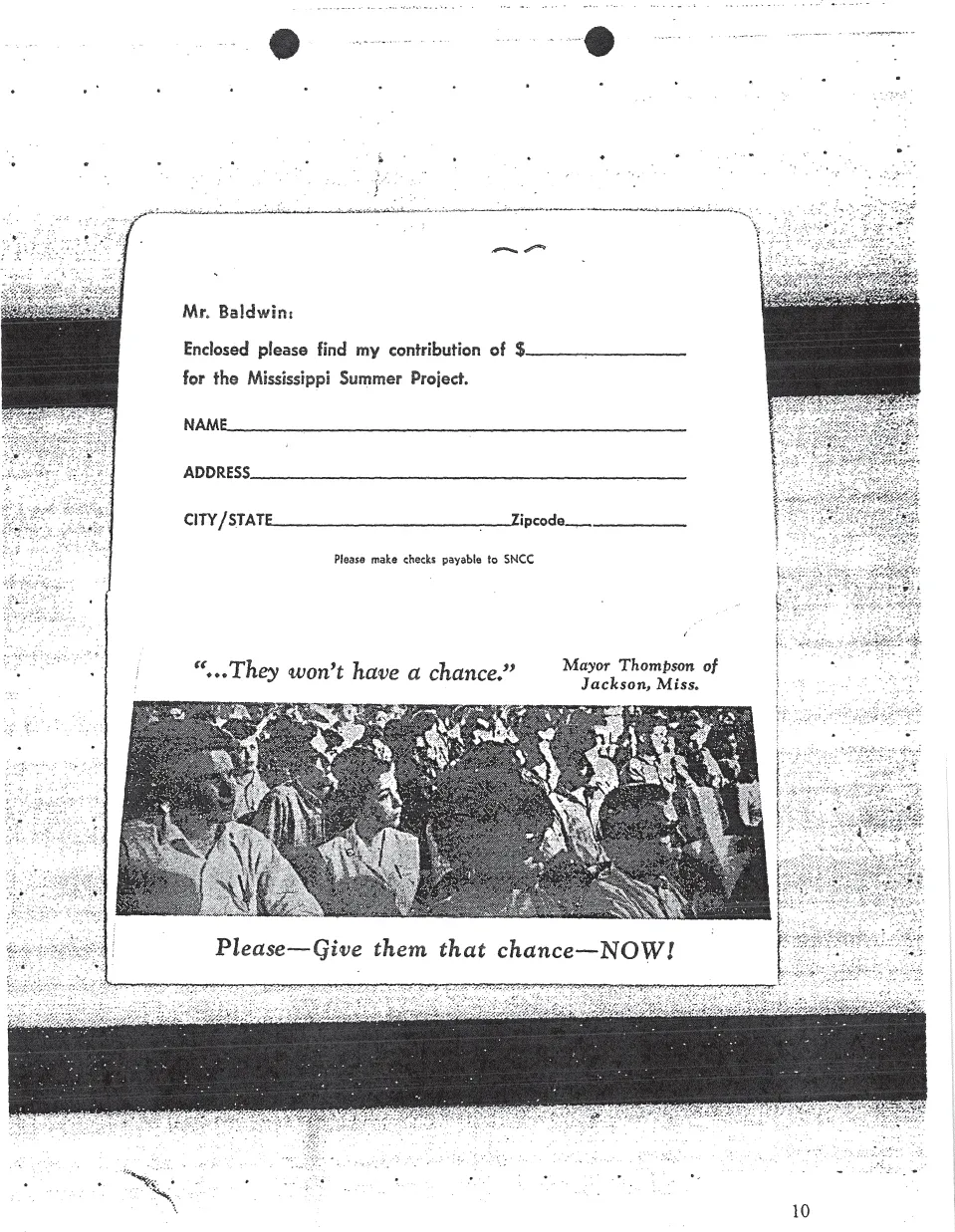
The second item in the envelope is a copy of an impassioned 1964 fundraising letter Baldwin wrote for the Mississippi Freedom Project led by the Student Nonviolent Coordinating Committee (SNCC), a group he joined well after his student days. This highly choreographed, often mythologized voter registration project drew over a thousand out-of-state volunteers, 90 percent of them white, into contact with experienced SNCC organizers and thousands of local African American citizens risking their lives for voting rights in the summer of 1964. It also drew the FBI into the business of investigating violence against civil rights workers: after years of Bureau inaction, Attorney General Robert F. Kennedy persuaded J. Edgar Hoover to probe the brutal “Mississippi Burning” murders of Freedom Project participants James Chaney, Andrew Goodman, and Michael Schwerner. Baldwin’s letter, written while the bodies of the trio were still missing, paints the Project as an existential advance and a virtuous children’s crusade, “an act of faith and courage” by young men and women “that is so extraordinary that I find myself struggling for words to describe my feelings toward them.” Why did the FBI find Baldwin’s appeal important enough to collect through a “Confidential Mail Box” set up to receive radical publications? In part because the Bureau, unlike Baldwin’s radical critics, consistently saw him as a militant protest leader as well as an influential author and commentator. Baldwin would in fact support SNCC’s turn to a combative Black Nationalism in 1966. SNCC chairman Stokely Carmichael’s call for Black Power, Baldwin argued, harmonized with at least one respected “canon of Western thought: the self-determination of peoples.” As the decade wore on, Baldwin’s continued sympathy for SNCC increasingly alarmed FBI headquarters, and became one justification for his official relisting as an “Independent Black Nationalist Extremist” in 1968.



The final item in the envelope heading up Baldwin’s file is another portrait photograph, this one hijacked from a 1966 version of his US passport. This second photo, just three years older than the first, reveals the FBI’s determination to keep an up-to-date headshot of Baldwin at the ready, the better to identify and detain him as a security risk in times of national emergency, as other documents in the file confirm. The source of the headshot testifies to the Bureau’s close coverage of Baldwin’s travels as a frequent transatlantic flyer (not just the concern of the CIA, officially charged with collecting national intelligence outside the US). Baldwin’s confident look at the camera and firm signature across the photo predict his efforts, unveiled elsewhere in the file, to spy on and write about the Bureau in return—to do unto the FBI, in other words, what its file had done to him. As the cultural historian Maurice Wallace sees it, Baldwin’s prominent eyes staring back from his Bureau dossier reflect “an eyeballing disposition of his own.”
2.
BALDWIN’S “FRECH ACCENT” ON AFRICAN INDEPENDENCE
JUNE 1961
Indexes in the file refer to stray FBI paperwork on Baldwin dating from 1958 and 1960, perhaps even from 1944, the year the apprentice author first met Richard Wright and launched the manuscript that became his debut novel, Go Tell It on the Mountain (1953). But the earliest complete document in the file comes from 1961 and concerns a public gathering of the Liberation Committee for Africa (LCA). This small, New York–based Pan-Africanist group is best remembered for publishing the Liberator, a leading political and cultural journal founded in response to the death of Patrice Lumumba, the Congolese independence leader assassinated with help from the CIA. Baldwin became a regular Liberator contributor and lent his voice to a June 1961 LCA meeting at a Broadway hotel whose audience included an undercover FBI spy. The three-page informer’s report that followed the meeting begins with a dreary account of a “heavy traffic tie-up on approaching the Lincoln Tunnel.” It nears its end with a bang, however, describing “the last speaker and the most f...
Table of contents
- Cover
- Title Page
- Copyright
- Contents
- Introduction: Baldwin and His File after Black Lives Matter
- James Baldwin’s FBI File, Sampled and Explained
- Sources of Quotations in the Commentaries
- Index to the Introduction and Commentaries
Frequently asked questions
Yes, you can cancel anytime from the Subscription tab in your account settings on the Perlego website. Your subscription will stay active until the end of your current billing period. Learn how to cancel your subscription
No, books cannot be downloaded as external files, such as PDFs, for use outside of Perlego. However, you can download books within the Perlego app for offline reading on mobile or tablet. Learn how to download books offline
Perlego offers two plans: Essential and Complete
- Essential is ideal for learners and professionals who enjoy exploring a wide range of subjects. Access the Essential Library with 800,000+ trusted titles and best-sellers across business, personal growth, and the humanities. Includes unlimited reading time and Standard Read Aloud voice.
- Complete: Perfect for advanced learners and researchers needing full, unrestricted access. Unlock 1.4M+ books across hundreds of subjects, including academic and specialized titles. The Complete Plan also includes advanced features like Premium Read Aloud and Research Assistant.
We are an online textbook subscription service, where you can get access to an entire online library for less than the price of a single book per month. With over 1 million books across 990+ topics, we’ve got you covered! Learn about our mission
Look out for the read-aloud symbol on your next book to see if you can listen to it. The read-aloud tool reads text aloud for you, highlighting the text as it is being read. You can pause it, speed it up and slow it down. Learn more about Read Aloud
Yes! You can use the Perlego app on both iOS and Android devices to read anytime, anywhere — even offline. Perfect for commutes or when you’re on the go.
Please note we cannot support devices running on iOS 13 and Android 7 or earlier. Learn more about using the app
Please note we cannot support devices running on iOS 13 and Android 7 or earlier. Learn more about using the app
Yes, you can access James Baldwin by William J. Maxwell in PDF and/or ePUB format, as well as other popular books in Historia & Biografías literarias. We have over one million books available in our catalogue for you to explore.