The issue of how Japanese society operates, and in particular why it has `succeeded', has generated a wide variety of explanatory models, including the Confucian ethic, classlessness, group consciousness, and `uniqueness' in areas as diverse as body images and language patterns.
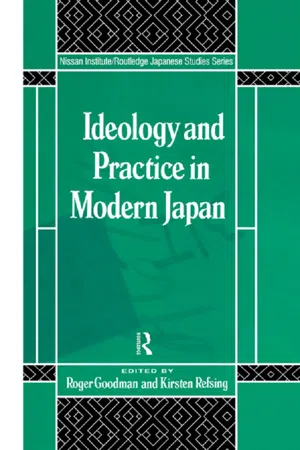
In Ideology and Practice in Modern Japan the contributors examine these models and the ways in which they have sometimes been used to create a sense of `Japaneseness', that obscures the fact that Japan is actually an extremely complex and heterogenous society. In particular, `practice' at the micro-level of society is explored to illuminate or express a broader ideology. The contributors investigate a wide variety of subjects - from attitudes to death to the role of education, from film making to gender segregation - to see what can be said about the phenomenon in particular, what it tells us about Japan in general, and what conclusions can be drawn for our understanding of society in the broadest sense.
- 256 pages
- English
- ePUB (mobile friendly)
- Available on iOS & Android
eBook - ePub
Ideology and Practice in Modern Japan
About this book
Information
Chapter 1
Ideology and practice in Japan Towards a theoretical approach1
NATIONALITIES, ASSUMPTIONS AND METHODOLOGIES
This volume is the third in a continuing series of publications from the Japan Anthropology Workshop, an organisation which prefers to go under the acronym JAWS. JAWS is an international organisation of over one hundred anthropologists—all specialising to some degree in the study of Japan—which meets every eighteen months to exchange ideas in an academic forum (see Hendry 1987; van Bremen 1989). The first two volumes contained chapters from sixteen and ten contributors respectively (see Hendry and Webber 1986; Ben-Ari, Moeran and Valentine 1990), representing nine different countries of origin. This current collection of twelve chapters also represents no less than nine different countries. One of the most interesting facets of attending the JAWS meetings is to see how scholars from different societies approach the same subject—Japan.
The question of different national approaches to the study of Japan is a difficult one. It is not always easy, as contributors to a volume edited by Befu and Kreiner (forthcoming) have pointed out, to isolate the individual national characteristics that play a part in formulating any scholarly account.2 This problem is illustrated in the biographies of some of the scholars whose work is contained in this volume. Harumi Befu, for example, is a Japanese American who received his education in both Japan and the United States; Moon Okpyo is a South Korean who undertook her doctoral studies in England; Rosemary Breger comes from Namibia and did her Ph.D. in West Germany. Jan van Bremen and Jacob Raz come from and now teach in Holland and Israel respectively, yet both of them received a significant proportion of their education in North America. D.P.Martinez was born in Spain, educated in the United States and teaches in Britain. In all such cases, one is left asking which has had the greatest influence on their work—their country of origin, their country of study or their country of residence?
The significance of personal background can perhaps be seen most clearly in the chapter by Moon. Her study of the different usages of the ‘language of Confucianism’ —a concept which we will examine later—in Japan and South Korea shows that there are also important differences where many scholars have found similarities. It also demonstrates the dynamic, changing nature of a phenomenon that many appear to consider a conservative and unchangeable code. Few scholars have the background that enables Moon to discuss these differences not only in depth but also in an analytical framework which is indigenous to neither society.3 Similarly, when reading the chapters by Kirsten Refsing, Rosemary Breger and Harumi Befu it is important to remember that they are written in the context of Danish, German and American societies respectively. The importance which a Japanese American, Harumi Befu, attaches to respect for the national flag and the monarchy is interesting in comparison with British society where Union Jack underpants and grotesque puppets of the Royal Family are popular sources of humour.
Just as a range of national origins is reflected in the chapters in this volume, so one can also see a number of differing methodological approaches to the understanding of Japanese society. Social anthropology is extraordinarily catholic in the range of methodologies it embraces. The most traditional approaches can be seen in the research undertaken by Joy Hendry, D.P.Martinez and Jacob Raz. All three draw on the participant observation approach generally associated with the name of Malinowski. Martinez lived in an ama community for over a year and participated in all their activities, including diving. Indeed, she herself became something of a local celebrity and was the subject of a television documentary.
Raz, who not only observed but also, at times, participated in the (legal) activities of the yakuza group he was studying, was clearly aware of how his presence, initially at least, affected the behaviour of the yakuza. Rather than despair, however, at the impossibility of undertaking genuine observation research as a foreigner—one of the criticisms levelled against anthropologists of Japan by such as Mouer and Sugimoto (1986:167) —he cleverly incorporates into his account those performances undertaken especially for his benefit.4
Hendry’s work is based on participant observation over a six-month period as a mother of children in a private kindergarten. The high profile of Japanese mothers in the education of their children—at the primary level they often spend a considerable amount of time in school themselves—meant that, even as a foreigner, her presence probably affected the subject she was researching much less than might otherwise be expected.
Regine Mathias’ account of social mobility in Japan during the early years of this century is based largely on extensive interviews with a single informant—reminiscent in style of Tessa Morris-Suzuki’s (1984) account of twentieth-century Japan based on a series of life histories. Most of the other chapters are, to a considerable extent, based on the analysis of written documents in circulation in Japan. It is this dimension—the long history of literacy—which renders the anthropology of Japan somewhat different from the more traditional studies of pre-literate or recently-literate societies. Fleur Wöss, for example, examines the published results of opinion polls taken over a twenty-five-year period concerning the views on death of different sections of Japanese society; van Bremen has picked up cheap paperback books and undertaken a close textual analysis of their contents for his discussion of the significance of Confucianism in contemporary Japan.
Neither Wöss nor van Bremen discuss here how the texts were constructed, although they both show awareness of the significance of this aspect at the beginning of their chapters. Breger, in contrast, takes a detailed quantitative approach in order to demonstrate how the discourse about Japan in German newspapers is determined by the political leanings of different sections of the German media. Befu also draws on contemporary newspapers and journals, though this time from Japan, in order to try and gain a sense of the current debate concerning Japan’s role in the world. If, at times, his approach appears to be partial—Pyle (1982), for example, offers at least three other mainstream arguments to be found in the same literature5 —this is clearly a deliberate attempt to understand the function and source of a nationalistic viewpoint which he feels is gaining in significance and importance.
Augustin Berque also makes use of a large range of data—including the view from his desk as he types his chapter—to expound on wider ideas of the relationship between nature and culture in modern Japan. Befu, Berque and, to some extent, van Bremen show how the apparently trivial ephemera of society can be central to the study of social anthropologists. Like a squirrel hoarding nuts, the anthropologist has a tendency to collect any data he or she comes across in case it should prove significant in later analysis.
Finally, Refsing offers an account of Japanese education which is undertaken in a way that presents a mirror-image of the type of research undertaken by Hendry. Hendry works from the micro level to the macro, from her observations of children in a Japanese elementary school to concepts of individuality and individualism in wider Japanese society; Refsing works from the macro to the micro by examining education in Japan in the light of debate currently taking place in countries around the world on drastic reforms to their education systems.6
LEVELS OF INTELLECTUAL COHERENCE
By this stage, the reader may well feel entitled to ask what is the rationale—apart from the fact that they all examine the subject of Japan—behind bringing together, in a single collection, chapters covering such a wide range of different backgrounds and methodological approaches.
At one level, it can be argued that simply the fact that they all examine Japanese society is, in itself, of sufficient value to merit the collection. Anthropological research, particularly at the micro level, does much to undermine accounts of the ‘Japanese’ as if they all behaved and lived in exactly the same way. The chapters in this volume emphasise how crucial differences of class, age, gender and ethnicity are in determining the lifestyle and life chances of individuals in Japan.
In the light of the heterogenous nature of Japanese society which is obvious in a reading of this volume, it may seem curious that anthropology as a discipline has been held responsible (see Mouer and Sugimoto 1986) for presenting an image of the Japanese as an homogeneous group.7 Nakane Chie’s Japanese Society (1973) has been particularly heavily criticised on this score (see Hata and Smith 1983). The problem lies not in the primary level of anthropological data—the ethnographic material—but in the way it is used to make generalisations about Japanese society.
One part of the problem of moving from the specific to the general in Japanese society lies in the fact that Japan has one of the highest literacy rates in the world. There is a danger, therefore, that attempts by anthropologists to explore the way Japanese see their world may, by publishing these theses, actually play a part in creating a particular worldview. Benedict’s (1946) tentative suggestion that, on a continuum between shame and guilt, Japanese culture tends towards the ‘shame’ model, or Nakane’s (1973) description of Japan as a ‘vertically-oriented’ society (tate shakai) have become so widely disseminated in Japanese society that they are often offered to new anthropologists entering the field by Japanese informants as an explanation of the way Japanese society works (see Dale 1988:4).8
It is clear that there will always be dangers inherent in moving from the specific to the general in a study of any complex, literate society, even if it is stressed that such general models are heuristic or, in a Weberian sense, ‘ideal types’. The anthropologist, however, has to attempt, at the very least, to try to gain some sense of what it is in Japan that makes an individual think of himself or herself as Japanese—as opposed, say, to identifying with a wider Asia—as well as what it is that they feel makes them a member of a specific group in Japan and what differentiates them from any other group in Japan. In an age of increasing interaction between Japanese and members of other societies, it may be particularly important to try and understand the assumptions of ‘Japaneseness’ that Japanese carry abroad with them. Not all Japanese, of course, accept all these ideas of ‘Japaneseness’ at face value; those whom van Wolferen (1989) calls ‘buffers’ —who serve to make contact with foreigners as smooth as possible—may be especially cynical, for example, about the ideas they pedal to explain trade problems in terms of cultural differences.
In anthropological analysis there is a classic tripartite division between what people say they do, what they say that they ought to do, and what the anthropologist perceives them actually to be doing. Values or ideas about ‘Japaneseness’ serve as a model or image of ‘Japanese’ behaviour—what they think they ought to be doing—against which individual Japanese can judge their own behaviour. It will become clear, moreover, from the chapters in this volume that the way the Japanese think of themselves is as relevant to the anthropologist as the way they are perceived by others.
It is at a broader level of analysis, however, that the greatest attempt has been made to produce an intellectual coherence in these chapters. The meetings of JAWS have concentrated on trying to make sense of human society in general in the light of an enhanced understanding of the particular case of Japan. As Hendry (in Hendry and Webber 1986:3) wrote in the introduction of the first JAWS volume, such meetings have two aims:
To draw the attention of anthropologists to some of the insights that studies of Japan may bring to topics of current interest in the field; and to demonstrate to Japanese specialists the value of the contribution anthropologists may make to the general understanding of Japanese society.
The theme which authors were asked to consider while writing their chapters for this volume was the significance of, and the relationship between, the concepts of ideology and practice in modern Japan. At the time there was no attempt to define how these terms should be used; authors were left to situate their material in the context of these ideas in any way they wished. It was believed that the authors all shared the same perception of the importance of the concepts of ideology and practice in Japan and accepted prima facie that these were useful and interesting ideas to pursue. It is, therefore, important to spell out some of these assumptions before examining the varying ways in which the writers actually approached the subject.
THE LANGUAGE OF IDEOLOGY AND PRACTICE IN JAPAN
One of the first distinctions any anthropologist embarking on research in Japan learns to make is between tatemae and honne. Tatemae—and like all culturally relative terms it is difficult to render its meaning exactly in English—refers to an individual’s explicitly stated principle, objective or promise; honne refers to what that individual is really going to do, or wants to do.
At one level, therefore, tatemae refers to the way individuals in Japan know they are expected to behave. This is normally expressed in terms of moral (sometimes Confucian) precepts and social obligations and expectations such as repaying social debts, loyalty in return for benevolence, respect for authority. Honne, on the other hand, refers to the way individuals actually want to behave—in terms of self-interest. Since, as the literature on Japan constantly stresses, self-interest (what Hendry describes in her chapter as ‘individualism’ rather than ‘individuality’) receives wide social disapproval, it is not surprising that one should present one’s actions in terms of tatemae even if one is determined to fulfil t...
Table of contents
- Cover
- Halftitle
- Title
- Copyright
- Contents
- List of contributors
- A note to the reader
- General Editor’s preface
- Acknowledgements
- 1 Ideology and practice in Japan: Towards a theoretical approach
- 2 Symbols of nationalism and Nihonjinron
- 3 Rivers in Tokyo: A mesological glimpse
- 4 Individualism and individuality: Entry into a social world
- 5 When blossoms fall: Japanese attitudes towards death and the otherworld: opinion polls 1953–87
- 6 From farm to urban middle class: A case study of the role of education in the process of social mobility
- 7 Japanese educational expansion: Quality or equality
- 8 A beacon for the twenty-first century: Confucianism after the Tokugawa era in Japan
- 9 NHK comes to Kuzaki: Ideology, mythology and documentary film-making
- 10 The discourse on Japan in the German press: Images of economic competition
- 11 Confucianism and gender segregation in Japan and Korea
- 12 Self-presentation and performance in the yakuza way of life: Fieldwork with a Japanese underworld group
- Index
Trusted by 375,005 students
Access to over 1.5 million titles for a fair monthly price.
Study more efficiently using our study tools.
Frequently asked questions
Yes, you can cancel anytime from the Subscription tab in your account settings on the Perlego website. Your subscription will stay active until the end of your current billing period. Learn how to cancel your subscription
No, books cannot be downloaded as external files, such as PDFs, for use outside of Perlego. However, you can download books within the Perlego app for offline reading on mobile or tablet. Learn how to download books offline
Perlego offers two plans: Essential and Complete
- Essential is ideal for learners and professionals who enjoy exploring a wide range of subjects. Access the Essential Library with 800,000+ trusted titles and best-sellers across business, personal growth, and the humanities. Includes unlimited reading time and Standard Read Aloud voice.
- Complete: Perfect for advanced learners and researchers needing full, unrestricted access. Unlock 1.5M+ books across hundreds of subjects, including academic and specialized titles. The Complete Plan also includes advanced features like Premium Read Aloud and Research Assistant.
We are an online textbook subscription service, where you can get access to an entire online library for less than the price of a single book per month. With over 1.5 million books across 990+ topics, we’ve got you covered! Learn about our mission
Look out for the read-aloud symbol on your next book to see if you can listen to it. The read-aloud tool reads text aloud for you, highlighting the text as it is being read. You can pause it, speed it up and slow it down. Learn more about Read Aloud
Yes! You can use the Perlego app on both iOS and Android devices to read anytime, anywhere — even offline. Perfect for commutes or when you’re on the go.
Please note we cannot support devices running on iOS 13 and Android 7 or earlier. Learn more about using the app
Please note we cannot support devices running on iOS 13 and Android 7 or earlier. Learn more about using the app
Yes, you can access Ideology and Practice in Modern Japan by Roger Goodman,Kirsten Refsing in PDF and/or ePUB format, as well as other popular books in Social Sciences & Ethnic Studies. We have over 1.5 million books available in our catalogue for you to explore.