- 360 pages
- English
- ePUB (mobile friendly)
- Available on iOS & Android
eBook - ePub
About this book
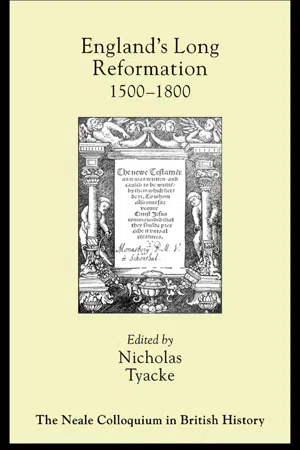
England's Long Reformation" brings together a distinguished team of scholars, who seek to advance beyond current debates concerning the English Reformation. It puts the religious changes of the 16th century in longer perspective than has been traditional and counters the recent emphasis on the popularity of pre-Reformation Catholicism. Instead the case is argued for an underlying trajectory of evangelical activity from the 1520s. The contributors also examine some of the hybrid religious forms which developed and the propagation of the more uncompromising messages of Puritanism and Counter-Reformed Catholicism.; Taking their cue fom continental historians, the authors demonstrate the insights which can be derived by taking a long view of the Reformation in England. The processes of Protestantization and indeed Christianization were involved, with each new generation needing to be won over or at least re- educated. The interaction of religion and society - particularly as regards the so-called "reformation of manners" - is another central theme. Ranging from Tudor Norwich to Hanoverian Bristol, the work collectively breaks down some of the artificial barriers created by periodization and encourages a new way of looking at the English Reformation. This volume should prove valuable reading for those interested in the making of a Protestant nation.
Information
1
Introduction: re-thinking the “English Reformation”1
Nicholas Tyacke
Historians of continental Europe are accustomed to taking a long-term view of the Reformation. Thus the modern discussion of its “success and failure” ranges across both the sixteenth and seventeenth centuries, while Jean Delumeau’s seminal treatment of the Counter-Reformation employs an even wider time frame.2 The case as regards England, however, is somewhat different, where the Reformation remains largely corralled in the mid-sixteenth century and the recent “revisionist” accounts seek only to edge forward a few decades. Part of the explanation for this historiographical contrast lies in the still dominant English tradition of political interpretation, which treats the subject as first and foremost a succession of legislative enactments—culminating under Elizabeth I and followed by a fairly rapid collapse of Catholicism.3 Continental historians, on the other hand, have been more willing to see the Reformation as a religious movement, and one furthermore that continued to be strongly contested.
Apart from this difference of approach, the English model requires glossing over a number of problems. Catholicism may have withered away, but how did a religion of the word (Protestantism) fare in a predominantly illiterate society? At least according to one account, itself a notable exception to the historiographic rule, magical beliefs came partly to fill the gap.4 Related to this question are the deep divisions among Protestants, which resulted during the seventeenth century in the temporary destruction of the Elizabethan “settlement of religion”, with the Puritans and their Dissenter successors claiming to be the true heirs of the Reformation—a conflict of interpretation which the 1689 Toleration Act only served to institutionalize. There are indeed analogies to be drawn here between this internecine Protestant strife and the struggle on the continent between reformers and counter-reformers. Moreover, the subsequent Enlightenment critique of all such bands of competing Christians, mounted during the eighteenth century, also owed a debt to English thinkers.
Nevertheless, considerations of this kind are far removed from those of most historians of the Reformation in England, where since the 1970s much energy has been consumed in a prolonged bout of revisionist enthusiasm.5 According to this new account, the Reformation was imposed from above upon an unwilling people, by a process both officially inspired and markedly piecemeal; religious change came about only gradually and largely because of the manoeuvrings of a section of the political elite; such was the enduring strength of Catholicism that Protestantism remained for long a sickly plant, its survival far from assured. These views are associated especially with the historians Christopher Haigh and J. J.Scarisbrick, although they have received powerful reinforcement from Eamon Duffy whose book concentrates more on the fifteenth century. While the centre of gravity of Scarisbrick’s The Reformation and the English people is the earlier sixteenth century and the focus of Haigh’s various writings is rather later, they are two parts of a related argument about Tudor religious developments. The thesis appears firmly grounded on the evidence of bountiful Catholic religious giving as recorded in the wills of the period, the building and adornment of churches right up to the Reformation, items of expenditure in churchwardens’ accounts during the first half of the sixteenth century, flourishing lay confraternities almost until the moment of their statutory abolition, and the high clerical standards revealed by pre-Reformation episcopal visitations. All in all, the English Church emerges from these documents as being in excellent shape at the accession of Henry VIII. Hence revisionists reject what they see as an essentially Protestant and triumphalist story of events thereafter, portraying them instead as an accidental by-product of Tudor politics.6
Closer inspection, however, reveals this “new” interpretation to be an old one resurrected. Specifically, it is a Catholic version propagated at the beginning of the twentieth century by Cardinal Aidan Gasquet and his protégé H. N.Birt. Gasquet’s book The eve of the Reformation, published back in 1900, now seems remarkably prescient, drawing as it did on wills, churchwardens’ accounts, records of lay confraternities, and visitation materials, among other sources, to illustrate the healthy state of the pre-Reformation English Church. Gasquet also suggested that the importance of anti-clericalism had been much exaggerated, and this argument too has recently been revived. But his main contention was that “up to the very eve of the [Reformation] changes the old religion had not lost its hold upon the minds and affections of the people at large”.7 On the other hand, the concern of Birt, in his 1907 publication The Elizabethan religious settlement, was with the fate of Catholicism under Queen Elizabeth. His conclusion was that
as in the case of the clergy, so in that of the laity, while some without doubt heartily embraced the change of religion, the majority of them were not favourable to it, but acquiesced outwardly for the sake of peace, not fully understanding the details of the differences between Protestantism and Catholicism.
At the same time, so Birt claimed, large numbers of Marian priests refused to submit to the Elizabethan regime, ministering instead to the Catholic laity, whom he characterized as numerically “not only considerable, but formidable, far into the reign”. Readers will be struck here by the distinct anticipations of Haigh’s arguments especially about the “continuity of Catholicism” across the Reformation, and the merging of the old Marian priests with the younger generation of seminarians trained abroad, as well as the alleged religious conservatism of many nominal Protestants.8
There is, of course, nothing shameful about following in the footsteps of previous historians, even if it does rather detract from revisionist claims to novelty. Nor is a Catholic version of events inherently any worse than a supposedly Protestant one, although it may be no better. Yet doubts arise, particularly concerning the relevance of the type of evidence used by Gasquet and his modern equivalents to understanding the Reformation process. Revisionist historians usually distinguish the Reformation in England from that elsewhere, but similar signs of Catholic health can be found in many parts of continental Europe which were to turn Protestant.9 Here indeed the original Gasquet version was distinctly superior, allowing as it did for a “Lutheran invasion” concurrent with the Henrician break from Rome, whereas Luther does not rate a single mention in Scarisbrick’s index—a telling, if extreme, example.10
Haigh offers us a stark choice between conceiving of the English Reformation as either “from above” or “from below”. Despite a further subdivision into “fast” and “slow”, these are the basic options.11 Reformation from below is linked pre-eminently, in this scenario, with the name of A. G.Dickens, who attempted the praiseworthy task of trying to provide a popular dimension to more traditional political accounts, along with emphasizing “the development and spread of Protestantism”.12 But this Haighian “choice” is largely illusory. Thus the concept of a Reformation from below, which we are asked to reject, is something of a revisionist straw man. In comparative continental terms it implies a broad popular movement only really conceivable if some kind of peasant revolt,13 as in Germany, had interacted with the early stages of the English Reformation, yet even then the attitude of the magistrate would still have been decisive in the long run. Conversely Haigh’s Reformation from above is defined extremely narrowly, in the high political terms of court faction. As a consequence a whole range of other possibilities are ruled out.
What, for example, of the intelligentsia and the role of ideas more generally? As on the continent, we need to take into account the very important part played by a clerical vanguard. Increasing signs of alarm were also registered by the English authorities over the influx of printed heretical literature. Thus May 1521 saw the formal burning of Luther’s works at St Paul’s Cross in London, with an accompanying sermon from Bishop Fisher of Rochester which sought, among other things, to refute the doctrine of justification by faith alone. There were similar book-burnings in Oxford and Cambridge at this time, as part of a nationwide campaign.14 Yet by the mid-1520s a heretical network had developed, which embraced London and both universities. The upper echelons included at least two heads of Cambridge colleges, Thomas Forman of Queens’ and William Sowode of Corpus Christi. Forman masterminded a trade in forbidden books from his London parish of All Hallows, Honey Lane. Arrested in 1528, he died the same year—his “Lutheran” views on justification recorded for posterity in the hostile pages of Thomas More. Nevertheless the successors of Forman at Queens’, Simon Heynes (1528) and William May (1537), turned out to be of a similar religious persuasion to him, as was Matthew Parker who followed Sowode at Corpus Christi in 1544. By this last date St John’s (John Taylor: 1538) and Pembroke (Nicholas Ridley: 1540) had joined the roster of colleges with reformist heads. We should probably add to the list Peterhouse, where the master John Edmunds died a secretly married man in 1544, and Christ’s whose master Henry Lockwood sponsored the performance that year of a Lutheran play. In addition, between 1528 and 1538 King’s had a reformist provost in the person of Edward Fox.15 Fellows of like mind can be found across the university as a whole and heretical works regularly show up in the inventories of individual Cambridge scholars from the 1530s onwards. During the same decade William Turner of Pembroke College was translating, for English publication, continental propaganda in favour of the “new” religion. Oxford undoubtedly lagged behind, only acquiring a clearly reformist head with Richard Cox, already in trouble for his religious views in the late 1520s, as dean of Christ Church in 1546, and continental reformed theology seems to have been much less widely available there.16 Even one English university, however, was springboard enough.
By the beginning of the 1530s the authorities had condemned over twenty heretical works in English and many more in Latin.17 Whereas a few years earlier it had been thought sufficient to catalogue the errors of Luther, now this treatment was extended to his fellow reformers as well as to a new breed of English language authors. From the mid-1520s some of the most intrepid English evangelists had journeyed to Luther’s Wittenberg itself, while a favoured port of call by the later 1530s was Bullinger’s Zurich, this last with the personal blessing of Archbishop Thomas Cranmer. Also during the 1530s works by Bullinger and Luther became available in English, along with others by Bucer, Lambert and Osiander; Melanchthon and Zwingli were added to the list in the early 1540s.18 Here, however, revisionists are able to counter that the bulk of the population was illiterate. Yet the spoken word is not constrained by such barriers and, as on the continent so in England, preaching proved central to the spread of what retrospectively was called Protestantism. The amount of preaching is unquantifiable, but we can cite as indirect evidence an instruction on this subject issued by Archbishop Cranmer in 1534. It appears to have been triggered by the reformist sermons of Hugh Latimer at Bristol but clearly had a much wider reference, other foci for example being the similar preaching of John Bale at Doncaster and that of Thomas Rose at Hadleigh in Suffolk. Cranmer stipulated that no one for a year should preach either for or against “purgatory, honouring of saints, that priests may have wives, that faith only justifieth”, the making of “pilgrimages” and the working of “miracles”, since these “things have caused dissension amongst the subjects of this realm already”.19 But that the orthodox Catholic view should now be a matter of doubt shows just how rapidly ideas were changing, courtesy in part of the pulpit.
Revisionists usually couch their accounts of the English Reformation in terms of the history of parliamentary legislation, yet this produces a very distorted picture. At the official level indeed it remains vital to distinguish between the Henrician and Edwardian Reformations, because only after 1547 was Protestantism established. Nevertheless there is an underlying trajectory of evangelical activity from the 1520s and through into the 1550s. At this unofficial level the allegedly piecemeal nature of the Henrician Reformation makes much less sense. Granted considerable wells of indifference or plain muddle, plenty of evidence also exists of growing polarization between the advocates of the “new learning” as opposed to the “old learning”, by which is meant religion. (The contemporary state papers are littered with such references.) Compared with this, the leading parliamentary issues of the 1530s, such as the royal supremacy and the dissolution of the monasteries, were relatively uncontentious matters. Therefore the argument that the Reformation crept up unnoticed on the educated classes presupposes an extraordinary insensitivity on their part to what was happening under their noses.20 Take, for instance, the electrifying sermons preached to the Convocation of Canterbury, in June 1536, by Latimer. Having previously been accused of “erroneous preaching” on purgatory and the veneration of images, he now daringly threw the charges back in the faces of the assembled clergy. Even more boldly he bracketed his own case ...
Table of contents
- Cover Page
- Title Page
- Copyright Page
- Preface
- Notes on contributors
- 1: Introduction: Re-thinking the “English Reformation”
- 2: The Long Reformation: Catholicism, Protestantism and the multitude
- 3: Comment on Eamon Duffy’s Neale Lecture and the Colloquium
- 4: Religious toleration and the Reformation: Norwich magistrates in the sixteenth century
- 5: From Catholic to Protestant: the changing meaning of testamentary religious provisions in Elizabethan London
- 6: Piety and persuasion in Elizabethan England: the Church of England meets the Family of Love
- 7: “The lopped tree”: the re-formation of the Suffolk Catholic community
- 8: Prisons, priests and people
- 9: “Popular” Presbyterianism in the 1640s and 1650s: the cases of Thomas Edwards and Thomas Hall
- 10: Bristol as a “Reformation City” c. 1640–1780
- 11: Was there a Methodist evangelistic strategy in the eighteenth century?
- 12: The making of a Protestant nation: “success” and “failure” in England’s Long Reformation
Trusted by 375,005 students
Access to over 1.5 million titles for a fair monthly price.
Study more efficiently using our study tools.
Frequently asked questions
Yes, you can cancel anytime from the Subscription tab in your account settings on the Perlego website. Your subscription will stay active until the end of your current billing period. Learn how to cancel your subscription
No, books cannot be downloaded as external files, such as PDFs, for use outside of Perlego. However, you can download books within the Perlego app for offline reading on mobile or tablet. Learn how to download books offline
Perlego offers two plans: Essential and Complete
- Essential is ideal for learners and professionals who enjoy exploring a wide range of subjects. Access the Essential Library with 800,000+ trusted titles and best-sellers across business, personal growth, and the humanities. Includes unlimited reading time and Standard Read Aloud voice.
- Complete: Perfect for advanced learners and researchers needing full, unrestricted access. Unlock 1.5M+ books across hundreds of subjects, including academic and specialized titles. The Complete Plan also includes advanced features like Premium Read Aloud and Research Assistant.
We are an online textbook subscription service, where you can get access to an entire online library for less than the price of a single book per month. With over 1.5 million books across 990+ topics, we’ve got you covered! Learn about our mission
Look out for the read-aloud symbol on your next book to see if you can listen to it. The read-aloud tool reads text aloud for you, highlighting the text as it is being read. You can pause it, speed it up and slow it down. Learn more about Read Aloud
Yes! You can use the Perlego app on both iOS and Android devices to read anytime, anywhere — even offline. Perfect for commutes or when you’re on the go.
Please note we cannot support devices running on iOS 13 and Android 7 or earlier. Learn more about using the app
Please note we cannot support devices running on iOS 13 and Android 7 or earlier. Learn more about using the app
Yes, you can access England's Long Reformation by Nicholas Tyacke in PDF and/or ePUB format, as well as other popular books in Storia & Storia mondiale. We have over 1.5 million books available in our catalogue for you to explore.