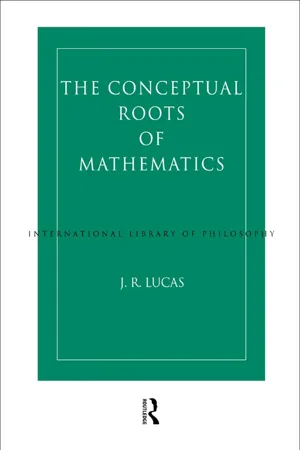
The Conceptual Roots of Mathematics is a comprehensive study of the foundation of mathematics. J.R. Lucas, one of the most distinguished Oxford scholars, covers a vast amount of ground in the philosophy of mathematics, showing us that it is actually at the heart of the study of epistemology and metaphysics.
The philosophy of mathematics begins with Pythagoras, who believed that mathematics gave us the key to understanding reality, but it is Plato who first gave it articulate form. In the Meno he proves that mathematics is known a priori—that is, without appeal to sense experience.1 He starts talking to a slave boy, and by a series of questions elicits from him a method of constructing a line
2 as long as a given one, using a special case of Pythagoras’ theorem. The general proof of Pythagoras’ theorem is difficult: for two thousand years it was the Pons Asinorum for school boys. In the Meno, however, Plato considers the special case of an isosceles right-angled triangle, where even someone who has never done geometry in his life can be brought to see how to construct a square with area twice that of a given square.
Readers often complain that Plato’s argument is unfair, because Socrates uses leading questions. But, although he does use leading questions, he is careful not to tell the slave boy any particular empirical facts. This is borne out by the boy’s making several mistakes along the way. He first suggests that, to get a square twice the area of the given one, we should take one with side twice as long. But, Socrates objects, that will not work, and draws a diagram on the sand, like Figure 1.1.1, and shows, very obviously, that if we have AK twice AB, then the square AKML will be not twice but four times the area of ABCD (Figure 1.1.2). So, says the boy, let us try with a side one-and-a-half times the length of the original side. That suggestion is gone over too, and we reach the conclusion that (1.5)2 is not equal to 2 (Figure 1.1.3).
Figure 1.1.1 How can we draw a square with twice the area of the given square ABCD?
Figure 1.1.2 The Boy’s First Suggestion: the square on AK is twice that on AB.
So, after these two false starts we arrive at the real solution, which is to construct a square on the diagonal of the original square, and Socrates shows why such a square must have an area that is half that of the big square, AKML, itself four times that of the original, ABCD. The slave boy finds this argument convincing, and—what is more important—so does everyone who attends to it. The argument is given in Figure 1.1.4.
Figure 1.1.3 The Boy’s Second Suggestion:
= 1.5. But, argues Socrates, the square on AE is nine times that on AN, whereas the square which has twice the area of ABCD should be eight times that on AN.
Figure 1.1.4 The Real Solution: the square on DB is twice that on AB. For the square DBHJ is the sum of the four triangles DBC, CBH, HJC, and CJD, and each of these is half the corresponding square, ABCD, BKHC, CHMJ and JLDC, and half four is two.
1.2 A Priori
Question
1. How do we know mathematics?
Plato’s conclusion is that mathematical knowledge is a priori, that is, that it is not based on the evidence of the senses, either our own, or other people’s transmitted to us by some form of communication. In this mathematics differs from most other subjects. With the exception of logic, and possibly philosophy, most subjects depend one way or another on empirical evidence which is at some stage or other based on people seeing, hearing, or feeling things. In scientific laboratories there are balances and spectrometers, and complicated instruments to detect fundamental particles, such as muons. We could not detect a muon unless either we had seen something—a flash on a screen, a track on a photographic plate, a trail in a bubble chamber—or had heard something—a click on a Geiger counter, or had had some other sensory experience. Equally, those studying the humanities, although they do not go to laboratories, do go to libraries, where they can read reports of what men did in time past. We cannot know that the Battle of Hastings took place in 1066, unless we can find a report from someone who was there, or from someone who was told by someone who was there, or something that was done in consequence of the battle, or some other word or deed which we can take as evidence of there having been a battle. We may base our knowledge on the Anglo-Saxon Chronicle, or on the Bayeux Tapestry; but we reckon that they are reliable sources of information only because they are, immediately or ultimately, based on what men actually witnessed with their eyes, their ears, or their other sense organs. Even in literary criticism, which is much more a matter of imagination, insight and flair, if we want to propound a serious interpretation of, say King Lear, we must actually have read the text. Mathematics is different. Although later I shall have to qualify what I am now saying and admit that mathematics, too, is quite often known second-hand,2 it is true, nevertheless, that one can do mathematics on one’s own. It is potentially a solipsistic, or, as we might even say, autistic, discipline. Autistic children cannot relate to other people, and are characteristically bad at the humanities, but can be good at mathematics. One does not have to know, one does not have to like, other people, in order to be a mathematician, whereas it is very difficult to study the humanities without some liking, or at least some disliking, for people. So mathematics is something which can be done, although with difficulty, by someone who is blind, deaf and deprived of all tactile sensation, and who, moreover is in solitary confinement. If I had had the misfortune to fall into the hands of the Communists, and had been sent to Siberia for thirty years, I should be unable to while away the time by studying chemistry or ancient history, but I could still in my cell do prime number theory. And that puts mathematics in a class apart.
If not Empiricism, then What?
1.3 Relevance
But there is a difficulty. What is the relation between mathematics, which is pure, and reality, which is relevant? If mathematical truths apply to empirical reality, as they surely do, they must be vulnerable to empirical refutation. Protagoras, one of the leading Greek sophists and a precursor of modern empiricism, argued that geometry was not true a priori but empirical in content and false. For geometry teaches that a tangent touches a circle in just one point, whereas casual observation reveals that they are coincident over a short length. If we observe a wheel on a road, or a hoop on a pavement, or a top lying on a table, we see that they do not touch at just one point, but are evidently touching over some small, but finite, distance.3 This is a matter of simple observation. Look at any bicycle. The propositions of mathematics, Protagoras concluded, are not true a priori, but are simple synthetic propositions, and, in the case of those actually asserted by mathematicians, in fact false. Plato is worried by this argument: his answer is “So much the worse for wheels and hoops and tops, and all particular exemplifications of circles”.4 He distinguishes the ideal circles of our thought from their imperfect exemplifications in the world around us. If I turn a top on a lathe, although it is more or less a circle, it is not a perfect circle. Similarly, no bicycle wheel is a perfect circle. But that is not telling us anything about geometry, but only about bicycling. Geometry expresses a priori truths about ideal shapes which material objects only imperfectly approximate to. Protagoras has not produced a counter-example to geometrical truth, but simply an example of material imperfection.
Two Questions
1. How do we know mathematics?
2. What is mathematics about?
The distinction between our concepts and the material objects to which they are applied is important and often lost sight of. Plato gives another example in the Phaedo.5 We have the concept of two things being equal, for example two sticks being equal in length. If we were to examine them closely, it is a fair guess that we should find that they were not exactly equal. Indeed, until the advent of quantum mechanics, it was a fair guess that no two material objects were exactly equal in length. Nevertheless, we have the concept of being exactly equal in length. We know that if A is exactly equal to B and B is exactly equal to C, then A is exactly equal to C. We might be faced with a series of objects, each apparently exactly equal to the next, but the first visibly smaller than the last. We do not then suppose that we have refuted by experimental test the claim that exact equality is a transitive relation; we do not say that even if A is exactly equal to B and B is exactly to C, A may not be exactly equal to C. Instead, we blame our application of the concept, and say that although we could not see it, some of the objects cannot have been exactly equal to the others. Rather than amend our clear and distinct idea of exact equality, we cast doubt on our use of it in the individual case.
As a first move it is fair enough to try blaming the application rather than the concept itself for any discrepancy with empirical observation, but we cannot be sure that the attempt to shift the blame will always be successful. In the two cases cited the discrepancy is not great, and the explanation plausible—the hoop touches the road for only a short distance, the first and last members of the series are only a little different in length, and it is quite likely that the hoop should have deformed a little, as a rubber tyre visibly does, and that very small inequalities should have been invisible, although their sum was visible. In other cases, however, the discrepancy might be great and no plausible explanation available. If the angles of a triangle added up to much less or much more than two right angles, it would be implausible to impute gross experimental error, and a few checks could eliminate that possibility altogether. On any one occasion Agamemnon might have miscounted if he reckoned that there were seven heroes in one ship, five in another, and yet not twelve in the two together, but if repeated checking by a chartered accountant still failed to conform to our simple arithmetical equation
7+5=12
we should be at a loss to know what to say.
Protagoras would have known what to say. An empirical generalisation, though hitherto well confirmed, had at long last been falsified. It is an attractive answer. It was put forward in the last century by Mill, and in recent years by Kitcher and Gillies.6 Mill’s arguments, in spite of Frege’s scathing criticisms,7 are not bad. He argues, as does Hume, against all forms of a priori and necessary knowledge; it is by long experience that I learn that seven plus five equals twelve. It is a synthetic truth; not, as Kant had made out, synthetic a priori, but synthetic a posteriori. It is a position that has found favour with many modern philosophers, but it has never found favour with the majority of mathematicians.8 Mathematicians, who have experienced the force of mathematical argument, do not believe that it is just the result of a Humean conditioning process, that they have so often discovered by experiment or been told by a teacher, that Pythagoras’ theorem is true, that now they have got into the habit of believing it and cannot break themselves of the habit. They follow Plato, and maintain that mathematical truth is, indeed, a priori, and then seek to reconcile the Pythagorean intimation that it does give us some knowledge of reality with the objection put forward by Protagoras that any statements about reality are vulnerable to empirical falsification.
What Plato himself does is to disconnect mathematical truth from too close a contact with empirical reality. It is not something peculiar to Plato to insulate cherished truths against unfavourable counter-instances; it is the argument of experimental error, often used by scientists when their theories come into collision with the evidence. But Plato pushes it very much further than modern scientists do. Modern scientists are prepared in the end to abandon even their most cherished theories in the ...
Table of contents
Cover Page
Title Page
Copyright Page
Introduction
Chapter 1: Plato’s Philosophies of Mathematics
Chapter 2: Geometry
Chapter 3: Formalism
Chapter 4: Numbers: The Cardinal Approach
Chapter 5: Numbers: The Ordinal Approach
Chapter 6: Numbers: The Abstract Approach
Chapter 7: The Infinite
Chapter 8: The Implications of Gödel’s Theorem
Chapter 9: Transitive Relations
Chapter 10: Prototopology0
Chapter 11: Magnitude and Measure
Chapter 12: Down With Set Theory
Chapter 13: Chastened Logicism?
Chapter 14: Mathematical Knowledge
Chapter 15: Realism Revisited
Envoi
Summaries
Trusted by 375,005 students
Access to over 1.5 million titles for a fair monthly price.
Study more efficiently using our study tools.
Frequently asked questions
Yes, you can cancel anytime from the Subscription tab in your account settings on the Perlego website. Your subscription will stay active until the end of your current billing period. Learn how to cancel your subscription
No, books cannot be downloaded as external files, such as PDFs, for use outside of Perlego. However, you can download books within the Perlego app for offline reading on mobile or tablet. Learn how to download books offline
We are an online textbook subscription service, where you can get access to an entire online library for less than the price of a single book per month. With over 1.5 million books across 990+ topics, we’ve got you covered! Learn about our mission
Look out for the read-aloud symbol on your next book to see if you can listen to it. The read-aloud tool reads text aloud for you, highlighting the text as it is being read. You can pause it, speed it up and slow it down. Learn more about Read Aloud
Yes! You can use the Perlego app on both iOS and Android devices to read anytime, anywhere — even offline. Perfect for commutes or when you’re on the go. Please note we cannot support devices running on iOS 13 and Android 7 or earlier. Learn more about using the app
Yes, you can access Conceptual Roots of Mathematics by J.R. Lucas in PDF and/or ePUB format, as well as other popular books in Philosophy & Philosophy History & Theory. We have over 1.5 million books available in our catalogue for you to explore.