At the close of the First World War, propaganda mapping played a crucial role in the creation of a consensus about German national territory.
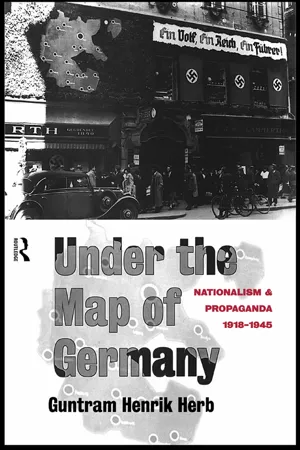
Under the Map of Germany provides a detailed and vivid analysis of the history and techniques of nationalist mapping in inter-war Germany. Using extensive archival documentation - including many previously undiscovered maps - the author charts the development of new concepts of national territory and the establishment of an effective propaganda mapping network. His research demonstrates that a consensus about the extent of the Greater German nation was not created by skillful Nazi propagandists, but by the collaborate efforts of respected scholars and nationalist activists during the Weimar Republic. Challenging the belief that national self-determination is a just cause, Under the Map of Germany reveals that national territories are not tangible entities that can be clearly delimited, but are artificial constructs open to a wide range of interpretations.
- 264 pages
- English
- ePUB (mobile friendly)
- Available on iOS & Android
eBook - ePub
About this book
Trusted by 375,005 students
Access to over 1.5 million titles for a fair monthly price.
Study more efficiently using our study tools.
Information
1
NATIONALISM, TERRITORY, MAPS, AND PROPAGANDA
Where political and national boundaries coincide, society ceases to advance…
(Lord Acton 1907)8
We are fooled by propaganda chiefly because we don’t recognize it when we see it.
(Institute for Propaganda Analysis 1937)9
The historical roots of the idea of “nation” can be traced back at least to the Middle Ages, but it only became a decisive political force at the end of the eighteenth century with the emergence of the doctrine of nationalism and the notion of popular sovereignty (Seton-Watson 1977:6–8). There is no universal definition for nation, but all nations make reference to a unique and separate identity and aspire to achieve self-determination.10
Despite the rhetoric of nationalists, nations are not organic entities with a common ancestral descent. The separate identity has to be understood as something that is collectively self-defined. Nations are “imagined communities” (B. Anderson 1991) whose consciousness of belonging together is founded on a “national myth” (Connor 1992). To preserve this feeling of being a unique group, nations yearn to be independent, which inevitably leads to the demand for a separate state. Only states are recognized by the international community as sovereign entities and thus have undisputed authority.11
Territory plays a key role in nationalism. National identity cannot be separated from links to a specific territory which provides the only tangible basis for the national myth. The homeland is the repository of national history. It is the place where the nation has its roots. The mountains of the national landscape are sacred, its rivers carry the national soul, its soil is soaked with the blood of national heroes (Williams and Smith 1983:509). Territory is also the only tangible basis on which to achieve the desired national selfdetermination because sovereign political power is exercised by states over a specific and clearly demarcated territory (Gottmann 1973).12
The territorial or spatial nature of nationalism encourages the use of cartographic depictions. Maps as “graphic representations that facilitate a spatial understanding of things, concepts, conditions, processes, or events in the human world” (Harley and Woodward 1987: xvi) are ideally suited to further the cause of nationalist movements. They can be used to demarcate the limits of a nation and to communicate these limits to others to create a consensus. Clear territorial limits are needed to fulfill the goal of nations to be exclusionary communities: to distinguish “us” from “them.”
Defining the limits of a nation without the help of graphic images is difficult, if not impossible. Even if references are made to natural landscape features, the message is rarely clear or unambiguous. For example, the first verse in the German national anthem (which is illegal today) conveys a general idea of the parameters of the German nation. It mentions rivers and straits in the four cardinal directions: “Von der Maas bis an die Memel, von der Etsch bis an den Belt.” But these geographical landmarks are not common knowledge and they still leave out considerable areas in the northwest, the southwest, and the southeast. In the case of the French nation, the Pyrenees are often used as a southern limit. But where in this mountain range is the national divide? In the northern foothills, along the ridge line, or somewhere on the southern slopes? And what if there are no clear natural features as in the case of the Eastern European plains? Only cartographic representations can communicate a clear image of the boundaries of national territory.
Maps as means of communication here does not presume that maps are mirrors of reality. The communication model used by many cartographers, in which maps are objective tools for transmitting information, is flawed (Pickles 1992:194–7). It presumes that cartography is a neutral science which constantly seeks to make representations more and more accurate, to bring them more and more in line with reality. However, the production of maps cannot be separated from the societal context in which it occurs.13
Even the seemingly most accurate map is still a transformed and thus an interpreted picture of reality. A case in point is official topographic maps which are generally considered scientific and “objective” documents. How can we explain the persistent inclusion of battlefields and other monuments deemed important to the nation, and the steadfast exclusion of toxic waste sites, abandoned public housing units, and other structures potentially threatening to the cohesion of our national community (Monmonier 1991:122)? The information that is represented had to be collected, classified, and encoded; a process that is structured by social norms and values, regardless of whether the cartographer is aware of it or not.14
Like all knowledge, maps are expressions of power; they are inherently rhetorical. Thus, to understand the role of maps in the construction of a national territorial identity, maps have to be deconstructed and analyzed in their “layers of textuality”: the cartographic image itself, the material it accompanies, and the larger social context (Pickles 1992:219). National identity is an artificial construct which is conceptualized and disseminated through social discourse. Maps have to be viewed as part of this discourse, as simply another text.15
Even though maps are rhetorical texts and cartography is “an art of persuasive communication” (Harley 1989:11), this does not mean that maps or cartography in general should be considered propaganda. There is much confusion about the terms rhetoric, persuasion, and propaganda in the literature and they are often used interchangeably. Propaganda is a much narrower concept; it can be characterized as a “deliberate and systematic attempt to shape perceptions, manipulate cognitions, and direct behavior” (Jowett and O’Donnell 1986:16; emphasis added). By contrast, persuasion or rhetoric do not attempt to restrict the flow of information and to conceal the overall purpose of the interaction; they are more neutral terms than propaganda (Jowett and O’Donnell 1986:15–24). At the same time, propaganda should not be equated with lies and falsity or with complete changes in attitudes and beliefs; it often contains an element of truth and exaggerates existing trends (Welch 1983:2 and 1993:5).16
In Germany, national cartographic discourse did not involve propaganda in the true sense in the early years. The appearance of maps of the German nation up to the First World War was sporadic and haphazard. Maps tended to be more individual responses to major events than products of deliberate and systematic campaigns. They reflect the absence of a clear concept about the limits of the German nation before 1871.
EARLY REPRESENTATIONS OF GERMAN NATIONAL TERRITORY
When a German national consciousness began to emerge at the turn of the eighteenth to the nineteenth century, it was guided by the ideas of Herder, which looked at German language and culture as a common national bond. However, there was no unified stance on how the German nation should be incorporated into a state structure, nor was it politically viable until 1848. Initial calls for national unification, such as Johann Gottlieb Fichte’s famous Addresses to the German Nation in the winter of 1807/8 and Ernst Moritz Arndt’s German songs (Lieder für Teutsche) apparently did not enjoy widespread support (Langewiesche 1992b: 353–4). A major problem of German self-determination was that the area inhabited by Germans was not centralized spatially. In Eastern Europe German settlements were widely and often thinly dispersed, which made it difficult to arrive at a clearly defined and generally recognized territorial base (Bassin 1987a: 475). The only agreement was that foreign rule by Napoleon and German particularism, that is, the division of the German area into individual principalities, had to be overcome (Schieder 1991:146–7).
The first maps of the German nation did not appear until the 1840s, shortly before the first national revolution in 1848 led to a German national assembly at St Paul’s Church in Frankfurt. As is customary for most maps of national territory, they used language as an indicator. Apart from political upheavals in Germany, these cartographic representations appear to have been stimulated by concerns about large-scale emigrations in the 1830s and 1840s (Fittbogen 1930:49). This interest in the overall distribution of the German language was complemented by a local research interest into areas where Germans faced competition from other national groups, such as the emerging Italian nation (Fittbogen 1927:26–7, 74).
The language map of Germany from 1844 by the scholar and politician Karl Bernhardi is the first recorded attempt at an overview. It was presented to the philologists and teachers who assembled in Kassel in October 1843 “for examination and sponsorship” and still had grave flaws, such as labeling Klagenfurt as Slavic (Isbert 1937a: 491–2).17 Work on the map had begun in 1834 with the support of fourteen German historical societies and under the leadership of Baron von Hormayer (Weidenfeller 1976:63). It was followed in 1848 by Heinrich Kiepert’s map of the German nation (Isbert 1937a: 492).
There was a lot of discussion about the boundaries of the German nation in the national assembly in Frankfurt, but it was clear that the future German national state would respect the integrity of the individual principalities and only attempt to unify them in a federal system.18 The main point of controversy was which of the rulers of the two largest German states, Prussia and Austria, would become the head of the German national state. The choice of the Austrian Habsburgs, known as the großdeutsch solution, included all German settlement areas but also a large number of minorities. By contrast, a preference for Prussian dominance along the lines of the German Customs Union, dubbed the kleindeutsch solution, meant the exclusion of the Germans in Austria. In the end the assembly opted for the kleindeutsch solution, but the revolution failed in 1849.
With the sovereignty of the individual German principalities restored, scholarly work on German national culture and its cartographic representation declined (Fittbogen 1930:50–1). The second edition of Bernhardi’s map, which had been prepared in collaboration with the Frankfurt physician Wilhelm Stricker in 1849, was indicative of this negative trend.19 It was dedicated to the members of the national constitutional assembly “in memory of the lively discussions about the natural borders of the German Empire.” 20 By stressing the importance of the map as a “memory” of the discussion, it looked backward rather than presenting the map as a program of what should be accomplished in the future.
The next forty years were not very conducive for the production of maps of the German nation. Nationalist activities were oppressed during the period of reaction which followed the failed revolution, and for the first decade after the founding of the German Empire, national consciousness focused on the political territory of the new German state. Only one map was published in 1867, around the time when it was clear that Bismarck was striving to unify German territories under Prussian tutelage. 21 The motivation behind this map might have been to raise public awareness about the discrepancy between the achievements of Bismarck and the full extent of the German nation.22
When a German national state was finally established in 1871, it was not the result of a popular revolution, but the product of Bismarck’s policy of unification from above. Despite the fact that it excluded the Germans in the Austro-Hungarian Empire—Bismarck had only realized a kleindeutsch solution—the establishment of the national state from above kept the loyalties to the state and the dynastic rulers intact (Fischer 1977:13–14). The people identified with their fatherland, i.e. the German Empire, rather than with their fellow Germans abroad (Jaworski 1978:371). The political boundaries of the new German national state respected the existing dynastic territorial units. This meant that areas with a clear majority of foreigners, such as the Polish districts in Prussia, were not excluded from the unification even though their separation from the Empire would have resulted in a more homogenous “national” German state. The national idea was also disregarded in cases where the German government made territorial gains: it was more interested in expanding its military base and economic might than in extending its control over German people.
The case of Alsace-Lorraine illustrates this point. When Bismarck annexed these territories in 1871, he was not guided by the idea of national self-determination, but by strategic considerations. Owing to pressure from the German military to establish a strong military frontier against France, the final course of Germany’s western boundary went well beyond the German-speaking regions on the left bank of the Rhine.23
Even though the German Empire of 1871 with its priorities on military security gave only secondary consideration to the German national idea, the success of finally achieving a unified German state gave German nationalism a decisive boost. In the 1880s a variety of nationalist organizations began to appear such as the Flottenverein and the Alldeutscher Verband.24 The nationalist ideology expounded by them was complex and changed over time, but there were two main camps: a group which identified with the new state, and an ethnic national movement yearning to be united with fellow Germans outside the state borders. Both movements were expansionist. The key difference is the type of community they identified with most strongly.25
The state-centered nationalism looked at the population of the German Empire as the “nation”, following Meineke’s idea of a Staatsnation or political nation....
Table of contents
- COVER PAGE
- TITLE PAGE
- COPYRIGHT PAGE
- FIGURES
- ACKNOWLEDGEMENTS
- ABBREVIATIONS
- INTRODUCTION
- 1 NATIONALISM, TERRITORY, MAPS, AND PROPAGANDA
- 2 CARTOGRAPHY AND NATIONAL TERRITORY AT THE END OF THE FIRST WORLD WAR
- 3 A CONCERN FOR ACCURACY
- 4 NEW CONCEPTS OF NATIONAL TERRITORY
- 5 COORDINATION OF CARTOGRAPHIC REVISIONISM The Stiftung für deutsche Volks- und Kulturbodenforschung
- 6 MAPS AS WEAPONS The development of suggestive cartography
- 7 CREATING A UNIFIED MESSAGE
- 8 CONCEPTS OF NATIONAL TERRITORY IN THE THIRD REICH
- 9 MAPS AND NAZI PROPAGANDA
- CONCLUSION
- NOTES
- PRIMARY SOURCES
- BIBLIOGRAPHY
Frequently asked questions
Yes, you can cancel anytime from the Subscription tab in your account settings on the Perlego website. Your subscription will stay active until the end of your current billing period. Learn how to cancel your subscription
No, books cannot be downloaded as external files, such as PDFs, for use outside of Perlego. However, you can download books within the Perlego app for offline reading on mobile or tablet. Learn how to download books offline
Perlego offers two plans: Essential and Complete
- Essential is ideal for learners and professionals who enjoy exploring a wide range of subjects. Access the Essential Library with 800,000+ trusted titles and best-sellers across business, personal growth, and the humanities. Includes unlimited reading time and Standard Read Aloud voice.
- Complete: Perfect for advanced learners and researchers needing full, unrestricted access. Unlock 1.5M+ books across hundreds of subjects, including academic and specialized titles. The Complete Plan also includes advanced features like Premium Read Aloud and Research Assistant.
We are an online textbook subscription service, where you can get access to an entire online library for less than the price of a single book per month. With over 1.5 million books across 990+ topics, we’ve got you covered! Learn about our mission
Look out for the read-aloud symbol on your next book to see if you can listen to it. The read-aloud tool reads text aloud for you, highlighting the text as it is being read. You can pause it, speed it up and slow it down. Learn more about Read Aloud
Yes! You can use the Perlego app on both iOS and Android devices to read anytime, anywhere — even offline. Perfect for commutes or when you’re on the go.
Please note we cannot support devices running on iOS 13 and Android 7 or earlier. Learn more about using the app
Please note we cannot support devices running on iOS 13 and Android 7 or earlier. Learn more about using the app
Yes, you can access Under the Map of Germany by Guntram Henrik Herb in PDF and/or ePUB format, as well as other popular books in Physical Sciences & Geography. We have over 1.5 million books available in our catalogue for you to explore.