Roman Edessa offers a comprehensive and erudite analysis of the ancient city of Edessa (modern day Urfa, Turkey), which constituted a remarkable amalgam of the East and the West. Among the areas explored are: * the cultural life and antecedents of Edessa * Edessene religion * the extent of the Hellenization at Edessa before the advent of Christianity * the myth of an exchange of letters between a King Abgar and Jesus.
Trusted by 375,005 students
Access to over 1.5 million titles for a fair monthly price.
Blessed with generous springs that made it a welcome stopping point for travelers in the parched steppeland of middle Mesopotamia, Edessa must certainly have attracted visitors and inhabitants from a very early date. Despite this likelihood, however, Edessa does not enter the historical record until the Hellenistic period. The city is known in Syriac and other Semitic languages as Orhai or Urhai, but it is hard to fix on the pre-Hellenistic traveler’s landscape, by either name. Cuneiform records supply a large number of toponyms in this part of Mesopotamia, but Orhai has never been securely identified. Nevertheless, given its desirability as a waystation, it seems highly probable that Edessa is mentioned under another name. The best candidate is ’DM’, mentioned in several old-Assyrian and Babylonian itineraries as a staging point near H. arran/Carrhae (Harrak 1992). The Syriac–Arabic lexicon of Bar-Bahloul, although late in date (tenth century), offers some confirmation; it identifies Adme (alternatively Admi or Admum) as ‘the name of a city, Al-Rahha’— which in its turn is the Arabic form of Orhai.1 Although this name is never used for Edessa in extant Syriac literature, the location of Adme/Admi/Admum in cuneiform sources – three stations away from H. arran – helps to consolidate the identification (Goetze 1953: 51–2; Harrak 1992: 213). There can be little doubt that the ‘exceptionally well-endowed and water-rich oasis of Urfa’ was frequently visited by commercial travelers of the Ancient Near East (Astour 1989: 687). The reason for its relative lack of prominence in the pre-Hellenistic period is a matter of conjecture.
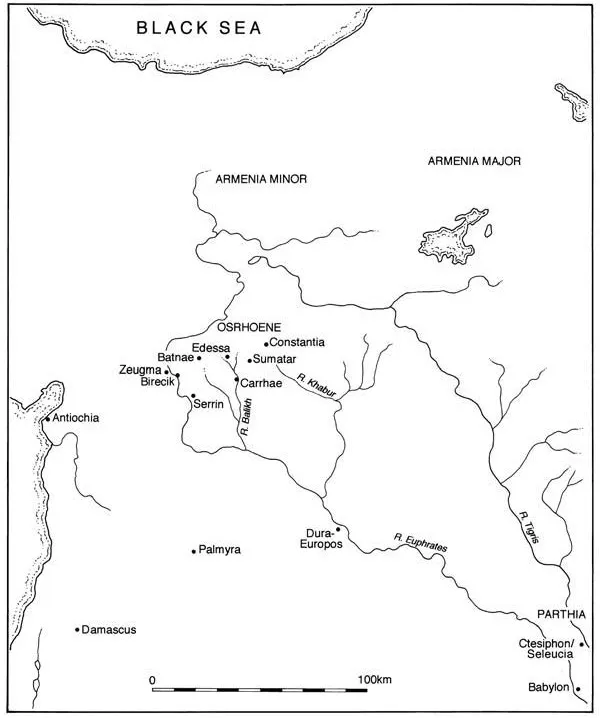
The picture, as far as we can tell, remained essentially unchanged under the Persian Empire, which dominated the Middle East from 550–330 bce. Orhai and the nearby H. arran may have been visited frequently by travelers along the Royal Road from Sardis in Asia Minor to Susa in the Persian heartland under Achaemenid rule, but Herodotus’s description of that route makes it seem as if that road (or at least the most frequently traveled version of it) passed through Mesopotamia further north (Hdt. 5.52; cf. Oates 1968: 10). The future Edessa remained a relatively minor waystation remote from the centers of power, despite the potential strategic and economic advantages of its situation (Fig. 1.1).
Figure 1.1 Map of Upper Mesopotamia showing the location of Edessa and nearby communities. Edessa’s well-watered oasis made it a frequent stopping point for travelers across the parched expanse to the east of the Euphrates, from a time long before the founding of the Hellenistic city.
The arrival of the Greco-Macedonian armies of Alexander the Great and his generals in the fourth century bce changed the face of the eastern Mediterranean world thoroughly and permanently. Alexander swept across the Persian Empire in a wave of conquest and destruction beginning in 334 bce, putting an end to Achaeme-nid rule. By the time of his death in Babylon, 323 bce, the lands formerly ruled by the Persians, from Egypt and Asia Minor as far east as Bactria and the borders of India, were potentially part of a unified Macedonian-ruled empire that would also have included the Aegean islands, Macedonia and the Greek mainland. By failing to arrange for a stable succession, however, Alexander practically guaranteed that this potential unity would collapse under the pressure of intense rivalries among his successors – Ptolemy, Antigonus, Lysimachus, Antipater, Cassander and Seleucus I Nicator (‘the Conqueror’). Seleucus’s recapture of Babylon in 312/311 bce—later marked as the starting-point of a new dating system, the Seleucid Era – was the beginning of momentous changes for Edessa and the entire Middle East.
One of the hallmarks of the Hellenistic period is the settlement, on broad areas of the newly conquered land, of Greeks and Macedonians – including not only the veterans of the wars of conquest and succession, but former residents of the European homeland whose need for land and new sources of wealth could now be more easily satisfied. The influx of settlers spread Greek culture across a vast expanse, bringing a new language, new artistic forms and new modes of religious and political expression, at least to the urban centers in the new territories. Alexander himself is renowned as the founder of numerous colonies, but the city-founding activities of Seleucus and his immediate successors also became legendary, especially in the Syrian portion of their kingdom. The founding of such Syrian colonies as Antioch, Seleucia-in-Pieria, Laodicea and Apamea was among the most successful of all Hellenistic urban endeavors. Antioch itself survived for centuries as an economic and cultural metropolis, long past the end of the Hellenistic period and even beyond Classical Antiquity. Seleucid colonization and cultivation of urban centers, however, was not limited to the Levant. By concentrating on Antioch and its environs, the historian may receive the impression that the Seleucid kings, too, focused their attentions on this, as the area of their kingdom that was in closest contact with the Greek world. A case can be made, however, that the rich region of Mesopotamia, with Babylon at its focus, was just as central to the kings’ thinking. It was certainly more central, geographically speaking, to the whole kingdom.
In this context, the situation of the future Edessa could hardly have been more advantageous. Unlike the Syro-Palestinian littoral, which was always a bone of contention between the Seleucids and the powerful Ptolemaic kingdom based in Egypt, the northern Mesopotamian region was firmly in the Seleucid realm. It would seem that one of the early Seleucid kings – according to tradition, Seleucus I himself – soon recognized the economic and strategic advantages of the site, close to the rich Syrian territories but in touch also with the kingdom’s Mesopotamian center of gravity, and capitalized on them by implanting there a new urban settlement.2 The new polis received, like many other Seleucid colonies, the name of a city in the Macedonian homeland (Appian 203; Stephanus Byzantinus s.v.
). According to Pliny the Elder, the city at some point bore the Seleucid royal name of Antioch; but this is not likely, since a dynastic name like this for a royal foundation was a mark of honor, and would not have been dropped in favor of the name Edessa.3 According to one tradition, Seleucus I is supposed to have referred to Edessa as
‘half-barbarian Antioch’ (Malalas 17.418). The source for this information – the Late Roman Antiochene orator Malalas – is not the most reliable, but in this instance, he may be reporting a truthful tradition. If so, it does not necessarily indicate that the city ever was officially named Antioch. The king may have been joking. In any case, it was the name Edessa that stuck – except among speakers and writers of Syriac. These habitually used the name Orhai, which over the course of the centuries evolved into the present-day Urfa.
If the purported quotation from Seleucus I is in fact genuine, it suggests that at Edessa, the importation of Greek ways of life and thought, and perhaps of Greek settlers themselves, was less thoroughgoing than elsewhere in Seleucid realms. There is very little information on which to base a judgment of this matter, but the persistence of the Semitic name – which may well have been the name in use before the Seleucid colonization – is suggestive. Even in the most thoroughly Hellenized places, such as Antioch, a large segment of society – the rural populace and the urban underclass – never took on more than a thin veneer, if that, of Hellenism. As it had under Persian rule, Aramaic remained in widespread use. Edessa, in the centuries after the breakup of the Seleucid kingdom, seems to have maintained rather a tenuous connection with Hellenism, and this is more easily understandable if the city was only slightly Hellenized to begin with.
By the end of the second century bce, the breakup of the Seleucid kingdom, under the pressures of internal rivalries for power and external competition, was practically complete. To the west, the squabbling Seleucids had to deal with the threat of ascendant Roman power as well as their traditional rivals, the Ptolemies; in the east, they faced the Arsacids (Parthians), coming from the northerly reaches of the old Persian Empire, who laid claim to the mantle of the Achaemenid monarchy and had begun to take over sections of the Seleucid kingdom as early as 247 bce. When Rome arrived in the Middle East in the first century, it found that the territory beyond the Euphrates was under Parthian hegemony, and the Roman–Parthian contretemps set the tone for the military and diplomatic activity of the next three centuries.
For the Greek cities of Mesopotamia, including Edessa, Parthian rule meant dealing with a different overlord, but not necessarily a different form of overlordship. The Parthian administrative system was not greatly different from the ‘satrapal’ organization that the Seleucids had adopted from their Persian predecessors. Significantly, it seems that in some cities the most prominent element of society continued to be the descendants of the original Greco-Macedonian settlers (Bauer 1933; Welles 1951).4 At Edessa, events took a different course. Simultaneously with the arrival of the Parthians, a new local regime took power: a series of kings or ‘toparchs’ bearing Semitic names that show clear affinities to Arabic, which historians call the Abgarid dynasty after the name that recurs most often, Abgar.5 How or why this came about is quite uncertain; presumably, however, the Abgarids were in some way allied to the Parthian invaders or simply took advantage of the unsettled conditions to impose their rule. The date of this event can be approximated: one source, the Chronicle of Zuqnin, states that in the ‘Year of Abraham’ 2233 the monarchy came to an end, after lasting for 352 years, which would place the installation of the monarchy in 135 bce. According to the preserved fragments of the Chronicle of Edessa, however, the kingdom was established in (Seleucid) Year 180, 132/131 bce (Chron. Ed. 2).6
Although many aspects of Edessan culture under the late monarchy betray Parthian influence, there is no telling whether, and how much, Edessa’s overall ethnic make-up changed at the time of the installation of the Abgarids. If Hellenistic Edessa was indeed ‘half-barbarian’ already, there may have been little change in the general population below the level of the ruling elite.
The first decades of Abgarid rule in Edessa lie in near-total obscurity, relieved only by the names of the first kings as given by the Zuqnin chronicler: a list which is of dubious reliability.7 After the organization of the Province of Syria by Pompey in 64 bce, however, Edessa began to be noticed by Rome as an important principality in the region just beyond the frontier, and its kings to be considered as potential friends and helpers. When Pompey’s general Afranius traversed northern Mesopotamia he required the assistance of the local population (Dio 37.5.5, specifically mentioning the people of Carrhae but not Edessa). A friendly relationship seems to have been achieved between Edessa and Rome, for when Pompey’s ally in the ‘First Triumvirate,’ Marcus Licinius Crassus, arrived on the scene ten years later to seek his military fortune against the Parthians, he relied on the assistance of Abgar of Edessa to guide him on unfamiliar ground (Plutarch Crassus 21–2; Dio 40.20 ff.). The expedition ended in disaster for the triumvir, allegedly because of the treachery of Abgar; yet it is entirely uncertain whether he was led astray by this betrayal or by his own ambition and poor generalship. The incident does, however, confirm an early willingness on Edessa’s part to form a friendly relationship with Rome, even while it remained in what was supposedly the Parthian sphere of influence.
Up until the end of the first century ce, however, there was little reason to expect any further extension of the limits of the empire to the east. The boundary with Parthia had been more or less fixed along the lines of the upper Euphrates since pre-Augustan times, and despite the activities of adventurers such as Crassus during the Late Republic, the Augustan diplomacy that recovered Crassus’s standards was seen, at least in imperial propaganda, as establishing a stable Roman–Parthian relationship (and one that was favorable to Rome).8 A key element of this arrangement was the Armenian buffer kingdom, and disputes over Armenia brought Roman legions to the east repeatedly. A second example of the Roman willingness to seek the cause of failures in this region in local treachery is Tacitus’s description of the behavior of another Abgar during a Roman attempt to install Meherdates, a candidate for the Armenian throne, in 49 ce. According to Tacitus (Ann. 12.12 and 14), Abgar went to receive Meherdates and detained him treacherously, eventually abandoning him in Adiabene and leaving him to be defeated by his rival Gotarzes. Again, regardless of the truth of this specific charge, the background to the alleged betrayal indicates that Rome saw in Edessa at least a potentially useful ally.
In each case, the accusati...
Table of contents
Cover Page
Title Page
Copyright Page
Figures
Preface
Acknowledgements
Abbreviations
Introduction
1. The Earliest Edessa
2. The Coming of Rome
3. From Kingdom to Province
4. A King In Rome’s Service
5. A ‘Golden Age’? The Culture of Pre-Christian Edessa
6. Early Christianity and Edessan Culture
7. Conclusion
Appendix: Numismatic Notes
Notes
Bibliography
Frequently asked questions
Yes, you can cancel anytime from the Subscription tab in your account settings on the Perlego website. Your subscription will stay active until the end of your current billing period. Learn how to cancel your subscription
No, books cannot be downloaded as external files, such as PDFs, for use outside of Perlego. However, you can download books within the Perlego app for offline reading on mobile or tablet. Learn how to download books offline
Perlego offers two plans: Essential and Complete
Essential is ideal for learners and professionals who enjoy exploring a wide range of subjects. Access the Essential Library with 800,000+ trusted titles and best-sellers across business, personal growth, and the humanities. Includes unlimited reading time and Standard Read Aloud voice.
Complete: Perfect for advanced learners and researchers needing full, unrestricted access. Unlock 1.5M+ books across hundreds of subjects, including academic and specialized titles. The Complete Plan also includes advanced features like Premium Read Aloud and Research Assistant.
Both plans are available with monthly, semester, or annual billing cycles.
We are an online textbook subscription service, where you can get access to an entire online library for less than the price of a single book per month. With over 1.5 million books across 990+ topics, we’ve got you covered! Learn about our mission
Look out for the read-aloud symbol on your next book to see if you can listen to it. The read-aloud tool reads text aloud for you, highlighting the text as it is being read. You can pause it, speed it up and slow it down. Learn more about Read Aloud
Yes! You can use the Perlego app on both iOS and Android devices to read anytime, anywhere — even offline. Perfect for commutes or when you’re on the go. Please note we cannot support devices running on iOS 13 and Android 7 or earlier. Learn more about using the app
Yes, you can access Roman Edessa by Steven K. Ross in PDF and/or ePUB format, as well as other popular books in History & Ancient History. We have over 1.5 million books available in our catalogue for you to explore.