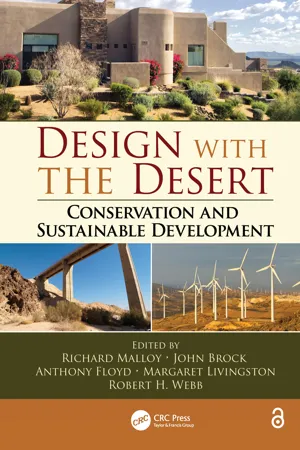
Typical development in the American Southwest often resulted in scraping the desert lands of the ancient living landscape, to be replaced with one that is human-made and dependent on a large consumption of energy and natural resources. This transdisciplinary book explores the natural and built environment of this desert region and introduces development tools for shaping its future in a more sustainable way. It offers valuable insights to help promote ecological balance between nature and the built environment in the American Southwest-and in other ecologically fragile regions around the world.
eBook - ePub
Design with the Desert
Conservation and Sustainable Development
- 620 pages
- English
- ePUB (mobile friendly)
- Available on iOS & Android
eBook - ePub
Design with the Desert
Conservation and Sustainable Development
About this book
Trusted by 375,005 students
Access to over 1 million titles for a fair monthly price.
Study more efficiently using our study tools.
Information
Some of the most rapidly growing urban areas on Earth are in desert regions. Whether on the Indian subcontinent, North Africa, western China, central Australia, or the southwestern United States, growth has steadily transformed deserts from what is perceived as a hostile, dangerous environment to a network of infrastructure and houses. Part and parcel of this growth is the joint assumption that the desert environment is unchanging, offering stable building sites; that water supplies can be found, either on the surface, in the subsurface, or through transbasin transfers from more mesic regions; and that hazards are reduced in a region of low rainfall and seasonally high temperatures. While these assumptions may hold true for short or even long time periods, eventually the reality of the desert environment sets in, creating constraints on urban design and development.
This part provides a general introduction to the physical environments of deserts worldwide and particularly in the southwestern United States, where considerable research on the characters and processes affecting the desert environment provides a wealth of information useful for urban design. We begin with a modified version of a chapter describing deserts of the world from the classic book Desert Geomorphology by Ronald Cooke, Andrew Warren, and Andrew Goudie. Without changing its substance, we were compelled to convert the units from metric to English and add explanatory footnotes to define technical terms that may not be well known within the community concerned with design in deserts. The scope of this chapter, as well as its discussion of evolution of deserts on six continents, makes it an invaluable contribution to this book for those who want a deeper understanding of how deserts originated and their common characteristics worldwide.
We follow the opening chapter with contributions on desert soils and climate, two closely related subjects. These chapters focus on the southwestern United States and particularly the desert regions of Arizona, which sustains several of the largest cities in the arid regions of North America. The chapter on desert geology and soils, by William L. Stefanov and Douglas Green, expands on general concepts presented in the opening chapter to give a more detailed perspective in a smaller region of the Sonoran Desert. Likewise, Anthony J. Brazel’s discussion of climate uses a focus on desert cities in the Southwest and that region to provide a more expansive view of short- and long-term desert climate, particularly in light of predicted future changes expected to be caused by greenhouse-gas emissions.
These chapters are followed by two chapters that discuss the related topics of desert hydrology, water supplies, and hazards in the southwestern United States, particularly in Arizona. This region provides a microcosm of hydrology and hazards in deserts worldwide, where the details change but the processes remain the same. The water resources of surface water and groundwater are intertwined in process and supply, and other characteristics important to design where environmental concerns are paramount, especially riparian vegetation, are discussed. In particular, an understanding of the hydrologic cycle in deserts, and how that influences the supply and movement of groundwater and the availability of surface water, is presented to allow some basic understanding of the potential for water supplies in deserts and their limitations.
Hazards in the desert environment, and how they relate to urban design, are discussed in detail from the perspective of the physical environment instead of design. These hazards range from natural, such as flooding and earthquakes, to human caused, such as toxic waste dumps and land subsidence.
In Part I, we strive to provide overviews of characters and processes, providing the reader with additional resources for deeper understanding of this unique physical environment. In particular, we point to various tools that enable those interested in urban design to determine climatic characteristics, examine the spatial distribution of soil types and properties in an area of interest, estimate water resources, and determine what hazards might be of concern and what their magnitude might be. Needless to say, the physical environment of deserts is both complex and nuanced, and our introduction in this part hopefully will provide sufficient information for the reader to investigate further on issues of specific concern to urban design.
CONTENTS
1.1 Introduction
1.2 The Sahara and Its Margins
1.3 Southern Africa
1.4 The Great Indian Desert or Thar
1.5 Arabia and the Middle East
1.6 China and Central Asia
1.7 Australia
1.8 South America
1.9 North America
1.10 Conclusion
1.11 Postscript
References
1.1 Introduction
To some, deserts are simply barren areas, barely capable of supporting life forms. Many places meet this criterion: Mangin’s The Desert World, published in 1869,1 embraced environments as diverse as the waste heaps of the china clay quarries in Cornwall, the steppes of Tartary, the Dead Sea, and the Arctic wildernesses. But most deserts are areas of aridity and they are usually defined scientifically in terms of some measure of water shortage. Such measures, indices of aridity, are commonly based on the relationships between water gained from precipitation and water lost by evaporation or transportation. There are plenty of indices to choose from, the differences between them reflecting different objectives of classification.2
The areas shown in Figure 1.1 constitute the warm deserts realm. Within it, there are five major regions of aridity: the deserts of North and South America, North Africa, Eurasia, southern Africa, and Australia. They cover a third of the Earth’s land surface and are the context for this study of desert geomorphology.† There are also arid areas in the polar latitudes, but, geomorphologically, they are very different from the subtropical deserts and are excluded from this review.
_____________
* Adapted from R. Cooke, A. Warren, and A. Goudie, Deserts of the world, in Desert Geomorphology (London, U.K.: University of London Press, 1993), pp. 423–447.
† Definitions used in footnotes in this chapter are derived from the combination of W. R. Osterkamp and A. Allaby and M. Allaby.3

Map showing world-wide distribution of the warm deserts.
1.2 The Sahara and Its Margins
The Sahara is the world’s largest desert (covering c. 2.7 million miles2), and the region comprising the Sahara and the Nile occupies about half of the entire African continent.4 The greater part of the region is free of surface water and is sparsely vegetated, and, being exposed to dry, descending, northeasterly airstreams, its mean annual rainfall is less than 16 in. and over vast areas less than 4 in.5 Temperatures are also high, and evaporation losses from free water surfaces and transpiration losses from vegetated areas are greater than anywhere else on the globe*
The...
Table of contents
- Cover
- Half Title
- Title Page
- Copyright Page
- Table of Contents
- Foreword
- Preface
- Acknowledgments
- Introduction
- Editors
- Contributors
- Part I Physical Aspects of the Desert Environment
- Part II The Living Desert
- Part III Desert Planning
- Part IV Ecology in Design of Urban Systems
- Part V Urban Sustainability
- Index
Frequently asked questions
Yes, you can cancel anytime from the Subscription tab in your account settings on the Perlego website. Your subscription will stay active until the end of your current billing period. Learn how to cancel your subscription
No, books cannot be downloaded as external files, such as PDFs, for use outside of Perlego. However, you can download books within the Perlego app for offline reading on mobile or tablet. Learn how to download books offline
Perlego offers two plans: Essential and Complete
- Essential is ideal for learners and professionals who enjoy exploring a wide range of subjects. Access the Essential Library with 800,000+ trusted titles and best-sellers across business, personal growth, and the humanities. Includes unlimited reading time and Standard Read Aloud voice.
- Complete: Perfect for advanced learners and researchers needing full, unrestricted access. Unlock 1.4M+ books across hundreds of subjects, including academic and specialized titles. The Complete Plan also includes advanced features like Premium Read Aloud and Research Assistant.
We are an online textbook subscription service, where you can get access to an entire online library for less than the price of a single book per month. With over 1 million books across 990+ topics, we’ve got you covered! Learn about our mission
Look out for the read-aloud symbol on your next book to see if you can listen to it. The read-aloud tool reads text aloud for you, highlighting the text as it is being read. You can pause it, speed it up and slow it down. Learn more about Read Aloud
Yes! You can use the Perlego app on both iOS and Android devices to read anytime, anywhere — even offline. Perfect for commutes or when you’re on the go.
Please note we cannot support devices running on iOS 13 and Android 7 or earlier. Learn more about using the app
Please note we cannot support devices running on iOS 13 and Android 7 or earlier. Learn more about using the app
Yes, you can access Design with the Desert by Richard Malloy, John Brock, Anthony Floyd, Margaret Livingston, Robert H. Webb, Richard Malloy,John Brock,Anthony Floyd,Margaret Livingston,Robert H. Webb in PDF and/or ePUB format, as well as other popular books in Economía & Desarrollo sostenible. We have over one million books available in our catalogue for you to explore.