- 674 pages
- English
- ePUB (mobile friendly)
- Available on iOS & Android
eBook - ePub
About this book
In the last decade, wireless or wired sensor networks have attracted much attention. However, most designs target general sensor network issues including protocol stack (routing, MAC, etc.) and security issues. This book focuses on the close integration of sensing, networking, and smart signal processing via machine learning. Based on their world-class research, the authors present the fundamentals of intelligent sensor networks. They cover sensing and sampling, distributed signal processing, and intelligent signal learning. In addition, they present cutting-edge research results from leading experts.
Trusted by 375,005 students
Access to over 1 million titles for a fair monthly price.
Study more efficiently using our study tools.
Information
Subtopic
Information TechnologyI
INTELLIGENT SENSOR NETWORKS: MACHINE LEARNING APPROACH
Chapter 1
Machine Learning Basics
Contents
1.1 Supervised Learning
1.1.1 Decision Trees
1.1.2 Bayesian Network Classifiers
1.1.2.1 Static Bayesian Network Classifiers
1.1.2.2 Dynamic Bayesian Network Classifiers
1.1.3 Markov Models
1.1.3.1 Hidden Markov Model
1.1.3.2 Hidden Semi-Markov Models
1.1.4 Conditional Random Fields
1.1.4.1 Semi-Markov Conditional Random Fields
1.1.5 Support Vector Machines
1.1.6 k-Nearest Neighbor Algorithms
1.2 Unsupervised Learning
1.2.1 Clustering
1.2.1.1 k-Means Clustering
1.2.1.2 DBSCAN Clustering
1.2.2 Self-Organizing Map
1.2.3 Adaptive Resonance Theory
1.2.4 Other Unsupervised Machine Learning Algorithms
1.3 Semi-Supervised Learning
1.4 Summary
References
The goal of machine learning is to design and develop algorithms that allow systems to use empirical data, experience, and training to evolve and adapt to changes that occur in their environment. A major focus of machine learning research is to automatically induce models, such as rules and patterns, from the training data it analyzes. As shown in Figure 1.1, machine learning combines techniques and approaches from various areas, including probability and statistics, psychology, information theory, and artificial intelligence.
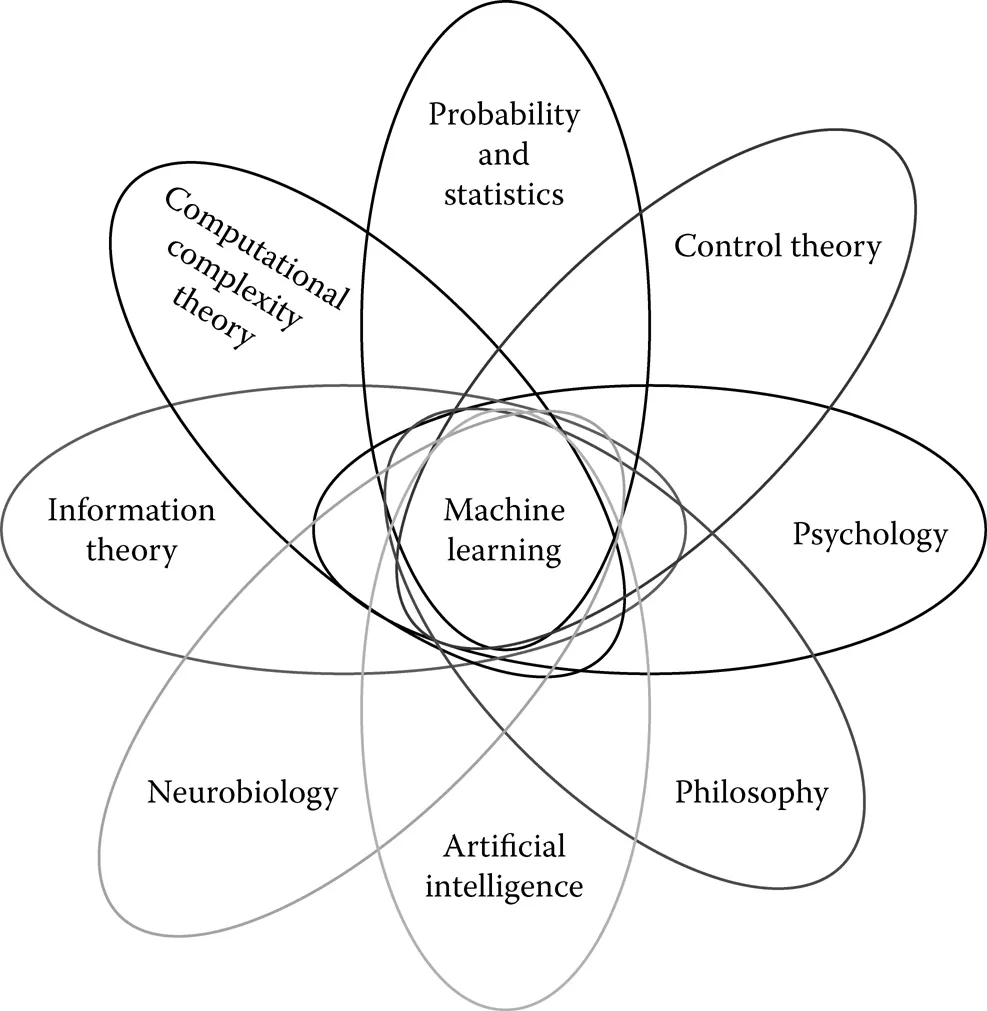
Figure 1.1 Machine learning is a broad discipline, combining approaches from many different areas.
Wireless sensor network (WSN) applications operate in very challenging conditions, where they constantly have to accommodate environmental changes, hardware degradation, and inaccurate sensor readings. Therefore, in order to maintain sufficient operational correctness, a WSN application often needs to learn and adapt to the changes in its running environment. Machine learning has been used to help address these issues. A number of machine learning algorithms have been employed in a wide range of sensor network applications, including activity recognition, health care, education, and for improving the efficiency of heating, ventilating, and air conditioning (HVAC) system.
The abundance of machine learning algorithms can be divided into two main classes: supervised and unsupervised learning, based on whether the training data instances are labeled. In supervised learning, the learner is supplied with labeled training instances, where both the input and the correct output are given. In unsupervised learning, the correct output is not provided with the input. Instead, the learning program must rely on other sources of feedback to determine whether or not it is learning correctly. A third class of machine learning techniques, called semi-supervised learning, uses a combination of both labeled and unlabeled data for training. Figure 1.2 shows the relationship between these three machine learning classes.
In this chapter, we have surveyed machine learning algorithms in sensor networks from the perspective of what types of applications they have been used for. We give examples from all three machine learning classes and discuss how they have been applied in a number of sensor network applications. We present the most frequently used machine learning algorithms, including clustering, Bayes probabilistic models, Markov models, and decision trees. We also analyze the challenges, advantages, and drawbacks of using different machine learning algorithms. Figure 1.3 shows the machine learning algorithms introduced in this chapter.

Figure 1.2 Machine learning algorithms are divided into supervised learning, which used labeled training data, and unsupervised learning, where labeled training data is not available. A third class of machine learning technique, semi-supervised learning, makes use of both labeled and unlabeled training data.
1.1 Supervised Learning
In supervised learning, the learner is provided with labeled input data. This data contains a sequence of input/output pair...
Table of contents
- Cover
- Half Title
- Title Page
- Copyright Page
- Dedication
- Table of Contents
- Preface
- Editors
- Contributors
- Part I Intelligent Sensor Networks: Machine Learning Approach
- Part II Intelligent Sensor Networks: Signal Processing
- Part III Intelligent Sensor Networks: Sensors and Sensor Networks
- Index
Frequently asked questions
Yes, you can cancel anytime from the Subscription tab in your account settings on the Perlego website. Your subscription will stay active until the end of your current billing period. Learn how to cancel your subscription
No, books cannot be downloaded as external files, such as PDFs, for use outside of Perlego. However, you can download books within the Perlego app for offline reading on mobile or tablet. Learn how to download books offline
Perlego offers two plans: Essential and Complete
- Essential is ideal for learners and professionals who enjoy exploring a wide range of subjects. Access the Essential Library with 800,000+ trusted titles and best-sellers across business, personal growth, and the humanities. Includes unlimited reading time and Standard Read Aloud voice.
- Complete: Perfect for advanced learners and researchers needing full, unrestricted access. Unlock 1.4M+ books across hundreds of subjects, including academic and specialized titles. The Complete Plan also includes advanced features like Premium Read Aloud and Research Assistant.
We are an online textbook subscription service, where you can get access to an entire online library for less than the price of a single book per month. With over 1 million books across 990+ topics, we’ve got you covered! Learn about our mission
Look out for the read-aloud symbol on your next book to see if you can listen to it. The read-aloud tool reads text aloud for you, highlighting the text as it is being read. You can pause it, speed it up and slow it down. Learn more about Read Aloud
Yes! You can use the Perlego app on both iOS and Android devices to read anytime, anywhere — even offline. Perfect for commutes or when you’re on the go.
Please note we cannot support devices running on iOS 13 and Android 7 or earlier. Learn more about using the app
Please note we cannot support devices running on iOS 13 and Android 7 or earlier. Learn more about using the app
Yes, you can access Intelligent Sensor Networks by Fei Hu, Qi Hao, Fei Hu,Qi Hao in PDF and/or ePUB format, as well as other popular books in Technology & Engineering & Information Technology. We have over one million books available in our catalogue for you to explore.