A significant reinterpretation of Sarawak history, Power and Prowess explores the network of power, economic and ritual relationships that developed on the northwest coast of Borneo in the mid-nineteenth century, from which a coalition led by James Brooke established the state of Sarawak. Where many authors placed Brooke in the context of nineteenth century British imperialism, this study perceives him in the context of Bornean cultures and political economies. Brooke emerges from the historical record as a 'man of prowess', with the author identifying important ritual sources of Brooke's power among Malays, Bidayuh and Ibans, sources which derived from and expressed indigenous cultural traditions about fertility, health and status.Drawing on conceptual frameworks from political science, as well as recent southeast Asian historiography, Power and Prowess offers a detailed political history of the period and new interpretations of Brooke's career. This study also retrieves from the historical sources previously concealed narratives which reflect the interests, priorities and activities of Sarawak people themselves.J.H. WALKER lectures in political science at the University of New South Wales at the Australian Defence Force Academy.
Prior to 1841, the term ‘Sarawak’ referred to the Sarawak River area and the territory accessible from it. Since then, it has become associated with the polity that was created by James Brooke and his allies and that, throughout the latter half of the 19th century, expanded along the northwest coast of Borneo. Today that entity is one state of Malaysia.
Sarawak is divided into three geographic zones: a low-lying, poorly drained coastal plain comprises about one-fifth the State’s area; behind the plain are steep, forested hills rising to about 1000 feet, which comprise about three-fifths of the State; the remaining one-fifth comprises rugged, forested mountain ranges in which begin the many rivers that have shaped the State’s history and demography. Although parts of the Sarawak and Sadong River basins have fertile soils suitable for the intensive agriculture associated with alluvial areas elsewhere in Southeast Asia, much of the lowland areas, particularly in the basins of the Skrang, Saribas and Rejang Rivers, is composed of acidic peat unsuitable for intensive cropping.1
The amount of rain that falls on Borneo defines the other main features of the island’s geography, producing rivers on the largest scale, such as the Rejang, Barito, Mahakam and Kapuas. Three hundred and fifty miles long, the Rejang is navigable for steamers for 150 miles up to Kapit. Ocean-going ships berth at Sibu, and even at Kanowit it is half a mile wide. The rains also sustain some of the world’s greatest rainforest ecosystems. The botanist Odoardo Beccari had nowhere seen ‘primeval forests so rich, so varied, and peculiar in their flora as in the vicinity of Kuching’.2
The forests create illusions of agricultural potential. Although lush and vigorous, they grow on shallow topsoils that need constant regeneration from the forest’s own humus to support them. Destroy the forests, therefore, and the source of agricultural wealth itself is destroyed. The solution to this agricultural barrier in Borneo was the development of systems of
Map 1 Northwest Borneo, 1835–1868
slash-and-burn farming. The ashes of burned forest provided enough additional nutrients to sustain dry-rice and other cultivation for a few years, after which the area was allowed to regenerate. Fallow areas were colonised by secondary growth which, in its turn, provided ashes to the soil to nourish crops. Far from being a ‘prodigal farming system’,3 slash-and-burn was a sustainable form of agriculture suited to the limitations of Bornean ecology.
The Bornean jungle also provided a wide range of products for jungle dwellers to consume or to trade with outsiders. ‘The rattans of Borneo’, Hugh Low recorded, ‘are esteemed finer than those produced in any other part of the world’.4 To this he added camphor, gutta percha, and timbers like belian and ebony in a list of forest exports.5 Borneo people also exported sago, which they cultivated so extensively in the 19th century that Mukah, Oya, Bintulu, Matu and Bruit among them produced more than half the world’s supply.6
Control of downriver areas was central to the processes of domination and state formation in Borneo. Upriver groups needed salt and dried fish products as well as iron.7 Control of river mouths gave downriver groups some potential to monopolise the trade in these and other products. Thus river systems supported trade-based polities which, through relationships of varying inequality, sought to expropriate the jungle produce of tribal peoples living upriver. Downriver groups traded this produce into the international trading networks centred on China or one of the major archipelagic entrepôts serving the China trade. Relations between downriver Malayo-Moslem elites and upriver tribes were uneasy and shifting, however.
It has been a commonplace view in the literature about Borneo that forests created barriers to communications by land, encouraging the use of rivers. According to one Bornean cliché, ‘the water unites and the land divides’.8 In this view it was because they facilitated movement that rivers became the primary locus of human settlement, the major arteries of trade and a major focus of power and identity. But there are a number of problems with such materialist interpretations. Healey proposed in 1985 that:
Contrary to the apparent assumptions of most commentators on central Borneo, this orientation to rivers as lines of communication was surely not an ecological imperative. In other parts of the tribal world (e.g. in New Guinea) communications are often concentrated in high ground rather than along rivers, even if they are navigatable. Indeed, many stretches of waterway in inland Borneo are broken by rapids dangerous to canoes or rafts. The orientation of Borneo tribalists to river-borne transport seems as much induced by ideological factors as by topography and ecology. Rivers occupy a significant place in tribal cosmology, often serving as lines of contact with deities of the upper air and the upstream and with deities, dragons and serpents of the underworld and downstream. Burial customs often include themes of river voyages.9
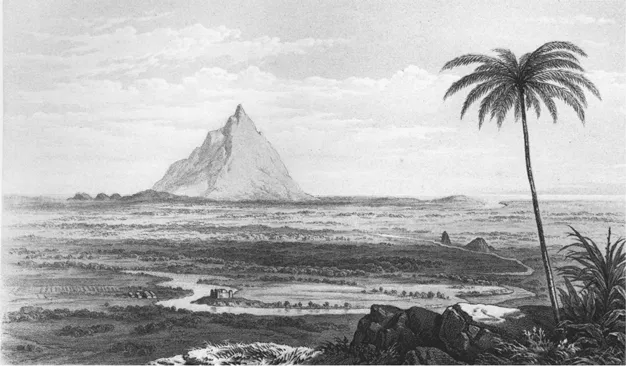
In Borneo, downriver groups sought to monopolise upriver trade as a basis for domination and power. The Rajah’s fort at Belidah is clearly visisble in this view from his holiday bungalow
A range of examples from across northwest Borneo support Healey’s suggestion. The ease of land-based communications between Sambas and Pontiank was sufficient to undermine the Sambas economy as early as 1812. The watershed between the Sarawak River and the Kapuas was also permeable, allowing ready land access between the interiors of Sarawak and Sambas and Pontianak.10 The Iban of the Saribas and Skrang rivers maintained an inland system of communication through paths which ‘intersect the forests between the villages of all the Sakarran and Sarebas tribes, so that a constant communication is easily kept up…’11 Rather than trading in the Rejang delta, the Punan Bah of the upper Rejang travelled up the Belaga branch of the Rejang, trekked overland to the Tubau river and down the Kemena,12 a route followed also by the Kenyah Badeng settled on the Plieran and Danum tributaries of the Rejang.13 Similarly, in the 1840s, Robert Burns found that Kayan wishing to trade could travel down to the Rejang delta, or travel further up the Rejang, trek for five or six days across the watershed, and descend the rivers flowing south and east.14 Although both downriver and upriver groups might have conceived movement and identity in terms of rivers and river basins, upriver groups throughout northwest Borneo were alert to the potential of land-based communications to subvert the control sought by downriver groups.
HISTORY
Indianised remains discovered at Kutai suggest that Borneo has sustained high levels of civilisation since the 5th century.15 The first of a succession of advanced states based on the northwestern coast was Po-ni, which probably encompassed what is now Sarawak’s First Division. Po-ni’s economy was partly industrial. Santubong, at the mouth of the Sarawak River, was a significant iron-smelting centre by the 11th century.16 It is not clear whether Po-ni can be identified as an early name for Brunei, or whether it was a predecessor state. Nor is its relationship to a 7th-century state on the northwest coast known as Vijayapura at all clear.17
The relationship between Melaka and Brunei in the Melakan period is also obscure. Although the dating of the conversion of the Brunei court to Islam remains controversial, it probably occurred through intercourse with Melaka in the 16th century.18 Notwithstanding increasing European contacts with the north and west coasts of Borneo from this period, Brunei resisted Spanish encroachment from the north, in reprisal for which the Spanish burned the Brunei capital in 1645.19
A Spanish report from 1530 describes Cerava (Sarawak) as one of the four chief ports of Borneo, inhabited by ‘many and rich merchants’ whose trade consisted of diamonds, camphor, aloes-wood, provisions and wine.20 Bob Reece suggested that the Sultan of Brunei gave Sarawak to a Portuguese captain, ‘penguilan Maraxa de Raxa’, in 1578, in reward for ‘de Raxa’s’ support against the Spanish: ‘Helping to restore Sultan Saif ul Rijal to the throne, it seems likely that de Raxa was rewarded with a wife and the opportunity to carve out his own little kingdom on the northwest coast.’ Although Reece acknowledged that little more is known of this first white Rajah of Sarawak, he suggested that the cannon captured at Sadok after Rentap’s flight, ‘may also have come from de Raxa’s ship’.21
One problem with this reconstruction is the absence of evidence to support it. The documents Reece cited do not suggest either that Maraxa de Raxa was Portuguese or that he was given Sarawak by the sultan. As Nicholl explained, ‘penguilan Maraxa de Raxa’ was a Spanish rendering of a Malay title, Pengiran Maharaja de Raja. There is no mention in the sources of his being married to anyone, and it is not certain that he even went to Sarawak. He was said to have been instructed by the Sultan to visit all the rivers ‘as far as Saragua’.22 ‘Penguilan Maraxa de Raxa’ was noteworthy to his Spanish contemporaries because he was a leading official of the Brunei court, not because he was Portuguese. Nor did the Spanish treat him as though he were Portuguese. When they wrote to him, they translated their letters into Malay before dispatching them.23 Moreover, far from being hostile to the Spanish, as Reece suggested, the Pengiran was one of the Brunei officials friendly to Spain. The Spanish Captain-General in Manila, De Sande, claimed to have appointed him a ‘commander’, giving him a ‘letter of assurance and friendship’ and instructing his captain to ‘observe all friendship’ towards him.24 Finally, the cannon taken at Sadok was ‘Bujang Timpang Brang’, a gun that had been captured by the Iban leader, Orang Kaya Pamancha Dana, in Sambas in 1825.25
Although Sarawak figures prominently in the 16th-century sources collected by Nicholl, its importance must have declined during the following century. It is not marked on 17th-century European maps of the area. Nor did Berthelot, who sailed in the region in 1626–1627, mark it, although he did note one of the Rejang’s tributaries.26
Brunei had risen to regional dominance by monopolising trade from the northwest coast of Borneo. From the late 17th century, however, a series of conflicts within the ruling family diminished Brunei’s control over its northern territories.27 As the volume of trade controlled by the Brunei elite decreased, Brunei people sought to maintain their standard of living by increasing the profits they made from the surviving traffic. By 1821 Brunei’s once considerable trade with China had ceased and the Chinese population ...
Table of contents
Cover
Half Title
Series Page
Title Page
Dedication Page
Contents
Illustrations
Maps and genealogies
Spelling, weights and measures
Glossary
Abbreviations
Acknowledgements
Approaching 19th-century Sarawak
1 Power and prowess in northwest Borneo
2 Insurgency and the foundations of Brooke power
3 Integration and exclusion in the early Brooke state
4 The Iban challenge
5 Competition, resistance and ritual in patron–client systems
6 Chinese power and the failure of prowess
7 The Rejang basin
8 The succession to Sarawak
9 ‘Doing honour to the Rajah’
Notes
Bibliography
Index
Frequently asked questions
Yes, you can cancel anytime from the Subscription tab in your account settings on the Perlego website. Your subscription will stay active until the end of your current billing period. Learn how to cancel your subscription
No, books cannot be downloaded as external files, such as PDFs, for use outside of Perlego. However, you can download books within the Perlego app for offline reading on mobile or tablet. Learn how to download books offline
Perlego offers two plans: Essential and Complete
Essential is ideal for learners and professionals who enjoy exploring a wide range of subjects. Access the Essential Library with 800,000+ trusted titles and best-sellers across business, personal growth, and the humanities. Includes unlimited reading time and Standard Read Aloud voice.
Complete: Perfect for advanced learners and researchers needing full, unrestricted access. Unlock 1.4M+ books across hundreds of subjects, including academic and specialized titles. The Complete Plan also includes advanced features like Premium Read Aloud and Research Assistant.
Both plans are available with monthly, semester, or annual billing cycles.
We are an online textbook subscription service, where you can get access to an entire online library for less than the price of a single book per month. With over 1 million books across 990+ topics, we’ve got you covered! Learn about our mission
Look out for the read-aloud symbol on your next book to see if you can listen to it. The read-aloud tool reads text aloud for you, highlighting the text as it is being read. You can pause it, speed it up and slow it down. Learn more about Read Aloud
Yes! You can use the Perlego app on both iOS and Android devices to read anytime, anywhere — even offline. Perfect for commutes or when you’re on the go. Please note we cannot support devices running on iOS 13 and Android 7 or earlier. Learn more about using the app
Yes, you can access Power and Prowess by JH Walker in PDF and/or ePUB format, as well as other popular books in Politics & International Relations & Politics. We have over one million books available in our catalogue for you to explore.