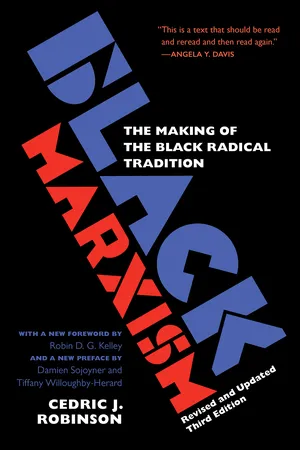
In this ambitious work, first published in 1983, Cedric Robinson demonstrates that efforts to understand Black people’s history of resistance solely through the prism of Marxist theory are incomplete and inaccurate. Marxist analyses tend to presuppose European models of history and experience that downplay the significance of Black people and Black communities as agents of change and resistance. Black radicalism, Robinson argues, must be linked to the traditions of Africa and the unique experiences of Blacks on Western continents, and any analyses of African American history need to acknowledge this.
To illustrate his argument, Robinson traces the emergence of Marxist ideology in Europe, the resistance by Blacks in historically oppressive environments, and the influence of both of these traditions on such important twentieth-century Black radical thinkers as W. E. B. Du Bois, C. L. R. James, and Richard Wright. This revised and updated third edition includes a new preface by Tiffany Willoughby-Herard, and a new foreword by Robin D. G. Kelley.
eBook - ePub
Black Marxism, Revised and Updated Third Edition
The Making of the Black Radical Tradition
- 496 pages
- English
- ePUB (mobile friendly)
- Available on iOS & Android
eBook - ePub
Black Marxism, Revised and Updated Third Edition
The Making of the Black Radical Tradition
Part 1: The Emergence and Limitations of European Radicalism
Chapter 1: Racial Capitalism: The Nonobjective Character of Capitalist Development
The historical development of world capitalism was influenced in a most fundamental way by the particularistic forces of racism and nationalism. This could only be true if the social, psychological, and cultural origins of racism and nationalism both anticipated capitalism in time and formed a piece with those events that contributed directly to its organization of production and exchange. Feudal society is the key. More particularly, the antagonistic commitments, structures, and ambitions that feudal society encompassed are better conceptualized as those of a developing civilization than as elements of a unified tradition.
The processes through which the world system emerged contained an opposition between the rationalistic thrusts of an economistic worldview and the political momenta of collectivist logic. The feudal state, an instrument of signal importance to the bourgeoisie, was to prove to be as consistently antithetical to the commercial integration represented by a world system as it had to the idea of Christendom. Neither the state nor later the nation could slough off the particularistic psychologies and interests that served as contradictions to a global community. A primary consequence of the conflict between those two social tendencies was that capitalists, as the architects of this system, never achieved the coherence of structure and organization that had been the promise of capitalism as an objective system.1 On the contrary, the history of capitalism has in no way distinguished itself from earlier eras with respect to wars, material crises, and social conflicts. A secondary consequence is that the critique of capitalism, to the extent that its protagonists have based their analyses upon the presumption of a determinant economic rationality in the development and expansion of capitalism, has been characterized by an incapacity to come to terms with the world system’s direction of developments. Marxism, the dominant form that the critique of capitalism has assumed in Western thought, incorporated theoretical and ideological weaknesses that stemmed from the same social forces that provided the bases of capitalist formation.
The creation of capitalism was much more than a matter of the displacement of feudal modes and relations of production by capitalist ones.2 Certainly, the transformation of the economic structures of noncapitalist Europe (specifically the Mediterranean and western European market, trade, and production systems) into capitalist forms of production and exchange was a major part of this process. Still, the first appearance of capitalism in the fifteenth century3 involved other dynamics as well. The social, cultural, political, and ideological complexes of European feudalisms contributed more to capitalism than the social “fetters”4 that precipitated the bourgeoisie into social and political revolutions. No class was its own creation. Indeed, capitalism was less a catastrophic revolution (negation) of feudalist social orders than the extension of these social relations into the larger tapestry of the modern world’s political and economic relations. Historically, the civilization evolving in the western extremities of the Asian/European continent, and whose first signification is medieval Europe,5 passed with few disjunctions from feudalism as the dominant mode of production to capitalism as the dominant mode of production. And from its very beginnings, this European civilization, containing racial, tribal, linguistic, and regional particularities, was constructed on antagonistic differences.
Europe’s Formation
The social basis of European civilization was “among those whom the Romans called the ‘barbarians. ’ ”6 Prior to the eleventh or twelfth centuries, the use of the collective sense of the term “barbarian” was primarily a function of exclusion rather than a reflection of any significant consolidation among those peoples. The term signified that the “barbarians” had their historical origins beyond the civilizing reach of Roman law and the old Roman imperial social order. The “Europe” of the ninth century for which the Carolingian family and its minions claimed paternity was rather limited geopolitically7 and had a rather short and unhappy existence. Interestingly, for several centuries following the deaths of Charlemagne and his immediate heirs (the last being Arnulf, d.899), both the Emperor and Europe were more the stuff of popular legend and clerical rhetoric than manifestations of social reality.8 The idea of Europe, no longer a realistic project, was transferred from one of a terrestrial social order to that of a spiritual kingdom: Christendom.
In fact, those peoples to whom the Greeks and the Romans referred collectively as barbarians were of diverse races with widely differing cultures.9 The diversity of their languages is, perhaps, one measure of their differences. But in using this measure, we must be cautious of the schemes of classification of those languages that reduce the reality of their numbers to simple groupings like the Celtic, the Italic, the Germanic, the Balto-Slavonic, and Albanian languages.10
Direct and indirect evidence indicates that a more authentic mapping of the languages of the proto-Europeans would be much more complex. For instance, H. Munro Chadwick, as late as 1945, could locate extant descendants of those several languages among the Gaelic, Welsh, and Breton languages of Great Britain and France; the Portuguese, Spanish, Catalan, Provencal, French, Italian, Sardinian, Alpine, and Rumanian languages and dialects of southern and western Europe; the English, Frisian, Dutch, German, Danish, Swedish, Norwegian, and Icelandic languages of England, Scotland the Netherlands, Germany, and Scandinavia; the Russian, Bulgarian, Yugoslavian, Slovenian, Slovakian, Czech, Polish, and Lusitian languages and dialects of central and eastern Europe; and the Latvian and Lithuanian languages of northern Europe.11 But even Chadwick’s list was of merely those languages that had survived “the millennium of Europe.” The list would lengthen considerably if one were to consider the languages which existed in this area at the beginning of this era and are no longer spoken (for example, Latin, Cornish, and Prusai), along with those languages of peoples who preceded the migrations from the north and east of Rome’s barbarians (for example, Basque, Etruscan, Oscan, and Umbrian).12
The Ostrogoth, Visigoth, Vandal, Suevi, Burgundi, Alamanni, and Frank peoples—that is the barbarians—whose impact on the fortunes of the Late Roman Empire from the fifth century was quick and dramatic,13 were in fact a small minority of thousands among the millions of the decaying state. Henri Pirenne, relying on the estimates of Emile-Felix Gautier and L. Schmidt, reports that the Ostrogoths and Visigoths may have numbered 100,000 each, the Vandals 80,000, and the Burgundi 25,000.14 Moreover, the warrior strata of each kingdom are consistently estimated at about 20 percent of their populations. On the other hand, the Empire that they invaded contained as many as 50–70 million persons.15 Pirenne cautiously concludes:
All this is conjecture. Our estimate would doubtless be in excess of the truth if, for the Western provinces beyond the limes, we reckoned the Germanic element as constituting 5 percent of the population.16
More importantly, the vast majority of the barbarians “came not as conquerors, but exactly as, in our own day, North Africans, Italians, Poles cross into Metropolitan France to look for work.”17 In a relatively short time, in the southern-most European lands that were bounded by the Western Roman Empire, these peoples were entirely assimilated by the indigenous peoples as a primarily slave labor force.18 The pattern was already a familiar one within the dying civilization of the Mediterranean19 with which they desired and desperately needed to join.20 It is also important to realize that with respect to the emerging European civilization whose beginnings coincide with the arrivals of these same barbarians, slave labor as a critical basis of production would continue without any significant interruption into the twentieth century.21From the familia rustica that characterized Roman and even earlier Greek (doulos) rural production within vast estates, through the manucipia of the colonicae and mansi land-holdings of Merovingian (481–752) and Carolingian eras, the feudal villains of western medieval Europe and England, and the sclavi of the Genoese and Venetian merchants who dominated commercial trade in the Mediterranean from the thirteenth to the sixteenth century, slave labor persisted as an aspect of European agrarian production up to the modern era.22 Neither feudal serfdom nor capitalism had as their result the elimination or curtailment of slavery.23 At the very most (it is argued by some), their organization served to relocate it.24
Despite the “Romanization” of the southern Goths, or seen differently because of it, the Germanic tribes did establish the general administrative boundaries that were to mark the nations of modern western Europe. The kingdoms that they established, mainly under the rules of Roman hospitalitas and in accordance with Roman administration,25 were in large measure the predecessors of France, Germany, Spain, and Italy.
Still, we must not forget that in historical reconstruction, a medieval age is to be intervened between these two ages. Medieval Europe, though still agricultural in economy, was a much cruder existence for slave, peasant, farmer, artisan, land-owner, cleric, and nobility alike than had been the circumstance for their predecessors in the Empire. Urban life declined, leaving the old cities in ruins,26 long-distance trade, especially by sea routes, decayed dramatically.27 Latouche summarizes:
The balance-sheet of the Merovingian economy is singularly disappointing. The now fashionable, if unpleasant, word “rot” describes it to perfection. Whether in the sphere of town life, commerce, barter, currency, public works, shipping, we find everywhere the same policy of neglect, the same selfish refusal to initiate reform. From this disastrous, drifting laissez-faire which left men and things as they had always been, pursuing unchanged their traditional way of life, there sprang the illusion that the ancient world still lingered on; it was, in fact, no more than a facade.28
The Carolingian Empire did little to repair the “rot” that anticipated the restructuring of Europe in feudal terms. The Muslim conquests of the Mediterranean in the seventh and eighth centuries had deprived the European economies of the urban, commercial, productive, and cultural vitality they required for their reconstruction. Pirenne put it boldly:
The ports and the cities were deserted. The link with the Orient was severed, and there was no communication with the Saracen coasts. There was nothing but death. The Carolingian Empire presented the most striking contrast with the Byzantine. It was purely an inland power, for it had no outlets. The Mediterranean territories, formerly the most active portions of the Empire, which supported the life of the whole, were now the poorest, the most desolate, the most constantly menaced. For the first time in history the axis of Occidental civilization was displaced toward the North, and for many centuries it remained between the Seine and the Rhine. And the Germanic peoples, which had hitherto played only the negative part of destroyers, were now called upon to play a positive part in the reconstruction of European civilization.29
Latouche, though he differed with Pirenne on many of the particulars of the Carolingian response to the loss of the Mediterranean, finally concurred:
[T]he Empire broke up less than half a century after its creation, and Charlemagne did nothing to prevent, and did not even attempt to delay, the development of feudal institutions, so heavy with menace for the future . . . a world in which there were no great business concerns, no industries, and in which agricultural activity was predominant.30
Urban life, trade, and market systems incorporating the goods of long-distance trade did not return to Europe until the...
Table of contents
- Cover Page
- Black Marxism
- Copyright Page
- Dedication Page
- Contents
- Foreword: Why Black Marxism? Why Now? by Robin D. G. Kelley
- Preface: Unhushable Wit: Pedagogy, Laughter, and Joy in the Classrooms of Cedric J. Robinson by Damien Sojoyner and Tiffany Willoughby-Herard
- Preface to the 2000 Edition
- Preface
- Acknowledgments
- Introduction
- Part 1: The Emergence and Limitations of European Radicalism
- Part 2: The Roots of Black Radicalism
- Part 3: Black Radicalism and Marxist Theory
- Notes
- Bibliography
- Index
Trusted by 375,005 students
Access to over 1.5 million titles for a fair monthly price.
Study more efficiently using our study tools.
Frequently asked questions
Yes, you can cancel anytime from the Subscription tab in your account settings on the Perlego website. Your subscription will stay active until the end of your current billing period. Learn how to cancel your subscription
No, books cannot be downloaded as external files, such as PDFs, for use outside of Perlego. However, you can download books within the Perlego app for offline reading on mobile or tablet. Learn how to download books offline
We are an online textbook subscription service, where you can get access to an entire online library for less than the price of a single book per month. With over 1.5 million books across 990+ topics, we’ve got you covered! Learn about our mission
Look out for the read-aloud symbol on your next book to see if you can listen to it. The read-aloud tool reads text aloud for you, highlighting the text as it is being read. You can pause it, speed it up and slow it down. Learn more about Read Aloud
Yes! You can use the Perlego app on both iOS and Android devices to read anytime, anywhere — even offline. Perfect for commutes or when you’re on the go.
Please note we cannot support devices running on iOS 13 and Android 7 or earlier. Learn more about using the app
Please note we cannot support devices running on iOS 13 and Android 7 or earlier. Learn more about using the app
Yes, you can access Black Marxism, Revised and Updated Third Edition by Cedric J. Robinson in PDF and/or ePUB format, as well as other popular books in History & African American History. We have over 1.5 million books available in our catalogue for you to explore.