- 178 pages
- English
- ePUB (mobile friendly)
- Available on iOS & Android
eBook - ePub
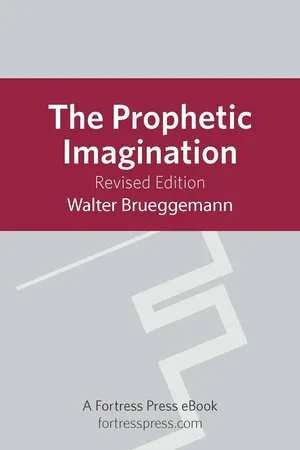
Prophetic Imagination
About this book
In this challenging and enlightening treatment, Brueggemann traces the lines from the radical vision of Moses to the solidification of royal power in Solomon to the prophetic critique of that power with a new vision of freedom in the prophets. Here he traces the broad sweep from Exodus to Kings to Jeremiah to Jesus. He highlights that the prophetic vision and not only embraces the pain of the people but creates an energy and amazement based on the new thing that God is doing. In this new edition, Brueggemann has completely revised the text, updated the notes, and added a new preface.
Tools to learn more effectively

Saving Books

Keyword Search

Annotating Text

Listen to it instead
Information
1
The Alternative Community of Moses
A study of the prophets of Israel must try to take into account both the evidence of the Old Testament and the contemporary situation of the church. What we understand about the Old Testament must be somehow connected with the realities of the church today. So I shall begin with a statement of how I see our present situation and the task facing us in ministry. I will not elaborate but only provide a clue to the perspective from which I am presenting the subject.
The contemporary American church is so largely enculturated to the American ethos of consumerism that it has little power to believe or to act. This enculturation is in some way true across the spectrum of church life, both liberal and conservative. It may not be a new situation, but it is one that seems especially urgent and pressing at the present time. That enculturation is true not only of the institution of the church but also of us as persons. Our consciousness has been claimed by false fields of perception and idolatrous systems of language and rhetoric.
The internal cause of such enculturation is our loss of identity through the abandonment of the faith tradition. Our consumer culture is organized against history. There is a depreciation of memory and a ridicule of hope, which means everything must be held in the now, either an urgent now or an eternal now. Either way, a community rooted in energizing memories and summoned by radical hopes is a curiosity and a threat in such a culture. When we suffer from amnesia, every form of serious authority for faith is in question, and we live unauthorized lives of faith and practice unauthorized ministries.
The church will not have power to act or believe until it recovers its tradition of faith and permits that tradition to be the primal way out of enculturation. This is not a cry for traditionalism but rather a judgment that the church has no business more pressing than the reappropriation of its memory in its full power and authenticity. And that is true among liberals who are too chic to remember and conservatives who have overlaid the faith memory with all kinds of hedges that smack of scientism and Enlightenment.
It is the task of prophetic ministry to bring the claims of the tradition and the situation of enculturation into an effective interface. That is, the prophet is called to be a child of the tradition, one who has taken it seriously in the shaping of his or her own field of perception and system of language, who is so at home in that memory that the points of contact and incongruity with the situation of the church in culture can be discerned and articulated with proper urgency.1 In what follows, I want to urge that there are precise models in Scripture for discerning prophetic ministry in this way.
A study of the prophets of Israel must also try to take into account both the best discernment of contemporary scholarship and what the tradition itself seems to tell us. The tradition and contemporary scholarship are likely to be in some kind of tension, and we must try to be attentive to that. The weariness and serenity of the churches just now make it a good time to study the prophets and get rid of tired misconceptions. The dominant conservative misconception, evident in manifold bumper stickers, is that the prophet is a fortune-teller, a predictor of things to come (mostly ominous), usually with specific reference to Jesus. While one would not want to deny totally those facets of the practice of prophecy, there tends to be a kind of reductionism that is mechanical and therefore untenable. While the prophets are in a way future-tellers, they are concerned with the future as it impinges upon the present. Conversely, liberals who abdicated and turned all futuring over to conservatives have settled for a focus on the present. Thus prophecy is alternatively reduced to righteous indignation and, in circles where I move, prophecy is mostly understood as social action. Indeed, such a liberal understanding of prophecy is an attractive and face-saving device for any excessive abrasiveness in the service of almost any cause. Perhaps our best effort would be to let the futuring of such conservatives and the present criticism of the liberals correct each other. But even that is less than might be claimed. I believe that neither convention adequately understands what is really at issue in the Israelite understanding of prophecy.
The hypothesis I will explore here is this: The task of prophetic ministry is to nurture, nourish, and evoke a consciousness and perception alternative to the consciousness and perception of the dominant culture around us.2 Thus I suggest that prophetic ministry has to do not primarily with addressing specific public crises but with addressing, in season and out of season, the dominant crisis that is enduring and resilient, of having our alternative vocation co-opted and domesticated. It may be, of course, that this enduring crisis manifests itself in any given time around concrete issues, but it concerns the enduring crisis that runs from concrete issue to concrete issue. That point is particularly important to ad hoc liberals who run from issue to issue without discerning the enduring domestication of vision in all of them.
The alternative consciousness to be nurtured, on the one hand, serves to criticize in dismantling the dominant consciousness. To that extent, it attempts to do what the liberal tendency has done: engage in a rejection and delegitimizing of the present ordering of things. On the other hand, that alternative consciousness to be nurtured serves to energize persons and communities by its promise of another time and situation toward which the community of faith may move. To that extent, it attempts to do what the conservative tendency has done, to live in fervent anticipation of the newness that God has promised and will surely give.
In thinking this way, the key word is alternative, and every prophetic minister and prophetic community must engage in a struggle with that notion. Thus, alternative to what? In what ways alternative? How radically alternative? Finally, is there a thinkable alternative that will avoid domestication? And, quite concretely, how does one present and act out alternatives in a community of faith which on the whole does not understand that there are any alternatives or is not prepared to embrace such if they come along? Thus it is a practice of ministry for which there is little readiness; indeed, not even among its would-be practitioners. So my programmatic urging is that every act of a minister who would be prophetic is part of a way of evoking, forming, and reforming an alternative community. And this applies to every facet and every practice of ministry. It is a measure of our enculturation that the various acts of ministry (for example, counseling, administration, even liturgy) have taken on lives and functions of their own rather than being seen as elements of the one prophetic ministry of formation and reformation of alternative community.
The functional qualifiers, critical and energizing, are important. I suggest that the dominant culture, now and in every time, is grossly uncritical, cannot tolerate serious and fundamental criticism, and will go to great lengths to stop it. Conversely, the dominant culture is a wearied culture, nearly unable to be seriously energized to new promises from God. We know, of course, that none of us relishes criticism, but we may also recognize that none of us much relishes energizing either, for that would demand something of us. The task of prophetic ministry is to hold together criticism and energizing, for I should urge that either by itself is not faithful to our best tradition. Our faith tradition understands that it is precisely the dialectic of criticizing and energizing that can let us be seriously faithful to God. And we may even suggest that to choose between criticizing and energizing is the temptation, respectively, of liberalism and conservativism. Liberals are good at criticism but often have no word of promise to speak; conservatives tend to future well and invite to alternative visions, but a germane criticism by the prophet is often not forthcoming. For those of us personally charged with this ministry, we may observe that to be called where this dialectic is maintained is an awesome call. And each of us is likely to fall to one side or the other.
As a beginning point in these considerations, I propose that our understanding of prophecy comes out of the covenantal tradition of Moses. I do not minimize the important scholarly contributions concerning non-Israelite antecedents to prophecy in Israel. These include (1) studies in the Canaanite phenomenon of ecstasy, surely echoed in 1 Samuel 10 and 19; and, more recently, (2) the evidence from Mari and Assyria concerning institutional offices of prophecy, both in the cult and in the court.3 Both these kinds of evidence illuminate practices and conventions to which Israel undoubtedly appealed in its extensive borrowing. But the tradition itself is not ambiguous when it comes to the dominating figure of Moses who provides our primary understandings. That is to say, the shaping of Israel took place from inside its own experience and confession of faith and not through external appropriation from somewhere else. That urging is fundamental for this discussion, for I am urging in parallel fashion that if the church is to be faithful it must be formed and ordered from the inside of its experience and confession and not by borrowing from sources external to its own life.4
The ministry of Moses, as George Mendenhall and Norman Gottwald have most recently urged, represents a radical break with the social reality of Pharaoh’s Egypt.5 The newness and radical innovations of Moses and Israel in this period can hardly be overstated. Most of us are probably so used to these narratives that we have become insensitive to the radical and revolutionary social reality that emerged because of Moses. It is clear that the emergence of Israel by the hand of Moses cannot be extrapolated from any earlier reality. Obviously nothing like the Kenite hypothesis (that Moses learned his monotheism from his father-in-law, Jethro the Kenite) or the monotheism of the eighteenth dynasty in Egypt (instituted by Pharaoh Akhenaton) will help us at all. While there are some hints that the God of Israel is known to be the God of the fathers (see. Exod 15:2), that evidence is at best obscure. In any case, the overriding experience of Exodus is decisive and not some memory now only hinted at in the tradition. However those antecedents are finally understood, the appearance of a new social reality is unprecedented. Israel in the thirteenth century is indeed ex nihilo. And that new social reality drives us to the category of revelation.6 Israel can only be understood in terms of the new call of God and his assertion of an alternative social reality. Prophecy is born precisely in that moment when the emergence of social political reality is so radical and inexplicable that it has nothing less than a theological cause. Theological cause without social political reality is only of interest to a professional religionist, and social political reality without theological cause need not concern us here. But it is being driven by the one to the other that requires us to speak of and wonder about the call to the prophetic.7
Breaking with Triumphalism and Oppression
The radical break of Moses and Israel from imperial reality is a two-dimensioned break from both the religion of static triumphalism and the politics of oppression and exploitation. Moses dismantled the religion of static triumphalism by exposing the gods and showing that in fact they had no power and were not gods. Thus, the mythical legitimacy of Pharaoh’s social world is destroyed, for it is shown that such a regime appeals to sanctions that in fact do not exist. The mythic claims of the empire are ended by the disclosure of the alternative religion of the freedom of God.8 In place of the gods of Egypt, creatures of the imperial consciousness, Moses discloses that Yahweh, the sovereign one who acts in his lordly freedom, is extrapolated from no social reality and is captive to no social perception but acts from his own person toward his own purposes.
At the same time, Moses dismantles the politics of oppression and exploitation by countering it with a politics of justice and compassion. The reality emerging out of the Exodus is not just a new religion or a new religious idea or a vision of freedom but the emergence of a new social community in history, a community that has historical body, that had to devise laws, patterns of governance and order, norms of right and wrong, and sanctions of accountability. The participants in the Exodus found themselves, undoubtedly surprisingly to them, involved in the intentional formation of a new social community to match the vision of God’s freedom. That new social reality, which is utterly discontinuous with Egypt, lasted in its alternative way for 250 years.
We will not understand the meaning of prophetic imagination unless we see the connection between the religion of static triumphalism and the politics of oppression and exploitation. Karl Marx had discerned the connection when he observed that the criticism of religion is the ultimate criticism and must lead to the criticism of law, economics, and politics.9 The gods of Egypt are the immovable lords of order. They call for, sanction, and legitimate a society of order, which is precisely what Egypt had. In Egypt, as Frankfort has show, there were no revolutions, no breaks for freedom. There were only the necessary political and economic arrangements to provide order, “naturally,” the order of Pharaoh. Thus the religion of the static gods is not and never could be disinterested, but inevitably it served the interests of the people in charge, presiding over the order and benefiting from the order. And the functioning of that society testified to the rightness of the religion because kings did prosper and bricks did get made.
It is the marvel of prophetic faith that both imperial religion and imperial politics could be broken. Religiously, the gods were declared no-gods. Politically, the opp...
Table of contents
- Cover
- Title
- Copyright
- Contents
- Preface to the Revised Edition
- Preface to the First Edition
- 1. The Alternative Community of Moses
- 2. Royal Consciousness: Countering the Counterculture
- 3. Prophetic Criticizing and the Embrace of Pathos
- 4. Prophetic Energizing and the Emergence of Amazement
- 5. Criticism and Pathos in Jesus of Nazareth
- 6. Energizing and Amazement in Jesus of Nazareth
- 7. A Note on the Practice of Ministry
- A Postscript on Practice
- Abbreviations
- Notes
- Selected Bibliography
- Scripture Index
Frequently asked questions
Yes, you can cancel anytime from the Subscription tab in your account settings on the Perlego website. Your subscription will stay active until the end of your current billing period. Learn how to cancel your subscription
No, books cannot be downloaded as external files, such as PDFs, for use outside of Perlego. However, you can download books within the Perlego app for offline reading on mobile or tablet. Learn how to download books offline
Perlego offers two plans: Essential and Complete
- Essential is ideal for learners and professionals who enjoy exploring a wide range of subjects. Access the Essential Library with 800,000+ trusted titles and best-sellers across business, personal growth, and the humanities. Includes unlimited reading time and Standard Read Aloud voice.
- Complete: Perfect for advanced learners and researchers needing full, unrestricted access. Unlock 1.4M+ books across hundreds of subjects, including academic and specialized titles. The Complete Plan also includes advanced features like Premium Read Aloud and Research Assistant.
We are an online textbook subscription service, where you can get access to an entire online library for less than the price of a single book per month. With over 1 million books across 990+ topics, we’ve got you covered! Learn about our mission
Look out for the read-aloud symbol on your next book to see if you can listen to it. The read-aloud tool reads text aloud for you, highlighting the text as it is being read. You can pause it, speed it up and slow it down. Learn more about Read Aloud
Yes! You can use the Perlego app on both iOS and Android devices to read anytime, anywhere — even offline. Perfect for commutes or when you’re on the go.
Please note we cannot support devices running on iOS 13 and Android 7 or earlier. Learn more about using the app
Please note we cannot support devices running on iOS 13 and Android 7 or earlier. Learn more about using the app
Yes, you can access Prophetic Imagination by Walter Brueggemann in PDF and/or ePUB format, as well as other popular books in Theology & Religion & Religion. We have over one million books available in our catalogue for you to explore.