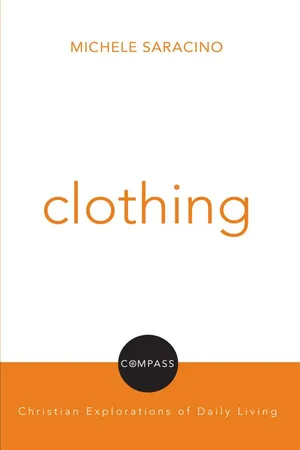
eBook - ePub
Clothing
Compass: Christian Explorations of Daily Living
- 128 pages
- English
- ePUB (mobile friendly)
- Available on iOS & Android
eBook - ePub
Clothing
Compass: Christian Explorations of Daily Living
About this book
Reinhold Niebuhr argued that one of the fundamental challenges to human existence is the anxiety caused by our desire to be perfect and godlike while knowing we are limited and mortal. This book explores how human adornment practices negotiate anxieties about our finitude. Through our clothing, we often shield ourselves from feeling our human frailty and from having others detect our emotional, physical, and spiritual vulnerabilities. Looking at the incarnation as a form of "dress," Saracino claims that getting naked with Jesus or embracing our vulnerability is our only hope at creating life-giving relationships with God and others in the global world.
Tools to learn more effectively

Saving Books

Keyword Search

Annotating Text

Listen to it instead
Information
1
Chapter 1 : Vulnerability and the Human Condition
“Therefore I tell you, do not worry about your life, what you will eat or what you will drink, or about your body, what you will wear. Is not life more than food, and the body more important than clothing?”
Matthew 6:25
Human beings have a limited tolerance for feeling vulnerable. Sure, when babies are born, we honor their fragile nature and embrace it as part of the miracle of life. We swathe them with our warmest blankets and softest clothes and bathe their delicate bodies with soothing cleansers and lotions. We cherish the helplessness of infants, accepting their limits without question, at times being contented by their dependence on us. In most cases, we are comfortable with their messiness and unpredictability, changing their diapers at inconvenient times and feeding them at all hours of the day. We expect them neither to have control over their embodied selves nor to be perfect.
However, as the years pass, our expectations and comfort level regarding their vulnerability slowly change. Children’s parents, along with their physicians, teachers, and caregivers, track and foster the children’s growth out of this original state of dependence. We anticipate development from this fragile and vulnerable condition toward reaching the appropriate physical and social milestones. We have patience throughout the process. As babies begin to walk, we don’t ridicule them when they fall. Instead, we keep encouraging them toward their goal. When children begin to dress themselves, we forgive and even embrace their mismatched socks and bunched-up pants because we know they are learning and this state of disarray is temporary.
Without fail, as children grow up, our acceptance of their limits wanes, and we find that the world is far less forgiving of their frailties. Messy bodies are understood to be in need of fixing, so much so that as soon as children step onto the playground, they are strongly encouraged, if not bullied, into acting and—more important for this conversation—into looking a certain way. A clumsy gait is no longer cute, but rather a possible first sign of a developmental delay. Runny noses could symbolize poor hygiene, and last year’s fashions often signify a lower social and economic status. Neediness is read as a sign of weakness. Children are faced head-on with implicit social rules about their body and embodied practices to which they must conform. Nonconformity risks at the very least scorn, and at the very worst being treated as less than human. All of us experience an unsaid but deeply felt correlation between the norms of dress and the norms of humanity.
Perhaps the pressure on children today is not this bleak, and I am being too sensitive to growing pains. Yet few make it through childhood without experiencing some of these stressors, creating anxiety that transcends their childhood and follows them into adulthood. Clearly, beyond playground politics, the college students I encounter report that when they go on their first job interviews, they must prepare to meet certain expectations about dress and clothing taboos as well. For instance, they tell me that while most of their peers have tattoos and piercings, having too many is unfavorable in professional contexts. So if they really want the work, they need to cover up the tattoos with long sleeves and remove the nose rings.
What I am hoping to illustrate here is that at every stage of our life, what we wear and why we wear it largely result from a negotiation of anxiety about what is expected, what is the norm, and what is considered human. Nonconformance to social expectations is at times read as a sign of weakness, of not being properly socialized, and even a scar on our humanity. The bottom line is that showing weakness and vulnerability either on the playground or in the boardroom is unappealing to others and often a liability. Yet even though we learn from early childhood on that our clothing has the potential to hide our human frailties and neediness, and we struggle to adhere to what is considered “normal” rather than “deviant,” many of us barely pass the test, and our humanity is challenged. The impossible ideal of perfection, which seems to be the new look for humanity, is always just beyond our reach.
The pressure to be perfect and have total control over one’s body at all times is ubiquitous. If school and work don’t convince us that to be human is to keep our bodies in check, the media are quite effective in spreading the news. Every time we turn on our television or surf the Internet, this or that advertisement practically brainwashes us into believing the idea that if we adorn ourselves appropriately and perfectly, we can escape teasing and succeed in life. Some scholars, particularly those in the field of disability studies, refer to the cultural notion that we can and ought to control our bodies in order to be successful and happy as the “myth of control.”[1]Success is one of the slippery terms and in this context usually means being in control of life, not being dependent on others, and practically being perfect. Conversely, feeling mentally, physically, or spiritually out of control, being dependent and interconnected with others in complicated relationships, not fitting into the norm, and being less than perfect are framed as problems that need to be overcome. A question to ponder is whether vulnerability is always part of the human condition. If the answer is yes, then why do we hide from it, and why does it make us so anxious? In other words, why do we worry? We may not need diapers, but someday we might. We may not need bibs, but when we are tired and as we age, drooling can and does happen. Once we mature, we may be able to live on our own, but we always need companions to enrich our life journey. When framed this way, neediness is part of creaturely existence.
Vulnerability as a Fact of Life
Jean Vanier, a Canadian Catholic thinker and humanitarian, has devoted his life to demonstrating that vulnerability, far from being aberrant and abject, is a universal and transcultural norm in all creatures. For Vanier, we do not grow out of vulnerability; on the contrary, we grow into it. Our embrace of being limited, vulnerable, and mortal is the catalyst for our true freedom. Vanier is founder of L’Arche, a global network of residential communities where traditionally “abled” and “disabled” people live in Christian fellowship, appreciating the other’s humanity and gifts. This experience allows him to see the grace of vulnerability in all relationships, even as an invitation to communion with God and others. In his work Becoming Human, Vanier describes how each one of us is called to open up to our vulnerability, to imagine our neediness as way to connect with others and God, as an invitation for deep, sacramental relationships.[2] He argues further that exposing ourselves to this physical, emotional, and spiritual nakedness is what makes us human. Reading Vanier, one intuits that we are chosen as creatures to enact our freedom in ways that expose our neediness to others. Our neediness then is not only a fact of life, but also a gift that orients us and our freedom toward others.
This is a vastly different sense of freedom from the one in which many of us have been raised—an individualistic and privatized notion of freedom in which the totality of our choices are geared toward personal advancement regardless of the cost to those around us. To be free in this commonsense way requires that we hide and suppress all feelings of vulnerability, as they have become conflated with powerlessness. At least for the past century, in the industrialized, capitalized superpower nations, to be human means to be powerful, to make it on one’s own, and not to need anyone for help. It is interesting that from somewhat of a skewed Christian perspective, many of us have been socialized into thinking and feeling that being limited is a fault that needs to be rectified, even a sin that requires purgation and payment. We have lost sight of the reality that being creaturely is correlative to being imperfect. As a result, we have a blind spot that fools us into thinking we can overcome our weaknesses.
When we begin to really think about our dress habits, we may come to see that clothing allows us to cover up our so-called sins and mask all our uncomfortable feelings about being creatures with limits. Not all dress is used for this purpose, since sometimes we use dress to cover up from the dangerous elements of our environment, such as the seasonal climates of heat and cold. Without gloves in a snowstorm, we risk the pain of frostbite. Without sunscreen to block the damaging ultraviolet rays in the summer, we risk the suffering associated with sunburns or, even worse, skin cancer. These are practical instances in which clothing allows us to survive. Still, much of the time, our adornment practices are far from pragmatic and rather more a way of conforming to social pressures and satiating desires to be accepted as “normal.” We don’t wear just any hat or boots; instead, we dress to meet social expectations and match up with norms of style, class, gender, religion, and so on. We dress to look good, which makes us feel less anxious about our social standing. Our clothing wields cultural capital in that it protects us from negative judgments by our peers. In consumer culture, we have come to believe, as the English philosopher Herbert Spencer once noted, that our dress can provide us with a “peace” that religion fails to offer us.[3] Unfortunately, more often than not, this “peace,” or high even, is short-lived. If we are unable to adorn ourselves or our loved ones with the “right stuff,” whatever that is, we experience a terrible low, an unsettling anxiety, throwing us into a cycle of decline. In this way, dress has become an accomplice to humanity’s denial of limits, fostering distorted conceptions of human existence and resulting in destructive relationships.
For Vanier, and imaginably many Christians who are trying to live as Jesus did, this interpretation of what it means to be human is dangerous. It is disturbing to conceptualize human limits and vulnerability as something to be avoided, especially when Christians are called both to imitate a messiah who seeks out the vulnerable in society and who embraces exposure on the cross, and to worship a God who through the incarnation becomes human in the fullest sense, including that of having limits and being vulnerable. Vanier hopes to show that this perverse reading of vulnerability and the resulting self-centered notion of freedom fail to reflect the spirit of the Christian tradition and damage our capacity for well-being. While such notions of freedom that are related to being independent and being in control may appear to support our flourishing, the effect is short-lived and superficial, leaving us with what he calls a “false” sense of self, whereby our freedom closes us in on ourselves. To “become human,” we have to risk living without this pretense of being free for ourselves only and accept the liminality of relationships with all types of individuals and communities. For Vanier and others like him, being human is a process that takes work, including vigilance about how we understand our sense of self and use our freedom in relation to others, and here we would be right to include all others—human beings, animals, plants, and so on.
Thinking about vulnerability as a fact of life and a gift from God sets the stage for examining how our dress practices reflect our understanding of freedom and their impact on our quality of life. One way to understand clothing is as a fluid, porous border between ourselves and others, in which what we wear and why we wear it have as much effect on others as on ourselves. When framed this way, our dress bonds us to all others, creatures and the creator alike, in an intimate and profound way. In getting dressed, we have the choice of acknowledging this border not only for the good of ourselves but for all creatures. Do we dress in a way that is hospitable and in solidarity with others, or in a way that cuts off relationships with them? These are the types of issues and questions that Vanier’s work stimulates. Exposing our vulnerability in genuine, embodied relationships can be beautiful, and by revealing our needs for another’s love, touch, and protection, we open ourselves to the depths of the human heart.
Vulnerability and the Real World. Some of the college students I encounter hope to get a job that pays enough for them to live in the city, while others are on their way to graduate school or service internships. Whatever their story and aspirations, most really appreciate Vanier’s insights about healthy relationships and commitment to the marginalized and, as previously mentioned, Paulsell’s attentiveness to body as a site of sacred vulnerability. Yet they are quick to interject that vulnerability and neediness are not readily accepted in Western consumerist culture. On more than one occasion, students have pressed me on this simple question: What’s so great about vulnerability? Sometimes they put it this way: If we are all trying so hard to avoid being vulnerable, why would we work so hard to embrace it? One student wanted the bottom line on accepting vulnerability by asking, “What’s the incentive?”
These are the tough and important questions—the “so what?” factor, as I like to put it. I want to respond in a way that confirms the rigor and genuineness of such critical analysis, not with a stilted catechetical response like “Christians believe God made humans that way,” or “The incarnation sacralizes that lived reality.” Even though these points are sound, such a quick response is insensitive to students’ concerns, especially as some do not consider themselves particularly religious. Although their skepticism does not come out of the blue, I find myself fumbling around as if this were the first time I had been confronted with these questions. I manage to give an abbreviated yet affirming response, but my students want and deserve more. We all feel a ton of pressure to demonstrate that we have our lives under control and that we do not need much of anything from anyone. I experience those pressures and the negative stress associated with the students. So before I get to the theological responses, I empathize with them. I know firsthand that exposing one’s feelings about being less than perfect and in control—needing others—can be terrifying. What if the thing or person we need is unavailable or just plain uninterested in being in a relationship? I, too, at times wonder about what is so good about being limited, about being confined to the laws of time and space, about being mortal, and about fundamentally being unable to survive without others, particularly in a culture that prides itself on the values of independence, individualism, and autonomy. These concerns catapult us to the shadow side of vulnerability, where neediness becomes a dirty word.
Dress, like many of the other embodied practices we engage in every day, negotiates these two sides of creaturely existence—the vulnerability that invites relationship and the vulnerability that repels it. While all might benefit from embracing vulnerability as a fact of life, Christians in particular—since they believe human frailty to be sacramentalized in the incarnation, in God becoming human—are obligated to deal with this tension, to imagine vulnerability as a way of connecting to others, and to reject any notion that vulnerability is a defect or sin. Beginning here may provide a well-deserved response to the “so what?” factor that is less sickeningly sweet and ultimately more honest. Moreover, as a side note, the desire to overcome our vulnerability is futile, since we can never get beyond our finitude, our here-and-nowness, our mortality. When we fail to recognize the futility of this desire, we risk squandering important opportunities to develop deeper and more life-giving relationships with others.
So back to my student’s million-dollar question: What’s the incentive? The answer for me is the good life—a life in which we are genuinely free, in a way analogous to what Vanier envisions, whereby freedom is activated by exposing our humanity to the other. Fear constricts our choices, and when we relinquish and/or transform our anxieties about our humanity from fear to hope, we are opened to new horizons and new heights.
Anxiety and the Human Condition. Dealing with human apprehension about being mortal, and thus about having limits, is not new. Throughout history, theologians, philosophers, and of course clinicians in the fields of psychology and psychiatry have been concerned about the effects of this anxiety on human existence. One of the world’s great religions, Buddhism, teaches us that desire brings suffering, and we need to overcome that desire to reach enlightenment. Christians also have conceptual frames for explaining the damaging effects of desire. In The Nature and Destiny of Man, Reinhold Niebuhr, a prominent American Protestant theologian of the twentieth century, claims that a fundamental challenge to human existence is the anxiety caused by our desire to be perfect and godlike, even with the knowledge that creaturely existence is characterized by limits and, of course, mortality.[4] This anxiety is not necessarily sinful, according to Niebuhr, yet if it is not acknowledged and worked through, it has the potential to cause pain and suffering and lead to sin and brokenness.
When read this way, anxiety presents an invitation to find out what drives us and whether that is healthy and life-giving. In not paying attention to moments of anxiety over feeling vulnerable, and even denying that anxiety with a pretense of being superhuman or above it all, we may find ourselves in negative patterns of self-loathing. In the context of the daily practice of clothing, we may be repeatedly disappointed in what we look like, perhaps developing eating ...
Table of contents
- Cover
- Title Page
- Table of Contents
- Copyright
- Series Foreword
- Preface
- Introduction: The Mirror Moment
- 1. Chapter 1 : Vulnerability and the Human Condition
- 2. Chapter 2: The Path to Perfection Is the Road to Destruction
- 3. Chapter 3: Redeeming Fashion
- 4. Suggestions for Further Reading
- 5. Reader's Guide
Frequently asked questions
Yes, you can cancel anytime from the Subscription tab in your account settings on the Perlego website. Your subscription will stay active until the end of your current billing period. Learn how to cancel your subscription
No, books cannot be downloaded as external files, such as PDFs, for use outside of Perlego. However, you can download books within the Perlego app for offline reading on mobile or tablet. Learn how to download books offline
Perlego offers two plans: Essential and Complete
- Essential is ideal for learners and professionals who enjoy exploring a wide range of subjects. Access the Essential Library with 800,000+ trusted titles and best-sellers across business, personal growth, and the humanities. Includes unlimited reading time and Standard Read Aloud voice.
- Complete: Perfect for advanced learners and researchers needing full, unrestricted access. Unlock 1.4M+ books across hundreds of subjects, including academic and specialized titles. The Complete Plan also includes advanced features like Premium Read Aloud and Research Assistant.
We are an online textbook subscription service, where you can get access to an entire online library for less than the price of a single book per month. With over 1 million books across 990+ topics, we’ve got you covered! Learn about our mission
Look out for the read-aloud symbol on your next book to see if you can listen to it. The read-aloud tool reads text aloud for you, highlighting the text as it is being read. You can pause it, speed it up and slow it down. Learn more about Read Aloud
Yes! You can use the Perlego app on both iOS and Android devices to read anytime, anywhere — even offline. Perfect for commutes or when you’re on the go.
Please note we cannot support devices running on iOS 13 and Android 7 or earlier. Learn more about using the app
Please note we cannot support devices running on iOS 13 and Android 7 or earlier. Learn more about using the app
Yes, you can access Clothing by Michele Saracino,Joefrerick Ating,David H. Jensen, David H. Jensen, Michele Saracino in PDF and/or ePUB format, as well as other popular books in Theology & Religion & Christian Theology. We have over one million books available in our catalogue for you to explore.