- 240 pages
- English
- ePUB (mobile friendly)
- Available on iOS & Android
eBook - ePub
About this book
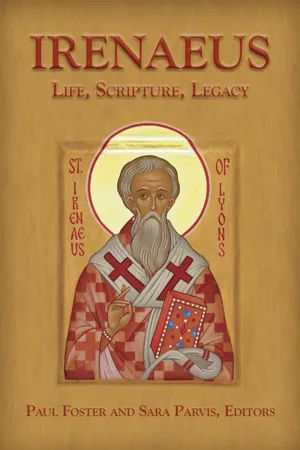
Champion of martyrs, scourge of heretics, erudite theologian, shrewd politician–no account of early Christianity is complete without careful consideration of Irenaeus of Lyons. Here a team of international scholars examine aspects of the saint’s life, historical context, engagement with scripture, and his ecclesiastical and theological legacy for succeeding generations.
Tools to learn more effectively

Saving Books

Keyword Search

Annotating Text

Listen to it instead
Information
Part 1. Life: Irenaeus and His Context
1
Who Was Irenaeus: An Introduction to the Man and His Work
Paul Parvis
Who was Irenaeus? This chapter will attempt to provide some sort of an answer to that rather complex question while, along the way, introducing some of the key literature that helps to articulate the study of Irenaeus.
We could try to answer it by looking at the bare bones of the little that is known of his life: he came from the East, was bishop of Lyons in the 180s, and wrote a monumental Against the Heresies. But that sort of an answer would not give us a handle on why he really matters—on why the question is of more than antiquarian interest in the first place.
Or we could give an answer in terms of his “achievement,” which might involve us in talking about his role in the development of the very notions of orthodoxy and heresy or his contribution to a doctrine of “apostolic succession” or an understanding of the role of tradition in the life of the Church. But there are at least two problems there. One is the obvious fact that that sort of an approach means treating him as a sort of disembodied mind—“notions,” “doctrine,” “understanding”—rather than as one passionately engaged in the struggles and in the dramas of the world he lived in. And the other is the rather subtler danger of viewing him only from our end, as it were, for focusing on such “achievements” inevitably means privileging the problems and questions of later ages and that in turn means both belittling and distorting his thought by trying to wedge it into later categories. And the Irenaeus we are then left with is an inevitably divisive character because in the foreground as we look at him are issues that have caused and continue to cause division both within the Church and among the churches.[1]
So I would like to approach the question from another angle—by looking at the first more or less coherent account we have of Irenaeus and seeing how it does and how it does not fit the a priori questions we might be tempted to raise. That earliest account comes from the Historia Ecclesiastica of Eusebius of Caesarea, the first edition of which was produced shortly before the year 300.[2]
Eusebius tells us that Irenaeus (1) had in his youth been a “hearer” of Polycarp of Smyrna and (2) became bishop of Lyons in Gaul sometime around 180. He gives (3) a catalogue of Irenaeus’s own writings, at least those “that have come to our knowledge” (HE V.26) and (4) an account of the books Irenaeus accepted as canonical. He is (5) suspicious of Irenaeus’s views on chiliasm and the thousand-year reign of Christ but (6) knows him as a man of peace—which is, after all, what the name “Irenaeus” means— and as one who was active and influential in the ecclesiastical affairs of his day.
Those six points deserve to be looked at one at a time.
Polycarp of Smyrna
First, Polycarp. Irenaeus twice says that he knew Polycarp. In a letter that Eusebius quotes but which is otherwise lost to us, Irenaeus reminds the Florinus to whom it is addressed that “I saw you when I was still a boy, in lower Asia” and recounts how “I can speak of the place in which the blessed Polycarp used to sit and converse and how he would go out and come in and his manner of life and his bodily appearance and the talks he gave to the people and how he described his association with John and with the others who had seen the Lord and how he recalled their words” (HE V.20.5-6). That takes us back to the middle of the second century, if not slightly earlier, since Polycarp was martyred—burned alive in the arena in Smyrna—at the age of eighty-six on a date that appears to be 23 February 157.[3] Polycarp is important to Irenaeus because he thinks that through him he is himself linked to the apostolic age.[4]
And there we come to one of the central elements of Irenaean theology—the role of the bishop and succession from the apostles. For him the bishop is above all a teacher, a publicly accredited witness to the teaching of the apostles. It is easy for us to misunderstand that and to read him as if he were speaking of authority and some kind of juridical power.[5] He is not. While a later theology[6] came to affirm that the bishops are what the apostles were, Irenaeus wants to say that the bishops teach what the apostles taught. That can be clearly seen from his enumeration of the successive bishops of Rome in Haer. III.3.3.[7]
The Roman church, he thinks, was “founded and established by the two most glorious apostles Peter and Paul,” and he lists the bishops from Linus to Eleutherus, who “now holds the episcopacy in the twelfth place from the apostles.” There are twelve names in his list. In other words, Peter and Paul kicked off the succession at Rome but were not themselves bishops of Rome—indeed, there is no reason to think that he assumes they were “bishops” in any real sense at all. It is the job of the bishops to teach what the apostles taught rather than to be what the apostles were.
He thinks that he could in principle produce such a succession list for all the churches, but the only other example he even sketches in is Smyrna, where Polycarp, who “had been taught by the apostles and had conversed with many who had seen the Lord” was “established as bishop by apostles”—Polycarp, “whom we also saw when we were young” (Haer. III.3.4).
Eusebius dutifully copies Irenaeus’s list of twelve names (HE V.6.1-5), but he does so without surprise. It has for him simply become self-evident that there should be in each of the major sees a chain of bishops leading back to the apostles.
But in selling the other part of his package—the role of the bishop as teacher—Irenaeus was in the end to be less successful. His model was based at least in part on the contemporary understanding of the “successions” in the schools of philosophy and medicine. The idea was that in each generation there had been a nameable individual who could be regarded as the official head of the school—Aristotelians, Stoics, Epicureans, and the like—and therefore as its official spokesperson.[8]
For Irenaeus, the bishop was an official spokesman—the nameable, identifiable individual you could go to in each city to find out what the apostles had taught. But even by the time of Eusebius that picture of the bishop as spokesman and witness was being displaced by a more juridical model, one based on the idea of a succession of authority. Hence the significance of the claim that the apostles had themselves been the first members of the various chains of episcopal succession: the bishops had in effect become what the apostles were.
Hence the importance of Polycarp for Irenaeus. It seems natural to infer as a corollary that Irenaeus was himself from Smyrna—the modern Izmir on the Aegean coast of Turkey—though he nowhere says so explicitly. Nor does Eusebius, who had little interest in anything like biography in the modern sense and who in any case would have had no source of information other than what he had read in Irenaeus himself.
It is in any event clear that Irenaeus was from the East. He thought and wrote in Greek and has links both personal and theological with Asia Minor.[9] But at some point he came west, from Smyrna in the Roman province of Asia to Lugdunum—the modern Lyons—capital of the province of Lugdunensis.
Lyons
Irenaeus never mentions Lyons either, though he does say that he dwells “among the Celts” and “busies” himself “for the most part with a barbaric tongue” (Haer. I. pref. 3).[10] The latter may be something of an exaggeration: the remark is made as part of a conventional apology for writing in a supposedly unpolished style.
The Lugdunum of Irenaeus’s day was in fact quite a polished and cultured city—a Roman “colony” and, until the mid-third century, the largest city north of the Alps. It was the religious and economic hub of the whole of Gaul. There leading figures of all the Gallic provinces met annually to offer sacrifice at the altar of Rome and Augustus.
It was also a cosmopolitan city. What had initially brought Irenaeus there we do not know, but he was following a route taken by many others from the East.[11] His flock must have consisted largely, though not exclusively, of immigrants. It was a Greek-speaking community in a Latin-speaking city nestled in the midst of a Celtic-speaking countryside. They would in no small part have been outsiders, strangers in a strange land, alienated culturally as well as religiously from the life of the city around them. And they were, for that reason among others, mistrusted and despised.
Around the year 180 or very shortly before a vicious local persecution erupted. It began with mob violence that led to Christians being rounded up by the civic authorities and finally to a number of them being cruelly executed in the amphitheater by the Roman governor of the province.[12]
There is a detailed account of the persecution in the long and moving letter from “the slaves of Christ who sojourn in Vienne and Lyons to the brethren throughout Asia[13] and Phrygia who have the same faith and hope of redemption that we do,” a document quoted at length by Eusebius in HE V.1.1—3.3. In the course of the persecution, the aged bishop Pothinos—“over ninety years of age” (V.1.29)—died in prison as a result of the maltreatment and torture to which he had been subjected. And he was succeeded by Irenaeus.
How Irenaeus escaped the persecution is unknown. It was, like all persecutions before the mid-third century, local, random, and haphazard. Perhaps in its ear...
Table of contents
- Cover
- Title Page
- Table of Contents
- Copyright
- Acknowledgments
- Contributors
- The Writings of Irenaeus
- Timeline
- Introduction: Irenaeus and His Traditions
- Part 1. Life: Irenaeus and His Context
- Part 2. Scripture: Irenaeus and His Scriptural Traditions
- Part 3. Legacy: Irenaeus and His Theological Traditions
- Bibliography
Frequently asked questions
Yes, you can cancel anytime from the Subscription tab in your account settings on the Perlego website. Your subscription will stay active until the end of your current billing period. Learn how to cancel your subscription
No, books cannot be downloaded as external files, such as PDFs, for use outside of Perlego. However, you can download books within the Perlego app for offline reading on mobile or tablet. Learn how to download books offline
Perlego offers two plans: Essential and Complete
- Essential is ideal for learners and professionals who enjoy exploring a wide range of subjects. Access the Essential Library with 800,000+ trusted titles and best-sellers across business, personal growth, and the humanities. Includes unlimited reading time and Standard Read Aloud voice.
- Complete: Perfect for advanced learners and researchers needing full, unrestricted access. Unlock 1.4M+ books across hundreds of subjects, including academic and specialized titles. The Complete Plan also includes advanced features like Premium Read Aloud and Research Assistant.
We are an online textbook subscription service, where you can get access to an entire online library for less than the price of a single book per month. With over 1 million books across 990+ topics, we’ve got you covered! Learn about our mission
Look out for the read-aloud symbol on your next book to see if you can listen to it. The read-aloud tool reads text aloud for you, highlighting the text as it is being read. You can pause it, speed it up and slow it down. Learn more about Read Aloud
Yes! You can use the Perlego app on both iOS and Android devices to read anytime, anywhere — even offline. Perfect for commutes or when you’re on the go.
Please note we cannot support devices running on iOS 13 and Android 7 or earlier. Learn more about using the app
Please note we cannot support devices running on iOS 13 and Android 7 or earlier. Learn more about using the app
Yes, you can access Irenaeus by Sara Parvis, Paul Foster, Sara Parvis,Paul Foster in PDF and/or ePUB format, as well as other popular books in Theology & Religion & Christian Theology. We have over one million books available in our catalogue for you to explore.