T. F. Torrance was one of the most significant English-language theologians of the twentieth-century known extensively for his curatorship of the English translation of Barths Church Dogmatics but also for his own prodigious theological scholarship. The complexity and astonishing breadth of Torrances output, however, have made assessment and appropriation markedly difficult. This volume seeks to rectify that lack of assessment through careful exposition of the vital centers and interconnections within Torrances theology alongside constructive appraisal and critique of his contributions to contemporary theology.
eBook - ePub
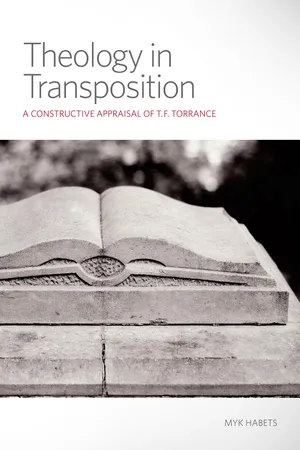
Theology in Transposition
A Constructive Appraisal of T. F. Torrance
- 208 pages
- English
- ePUB (mobile friendly)
- Available on iOS & Android
eBook - ePub
Theology in Transposition
A Constructive Appraisal of T. F. Torrance
About this book
Trusted by 375,005 students
Access to over 1.5 million titles for a fair monthly price.
Study more efficiently using our study tools.
Information
Topic
Theology & ReligionSubtopic
Christian Theology1
The Architectonic Nature of Torrance’s Scientific Christian Dogmatics: Essays on Method
1
Who Is Thomas Forsyth Torrance?
Professor Thomas Forsyth Torrance—TF to his students (to distinguish him from his brother JB), or Tom to those who knew him—was a towering figure in twentieth century theology. His prodigious literary output, translation work, edited volumes, international speaking engagements, and ecclesiastical and ecumenical endeavors cast a huge influence over theology and theologians working with him, against him, and after him. Now in the twenty-first century the impact of his work is still being felt as PhDs are completed on his work, monographs roll off the presses detailing and critiquing aspects of his theology, and societies and even entire denominations are established to disseminate central features of his thought.[1] Clearly, the theology of Thomas Torrance, his method and content, continues to be of interest today, and for good reason.
To introduce Torrance (1913–2007), a full biography of the man and his life is not in order. Alister McGrath has done an admirable job in providing the interested reader with an intellectual biography.[2] However, given Torrance’s axiom that to know God we must know God in God’s act and being, it seems appropriate to apply the same methodology to our exploration of Torrance: to know his theology is to know him, and vice versa. To this end we ask: Who is Thomas Forsyth Torrance?
T. F. Torrance is variously described as “an outstanding churchman and theologian,”[3] “one of the greatest Protestant theologians of our day,”[4] “undoubtedly one of the most significant Christian theologians of the twentieth century,”[5] or as Alister McGrath opens his biography on Torrance, “widely regarded, particularly outside Great Britain, as the most significant British academic theologian of the twentieth century.”[6] Donald MacLeod, in a critical assessment of Torrance’s work on Scottish theology, refers to him as “among the immortals of Scottish theology, his work on the trinity an enduring and priceless legacy.”[7] It is perhaps more appropriate to say, with Torrance’s American commentator Elmer Colyer, that “there is a growing consensus that Thomas F. Torrance is one of the premier theologians in the second half of the twentieth century.”[8] Personally, I find Torrance to be one of the most stimulating and exacting theologians of the past century. Torrance has been particularly formative for my own theological thinking by forcing me back to the Fathers, into other avenues of scientific enquiry, and in developing the doctrine of the Trinity as the ground and grammar of Christian theology. Torrance is a theologian’s theologian, and for that reason alone he rewards his commentators with stimulating and fruitful study.
Torrance was a minister of the Church of Scotland, a distinguished professor of Christian dogmatics, a patristic scholar, the chief interpreter of Barth in the English-speaking world, a faithful husband, devoted father, Christian scientist, ecumenical leader, preacher of the gospel, and son of a missionary with an intense missionary fervor himself.[9] Perhaps the greatest accolade one could pay Torrance that he himself would welcome is that he was a Christian and one who was utterly persuaded by the truth of the gospel and sought to persuade others of this same truth. He once described himself to his Beechgrove congregation as “a servant of Christ’s Word [here] to introduce you to the Saviour, and to help you enter into the fullness of the Christian life.”[10]
Family History
Torrance was born in Chengdu, in the province of Sichuan, West China, to missionary parents on August 30, 1913.[11] He is the second-born of six children, three males and three females.[12] Somewhat remarkably, T. F. Torrance’s two brothers, James Bruce Torrance and David Wishart Torrance, went on to be theologically educated and ordained as ministers of the Church of Scotland.[13] All three also studied at one time or another under Karl Barth in Basel. The three daughters married ordained ministers of the Church of Scotland. Adding to this already impressive family are two more ministers of the Church of Scotland and professors of theology: Iain, the son of T. F. Torrance,[14] and Alan, the son of J. B. Torrance.[15] It is no wonder that the Torrance clan is sometimes referred to as a theological dynasty![16] Tongue firmly in cheek, Ian Mackenzie comments that Torrance’s brain is “in a class of its own.” Elaborating further, tongue not so firmly in cheek, he comments, “The Torrance brain is, of course, a reproductive brain, reproducing other Torrance brains in due season, but so far Godfather Torrance is not intellectually threatened by junior members of the neo-orthodox Mafia littered elegantly around the theological colleges of Scotland.”[17] In a similar vein, Duncan Forrester once remarked, “And what of Tom the person? We all know him as a bonny fechter [fighter]. He does not cease from mental fight, nor does his sword sleep in his hand. He is the chieftain and patriarch of a remarkable theological clan.”[18]
Prior to teaching, T. F. Torrance spent ten years in the ministry of the Church of Scotland, both before and after the Second World War,[19] and later served as Moderator of the General Assembly (1976–77). During the Second World War, Torrance was an army chaplain for the Church of Scotland’s Huts and Canteens Committee in the Middle East and then with the Tenth Indian Division in Italy as the Church of Scotland chaplain to one of the battalions, mostly an English battalion—The King’s Own Royal Rifles.[20] Torrance’s service in the army was recognized in his 1944 reception of the MBE (Member of the British Empire) for bravery.[21]
Education
At the University of Edinburgh Torrance studied classics and philosophy, winning various scholarships and awards. It was at this period that he also showed an interest in the philosophy of science. In 1934, after gaining his MA in Classical Languages and Philosophy, Torrance switched to New College and in 1937 gained the BD degree in theology with distinction.[22]
Various teachers in the divinity faculty exercised a lasting influence over Torrance. His interest in Christianity and science was further enhanced as Daniel Lamont introduced Torrance to the work of the scientist Karl Heim of Tübingen. Years later, Torrance would become a member of the Karl Heim Gesellschaft. From Hugh Ross Mackintosh Torrance learned the supreme importance of the centrality of Christ, the atonement and the missionary cause. Mackintosh also prompted his interest in the work of Karl Barth,[23] an acquaintance his mother had enhanced when she gave her son a copy of Barth’s Credo when he entered the Faculty of Divinity at New College. It was this interest and admiration for Barth that prompted Torrance to study under him at Basel in 1937–38 as a member of Barth’s little Sozietät.[24] Torrance’s love for and respect of Barth’s theology never waned. In one sense his entire writing career has been an attempt to critically explicate the central concerns of Barth’s theological method.[25] Torrance would go on to oversee the translation of the Kirchliche Dogmatik into English,[26] in addition to devoting several monographs to Barth’s life and work.[27]
One should not take from this, however, that Torrance is a Barthian pure and simple. He has always rejected the title and was an appreciative critic of Barth’s work, going back to his year studying with Barth in Basel. In a letter to his sister Grace in 1937 he wrote: “I am rereading just now a little book of Barth’s on predestination, and so far I don’t think he has got to the root of the matter. I have been reading a lot of Barth this summer, and I have been growing rather critical of some things—he lacks the missionary note and the evangelistic note rather sadly. I can’t quite make it out, but it is due to his idea of preaching. Barthians are not good preachers. But I will write later about this when I have thought it out more.”[28] In a letter to his brother-in-law Ronnie Wallace around the same time Torrance wrote: “‘Barth’ in German means a beard. Leitzman remarked that one had to be careful and not let one’s ‘barth’ grow too long! I must tell Prin. Curits that when I write him: it will tickle him no end.”[29] It obviously amused Torrance too!
Significant Influences
Throughout Torrance’s life and career a constant refrain was the various influences on his spirituality and theology, most notably Athanasius, John Calvin, and Karl Barth in theology,[30] and John Philoponos, Albert Einstein, and Michael Polanyi in the philosophy of science.[31]
Torrance was trained in classics and was a patristic scholar of some renown; his theology is richly steeped in the patristic tradition. His main patristic mentor was Athanasius the bishop of Alexandria.[32] As one of the main shapers of Nicene theology, Athanasius is returned to time and time again in Torrance’s corpus for insight and perspective on a range of Trinitarian, christological, and soteriological issues. From Athanasius Torrance adopts the use of the homoousion as a...
Table of contents
- Cover
- Title Page
- Copyright
- Table Of Contents
- Acknowledgements
- Abbreviations
- Foreword
- Introduction
- The Architectonic Nature of Torrance’s Scientific Christian Dogmatics: Essays on Method
- Select Themes within Torrance’s Theological Oeuvre: Essays on Content
- Postscript: Torrance for the Twenty-First Century
- Bibliography
- Index of Names and Subjects
Frequently asked questions
Yes, you can cancel anytime from the Subscription tab in your account settings on the Perlego website. Your subscription will stay active until the end of your current billing period. Learn how to cancel your subscription
No, books cannot be downloaded as external files, such as PDFs, for use outside of Perlego. However, you can download books within the Perlego app for offline reading on mobile or tablet. Learn how to download books offline
Perlego offers two plans: Essential and Complete
- Essential is ideal for learners and professionals who enjoy exploring a wide range of subjects. Access the Essential Library with 800,000+ trusted titles and best-sellers across business, personal growth, and the humanities. Includes unlimited reading time and Standard Read Aloud voice.
- Complete: Perfect for advanced learners and researchers needing full, unrestricted access. Unlock 1.5M+ books across hundreds of subjects, including academic and specialized titles. The Complete Plan also includes advanced features like Premium Read Aloud and Research Assistant.
We are an online textbook subscription service, where you can get access to an entire online library for less than the price of a single book per month. With over 1.5 million books across 990+ topics, we’ve got you covered! Learn about our mission
Look out for the read-aloud symbol on your next book to see if you can listen to it. The read-aloud tool reads text aloud for you, highlighting the text as it is being read. You can pause it, speed it up and slow it down. Learn more about Read Aloud
Yes! You can use the Perlego app on both iOS and Android devices to read anytime, anywhere — even offline. Perfect for commutes or when you’re on the go.
Please note we cannot support devices running on iOS 13 and Android 7 or earlier. Learn more about using the app
Please note we cannot support devices running on iOS 13 and Android 7 or earlier. Learn more about using the app
Yes, you can access Theology in Transposition by Myk Habets, Carey Baptist College, Myk Habets in PDF and/or ePUB format, as well as other popular books in Theology & Religion & Christian Theology. We have over 1.5 million books available in our catalogue for you to explore.