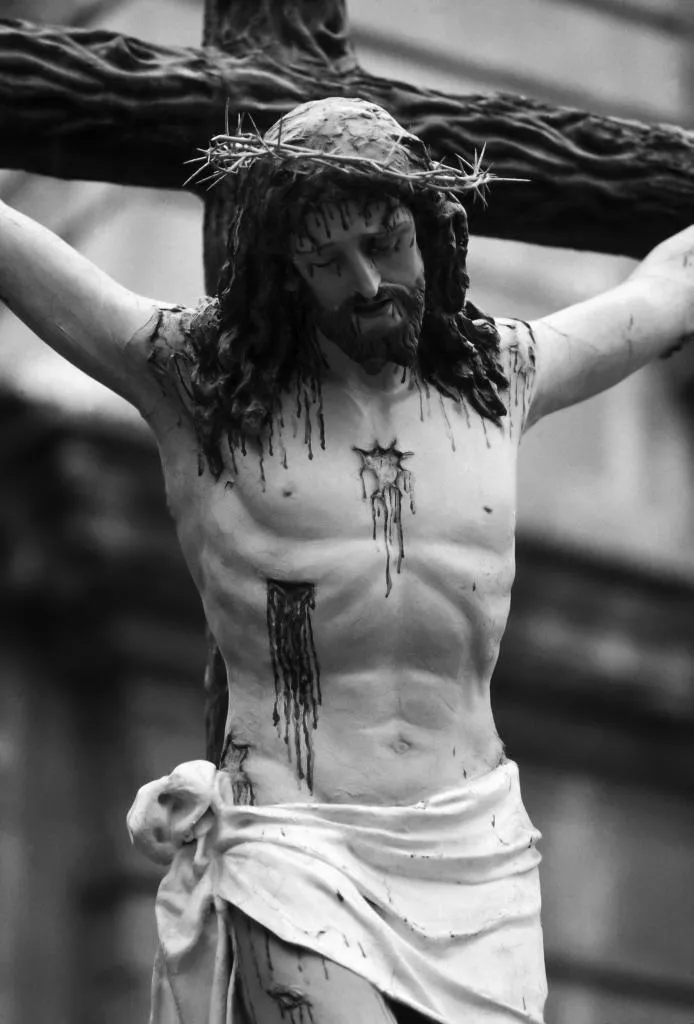
Fig. 5.1. Some Christians display a crucifix with the body of Christ bloody from his wounds.
An answer from a scholar
Ninian Smart (1927–2001), a Scottish scholar who taught at universities in the United Kingdom and the United States and wrote several influential books on the phenomenology of religion, was instrumental in establishing the field of secular religious studies. Before the 1960s, most study of religion was conducted from within a single religious tradition, which then provided the categories for analysis and comparison. Smart’s knowledge of non-Western languages and world religions led him to advocate a value-free approach for secular universities, characterized by both information and empathy. He used the term “worldview” to indicate the way that religion, culture, and ideology interact, and he maintained that understanding diverse religious worldviews was essential for humankind’s future. He studied both classic world religions and New Religious Movements, such as Sun Myung Moon’s Unification Church.
New Religious Movements (NRMs) = recently formed religions that are not connected with the classic world religions.
He described himself as “a Westerner, a Scot, a male, an Episcopalian, albeit with Buddhist leanings,”[1] explaining that no single worldview could contain all truth. Smart is famous for the quip, “She who knows but one religion knows none.”[2]
Analyzing the phenomenon of worldviews, Smart proposed that there are seven dimensions to religion. These seven patterns of belief and practice exist in varying degrees in all the world’s religions, although one worldview may give ritual the highest significance, and another worldview makes ethics most important. To complicate analysis, each religion varies over time and place, and these seven patterns help the scholar think objectively about religion’s complexities.
The insider has certain feelings and beliefs and they are an important part of the data we as religionists are set to explore. But an insider can be terribly wrong about her tradition, ignorant about or insensitive to the variety of her religious heritage. I once heard a Baptist minister give a lecture on Christianity which was, phenomenologically speaking, absurd. What he identified as true Christianity would not be accepted by great swathes of Catholicism, Orthodoxy, Episcopalianism, Methodism and so on. The most important point here is that traditions are plural. The Episcopal church in Fiji may vary greatly from its counterpart in Scotland. – Ninian Smart[3]
Describing this order as random, Smart delineated seven dimensions of the sacred. (1) The ritual or practical dimension includes worship, prayer, pilgrimage, and other formalized communal activities that have sacred meaning and connect the visible with the invisible. (2) The doctrinal or philosophical dimension is a worldview’s organized system of beliefs that intellectually explain seeming contradictions. (3) The mythic or narrative dimension includes traditional stories that undergird present identity by presenting the script for rituals, explaining origins, imagining the future, and connecting the divine and the human. (4) The experiential or emotional dimension has been especially evident in world history, when a religious emotion has altered individual or communal life. (5) The ethical or legal dimension includes imperatives to moral behavior and describes optimal virtues, which may or may not involve any divine authority. (6) The organizational or social dimension is necessary for the maintenance of the worldview and for the effectiveness of the leadership. (7) The material or artistic dimension includes the concrete things—buildings, art, musical instruments, symbolic objects—important in expressing and maintaining the religious worldview.
Fig. 5.2. How many of Smart’s seven dimensions stand behind this photo of a worshipping community?
Smart’s proposal, that every religious worldview spanning centuries and cultures will evidence these seven dimensions, helps explain the diversity of Christian branches, denominations, and spiritualities.
spirituality = concern for the moral life and an appreciation of wholeness which may or may not be connected with organized religion
Each Christian community will incorporate all seven dimensions, but will perhaps focus on one. (1) The ritual dimension is especially important in Roman Catholicism, with its emphasis on worship. (2) The doctrinal dimension is important to the Protestant churches that arose during the sixteenth-century European Reformation.
Reformation = a movement in sixteenth-century Europe hoping to reform the Roman Catholic Church that resulted in the rise of new denominations
(3) The narrative dimension, emphasizing biblical stories and the biographies of its leaders, is especially significant for African and African American denominations. (4) The emotional dimension is essential in Pentecostal churches, which promote experiences of ecstasy.
Pentecostal churches = those churches that emphasize Pentecost and the gifts of the Holy Spirit, ecstasy, and healing
(5) The ethical dimension is especially significant for the contemporary movement called evangelical, in which personal, family, and social codes of behavior receive great attention.
evangelical churches = those churches that emphasize the authority of the Bible, personal commitment to Jesus, witnessing to Jesus, and conservative social reform
(6) The social dimension is primary in the countless independent churches, which stress local identity-markers. (7) The artistic dimension is paramount in the Orthodox churches, with their reverence for icons and traditional ethnic style of music. Smart’s categories thus provide one answer to the inquiry about Christianity diversity: every religion will contain each of these seven features, and in Christianity, this diversity is expressed through its denominations.
Answers from the churches
One complication in considering the many Christian denominations and spiritualities is a confusion in labeling. Imagine trying to place a certain First Church in a diagram of Christianity. Historically, First Church is Baptist, a denomination that originated in the late sixteenth-century Reformation. However, during the nineteenth century, this congregation aligned itself with others that were entirely African American in membership.
congregation = usual Protestant designation for a local church
Thus, ethnically, First Church is called Black Church, and now its African heritage is more important to its identity than its Baptist origins.
Black Church = those Protestant churches with a majority African American membership and worship that features enthusiastic preaching and singing
In the mid-twentieth century, First Church bonded with other evangelical churches, actively promoting conservative social agendas. Because a conservative biblical interpretation marks all the preaching and education at this church, other Christians call it a fundamentalist church. Finally, in the late twentieth century, First Church built an immense, 7000-seat theater that is filled each Sunday for worship, and it now calls itself a megachurch.
megachurch = a church, usually independent Protestant, serving thousands of worshipers
So it is not clear whether First Church is to be labeled Baptist, Black, evangelical, fundamentalist, or megachurch.
Christianity is comprised of institutions, local, national, international. To remain alive, every institution needs to perpetuate itself. Some churches accomplish this by encouraging large families or urging their members to evangelize. Successful institutions also provide their members with a sense of belonging. For churches, this belonging may be achieved through a beloved theology, a distinctive spirituality, a style of music, or a bonding through social action. Any successful group needs to promote a clear sense of purpose. A church may have as its focus to keep people from sin, to comfort all who suffer, to nurture a lively local community, to remake society at large. A successful group needs to preserve order and authorize its leaders but also to systemize change. Even when churches relish their historic connections, every branch, denomination, spirituality, and local church undergoes continual change. Some churches welcome change as a sign of the continual working of the Holy Spirit, and others resist change, judging that God has blessed especially their historic patterns.
Which churches claim to be the oldest?
The Eastern Orthodox churches
Already in the third century, the area east and northeast of the Mediterranean Sea was home to many Christians. Its central city Byzantium, later named Constantinople and now Istanbul, was the eastern capital of the Roman Empire. Here, in present-day Syria, was found the remains of the earliest church; here, in Egypt, monasticism began; here, in what is now Turkey, the fourth- and fifth-century councils that determined Christian creeds were held. Most Christians now residing in this area are members of Eastern Orthodox churches, which are organized by language and geography into national churches. Thus both in those countries and wherever there are immigrant groups there may be Orthodox churches that are Albanian, Antiochian, Armenian, Bulgarian, Carpatho-Russian, Coptic, Ethiopian, Greek, Romanian, Russian, Serbian, Syrian, and Ukrainian, and their ethnic identity may be paramount in their parish life.
parish = the usual Orthodox and Roman Catholic designation for a local churchIn keeping with their label, Orthodox Christians value their heritage as maintaining the right teaching and worship.
The matins service of the Armenian Orthodox Church includes a week’s cycle of hymns that celebrate God’s acts of creation as recorded in Genesis. The Sunday hymn recalls the four primal elements—fire, earth, air, and water—that God has ordered into a harmony. . . . God is like a cantor who chants his Creation into existence and rejoices everlastingly over its beautiful harmony. His song continues, and its melody moves and inspires humankind to restore beauty and harmony to a Creation that is fallen and misshapen. – Vigen Guroian[4]
Two thousand years have seen considerable development within Orthodox churches. Yet usually Orthodoxy prefers what is oldest. At the head of each national Orthodox church is a patriarch, who is equal to the other national patriarchs. [TS: INSERT definition of “patriarch” in sidebar here: patriarch = usually, the Orthodox bishop of a national church] This polity is understood as the most ancient and thus, in their judgment, the best. As in the early church, priests can marry. Orthodox thinkers continue to honor Platonism, the philosophy that was important in early Christian th...