- 124 pages
- English
- ePUB (mobile friendly)
- Available on iOS & Android
eBook - ePub
About this book
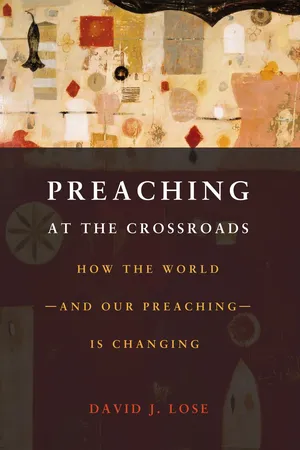
Postmodernism. Secularism. Pluralism. These are the words often used to describe the tumultuous changes that have affected our culture and our churches. But what do they really mean? More importantly, what challenges and opportunities do they provide today's preachers? David Lose takes preachers on a tour of the major cultural influences of the last century, explaining how they have contributed to the diminishment of the church and exploring how they also offer opportunities to cultivate a more vibrant and relevant faith in the twenty-first century. Filled with lucid analysis and practical suggestions, Preaching at the Crossroads invites preachers to reclaim the art of preaching the timeless Gospel in a timely and compelling manner.
Trusted by 375,005 students
Access to over 1.5 million titles for a fair monthly price.
Study more efficiently using our study tools.
Information
Topic
Theology & ReligionSubtopic
Christian Church1
Postmodernism
1
Preaching at the End of the World (as We Know It)
Whether you are reading various preaching and theological periodicals, church growth literature, journalistic magazines like the Atlantic, or almost anything else that comments on our contemporary culture, you’ve probably been struck by the degree to which all of them agree on at least one thing: our world is changing, and changing faster than at any period in recent history.
Depending on their audience, various authors and commentators may refer to these cultural shifts in different ways. Those in the church will speak of a post-Christian or post-Constantinian age. Others in business will refer to the post-industrialized world or the silicon age. Still others will indicate the distinctive character of emerging generations with labels such as GenX or the Millennial Generation. Whatever the terms employed, the shared conviction is that we live in an age of enormous societal and cultural change. And of all the various labels and handles people have tried out to capture these changes, probably the most frequent descriptor used in recent years is postmodern. While the term is now fairly commonplace, many church leaders and preachers—not to mention the cultural pundits themselves!—continue to grapple with what it actually means and what it implies for preaching.
For this reason, we begin our exploration of preaching at the crossroads at the intersection of modernist certainty and postmodern skepticism. Despite the suspicions, if not outright hostility, many Christian leaders harbor toward postmodernity, I believe it offers more opportunities than challenges. Indeed, I am convinced it offers preachers the best chance for offering a lively witness to, and gaining an engaged hearing of, the gospel that we’ve had in several centuries.
I offer the reasons for my confidence in the next three sections of this chapter. In the first, I will sketch the broad contours of the movement—what makes postmodernity actually postmodern. In the second, I will address the central challenge the movement poses Christian preachers: the nature of our access to truth. In the third, I will describe several elements of preaching affected by postmodern theory that may help us offer our witness to the gospel faithfully and effectively in this day and age. Finally, in a fourth section, I will conclude with a few thoughts—and, truth be told, exhortations—on the need for postmodern courage.
Putting the “Postmodern Age” in Perspective
Of the three elements of the cultural zeitgeist I have named, postmodernism is perhaps the broadest, most currently pervasive, and probably least understood of the movements we’ve set ourselves to face. For this reason, it often feels both omnipresent and indecipherable. Curiously, the chief difficulty in coming to grips with the nature and implications of postmodernity is its very name, which is as ungainly and confusing as any descriptive tag we’ve heard in recent years.
In particular, it’s difficult for many of us to sort out what “postmodern” can mean when we regularly associate the word modern with whatever is most contemporary, current, or up-to-date. That is, how can something that exists now be “post-today”? But when cultural theorists, philosophers, and others employ the term modern, they refer not to whatever is most current but rather to a distinct historical era of the Western world.[1] For this reason, it will be helpful to consider briefly some of the characteristics of the modern age in order to appreciate what postmodernity is seeking to move beyond.[2]
Modernity in a Nutshell
Inaugurated in the middle of the seventeenth century in the aftermath of the Thirty Years’ War, the modern era represented a shift from grounding one’s basic assumptions about the world and society largely on religious faith to doing so based solely on human reason. This shift had significant implications, as it dramatically affected the criteria the leading intellectuals of the day—and later the larger populace—used to determine what is true, reliable, and valid.
In the ancient world, the standards for legitimacy (that is, the means by which one validates what is undeniably true) were twofold: coherency and fidelity. Coherency means your theory had to make sense and not have any logical contradictions; fidelity means it could not contradict previously validated traditions. For instance, when the Protestant Reformers made their case before the pope, emperor, and general populace, they consistently offered arguments that were logically sound and based on interpretations of Scripture and church tradition, suggesting that, far from doing anything new, their understanding of these ancient authorities was actually more accurate and more faithful than that of their opponents. Practitioners from across disciplines employed similar criteria.
After the devastating religious wars of the seventeenth century, however, intellectual and cultural leaders despaired of understanding and ordering the world and human society via a shared but disputed religious tradition. We should be clear, at this point, that by reaching this conclusion, the early modernists were not rejecting faith; most continued to be faithful members of the church. Rather, they were rejecting the use of religious dogma as an adequate foundation on which to base their theories about the nature of the world. The difficulty they immediately faced, however, is that one needs some kind of self-evident and indisputable foundation in order to develop indisputable criteria by which to arbitrate between competing truth claims in order to construct any reliable theories about the nature of the world.[3] For this reason, simply rejecting religious or dogmatic foundations was not enough; they had to seek out another, more reliable footing upon which to erect theories about the natural and social world. In this pursuit, they turned from faith to reason, shifting their attention from speculation about the Creator to earnest study of the creation.[4]
As a result, there soon emerged a single standard of legitimacy: rational verifiability. That is, the architects of modernity demanded that all conclusions about the observable world be reached through the careful application of human reason such that any other rational person employing similar means would reach the same conclusion. The promised reward of this methodology was knowledge about the world that was entirely objective and universally valid. The modernists pursued this goal with a passion, believing that the discovery and use of such knowledge would benefit all humanity.[5] This pursuit of knowledge, in turn, gave birth to the scientific method and the rise of the industrial, mechanical, medical, and technological revolutions that followed, all of which are based on the premise that one can trust only those conclusions that can be studied, replicated, and thereby verified by agreed-upon standards of human rationality.
After a brief though distinct period of anxiety (after all, it’s not easy to abandon one’s basic view of how to make sense of the world), the modern era came to be dominated by a pervasive optimism that through the diligent application of reason, humans could solve most of the world’s problems. And indeed—as witnessed by the development of modern medicine, which has limited the impact of many previously deadly diseases, and the advent of modern farming, which has greatly increased food production, to cite just two examples—the confidence, energy, and ingenuity of modern thinkers has produced dramatic benefits.
By the late twentieth century, however, more and more persons came to believe that, whatever its benefits, the modern view of the world has also exacted tremendous costs. To name only a few of the “disappointments” of the modern age, poverty has not been eradicated, wars have not ceased, in the place of old diseases we have new and deadlier ones (and some of the old ones are reappearing more virulent than ever), and after three centuries of harvesting the world’s resources to meet the demands of technological advancement, our world stands on the brink of environmental disaster. In light of all this, modernist confidence has waned, if not been extinguished, and there has arisen in its place a distinct skepticism about claims of the sufficiency of human reason to solve all problems and meet every need.
The Postmodern Reaction
It is this skepticism, in fact, that marks the current age as postmodern. Postmodernists seek to move beyond what they believe was the naive, self-serving, and ultimately destructive optimism of modernity. In particular, postmodernists dispute the claim that there are neutral, self-evident, and universal foundations one can appeal to for determining what is true. Rather, they contend that all our theories—as well as the way in which such theories are implemented in the sphere of human relations—are influenced by preconceptions we hold based on our race, gender, nationality, religion, economic status, previous experience, and other factors that even the most exacting methods cannot entirely rule out.
In short, according to postmodern critics, there is no rational foundation that guarantees absolute objectivity or neutrality. To put it another way, there is no “God’s-eye view” that allows us to view all sides of any particular issue with absolute impartiality. Ultimately, they contend, there is no way to get around the phenomenon that we see what we see and believe what we believe in part because of where we are standing at the time. Hence, postmodernists are aptly described as “antifoundational,” rejecting any neutral, objective, and ultimate court of appeal by which to adjudicate between competing truth claims.
In contrast to the modernist quest for self-evident foundations and timeless truth, therefore, postmodernists argue that whatever theories, or even constructions, about reality that are rife with our own unacknowledged biases and turn out to be, ultimately, made up as much by convictions and beliefs as they are by evidence. The chief impulse and duty of the postmodern critic, then, is not merely to point out the unquestioned beliefs that lie quietly beneath our various worldviews, but also to draw such unacknowledged convictions out into the open for public scrutiny and evaluation.
Further, postmodernists are eager to point out the degree of hostility and even violence directed at those who dare question such constructions of reality and thereby challenge the status quo. The history of the Western world, they argue, is one long, distressing story of the consistent quelling, if not outright quashing, of dissident voices that refuse to conform to the order established by those in power. From Galileo and Copernicus to Susan B. Anthony and Martin Luther King Jr., those who call into question the culture’s basic sense of what is undeniably true—whether in the world of science, politics, religion, or social relations—inevitably risk their reputations and even their very lives. A secondary impulse of postmodernists is therefore to resist the modernist desire for uniformity and conformity that has all too often been achieved through the use of force.
What we soon come to realize, then, is that the term postmodern does not designate a particular discipline or isolated movement so much as it describes a more general attitude of unrelenting skepticism pervading a number of disciplines concerning the validity of previously held assumptions about the nature, and even existence, of objective truth.
Postmodern Convictions
The extent of the gap between modernist certainty and postmodern skepticism becomes clear when we examine the distinct shifts in perspective regarding the nature of reality, truth, language, and power. Indeed, examining these contested elements outlines what we might regard as widely held postmodern convictions.
First, whereas modernists seek to describe reality, postmodernists deny the existence of a singular reality, speaking instead of the various competing “metanarratives” or “standard stories,” one of which we unconsciously adopt and unquestioningly take as our reality. Only when confronted with an alternative do we become aware of the parameters of our own cultural-linguistic worldview, and then usually only long enough to dispute and oppose the alternative vision.
Second, while modernists searched for ultimate truth, postmodernists argue that what we call “truth” is simply the name we attach to those values the dominant culture has tacitly agreed upon. Truth, according to the postmodernist, is a social construct. After all, what any given culture has posited as undeniably, even self-evidently true has changed from generation to generation; what remains constant is the need to affirm one’s present values as the one and only Truth.
Third, while modernists view language as entirely descriptive, a neutral tool by which to describe Reality, postmodernists see language (and culture) as inherently productive, the raw material from which we fashion our worldview. This is why the names we use to describe those who are different from us are so important. The language we employ—positive or negative, affirming or pejorative—simultaneously creates and limits our capacity to experience those persons.
Finally, while modernists believe that one attains power by aligning oneself with reality (hence Francis Bacon’s “knowledge is power”), postmodernists assert that it is actually those who wield power in the culture who get to name what counts for knowledge and therefore to determine what is legitimate, true, and real. For this reason, Michel Foucault reversed Bacon’s dictum and declared instead that “power is knowledge.”[6]
While this clash of ideas and worldviews has raged for several decades in academic institutions, by the turn of the millennium it had seeped deeply into the popular culture. Films like Pulp Fiction, The Matrix, and Fight Club near the turn of the millennium, and Inception, The Tree of Life, and Life of Pi more recently, all portray postmodern skepticism and values not simply as the norm but as desirable for navigating a world where you cannot trust what is presented as real. Similarly, television shows like Lost, Mad Men, and numerous “reality” television programs play with our sense of reality, trace the antecedents of our preference for image over substance, and even invite the question of whether there is anything more than image in the first place. Throughout, these and other art forms acknowledge the deep distrust of received values and traditions that was percolating in our culture during the second half of the twentieth century and now has boiled over, calling into question any singular, comprehensive view of truth and reality.
In light of all these philosophical and cultural shifts, it is little wonder that so many find themselves confused, worried, and even threatened. In the postmodern world, it can feel as if just about everything we once cherished as true is now up for grabs, if not actually under assault. Indeed, the relentless onslaught of postmodern skepticism quickly provokes the question “Is anything true?” The answer we give to that question will have significant implications for our preaching in a postmodern age.
Telling the Truth in a Postmodern World
Although the challenges postmodernism offers Christian preachers and theologians are many, most can by grouped together under the overarching charge that postmodernism denies there is any universal Truth available to us. If truth, like beauty, is entirely in the eye of the beholder, and if we would therefore be better to abandon the word altogether in favor of less ambitious ones like value or meaning, then those of us charged with proclaiming the gospel—a message we believe is true in all times and places—find ourselves rendered nearly mute.
Or do we? A more careful read of the postmodern critique of modernity reveals that postmodernists are not so much against truth in and of itself as they are against claims and assertions of self-evident truth. Once you declare something self-evident, you immediately place it beyond the pale of critical review and privilege it above all other ...
Table of contents
- Cover
- Title Page
- Copyright
- Dedication
- Table Of Contents
- Acknowledgments
- Introduction: At the Crossroads
- Postmodernism
- Secularism
- Pluralism
- Afterword: The Long and Winding Road
Frequently asked questions
Yes, you can cancel anytime from the Subscription tab in your account settings on the Perlego website. Your subscription will stay active until the end of your current billing period. Learn how to cancel your subscription
No, books cannot be downloaded as external files, such as PDFs, for use outside of Perlego. However, you can download books within the Perlego app for offline reading on mobile or tablet. Learn how to download books offline
Perlego offers two plans: Essential and Complete
- Essential is ideal for learners and professionals who enjoy exploring a wide range of subjects. Access the Essential Library with 800,000+ trusted titles and best-sellers across business, personal growth, and the humanities. Includes unlimited reading time and Standard Read Aloud voice.
- Complete: Perfect for advanced learners and researchers needing full, unrestricted access. Unlock 1.5M+ books across hundreds of subjects, including academic and specialized titles. The Complete Plan also includes advanced features like Premium Read Aloud and Research Assistant.
We are an online textbook subscription service, where you can get access to an entire online library for less than the price of a single book per month. With over 1.5 million books across 990+ topics, we’ve got you covered! Learn about our mission
Look out for the read-aloud symbol on your next book to see if you can listen to it. The read-aloud tool reads text aloud for you, highlighting the text as it is being read. You can pause it, speed it up and slow it down. Learn more about Read Aloud
Yes! You can use the Perlego app on both iOS and Android devices to read anytime, anywhere — even offline. Perfect for commutes or when you’re on the go.
Please note we cannot support devices running on iOS 13 and Android 7 or earlier. Learn more about using the app
Please note we cannot support devices running on iOS 13 and Android 7 or earlier. Learn more about using the app
Yes, you can access Preaching at the Crossroads by David J. Lose in PDF and/or ePUB format, as well as other popular books in Theology & Religion & Christian Church. We have over 1.5 million books available in our catalogue for you to explore.