- 640 pages
- English
- ePUB (mobile friendly)
- Available on iOS & Android
eBook - ePub
Introduction to the Hebrew Bible
About this book
John J. Collins' Introduction to the Hebrew Bible is one of the most reliable and widely adopted critical textbooks at undergraduate and graduate levels alike, and for good reason. Enriched by decades of classroom teaching, it is aimed explicitly at motivated students regardless of their previous exposure to the Bible or faith commitments. Collins proceeds through the canon of the Old Testament and the apocrypha, judiciously presenting the current state of historical, archaeological, and literary understanding of the biblical text, and engaging the student in questions of significance and interpretation for the contemporary world. The second edition has been revised where more recent scholarship indicates it, and is now presented in a refreshing new format.
Trusted by 375,005 students
Access to over 1.5 million titles for a fair monthly price.
Study more efficiently using our study tools.
Information
PART ONE
The Torah/Pentateuch

P1.1. One of two silver fragments containing scripture verses engraved in archaic Hebrew, including the so-called Priestly Blessing of Numbers 6:24-26; discovered at Ketef Hinnom, Israel.
Chapter 1
The Near Eastern Context
Introduction
This chapter provides an overview of the history of the ancient Near East, the context in which any historical understanding of the Hebrew Bible must be based. We will review aspects of the modern rediscovery of the ancient Near East and aspects of Mesopotamian, Canaanite, and Egyptian mythology especially.
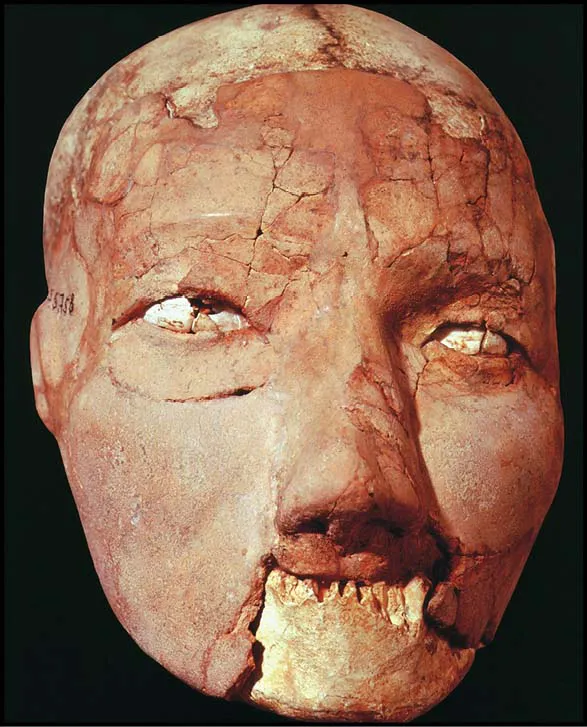
Fig. 1.1 A human skull, recovered in plaster and painted, from Jericho, ca. 6000–4000 B.C.E. Gianni Dagli Orti; ArtResource, NY
Early History of the Near East
Life in the ancient Near East can be traced back thousands of years before Bishop Ussher’s date for the creation of the world in 4004 B.C.E. There was a settlement at Jericho as early as the eighth millennium B.C.E., and village life developed throughout the Near East in the Neolithic period (8000–4000). With the coming of the Early Bronze Age (3200–2200), the first great civilizations emerged in proximity to the great rivers of the region, the Nile in Egypt, and the Tigris and Euphrates that define Mesopotamia (literally, the land “between the rivers”) in modern Iraq.
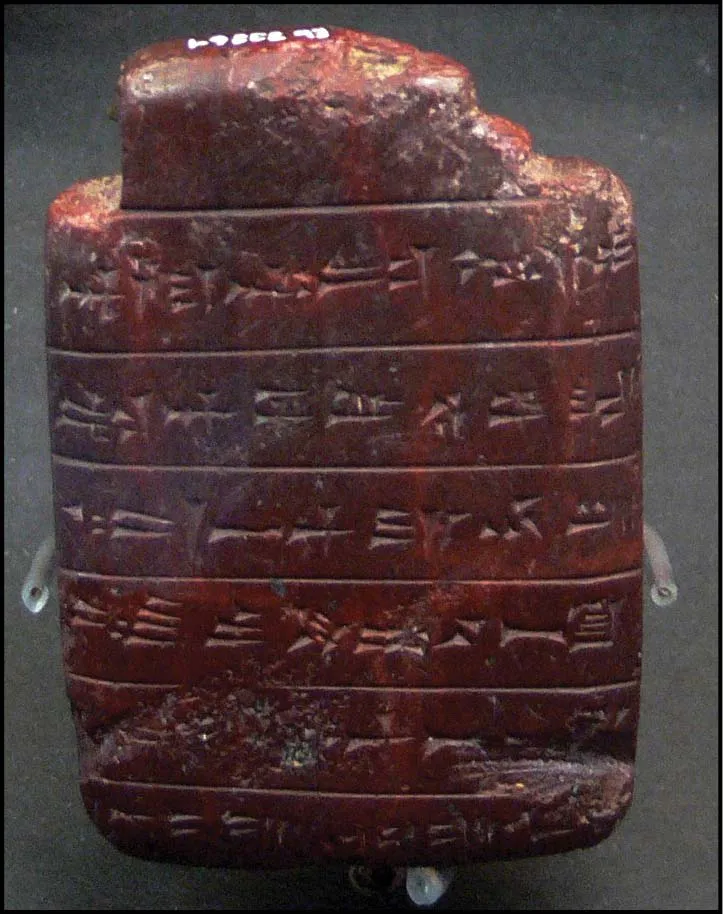
Fig. 1.2 Akkadian cuneiform (wedge-shaped) writing: A Neo-Assyrian amulet, ca. 900–600 B.C.E. Museum zu Allerheiligen, Schaffhausen. Commons.wikimedia.org
In southern Mesopotamia, around the junction and mouth of the two rivers, the Sumerians are credited with developing the earliest known writing system around 3200 B.C.E. The documents were written with reeds on clay tablets, which were then baked. The Sumerians developed the system of wedge-shaped signs called cuneiform, which was later used in Akkadian writing; but unlike Akkadian, Sumerian was not a Semitic language. The origin of the Sumerians is unknown. They developed city-states (Uruk, Lagash, Umma) that were diverse among themselves. Shortly before 2300 B.C.E. the Sumerians were conquered by Sargon of Akkad, which was slightly further north in Mesopotamia but still south of Babylon. Akkad gave its name to the Semitic language that remained the main medium of Mesopotamian literature for two thousand years (Akkadian). Sargon and his successors ruled the first Mesopotamian territorial state for almost two centuries. Then Akkad fell and neverB.C.E. rose again. Even the location of the city has been lost. After this, the Third Dynasty of Ur united most of Sumer for about a century around the end of the third millennium. Thereafter the Sumerians faded from history, but they bequeathed to the ancient Near East a rich legacy of art and literature.
The second millennium saw the rise of Babylon under Hammurabi (eighteenth century B.C.E.), a king most famous for the code of laws that bears his name. Thereafter Babylon’s power declined, and it only became dominant again a thousand years later, under Nebuchadnezzar, the conqueror of Jerusalem in the early sixth century B.C.E. Assyria, in northern Mesopotamia, first became powerful in the early second millennium. The Assyrians attained their greatest power, however, first in the Middle Assyrian period in the thirteenth and twelfth centuries and then especially in the Neo-Assyrian period in the ninth and eighth centuries B.C.E.
Egyptian civilization is almost as old as that of Sumer. A form of writing known as hieroglyphics first appeared around the end of the predynastic period (3100 B.C.E.). Stone buildings appeared shortly thereafter. Many of the great pyramids were constructed during the Old Kingdom (2700–2160). The Middle Kingdom extended from 2033 to 1648. For about a century in the middle of the second millennium (1648–1540), Egypt was ruled by foreigners from Asia known as the Hyksos, who were eventually driven out. In the period of the New Kingdom that followed, Egyptian power was extended all the way to the Euphrates. Egypt ruled over Canaan, the region where Israel would emerge, for much of this period. In the mid-fourteenth century, Pharaoh Amenhotep IV abandoned the traditional worship of the god Amun and devoted himself to the worship of the sun and the solar disk (Aten). He changed his name to Akhenaten and moved his capital to Amarna. This period is known as the Amarna period. It is important because of the monotheistic character of Akhenaten’s devotion, but also because of a hoard of tablets from this period that give information about the state of affairs in Canaan. These are the Amarna letters, which were letters sent to the pharaoh by vassals in Canaan. These letters figure prominently in discussions of the origin of Israel. After Akhenaten’s death, his successor, Tutankhamun, departed from Amarna and reverted to the cult of Amun.
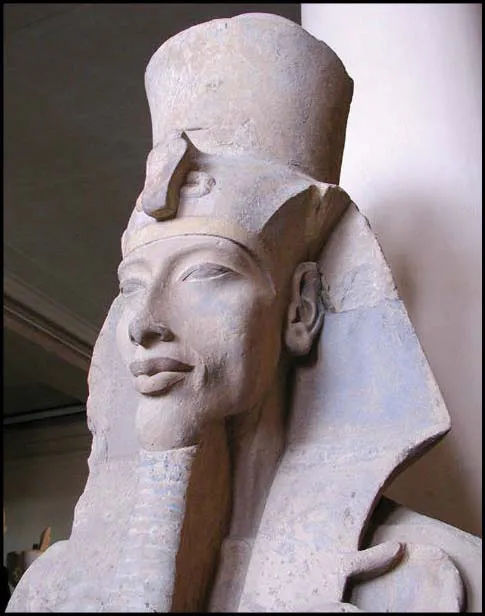
Fig. 1.3 Bust of Akhenaten, from the temple at Karnak, now in the Cairo Museum. Photo: Jon Bodsworth; Commons.wikimedia.org.
In this period, the main challenge to Egyptian power in Asia came from the Hittites, a people who lived in Anatolia, or modern Turkey. During the Amarna period, the Hittites established a province in Syria. In the thirteenth century, Ramesses II (1279–1213), who is often thought to be the pharaoh of the exodus, fought an indecisive battle against the Hittites at Qadesh on the Orontes in Syria, but Egypt subsequently lost control of most of Syria and Canaan, although Ramesses later regained it in part.
In between Egypt and Mesopotamia lay the land of Canaan, where Israel would carve out its territory along the southern half of the eastern shore of the Mediterranean. Canaan also extended further north, including modern Lebanon and part of Syria. It was not a political unit, except insofar as it was unified as an Egyptian province. Rather, it was a loose configuration of city-states. Later, in the first millennium, the Canaanites in the coastal cities of Tyre, Sidon, and Byblos were known as Phoenicians, from the Greek name for the area.
The biblical texts sometimes use the designation “Amorite” as an interchangeable variant for “Canaanite.” The name comes from Amurru, the Akkadian expression for the land in the west (relative to Mesopotamia). The Amorites appear to have originated in northern Syria. Whether they were nomadic or settled is disputed. ...
Table of contents
- Maps
- Illustrations
- Preface
- Preface to the Second Edition
- Abbreviations
- Introduction: What Are the Hebrew Bible and Old Testament?
- Part One: The Torah/Pentateuch
- The Near Eastern Context
- The Nature of the Pentateuchal Narrative
- The Primeval History
- The Patriarchs
- The Exodus from Egypt
- The Revelation at Sinai
- The Priestly Theology: Exodus 25–40, Leviticus, and Numbers
- Deuteronomy
- Part Two: The Deuteronomistic History
- The Book of Joshua
- Judges
- First Samuel
- Second Samuel
- 1 Kings 1–11: Solomon and the Divided Monarchy
- 1 Kings 12–2 Kings 25: Tales of Prophets and the End of the Kingdoms of Israel and Judah
- Part Three: Prophecy
- Amos and Hosea
- Isaiah, Micah, Nahum, and Zephaniah
- The Babylonian Era: Habakkuk, Jeremiah, and Lamentations
- The Exilic Period: Ezekiel and Obadiah
- The Additions to the Book of Isaiah
- Postexilic Prophecy: Haggai, Zechariah, Malachi, Joel
- Part Four: The Writings
- Ezra and Nehemiah
- The Books of Chronicles
- The Psalms and Song of Songs
- Proverbs
- Job and Qoheleth
- The Hebrew Short Story: Ruth, Esther, Tobit, Judith
- Daniel, 1-2 Maccabees
- The Deuterocanonical Wisdom Books: Ben Sira, Wisdom of Solomon, Baruch
- From Tradition to Canon
- Glossary
Frequently asked questions
Yes, you can cancel anytime from the Subscription tab in your account settings on the Perlego website. Your subscription will stay active until the end of your current billing period. Learn how to cancel your subscription
No, books cannot be downloaded as external files, such as PDFs, for use outside of Perlego. However, you can download books within the Perlego app for offline reading on mobile or tablet. Learn how to download books offline
Perlego offers two plans: Essential and Complete
- Essential is ideal for learners and professionals who enjoy exploring a wide range of subjects. Access the Essential Library with 800,000+ trusted titles and best-sellers across business, personal growth, and the humanities. Includes unlimited reading time and Standard Read Aloud voice.
- Complete: Perfect for advanced learners and researchers needing full, unrestricted access. Unlock 1.5M+ books across hundreds of subjects, including academic and specialized titles. The Complete Plan also includes advanced features like Premium Read Aloud and Research Assistant.
We are an online textbook subscription service, where you can get access to an entire online library for less than the price of a single book per month. With over 1.5 million books across 990+ topics, we’ve got you covered! Learn about our mission
Look out for the read-aloud symbol on your next book to see if you can listen to it. The read-aloud tool reads text aloud for you, highlighting the text as it is being read. You can pause it, speed it up and slow it down. Learn more about Read Aloud
Yes! You can use the Perlego app on both iOS and Android devices to read anytime, anywhere — even offline. Perfect for commutes or when you’re on the go.
Please note we cannot support devices running on iOS 13 and Android 7 or earlier. Learn more about using the app
Please note we cannot support devices running on iOS 13 and Android 7 or earlier. Learn more about using the app
Yes, you can access Introduction to the Hebrew Bible by John J. Collins in PDF and/or ePUB format, as well as other popular books in Theology & Religion & Biblical Criticism & Interpretation. We have over 1.5 million books available in our catalogue for you to explore.