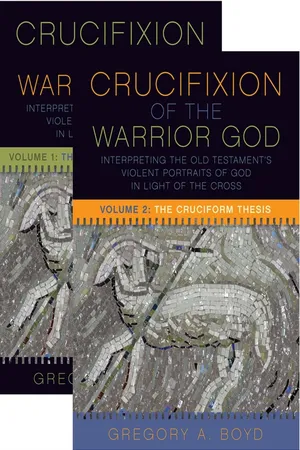
The Crucifixion of the Warrior God, in an epic constructive investigation, takes up the set of dramatic tensions between depictions of divinely sanctioned violence in Scripture and the message and life of peace of Jesus centering the New Testament. Over two volumes, author Gregory A. Boyd argues that we must take seriously the full range of Scripture as inspired, and the centrality of the crucified and risen Christ as the supreme revelation of God.
eBook - ePub
The Crucifixion of the Warrior God
Interpreting the Old Testament’s Violent Portraits of God in Light of the Cross
- 1,492 pages
- English
- ePUB (mobile friendly)
- Available on iOS & Android
eBook - ePub
The Crucifixion of the Warrior God
Interpreting the Old Testament’s Violent Portraits of God in Light of the Cross
About this book
Trusted by 375,005 students
Access to over 1.5 million titles for a fair monthly price.
Study more efficiently using our study tools.
Information
Topic
Theology & ReligionSubtopic
Biblical StudiesI
The Centrality of the Crucified Christ
1
The Faith of Jacob: Wrestling With “Strange” and “Alien” Portraits of God
The Lord will rise up as he did at Mount Perazim . . .
to do his work, his strange work,
and perform his task, his alien task.
—Isaiah 28:21
to do his work, his strange work,
and perform his task, his alien task.
—Isaiah 28:21
A curse on those who are lax in doing the Lord’s work!
A curse on those who keep their swords from bloodshed!
—Jeremiah 48:10
A curse on those who keep their swords from bloodshed!
—Jeremiah 48:10
The Old Testament is responsible for more atheism, agnosticism, disbelief
—call it what you will—than any book ever written.
—A. A. Milne[1]
—call it what you will—than any book ever written.
—A. A. Milne[1]
It behooves us to be careful what we worship,
for what we are worshiping we are becoming.
—Ralph Waldo Emerson[2]
for what we are worshiping we are becoming.
—Ralph Waldo Emerson[2]
The goal of this chapter is to lay the groundwork for all that is to follow by discussing three foundational issues. First, since my concern in this volume is to develop and defend a particular hermeneutic of Scripture, I need to go beyond what was said in the introduction and spell out a bit further my understanding of what is entailed in the confession that all Scripture is “God-breathed” (2 Tim 3:16).
Second, throughout this volume, as well as the one that follows, I will be encouraging readers to honestly wrestle with Scripture’s violent portraits of God. Yet, I am aware that the frank wrestling I will be encouraging readers to participate in may strike some as undermining faith in the “God-breathed” nature of Scripture. In this second section, therefore, I will argue that while the concept of faith that many contemporary western people embrace is incompatible with honestly questioning the way God sometimes is depicted in his written word, it is not at all incompatible with the biblical concept of faith. Indeed, I will argue that one’s willingness to question the way God appears when this appearance is out of character with the way God has revealed himself to be is, from a biblical perspective, an expression of faith, not the negation of faith.
Finally, while I am focused on the urgency of the theological challenge that Scripture’s violent portraits of God pose, there are also some very serious practical challenges that these portraits pose as well. I thus want to close this chapter by reviewing three of these challenges.
Implications of a “God-Breathed” Book
As I mentioned in the introduction, I consider it beyond dispute that Jesus and the authors of the NT shared the traditional Jewish view that all the material found within the canon was “God-breathed” (theo-pneustos [2 Tim 3:16]).[3] For this reason, the church throughout history has traditionally confessed that all material within the canon of Scripture is “God-breathed.” Without going into the multitude of disputed issues that surround how God “breathed” Scripture—issues that I will in a moment argue are as unnecessary to unravel as they are impossible to resolve—I will begin to flesh out my understanding of this confession by simply registering my agreement with the historic-orthodox tradition that this “breathing” entails that God is, in some sense, the ultimate author of all canonical works.
I consider the translation of theopneustos as “God-breathed” to be superior to the more common “divine inspiration,” despite the fact that it may sound wooden and/or idiosyncratic to some readers.[4] In my opinion, retaining the noun “God” in the translation better serves to remind us of the ultimate source of the “breathing” than the adjective “divine” does. Moreover, “inspiration” has come to be broadly applied to literature, music, art, and a host of other human productions that have nothing specifically to do with God. More importantly, “inspiration” has tended to lead people to locate God’s revelatory activity and authority on the individual human authors of Scripture. The assumption often is that God “inspired” (viz. breathed into) these people, thereby causing them to write what they wrote. By contrast, when Paul says all Scripture is theopneustos, the focus is rather on what God breathed out, thus making the biblical texts themselves the focus of God’s revelatory activity and authority.[5] Indeed, the Greek word says nothing about the process (or various processes) God may have used to expire his word. It simply implies that whatever were the means, the end result is that these texts were “breathed” by God and thus carry divine authority.[6]
Restricting our attention to the “God-breathed” nature of canonical texts relieves us of the impossible burden of trying to determine the means by which God made Scripture suitable to speak on his behalf.[7] It also means that insofar as we are reading Scripture to hear God’s word (viz. insofar as we are reading it theologically), we can focus on the final form that texts have assumed within the canon and not concern ourselves with whatever prehistory a text may have had prior to taking this form.[8] This is not to deny the value of source, form, and/or redaction criticism for the academic investigation of the Bible. It is simply to assert that for a distinctly theological reading of Scripture such as we will be conducting in this work, nothing of consequence hangs in the balance on the extent to which we can (for example) confidently discern earlier, previously independent sources that were redacted together in the process of the canon’s formation. The theological reading of Scripture simply takes the final “God-breathed” form of the canon as its starting point, and it allows the interpretation of every particular passage to be influenced by the canon as a whole.[9]
Another important consequence of locating the “God-breathed” nature of Scripture on the canonical texts is that it means our estimation of Scripture’s divine authority does not depend on our determining the relationship any particular text has with “actual history”—which, of course, is always a scholarly reconstruction of what happened based on an evaluation of available evidence.[10] As I will discuss at length in chapter 8, it is the “God-breathed” nature of the text that renders it authoritative, not the relation a text may or may not have with “actual history.” Yet, as I will also discuss in chapter 8, this starting point also means that I am not free to dismiss any portion of Scripture, including its violent portraits of God, simply because the narrative in which the portrait is found is judged by some to lack historical veracity.
In any event, while I will not altogether discontinue using “inspiration” in contexts in which “God-breathed” is simply too cumbersome, my preference throughout this work will be to use “God-breathed.” At the same time, it seems appropriate to place quotes around “God-breathed” as a reminder that I am quoting 2 Timothy 3:16 and that I am using it in place of the more customary term “inspired.”
Having spelled out in general terms the view of Scripture that will be assumed throughout this work, I turn now to the legitimacy, and even the necessity, of honestly questioning this very Scripture when it depicts God in ways that seem “strange” and “alien” to the way he has revealed himself to be in Jesus Christ (Isa 28:21).[11]
Embracing an “Israelite” Faith
Faith and Doubt
A widespread assumption among contemporary Christians is that faith is the antithesis of doubt. Hence, a person’s faith is typically thought to be as strong as it is free of doubt. As I have argued elsewhere, I believe this concept of faith is (among other things) unbiblical, for as we will see in a moment, there is a strong motif running throughout Scripture that suggests that being willing to honestly struggle with God and with his scriptural word lies at the heart of true faith.[12]
In my thirty-six years of working both as a pastor and professor at a Christian university, I have observed that when Christians assume that faith and doubt are incompatible, they typically work hard to avoid the latter. Indeed, when the strength of one’s faith is equated with the degree to which they are psychologically certain, the cognitive dissonance that accompanies doubt easily gets interpreted as something that is evil and that is therefore to be avoided at all costs. Hence, many who embrace this unfortunate model of faith understandably find it difficult, if not impossible, to honestly acknowledge—let alone feel the full force of—the merits of perspectives that challenge their belief system. Rather, they tend to quickly find solace in whatever responses are available to them, however inadequate these responses may be.
I am addressing this issue at the beginning of this work because while I trust it is by now clear that I strongly affirm the “God-breathed” nature of Scripture, the Cruciform Hermeneutic I will be proposing challenges the straightforward way most people have interpreted violent portraits of God, at least since the fifth century, and asks them to question the assumption that the meaning these portraits had for the original audience is the meaning they are supposed to have for us on th...
Table of contents
- Cover
- Praise for The Crucifixion of the Warrior God
- Title Page
- Copyright
- Dedication
- Table Of Contents
- Abbreviations
- Introduction: The “Magic Eye” of the Crucified Christ
- The Centrality of the Crucified Christ
- The Problem of Divine Violence
- The Cruciform Hermeneutic
- Appendix I: The Alleged Anti-Judaic Attitude of the Gospels
- Appendix II: Jesus and Violence
- Appendix III: Violence in the Pauline Epistles
- Appendix IV: Violence in the Book of Revelation
- Introduction: Something Else Is Going On
- The Principle of Cruciform Accommodation
- The Principle of Redemptive Withdrawal
- The Principle of Cosmic Conflict
- The Principle of Semiautonomous Power
- Postscript: Unlocking the Secret of the Scroll
- Appendix V: The Escalation of Violence in the Promised Land
- Appendix VI: Hardening People’s Hearts
- Appendix VII: Can Satan’s Kingdom Be Divided against Itself?
- Appendix VIII: The Quail Plague
- Appendix IX: The Testing of Abraham
- Appendix X: The Issue of Supersessionism
- Suggested Readings on Central Topics in The Crucifixion of the Warrior God
- Acknowledgments
- Index of Authors and Subjects
- Index of Scripture
Frequently asked questions
Yes, you can cancel anytime from the Subscription tab in your account settings on the Perlego website. Your subscription will stay active until the end of your current billing period. Learn how to cancel your subscription
No, books cannot be downloaded as external files, such as PDFs, for use outside of Perlego. However, you can download books within the Perlego app for offline reading on mobile or tablet. Learn how to download books offline
Perlego offers two plans: Essential and Complete
- Essential is ideal for learners and professionals who enjoy exploring a wide range of subjects. Access the Essential Library with 800,000+ trusted titles and best-sellers across business, personal growth, and the humanities. Includes unlimited reading time and Standard Read Aloud voice.
- Complete: Perfect for advanced learners and researchers needing full, unrestricted access. Unlock 1.5M+ books across hundreds of subjects, including academic and specialized titles. The Complete Plan also includes advanced features like Premium Read Aloud and Research Assistant.
We are an online textbook subscription service, where you can get access to an entire online library for less than the price of a single book per month. With over 1.5 million books across 990+ topics, we’ve got you covered! Learn about our mission
Look out for the read-aloud symbol on your next book to see if you can listen to it. The read-aloud tool reads text aloud for you, highlighting the text as it is being read. You can pause it, speed it up and slow it down. Learn more about Read Aloud
Yes! You can use the Perlego app on both iOS and Android devices to read anytime, anywhere — even offline. Perfect for commutes or when you’re on the go.
Please note we cannot support devices running on iOS 13 and Android 7 or earlier. Learn more about using the app
Please note we cannot support devices running on iOS 13 and Android 7 or earlier. Learn more about using the app
Yes, you can access The Crucifixion of the Warrior God by Gregory A. Boyd in PDF and/or ePUB format, as well as other popular books in Theology & Religion & Biblical Studies. We have over 1.5 million books available in our catalogue for you to explore.