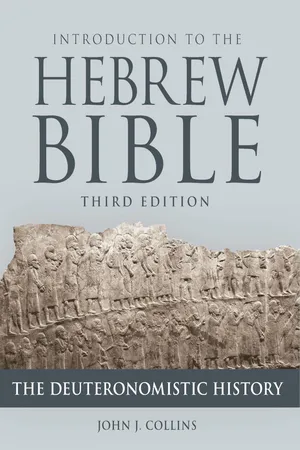
King Jehu prostrates himself before Shalmaneser III of Assyria. Panel from the Black Obelisk, now in the British Museum, London.
Introduction
The books of Joshua, Judges, Samuel and Kings (traditionally known as the Former Prophets) provide the main account that we have of the history of ancient Israel. All history writing is subject to ideological bias, and in the case of these books the bias might also be described as theological. History is viewed through the lens provided by the book of Deuteronomy. Accordingly, these books are known in modern scholarship as the Deuteronomistic History.
The view that the book of Deuteronomy once constituted a literary unit with the historical books was argued in detail by the German scholar Martin Noth in 1943, and has been widely accepted since then, although some scholars have questioned it in recent years. The historical books contain diverse kinds of material, and evidently drew on older sources and traditions. Other scholars before Noth had noticed that some elements in these books were influenced by the book of Deuteronomy. The books of Kings, for example, frequently condemn the kings of northern Israel for continuing “the sin of Jeroboam,” the first king of northern Israel, who erected places of worship at Bethel and Dan, as counterattractions to the temple in Jerusalem. This criticism clearly presupposes Josiah’s reform and Deuteronomic law. Noth, however, pointed out that similar language and ideology runs through all these historical books, and that this shows that they were edited in a consistent manner. The editor is called Deuteronomistic because history is judged in the light of Deuteronomic theology.
According to Noth, the Deuteronomist divided the history of Israel into four major periods: the time of Moses, the conquest of Canaan under Joshua, the period of the judges, and the monarchy. Key points in this history were marked by speeches. For example, a speech by Joshua in Joshua 1 marks the beginning of the conquest, and another in Joshua 23 marks its conclusion. Samuel’s speech in 1 Samuel 12 marks the transition to the time of the monarchy. Solomon’s prayer in 1 Kings 8 at the consecration of the temple also marks an important point in the history. Other Deuteronomistic passages take the form of narrative summaries: Joshua 12; Judg 2:11-22; 2 Kgs 17:7-18, 20-23. Subsequent scholars have identified other passages that have structural importance, most notably the promise to David in 2 Samuel 7, which is often recalled in 1–2 Kings.
Noth argued that the entire Deuteronomistic History was composed by one editor, during the Babylonian exile. The purpose of the work would then be to explain the disaster that befell Israel and Judah as divine punishment for their failure (and especially the failure of the kings) to keep the covenant. Other scholars, however, have insisted that this is not the only theme in the history. There is also a positive view of the kingship that is reflected in the promise to David in 2 Samuel 7 and in the account of Josiah’s reform. Various alternatives to Noth’s single editor have been proposed. The most influential of these in the English speaking world is the view of F. M. Cross that there were two editions of the history. The first edition was in the reign of Josiah. This had a positive view of the monarchy, and was in effect propaganda for Josiah’s reform. The second edition was in the Babylonian exile, after the release of King Jehoiachin from prison in 562 B.C.E., which is the last event reported in 2 Kings. The second edition was colored by the destruction of Jerusalem, and placed greater emphasis on the failure of the monarchy. Other scholars have proposed more complex theories. A theory of three editions, one with an historical focus, one prophetic, and one nomistic (emphasizing law), has enjoyed wide support in German scholarship.
For our present purposes, three considerations should be borne in mind in reading these books. First, this history was put together and edited no earlier than the late seventh century B.C.E., several hundred years after the supposed time of the conquest and the judges. The final edition of these books must be dated no earlier than the Babylonian exile, possibly later. It is not suggested that the Deuteronomistic writers invented their history out of whole cloth. They certainly had traditions and sources at their disposal. These traditions, however, were not all historiographical in nature. Their purpose was not necessarily to provide historical information. While the historical books may contain much reliable information about the history of Israel, they must be examined with caution before they can be used as historical sources.
Second, the reconstruction of the history of Israel in these books has a clear ideological character. It is heavily influenced by Deuteronomic theology, and sees a pattern of reward and punishment in history. It is written from a Judean perspective, with a strong belief in the divine election of Jerusalem and of the Davidic dynasty. It is decidedly unsympathetic to the kings of northern Israel. We need hardly add that it has no sympathy for the Canaanites, who are viewed only as a threat to Israel and its covenant. Moreover, the sources on which the Deuteronomists drew often had the character of legend. We should not doubt that these writers tried to give an accurate account of the past, as they understood it. But they also clearly wanted to convey a theological understanding of history, the belief that the course of events is shaped by God in response to human actions. This theological aspect of these books is as important for the modern reader as any historical information they contain.
Third, we must also reckon with the fact that these books contain some diversity of editorial perspective. Some passages have a clearly negative view of the monarchy, others are more positive (we find these conflicting views in 1 Samuel). This diversity is most easily explained by supposing that there were different editions of the book. Moreover, each of the books that make up the history has its own character, which is shaped by the underlying traditions on which it draws, and the different subject matter of each phase of the history. It is typical of biblical literature that these tensions in the text were not smoothed out by a final editor, but were allowed to stand, allowing us to see some of the diverse perspectives that shaped these books.
FOR FURTHER READING
A. F. Campbell and M. A. O’Brien, Unfolding the Deuteronomistic History (Minneapolis: Fortress Press, 2000). An analysis of the entire text, identifying redactional layers.
F. M. Cross, Canaanite Myth and Hebrew Epic (Cambridge: Harvard University Press, 1973) 99–105. Influential theory of two redactions.
G. N. Knoppers and J. G. McConville, eds., Reconsidering Israel and Judah: Recent Studies on the Deuteronomistic History (Winona Lake, Ind.: Eisenbrauns, 2000). Collection of essays representing recent scholarship.
S. L. McKenzie, “Deuteronomistic History,” ABD 2:160–68. Good summary of the state of the question.
R. Nelson, The Double Redaction of the Deuteronomistic History (JSOT 18; Sheffield: JSOT, 1981). Elaboration of the two-redaction theory proposed by Cross.
M. Noth, The Deuteronomistic History (JSOTSup 15; Sheffield: JSOT Press, 1991). Classic presentation of the Deuteronomistic ideology of Joshua–Kings.
J. Pakkala, Intolerant Monolatry in the Deuteronomistic History (Göttingen: Vandenhoeck & Ruprecht, 1999). Argues that “intolerant monolatry” was a late development in the Deuteronomistic History.
R. F. Person, The Deuteronomistic History and the Book of Chronicles: Scribal Works in an Oral World (Atlanta: Society of Biblical Literature, 2010) argues that DTR and Chronicles are competing histories from the Persian period, based on common traditions.
A. de Pury, T. Römer, and J.-D. Macchi, eds., Israel Constructs Its History: Deuteronomistic Historiography in Recent Research (JSOTSup 306; Sheffield: Sheffield Academic Press, 2000). Collection of essays representing recent scholarship.
T. C. Römer, The So-Called Deuteronomistic History. A Sociological, Historical and Literary Introduction (London: T & T Clark, 2007). Comprehensive discussion and history of scholarship. Defends a three-stage theory.
L. S. Schearing and S. L. McKenzie, eds., Those Elusive Deuteronomists: The Phenomenon of Pan-Deuteronomism (JSOTSup 268; Sheffield: Sheffield Academic Press, 1999). Collection of essays critical of loose use of the label “Deuteronomic,” with reference to prophetic and other literature.
H. Spieckermann, “The Former Prophets: The Deuteronomistic History,” trans. L. G. Perdue, in L. G. Perdue, ed., The Blackwell Companion to the Hebrew Bible (Oxford: Blackwell, 2001) 337–52. An example of a recent German approach to distinguishing multiple layers in the Deuteronomistic History.